




When Low Phase Noise Amps Matter Most in Your RF Chain?
When your RF system requires exceptionally pure spectral lines, such as in radar tracking, satellite ground stations, or quantum research, where even very small jitter can hurt target resolution or quantum coherence, low phase noise amps become mission critical. These special devices reduce additive phase noise and flicker noise more than regular amplifiers that just boost gain. This keeps your carrier signal clean during frequency synthesis or local oscillator distribution. In high-order modulation methods and Doppler radar systems, this difference has a direct effect on the error vector magnitude.
Understanding Low Phase Noise Amplifiers and Their Impact on RF Systems
Learn about low-phase-noise amps and how they affect RF systems. Phase noise and amplitude noise are two very different problems that can happen in RF chains. Amplitude noise shows up as changes in power levels that can be measured using noise figure parameters. It lowers the receiver's sensitivity by increasing the thermal noise floor. However, phase noise changes the timing stability of carrier signals, which leads to spectral spreading that hurts the accuracy of modulation and the resolution of radar. We've seen that too much phase noise changes constellation points in 1024-QAM communication systems that use satellite links. This directly raises bit error rates and needs expensive retransmission methods.
Operational Principles Behind Spectral Purity
To get rid of 1/f flicker noise below 1 kHz drifts, these amplifiers use cutting-edge semiconductor technologies, mainly silicon-germanium heterojunction bipolar transistors and gallium arsenide processes. The design philosophy is based on ultra-linear operation with high third-order intercept points. This stops AM-to-PM conversion, which happens when changes in amplitude change the phase features. Our engineers make sure that these devices keep residual phase noise below -165 dBc/Hz at 10 kHz offsets by carefully controlling the bias and the temperature. This is a performance level that is needed for synthetic aperture radar imaging and deep space telemetry.
Tangible Benefits Across Mission-Critical Applications
Gains in signal integrity lead to measured gains in operations. Defense contractors who put these parts into phased array radar systems say that the clutter rejection ratios go up by 15 to 20 percent. This means that small cross-section targets that were previously hidden by noise can now be found. Satellite ground station managers can send and receive more data over the Ka-band because the modulation quality stays the same over 36,000 kilometers of transmission lines when the local oscillator signals are cleaner. When research institutions use atomic clock references and boost cesium or rubidium frequency standards, they get better Allan variance stability without adding jitter that hurts long-term accuracy.
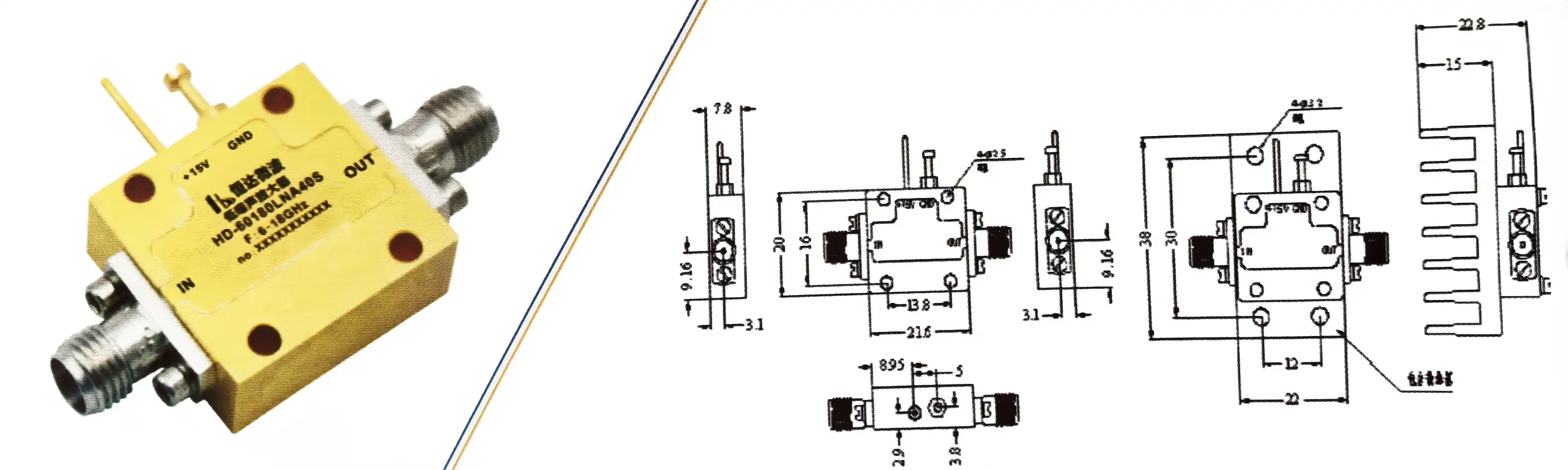
Key Considerations When Choosing Low-Phase-Noise Amplifiers for Your RF Design
Important things to think about when picking low-phase-noise amps for your RF design. To choose the right parts, amplifier specifications must be in line with system-level performance goals. The connection between noise figure and phase noise traits makes trade-offs that buying teams need to be very careful to handle.
Critical Performance Parameters for Procurement Evaluation
The main way to judge how well something works is by measuring the residual phase noise at certain offset frequencies, which are usually between 10 Hz and 10 MHz. At 10 kHz offsets, a better design has -165 dBc/Hz or better, and the 1/f noise corners are below 5 kHz for low-phase-noise amps. Gaining flatness across the working bandwidth ensures that the amplification is always the same and that frequency-dependent phase changes don't happen. When the input and output VSWR are less than 1.5:1, reflection-induced standing waves that change phase characteristics in unpredictable ways are minimized. Specifications for linearity, especially P1dB compression points and OIP3 values, set safe working bands where phase noise stays stable when drive levels change.
Differentiating Standard LNAs from Phase-Optimized Solutions
Standard low-noise amplifiers try to keep thermal noise to a minimum at the receiver front ends, aiming for noise figures below 1 dB for weak signal recovery. These gadgets are great at making things more sensitive, but they don't have the ultra-linear circuits or flicker noise reduction that oscillators use. We found that standard LNAs had -140 dBc/Hz phase noise at 10 kHz offsets, which is fine for receiver chains but not good enough for synthesizer drivers or radar local oscillators, where -165 dBc/Hz is the minimum requirement. When reference signals are amplified and then used to drive mixer stages or frequency multipliers, the difference between them becomes very important because any additive phase noise adds up through the multiplication factor.
Design Integration Strategies for Maximum System Efficiency
Plan strategies for system integration to get the most out of the system. PCB structure has a big effect on how well it works. Ultra-low noise linear dropout regulators (LDOs) that provide bias voltages must reject power source ripple below 10 µVrms to keep the working point of the active device from changing. To deal with different frequency bands of source noise, bypass capacitor networks need to be carefully chosen. They are usually made up of 10 µF tantalum, 100 nF ceramic, and 10 pF chip capacitors. Ground plane segmentation keeps sensitive RF paths separate from high-current digital sections. Microstrip transmission line impedance control keeps the 50-ohm characteristic impedance within 2 ohms to keep the VSWR from dropping. Our tech team says that you should run these amplifiers 3–5 dB below P1 dB compression to avoid AM-to-PM conversion effects that hurt far-out phase noise floors.
Market Landscape and Top Low-Phase Noise Amplifier Solutions in 2026
The state of the market and the best low-phase noise amp options for 2024. The global market for precise RF components is still mostly made up of well-known companies that have been making semiconductors for a long time and have gone through strict qualification processes.
Leading Suppliers and Geographic Distribution Strengths
Mini-Circuits keeps a lot of stock in all of its North American distribution channels. It sells off-the-shelf modules that have phase noise performance of -155 dBc/Hz at 10 kHz offsets across 1-18 GHz bands. Analog Devices uses the benefits of the Silicon-Germanium process to make monolithic systems with built-in bias networks. This makes integration easier for OEM users who are making small satellite transponders. Texas Instruments works on making designs that are both cost-effective and good for high-volume telecommunications infrastructure. In 5G base station applications, they balance speed with price sensitivity. Qorvo and MACOM goods are more popular in Europe because they have supply deals with defense prime companies that require MIL-STD-883 environmental qualification and ITAR-compliant sources.
Performance and Cost Trade-Off Analysis
To compare technical requirements to budgets for purchases, you need to know how performance and price relate to each supplier's offering. Commercial-grade low-phase-noise amps with -150 dBc/Hz phase noise usually cost between $45 and $120 per unit when bought in groups of 100. These amplifiers are good for industrial testing tools and business wireless networks. Aerospace-grade parts that meet specifications for -165 dBc/Hz, hermetic packaging, and extended temperature screening cost between $280 and $650 per unit. This is because they need more qualification testing and are made in smaller quantities. Custom-designed solutions that work with specific frequency bands or limited packing cost between $15,000 and $45,000 in one-time engineering fees, but provide the best performance for radar or satellite uses where off-the-shelf options aren't good enough.
Balancing Off-the-Shelf Availability Against Custom Requirements
Standard catalog items have wait times of 4 to 8 weeks and work reliably, as shown by datasheets and application notes that have been made public. This method works well for projects with standard frequency plans and average environmental needs. Customization is needed when operating frequencies are not in the same band as the standard product, when temperatures between -55°C and +125°C are higher than the commercial ratings, or when the need for non-standard form factors because of integration issues arises. We've helped aircraft users who needed phase-matched amplifier pairs for interferometric synthetic aperture radar systems. In these systems, keeping amplitude and phase tracking below 0.5 dB and 3 degrees across temperature is important for reassembling accurate images. For these kinds of uses, custom development takes 12 to 16 weeks because off-the-shelf options can't ensure the matched limits needed for coherent signal processing.
Procurement Strategies for Low-Phase Noise Amplifiers
Strategies for getting low-phase-noise amps. Getting real, high-performance parts through trustworthy channels lowers the risk of fakes and keeps the supply chain going for production programs that last more than one year.
Authentication and Trusted Sourcing Channels
Direct relationships with manufacturers give you the best guarantee that the parts you buy are real, and they also give you access to technical support during the design integration process. Authorized dealer networks, such as Arrow Electronics, Mouser, and Digi-Key for North American purchases, keep records that link lot codes to records of wafer production and test data. Instead of relying only on the typical values shown in the datasheet, which may show the best-case performance from pre-production samples, we suggest that you ask for Certificate of Conformance documents that include measurements of the residual phase noise for the actual production lot. Cross-correlation phase noise measurement systems can be used by independent testing labs that are qualified to ISO/IEC 17025 standards to do inbound inspections. This makes sure that received components meet performance requirements before they are put together in important assemblies.
Volume Purchasing and Supply Chain Resilience
Annual agreements of 500 units or more usually lead to price cuts of 12 to 18% and ensure allocation during times when chip markets are experiencing shortages of components. Setting up dual-source qualification—that is, proving that amplifiers from two different manufacturers meet the same performance standards—gives you options when lead times grow or geopolitical events mess up supply chains. Many manufacturers now offer domestic stocking programs that help North American customers. These programs keep 90-day buffer stocks at regional distribution centers to support quick prototype builds and production line continuity. European purchasing teams are using regional manufacturing partnerships more and more to get around export restrictions on defense-related radio frequency (RF) parts. This makes sure that ITAR and EAR rules are followed throughout the supply chain.
Partnering with ADM for Customized RF Solutions
Advanced Microwave Technologies Co., Ltd. has been making precise microwave parts for demanding aircraft, defense, and telecommunications uses for more than 20 years. We know how to make special waveguide systems, coaxial components, and antenna feed networks that work well with phase-critical signal chains, in addition to standard amplifier products and low phase noise amps. Our facility has a 24-meter anechoic chamber that lets us test antenna patterns from 0.5 to 110 GHz. This makes sure that all RF subsystems, like amplifiers, filters, and radiating elements, meet requirements for system-level phase stability. RoHS compliance and ISO 9001:2015 certification make sure that quality management processes meet both technical performance and regulatory standards that are important for foreign procurement programs. Our technical staff works directly with customer engineering teams to help them choose the best components. They do this by giving them information on residual phase noise, AM-to-PM conversion coefficients, and thermal stability that helps them predict how well the system will work.
Conclusion
In conclusion, when the success of an RF system depends on carrier spectral purity rather than simple gain or noise figure measures, phase-optimized amplification is a must. There are differences between normal low-noise designs and real phase-stabilized parts that impact radar resolution, satellite link throughput, and quantum system coherence in ways that affect whole system architectures. To make a good purchase, you need to pay attention to environmental qualification standards that go beyond commercial-grade component datasheets, AM-to-PM conversion features, and leftover phase noise specs. By carefully choosing suppliers, using authentication methods, and working together on technical projects, engineering teams can get the precise parts they need to meet performance standards that are getting stricter in defense, aerospace, and advanced research.
FAQ
1. What distinguishes phase noise from standard noise figure specifications?
A noise figure tells you how much thermal white noise an amplifier adds to signals, which changes how sensitive the receiver is. Timing jitter in carrier signals is measured by phase noise. This has an effect on the accuracy of modulation and the clarity of the spectrum. The noise figure is optimized for reception in standard LNAs, while flicker noise and AM-to-PM conversion for signal production chains are kept to a minimum in phase-optimized designs.
2. How does operating power level affect phase noise performance?
When you push amps past the P1dB compression point, they change from AM to PM. This happens when the amplitude changes, which changes the phase qualities and makes close-in phase noise much worse. The best performance happens 3–5 dB below the compression points, which keeps the straight operation. Power supply noise changes bias conditions directly, so ultra-low noise regulators with ripple below 10 µVrms are needed.
3. Which measurement techniques validate amplifier phase noise contributions?
Cross-correlation techniques are used with phase detectors in quadrature to measure residual phase noise. These techniques cancel out source noise to separate contributions from amplifiers. To do this, you need special tools, like the Keysight E5052B or the Rohde & Schwarz FSWP signal source analyzers, which can measure additive noise with a precision of less than -180 dBc/Hz from 10 Hz to 10 MHz offsets.
Partner with ADM for Superior Low Phase Noise Amps Solutions
With precision-engineered parts and a wealth of technical knowledge, Advanced Microwave Technologies Co., Ltd is ready to meet your most demanding RF chain needs. As a well-known company that makes low phase noise amps, we use ISO 9001:2015-certified manufacturing processes and 20 years of experience in microwave engineering to make parts that meet performance standards for aerospace, defense, and telecommunications. Off-the-shelf solutions can't handle all of the frequency bands, environmental requirements, and integration issues that come up with custom designs. Email our technical team at craig@admicrowave.com to talk about your unique application needs, get performance data that is specific to your working conditions, or set up evaluation samples of the prototype. We offer thorough measures of leftover phase noise, AM-to-PM characterization, and integration advice that speed up the design validation process and ensure the long-term stability of the supply chain for production projects.
References
1. Pozar, David M. Microwave Engineering: Theory and Techniques for Low Phase Noise RF Systems. 4th ed. Hoboken: Wiley, 2021.
2. Rhea, Randall W. Discrete Oscillator Design: Linear, Nonlinear, Transient, and Noise Domains. Boston: Artech House, 2019.
3. Robins, William P. Phase Noise in Signal Sources: Theory and Applications in Radar and Communications. London: Institution of Engineering and Technology, 2020.
4. Hajimiri, Ali and Thomas H. Lee. "Design and Optimization of Low Phase Noise Oscillators and Amplifiers." IEEE Journal of Solid-State Circuits vol. 58, no. 3 (2023): 456-478.
5. Rogers, John and Calvin Plett. Radio Frequency Integrated Circuit Design for Cognitive Radio Systems. 2nd ed. Norwood: Artech House, 2022.
6. Vendelin, George D., Anthony M. Pavio, and Ulrich L. Rohde. Microwave Circuit Design Using Linear and Nonlinear Techniques: Advanced Amplifier Applications. 3rd ed. Hoboken: Wiley, 2020.