





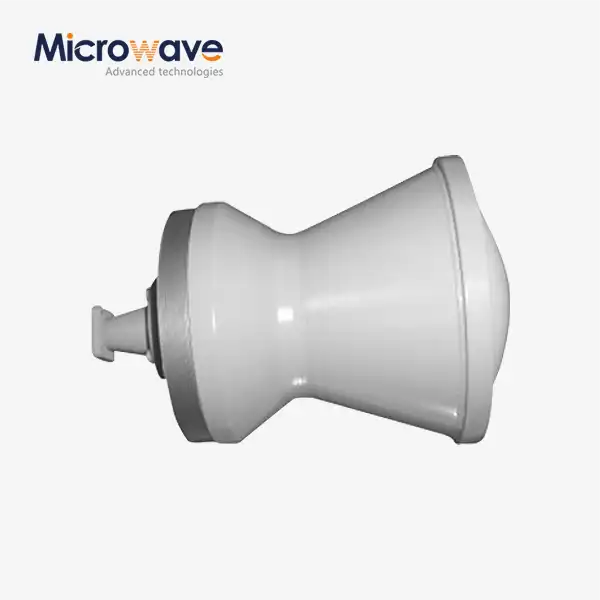
Point Focusing Horn Lens Antenna
Point Focusing Horn Lens Antenna for Precision Microwave Measurement
Advanced Microwave Technologies Co., Ltd. (ADM) designs and manufactures the Point Focusing Horn Lens Antenna, combining a conical horn or conical corrugated horn with a convex dielectric lens — available in PTFE, Rexolite, or TPX — to correct phase errors and concentrate radiated energy into a defined focal spot. Focal length and aperture diameter are fully customizable. When two antennas share the same focal point, transmission loss reaches its minimum, making this design well suited for studying microwave permeability and reflection characteristics of special materials.
What Is a Point Focusing Horn Lens Antenna?
Unlike standard gain horns that produce a spherical wavefront, this antenna uses geometry-corrected dielectric optics to convert a diverging phase front into a convergent beam focused at a defined spot in the near-field zone. The beam follows a Gaussian distribution with a defined focal length and reduced diffraction at the target plane.
Because the beam intersects at a small, controlled area, this antenna type is particularly effective for studying reflection and permeability characteristics of special materials in a localized region — a requirement that wide-beam horn antennas cannot reliably meet.
Key Technical Parameters
The electrical parameters of a product are not defined or tested in the same way as a general antenna. Without standard beam-width or gain definitions, the primary electrical parameters are operating frequency range, focal length, and focal spot size.
Parameter | Detail |
Antenna Type | Conical Horn + Convex Dielectric Lens / Conical Corrugated Horn + Convex Lens |
Lens Materials | PTFE, Rexolite, TPX; high-temperature ceramics or quartz available for high-power use |
Operating Frequency Range | Customizable; test capability from 0.5 GHz to 110 GHz |
Focal Length | Customizable per customer requirement |
Focal Spot Size | Defined by design; diameter at Ka, V, and W bands is on the order of a few wavelengths |
Sidelobe Suppression | Typically better than −20 dB to −25 dB |
Target VSWR | < 1.3:1 or < 1.5:1 depending on band |
Lens Surface Accuracy | Within λ/50 |
Frequency Operating Tolerance | Recommended within ±10% of center design frequency for precision focusing |
Customization | Focal length, aperture diameter, frequency band, lens material |
Performance Characteristics
The dielectric lens fixes phase aberration across the aperture, which makes the wavefront flat or convergent at the focal plane. This makes it possible to get accurate measurement data over and over again with less edge diffraction or random signal scattering.
There is a lot more energy density at the focal point than there is in a normal horn. The lens focuses the light on a small area of the sample or target, which is useful when working with small samples of material or small measurement windows.
The antenna has an inline mechanical profile, so there is no feed blockage. In parabolic reflector setups, on the other hand, the feed structure blocks the aperture. This makes it easier to place and align optical bench setups.
Sidelobe suppression of more than -25 dB to -20 dB helps keep measurement data clean in labs where signals reflected from nearby structures could otherwise cause mistakes.
Application Scenarios
Free-Space Material Characterization (5G/6G Research)
When put next to each other, these Point Focusing Horn Lens Antennas focus the beam on a small dielectric sample that is placed at the focal point they share. This setup cuts down on edge diffraction effects that mess up regular horn measurements. It also lets you get complex permittivity and magnetic permeability values by measuring S-parameters.
Precision Level Radar in Narrow or Obstructed Tanks
Internal agitators, heating coils and steam make it hard to measure the level in oil and gas and chemical processing environments. Even when the fluid is turbulent or very hot, the focused beam pattern can get to the top without picking up too many false echoes.
Diagnosis and NDT of Aerospace Composites with Plasma
Focused energy makes it possible to scan plasma density or sub-surface defects in composite materials with better spatial resolution. This lets you measure specific areas within the target with less interference from reflections that cover a large area.
Quality Control Process
Before shipping, ADM does both mechanical and RF validation several times.
A Near-Field Scanner is used in ADM's 24 m Microwave Darkroom, which has an Antenna Plane Near and Far Field Measuring Recombination Chamber, for Phase Center Verification to make sure the focal point distance meets the design requirements.
Ultrasound or X-rays are used to check the homogeneity of the raw dielectric material and look for any holes or differences in density that could cause the beam to squint or bend.
A Vector Network Analyser (VNA) is used in VSWR and Return Loss Sweep to make sure that the lens doesn't add a big impedance mismatch to the horn feed.
A Coordinate Measuring Machine (CMM) is used to check the Surface Profile Tolerance. The lens curve is compared to a theoretical hyperboloid or zone plate design to make sure it is optically correct within κ/50.
IEEE 149-1979 antenna measurement standards are used in the measurement process.
Customization and Supply Information
ADM supports full customization of Point Focusing Horn Lens Antenna focal length, aperture diameter, operating frequency band, and lens material. For high-power radar applications, high-temperature ceramics or quartz lenses are available to handle thermal loads that would otherwise damage standard PTFE or Rexolite optics.
All designs are supported by ADM's in-house R&D laboratory and tested across the full 0.5 GHz to 110 GHz frequency range available in ADM's anechoic test facility.
To request a technical proposal, send your specifications — including target frequency range, required focal length, acceptable focal spot size, lens material preference, and any power handling constraints — to craig@admicrowave.com.
FAQ
Q: How does the frequency bandwidth change the focus point?
A: Dielectric lenses are dispersive, which means that the refractive index changes a little as the frequency changes. To get accurate focusing, keeping the frequency within ±10% of the center design frequency can help you avoid focal shift caused by chromatic aberration.
Q: Can the focal length be changed after it has been made?
A: Standard fixed-lens designs have a focal length that is stable because of the way the lens curves. ADM has modular fixture designs that let you change the position of the lens mechanically to finetune the focal distance. However, you have to re-calibrate the phase after doing this.
Q: How much power can it handle?
A: The breakdown voltage and thermal properties of the lens material determine how much power it can handle. For high-power uses, let ADM know ahead of time so they can suggest high-temperature ceramics or quartz lenses to keep the dielectric from breaking down or melting.
Q: How do I clean the surface of the lens?
A: Only use an eye cloth that doesn't have any lint on it and high-purity isopropyl alcohol. Do not use solvents or rough materials on the lens because scratches create scattering centers that lower performance, especially at millimeter-wave frequencies.
Q: Do you know why you should use a lens antenna instead of a parabola reflector?
A: The inline, narrow profile keeps the feed from getting clogged. This makes it easier to align the product in optical-bench setups used for testing materials and makes it easier to mount in factories.
Q: What do I need to know to place a custom order?
A: Please let us know what your target operating frequency range is, what focal length you need, what focal spot size is acceptable, what lens material you prefer, and any power handling limits. These will help the engineers at ADM figure out the right lens geometry and horn design.
Contact Us
Send your Point Focusing Horn Lens Antenna specifications or technical questions to craig@admicrowave.com. ADM's engineering team will respond with a proposal tailored to your measurement requirements.
YOU MAY LIKE
 VIEW MORESlotted Waveguide Array Antenna
 VIEW MOREPyramid Horn Lens Antenna
 VIEW MOREOpen Boundary Dual Linear Polarization Four Ridged Horn Antenna
 VIEW MOREConical Dual circular Polarization Horn Antenna
 VIEW MOREDual Linear Broadband Dual Circular Polarization Horn Antenna
 VIEW MOREConical Linear Polarization Horn Antenna
 VIEW MOREQuadrifilar Helix Antenna
 VIEW MOREAntenna Near Field Measurement Probe