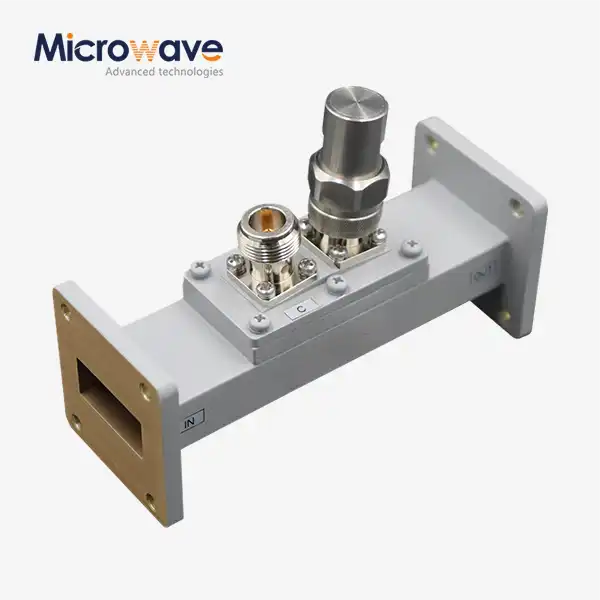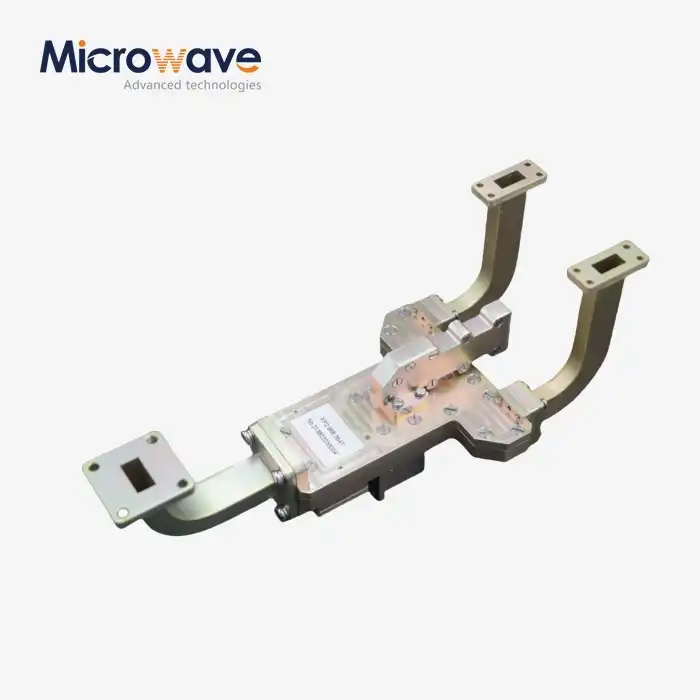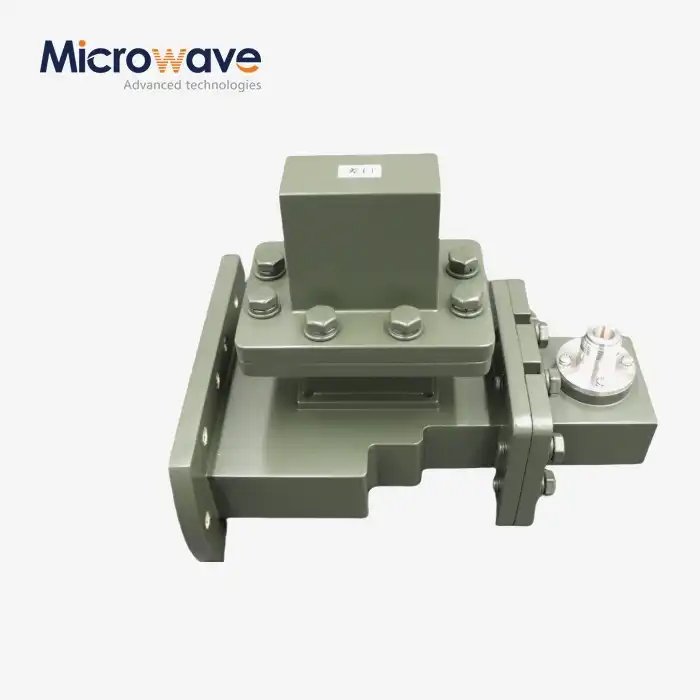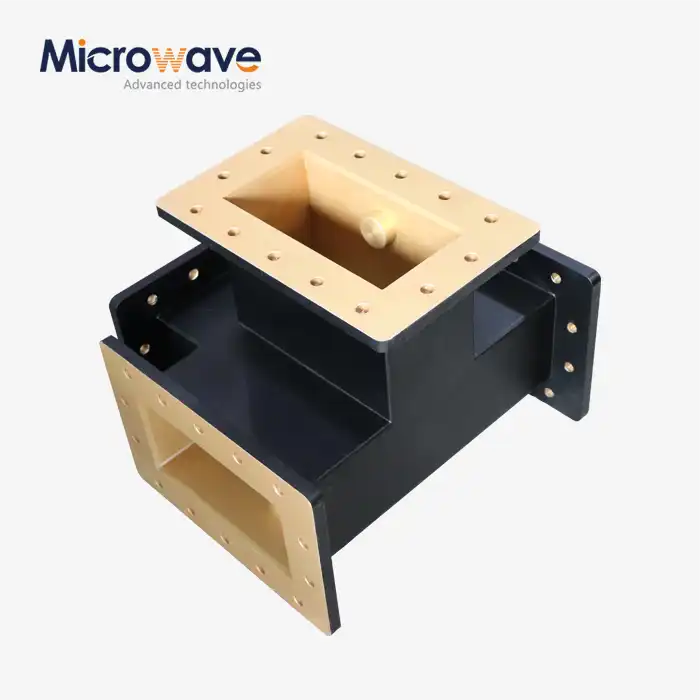





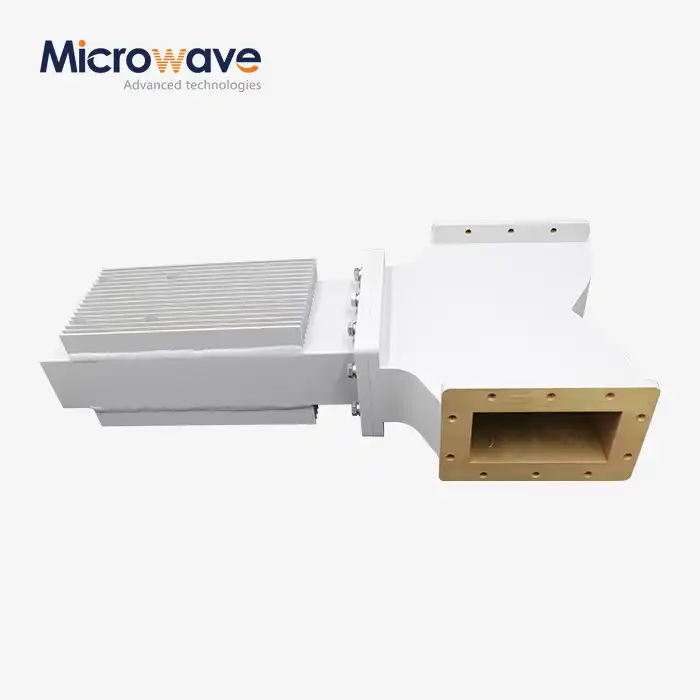
WG Isolator
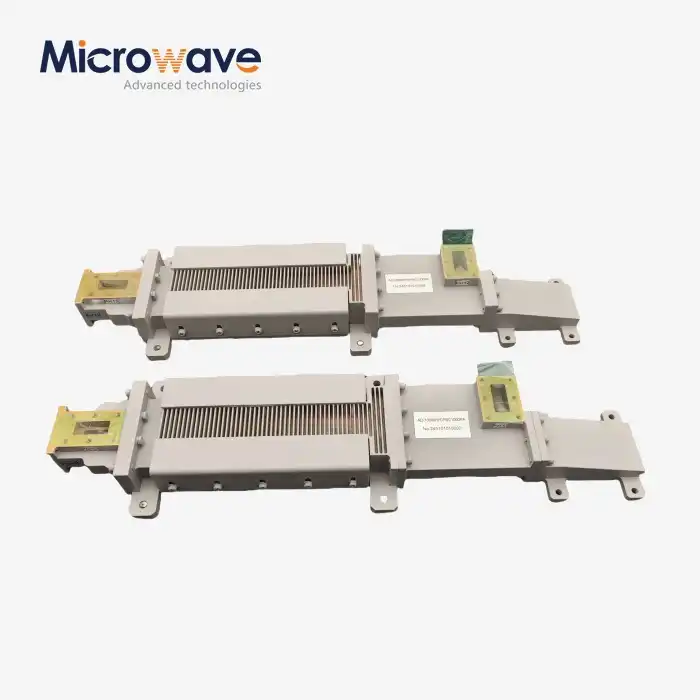
High Power Differential Phase Shift WG Isolator
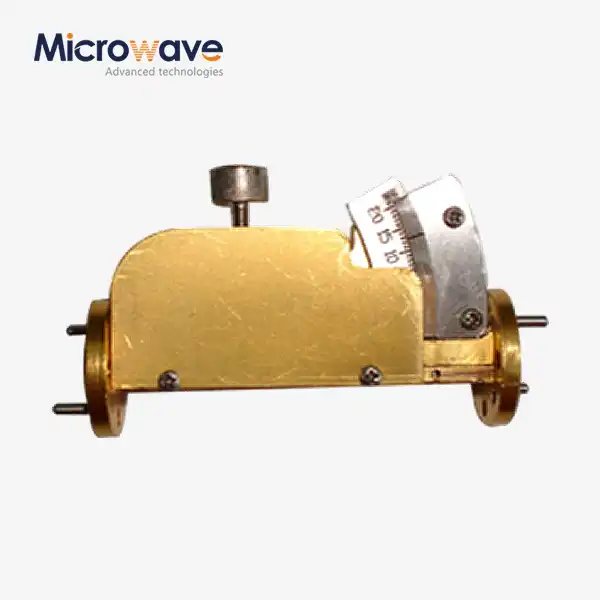
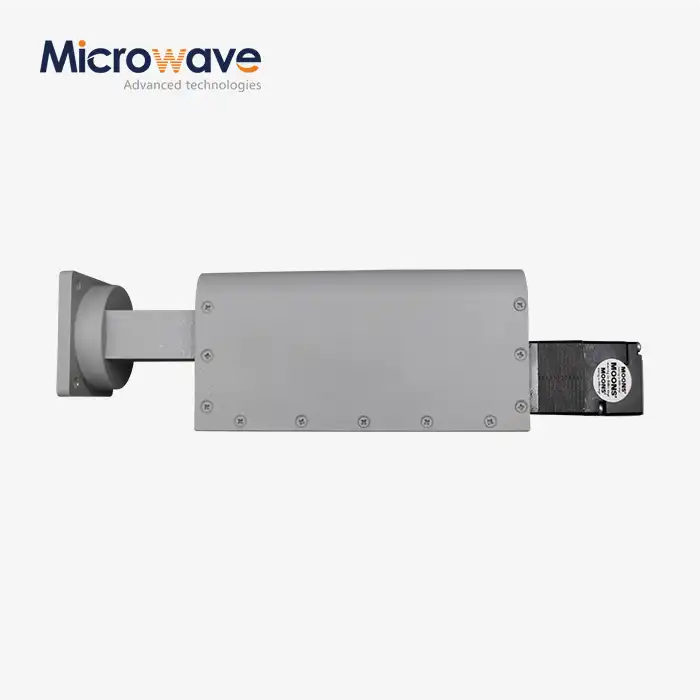
Advanced Microwave Technologies (ADM) makes WG Isolator units that keep high-power RF sources like klystrons, magnetrons, and TWTs safe from reflected signal energy that could damage them or make them unstable. With a differential phase shift architecture, these devices send signals forward through the system with little loss while sending energy that is reflected to an outside termination load. In most cases, insertion loss is less than 0.3 dB, isolation is more than 20 dB, and VSWR is less than 1.2:1. There are different versions that can handle average power of 1 kW to over 100 kW and peak power up to 1 megawatt.
What Is a Differential Phase Shift WG Isolator?
A differential phase shift product is a microwave device with four ports that doesn't work backward and forwards. It usually has a bent hybrid tee, two ferrite waveguide sections, and a short-slot hybrid. Low insertion loss lets signals that are moving forward through the network. Signals that are reflected have a different phase relationship and are sent to an external high-power termination load.
The main benefit over junction circulator designs is this external-load architecture. The ferrite material is not the main heat-handling element because the reflected energy is taken in from outside the ferrite section instead of inside it. The device can work at average and peak power levels that would cause thermal detuning in a junction circulator because of this separation.
Operating Principles
Microwave ferrites, like yttrium iron garnet (YIG) or lithium ferrite, are placed along the walls of the waveguide to cause the phase shift. The operating point is set by a bias magnetic field, and the difference in phase shift between the forward and backward paths is based on the shape of the waveguide sections.
In a junction circulator, the Y-junction must have a small ferrite disc that can directly take in and release reflected energy. In this design, the ferrite parts only need to create the phase shift; the external load and its cooling system will take care of the heat.
When the peak power is in the megawatt range, SF6 or dry nitrogen is used to pressurise the waveguide housing. Pressurising the waveguide increases the strength of the internal dielectric and stops voltage breakdown at high instantaneous field levels.


Technical Specifications
Parameter | Value / Description |
Insertion Loss | Typically < 0.3 dB |
Isolation | > 20 dB |
VSWR | < 1.2:1 |
Average Power Handling | 1 kW to > 100 kW |
Peak Power Handling | Megawatt range |
Bandwidth | Typically 10–20% of center frequency |
Waveguide Sizes | WR-284, WR-90, and other standard sizes |
Ferrite Material | Yttrium iron garnet (YIG) or lithium ferrite |
Pressurization Gas | SF6 or dry nitrogen (high peak power versions) |
Cooling Options | Water-glycol-cooled or forced-air-cooled external load |
Environmental | MIL-STD-202 shock and vibration testing |
Applications
Linear Accelerators (LINACs) in Medicine and Industry
The WG Isolator keeps high-power klystrons safe from reflections caused by the accelerating holes in cancer treatment systems and industrial sterilisation equipment. Stable isolation helps keep beam energy constant and cuts down on unplanned downtime for high-value RF sources.
Long-Range Surveillance and Weather Radar
For high-peak-power radar systems, antenna reflections can happen because of ice on the radome, mechanical problems, or changes in the transmission line's impedance. If you put an isolator between the transmitter and the receiver, the transmitter can still work even if the load changes quickly.
Plasma Heating and Fusion Research
In Tokamak reactors and plasma coating systems, a lot of radio frequency energy is mixed with plasma loads that are already unstable. The product can handle big and sudden differences in impedance, which protects the RF source from the high levels of reflected power that plasma processes often create.
Cooling and Pressurization
Based on the average power level and the worst-case VSWR the system may face, either water-glycol circulation or forced air is used to cool the external termination load.
Water-glycol cooling is good when the load needs to be able to handle almost the whole transmitter output, like when an antenna isn't working right. When the average power level is lower and reflected energy is a smaller part of overall output, forced air cooling may be enough.
Pressurised housing is standard for units that are meant to work at megawatt-class peak power. Before being sent out, helium leak detection is used to check each pressurised unit's hermetic closing integrity.
Quality Verification
A vector network analyser (VNA) is used to test each unit over its full working bandwidth and check the S-parameters, which are S21 insertion loss, S12 isolation, and S11 return loss. At stated peak and average power, high-power burn-in tests are done to look for thermal drift or ferrite detuning while the device is in use.
Pressurised units are checked for helium leaks to make sure the housing is solid. To find areas of uneven heat distribution near ferrite sections, thermal imaging of the housing and flanges while they are under load is used. For testing and keeping records, MIL-STD-202 guidelines for shock and shaking are used.
Custom Configurations
ADM supports custom WG Isolator configurations for applications where standard sizes or bandwidths do not match system requirements. Available options include:
· Waveguide sizes beyond standard WR series
· Selectable center frequency and bandwidth
· Water-cooled or air-cooled external load
· Pressurized or non-pressurized housing
· Custom connector styles and flange interfaces
ADM's engineering team will review your system specifications — frequency, power level, cooling interface, and environmental requirements — and work with you to define a configuration that fits your application.
FAQ
Q: How does this device differ from a junction circulator isolator?
A: A junction circulator uses a Y-junction ferrite disk that absorbs reflected energy internally. The differential phase shift design routes reflected energy to an external load, which removes the thermal burden from the ferrite material and allows operation at much higher average and peak power levels.
Q: Why is water cooling often required for the external load?
A: In fault conditions such as antenna failure, the external load may need to absorb close to 100% of transmitter output. Water-glycol cooling is needed to handle that level of continuous heat dissipation; forced air is generally not sufficient at those power levels.
Q: Can the isolator operate without pressurization?
A: At lower peak power levels, yes. For megawatt-class peak power, the waveguide must be pressurized with SF6 or dry nitrogen to prevent internal voltage breakdown and arcing.
Q: What bandwidth can I expect?
A: Typical bandwidth is 10–20% of the center frequency. This range covers most radar and accelerator system requirements, though it is narrower than some low-power junction circulator designs.
Q: What RF sources does this isolator protect?
A: The device is designed to protect klystrons, magnetrons, and traveling wave tubes (TWTs) — the RF sources most commonly used in radar, LINAC, and fusion applications and most susceptible to damage from load-side reflections.
Q: How does temperature affect performance?
A: Ferrite properties shift as temperature approaches the Curie point. Without adequate thermal management, heating reduces isolation and increases insertion loss. ADM's engineering review includes operating temperature range as a design parameter when configuring units for high duty-cycle applications.
Contact Us
Send your WG Isolator frequency, power level, and cooling requirements to craig@admicrowave.com. ADM's engineering team will review your specifications and respond with configuration options.