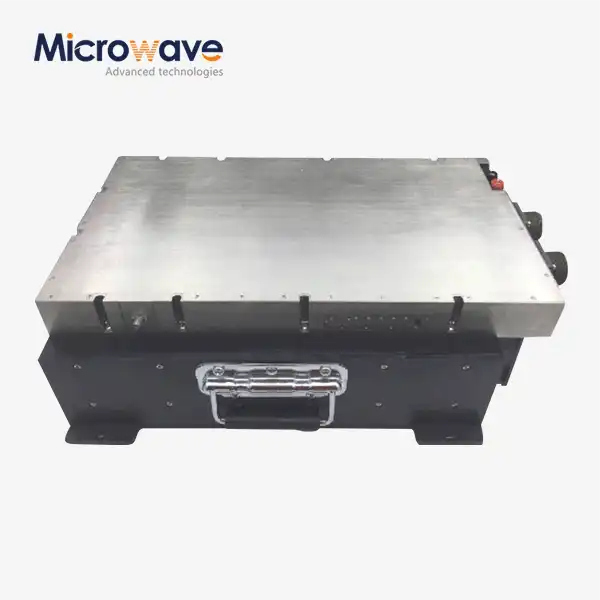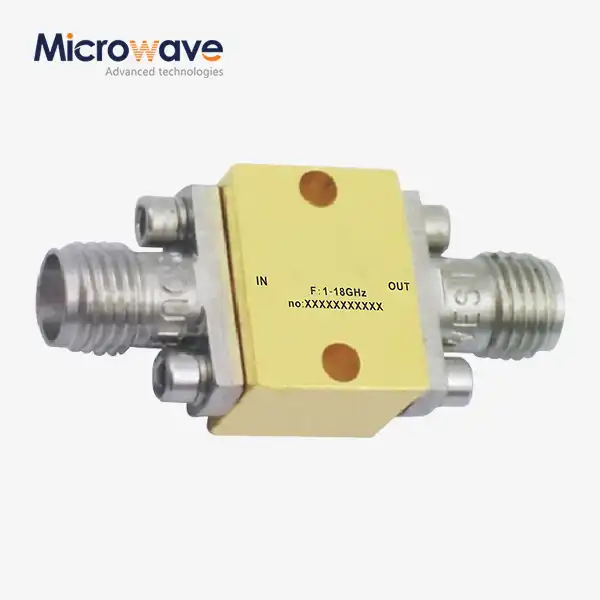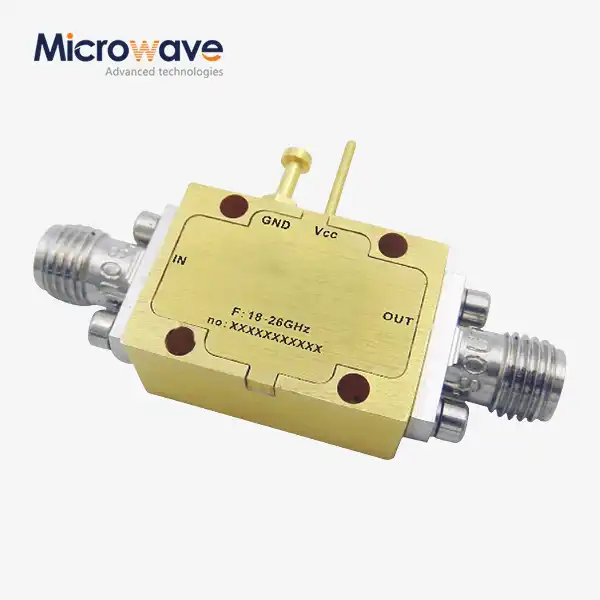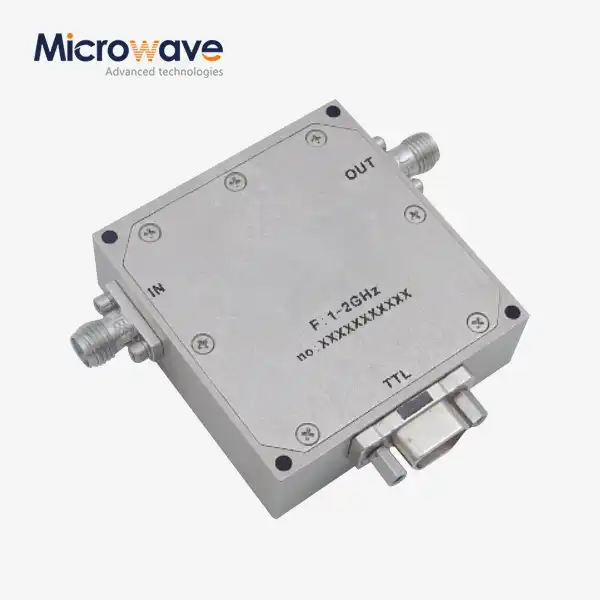





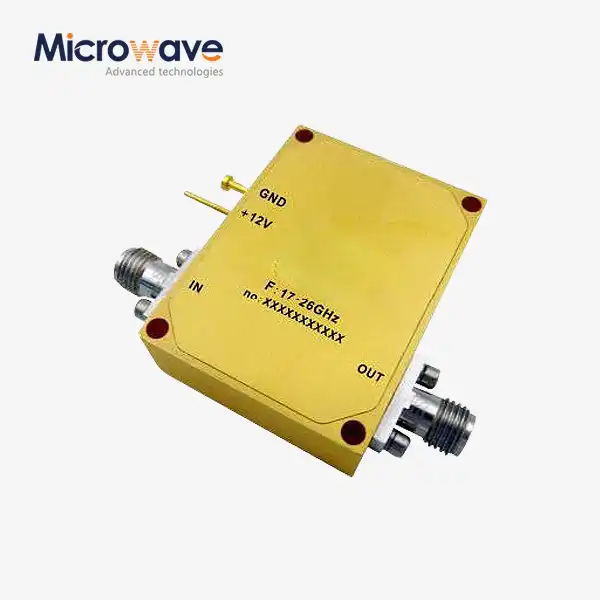
Low Phase Noise Amplifier
Low Phase Noise Amplifier for LO Networks, Radar & Satellite Systems
Advanced Microwave Technologies Co., Ltd. (ADM) designs and manufactures a broad portfolio of low phase noise amplifiers for LO distribution networks, receiver chains, and transmitter systems. These amplifiers span a wide range of frequencies and power levels, giving engineers a matched solution for each stage of a signal chain. ADM's development and validation work is supported by an in-house R&D laboratory and a 24-meter Microwave Darkroom capable of measurements from 0.5 GHz to 110 GHz.
What Is a Low Phase Noise Amplifier and Why Does It Matter?
A product (LPNA) is a specialized RF and microwave active component designed to amplify signal power while adding negligible phase noise to the carrier. This distinguishes it from a standard Low Noise Amplifier (LNA), which targets thermal noise reduction (Noise Figure). An LPNA preserves spectral purity at close-in offsets — from 1 Hz out to 1 MHz from the carrier — which matters most in signal generation and LO distribution rather than in front-end receiver sensitivity alone.
These amplifiers rely on transistor technologies such as Heterojunction Bipolar Transistors (HBT) in SiGe or GaAs processes, which have inherently low 1/f flicker noise corners and therefore reduce close-in phase degradation.
Key Technical Parameters
When selecting a product, the following specifications are the primary indicators of suitability for a given application:
Parameter | Typical Value / Requirement |
Residual Phase Noise (@ 10 kHz offset) | Better than -165 dBc/Hz |
Residual Phase Noise (@ 100 kHz offset) | Better than -175 dBc/Hz |
1/f Noise Corner Frequency | Low kilohertz range |
Input/Output VSWR | < 1.5:1 |
AM-to-PM Conversion | Minimized (degrees/dB) |
Operating Temperature Range | -40°C to +85°C |
Stability Factor (K-Factor) | K > 1 (unconditionally stable) |
Recommended Operating Back-off | 3–5 dB from P1dB |
Core Performance Characteristics
ADM's low phase noise amplifiers are built around design goals that directly affect system-level integration.
Ultra-low additive phase noise. Residual phase noise levels better than -165 dBc/Hz at 10 kHz offset keep the LO signal spectrally clean, which reduces constellation rotation and BER in high-order modulation schemes such as 1024-QAM.
High OIP3 and linear amplification. A high Output Third-Order Intercept Point keeps the amplifier operating in its linear region under demanding drive conditions, avoiding distortion products that corrupt the signal chain.
High reverse isolation. Adequate reverse isolation prevents load pulling of the oscillator source — a practical concern when the amplifier interacts with upstream components in an LO distribution chain.
Temperature stability. Phase consistency is maintained across the full -40°C to +85°C operating range, making these amplifiers suitable for outdoor, airborne, and satellite-mounted installations.
Low AM-to-PM conversion. When amplitude variations enter the amplifier from power supply ripple or drive level changes, a well-characterized LPNA keeps the phase response stable — particularly relevant in pulsed radar and frequency synthesis applications.
Application Scenarios
Phased Array and Synthetic Aperture Radar (SAR). In radar LO distribution networks, amplifier phase noise raises the close-in noise floor and can mask slow-moving targets against ground clutter. Amplifiers in these environments must also withstand high vibration and thermal shock conditions.
Satellite Communications and Deep Space Networks. Ground station uplinks and satellite transponders depend on clean LO signals during frequency conversion. In deep-space telemetry, where received signal levels are close to the noise floor, even modest amplifier-added phase noise can degrade data throughput.
5G and 6G Telecommunications. High-order modulation requires low Error Vector Magnitude (EVM). Phase noise introduced by amplifiers in the LO chain causes constellation rotation and increases BER directly.
Quantum Computing and Atomic Clocks. Control signals for qubit manipulation require low jitter to maintain coherence. In Cesium or Rubidium atomic clock designs, a product amplifies the reference frequency without degrading Allan Variance stability.
Precision Timing Networks. Amplifier-induced jitter degrades the accuracy of distributed reference clocks. A correctly specified low phase noise amplifier preserves timing synchronization across complex network infrastructures.
Measurement and Quality Validation
Along with standard S-parameter testing, ADM uses spectral validation methods.
Cross-correlation signal source analysers are used to measure residual phase noise. A clean source is split in two by the measurement path. One path goes through the amplifier being tested, and the other path goes through a reference. When you mix at quadrature, you get rid of source noise and only hear the noise from the Device Under Test (DUT). Offsets of 10 Hz to 10 MHz are used to look over the measurements.
The S-Parameter and Stability Analysis shows that the K-Factor is greater than 1 across the whole operating band. Oscillation would cause big phase noise spikes and make the amplifier useless for system integration, but unconditional stability stops it.
The AM-to-PM Conversion Coefficient Test measures in degrees/dB how much change in amplitude turns into phase error. This gives a clear picture of how the amplifier will behave in real-world drive conditions.
Environmental Stress Screening (ESS) includes thermal cycling to make sure the phase stays stable at different temperatures, burn-in operation at P1dB for 168 hours or more to find early transistor failures, and checking the sealability of ceramic or metal packages.
MIL-STD-883 environmental screening standards are used to make and test ADM's products. For defence uses, versions that are made for aerospace are available with hermetic sealing.
Customization and Supply Options
ADM lets you make your own settings for frequency range, power amount, package format, and connector type. Whether you need a standard catalogue amplifier or a design that has been changed to fit a certain LO chain, ADM's engineering team can help you from the specification stage all the way through performance validation.
The main office of ADM is in Xi'an, and it has branches in Chengdu, Beijing, Tianjin, and Shijiazhuang to help with customer service.
FAQ
Q: What's the difference between a product and a standard LNA?
A: At the receiver input, Noise Figure (the addition of thermal white noise) is kept to a minimum by an LNA. It is better for a product to have as little additive phase noise and flicker noise as possible, since that is what matters most in signal generation and LO distribution chains, not how sensitive the receiver is.
Q: What does AM-to-PM conversion have to do with phase noise performance?
A: When an amplifier works close to compression, changes in the input amplitude can move the device's capacitance and change the phase of the output. This change helps lower phase noise in high-performance systems as a whole. This effect can be lessened by using enough back-off and choosing a device with a low AM-to-PM coefficient.
Q: Does the quality of the power supply affect phase noise?
A: Yes. Noise and ripple in the power supply can change the bias point of the amplifier, making spur signals and broadband phase noise. This effect is lessened by using low-noise LDO regulators and enough bypass capacitance when putting the system together.
Q: How do you measure additive phase noise?
A: A signal from a clean source is split. The amplifier is on one line, and a reference phase shifter is on the other. At a phase detector working in quadrature, the two lines are joined together. This gets rid of the source noise and only leaves the noise that the amplifier added.
Q: What happens if too much power is put into the amplifier?
A: Going over P1dB makes the far-out noise floor worse and makes AM-to-PM conversion much worse. It is suggested that you work 3–5 dB away from the compression point to keep the specified phase noise performance.
Q: Can you tell me what frequency range ADM's amplifiers work with?
A: ADM can test and make products that work at frequencies from 0.5 GHz to 110 GHz, which means they can work with both common microwave communication bands and millimeter-wave applications.
Contact Us
To discuss a custom low phase noise amplifier requirement or request product specifications, contact ADM's engineering team at craig@admicrowave.com.