





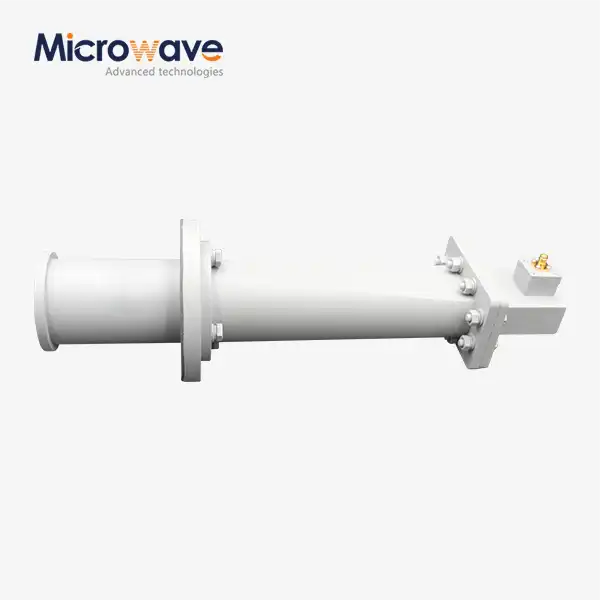
Corrugated Horn and Multimode Horn Antenna
Corrugated Horn and Multimode Horn Antenna — Broadband Feed Solutions for High-Precision Microwave Systems
Corrugated Horn and Multimode Horn Antenna products from Advanced Microwave Technologies (ADM) cover frequencies up to 300 GHz, built on broadband variable slot-depth and slot-width technology. Within the operating bandwidth, VSWR is maintained below 1.30 at the low-end frequency and below 1.06 under narrowband conditions. E-H lobe equalization at −15 dB achieves ±5° symmetry. ADM supports SATCOM, aerospace, and precision measurement applications from its facility in China.
What Are Corrugated Horn and Multimode Horn Antennas?
A Corrugated Horn — also referred to as a Scalar Horn — has annular slots or grooves machined into its inner walls. These grooves modify the boundary conditions to support hybrid HE11 mode propagation, producing an axially symmetric radiation pattern with matched E-plane and H-plane beamwidths and low cross-polarization.
A Multimode Horn achieves comparable pattern shaping by introducing step discontinuities or changes in the waveguide flare angle. This excites higher-order modes such as TM11 or TE21 alongside the dominant mode, shaping the aperture field distribution to produce a desired beam profile.
Both designs address three recurring challenges in microwave feed engineering: beam asymmetry between E and H planes, cross-polarization degrading polarization isolation, and spillover loss reducing system G/T ratio.
Key Technical Properties
The following performance parameters apply to ADM's antenna designs based on the variable slot-depth broadband architecture. Typical values reflect measured results under standard test conditions; specific figures depend on the frequency band and configuration.
Radiation and Pattern Performance
· Cross-polarization: typically −30 dB to −45 dB
· Sidelobe levels: typically −25 dB to −30 dB below the main beam
· Near-circular beam symmetry with Gaussian beam coupling efficiency typically exceeding 98%
· Phase center stable across the operating band
Impedance Performance
· Narrowband VSWR: < 1.06
· Low-end broadband VSWR: < 1.30
· Broadband VSWR typically < 1.15:1 across the operating band
Bandwidth
· Corrugated horns support close-to-octave-band operation (up to 2:1 bandwidth ratio) through variable slot depth and slot width design
· Multimode horns are configured for specific frequency bands with narrowband-optimized performance


Product Specifications
Parameter | Specification |
Frequency Range | Up to 300 GHz (customizable) |
Bandwidth | Close to octave band (broadband design) |
VSWR (Low-end, Broadband) | < 1.30 |
VSWR (Narrowband) | < 1.06 |
E-H Lobe Equalization at −15 dB | < ±5° |
Cross-Polarization | −30 dB to −45 dB (typical) |
Sidelobe Level | −25 dB to −30 dB (typical) |
Gaussian Beam Coupling Efficiency | > 98% (typical) |
Typical Bandwidth Ratio | Up to 2:1 (Corrugated type) |
Testing Frequency Coverage (ADM Lab) | 0.5 GHz to 110 GHz |
Test Facility | 24 m Microwave Darkroom |
Application Scenarios
SATCOM and Earth Station Signals
For C-band, Ku-band, and Ka-band parabolic reflectors, corrugated and multimode horn antennas, such as Corrugated Horn and Multimode Horn Antenna designs, are the main feeds. It is important to keep spillover noise to a minimum in dual-polarization satellite communication and streaming systems, and symmetric beam patterns help with this.
Radio Astronomy and VLBI
Low sidelobe levels make it harder to pick up ground noise, which is important for high-sensitivity receivers. In observatories, corrugated horns are used as low-noise feeds. Wide-area sky mapping can be done with multimode horn arrays set up as pixel arrays.
Compact Antenna Test Ranges (CATR) and Anechoic Chambers
When these antennas are used as source feeds for collimating mirrors, they make beams that can evenly distribute amplitude and phase in the Quiet Zone. This is useful for testing 5G/6G systems, radar for cars, and hardware for spacecraft in controlled settings.
Applications for Broadband Reflector Feed
ADM's corrugated horns are used as front or offset feeds for C-band and transmission antenna systems that need a stable beam shape and wide coverage across the bandwidth.
Manufacturing and Quality Control
High-precision CNC cutting or electroforming are used to make antennas, and the size errors are kept to less than 0.01 mm. HE11 mode transmission needs to be accurate to within a few wavelengths at frequencies above 100 GHz. Electroforming is used to achieve this.
To keep insertion loss in check, the surface finish is checked. Gold or silver plating is used to make things conduct electricity and resist corrosion.
Electrical Testing
A Vector Network Analyser (VNA) is used to check VSWR and return loss on each unit. In ADM's 24 m Microwave Darkroom, measurements of the far-field radiation pattern are made to prove symmetry in the E- and H-planes, cross-polarization discrimination (XPD > 30 dB at boresight under standard test conditions), and sidelobe suppression. Through its Antenna Plane Near and Far Field Measuring Recombination Chamber, ADM's facility can switch between near-field and far-field measurements over a range of frequencies, from 0.5 GHz to 110 GHz.
Dependability in the Environment
Units can be put through thermal vacuum cycling and vibration testing for space and aerospace uses to make sure the structure is strong and the coating sticks well. Before going into production, designs are made using test methods from IEEE Standard 149 and are simulated with HFSS or CST.
Customization Options
ADM can make changes to Corrugated Horn and Multimode Horn Antenna products based on what the system needs. You can specify the operating frequency range (up to 300 GHz), the lobe width and beam profile, the waveguide interface standard, the surface finish and plating material, as well as the mechanical dimensions and mounting configuration.
As part of the design process, ADM's engineering team works with customers to make sure that the antenna feed fits a certain reflector geometry, system gain goal, or test range configuration.
Why Choose ADM?
ADM has been designing microwave products for more than 20 years and has its own test equipment that can handle frequencies from 0.5 GHz to 110 GHz. The 24 m Microwave Darkroom lets you check patterns from far away without using outside testing facilities. This means that you can make changes more quickly during development and get more direct information about production units.
Since engineering and production are in the same building, changes to the design and output can be made more quickly and easily. ADM has offices in Xi'an, Chengdu, Beijing, Tianjin, and Shijiazhuang to help customers in China and around the world with technical questions and product delivery.
Before deciding on a design, you should talk to ADM's engineering team at craig@admicrowave.com about your feed configuration if you have specific frequency band or system needs.
FAQ
Q: What's the biggest difference between a Multimode Horn and a Corrugated Horn?
A: The Corrugated Horn usually has a wider operating bandwidth and less cross-polarization, but it is harder to machine because of the way the grooves are structured inside. The Multimode Horn has smooth walls with step discontinuities, which makes it easier to make and lighter, but it usually only works over a narrower bandwidth.
Q: Can these antennas be used in devices that send a lot of power?
A: To control the risk of electrical breakdown during high-power operation, the throat needs to be designed in a certain way. Multimode horns are often used in high-power microwave applications because they don't have any fine corrugations, which lowers the risk of multipaction. Based on your power levels and frequency, ADM can tell you what design needs to be done.
Q: During the design process, why is beam profile important?
A: A Gaussian beam profile makes diffraction spreading less noticeable and works well for connecting to lens systems, quasi-optical networks, and millimeter-wave test environments. This is important when trying to keep the pattern pure across the system or maximise the efficiency of energy flow.
Q: How does the accuracy of the cutting affect performance at the W-band or the D-band?
A: The dimensions of the corrugation are small compared to the wavelength at millimeter-wave frequencies. If the tolerance for machining goes beyond a certain percentage of the working wavelength, the HE11 mode can't propagate as well, which changes the pattern's symmetry and cross-polarization. For frequencies above 100 GHz, electroforming is used to keep the minimum level of accuracy in the dimensions.
Q: How does a Corrugated Horn set its low-frequency cutoff?
A: The slot depth sets the low-frequency cutoff most of the time. To get the capacitive surface reactance needed for hybrid mode support, holes are usually made to be about 1/4 of the way deep at the lowest frequency.
Q: Can ADM change the beam pattern and frequency range?
A: Yes. Depending on your need, you can choose the frequency range, lobe width, waveguide interface, and mechanical parameters. Email craig@admicrowave.com to talk about what your system needs.
Contact Us
Contact ADM's engineering team at craig@admicrowave.com to discuss your Corrugated Horn and Multimode Horn Antenna feed requirements, request a custom specification, or ask technical questions about your application.
YOU MAY LIKE
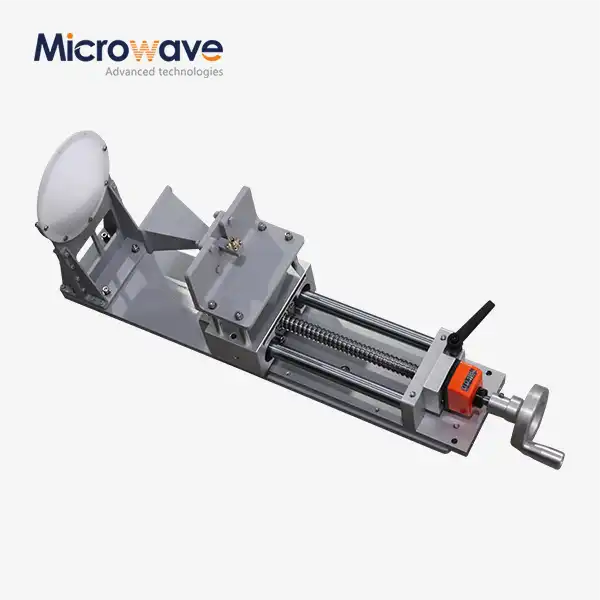 VIEW MOREFeed Fired Lens Antenna
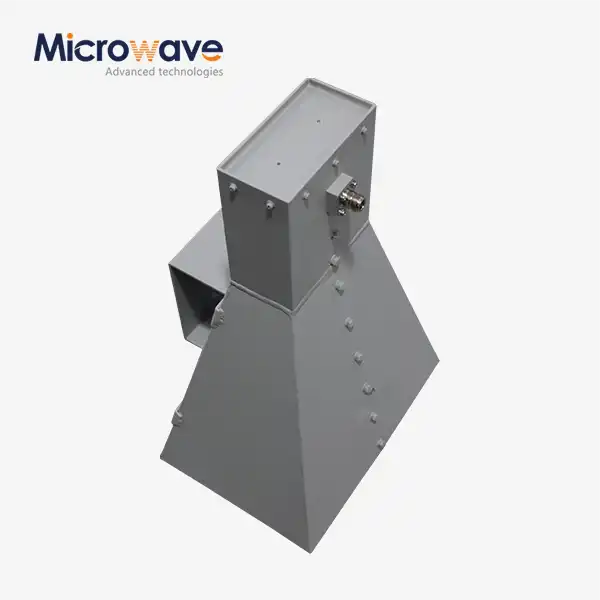 VIEW MOREWideband Double-ridged Horn Antenna
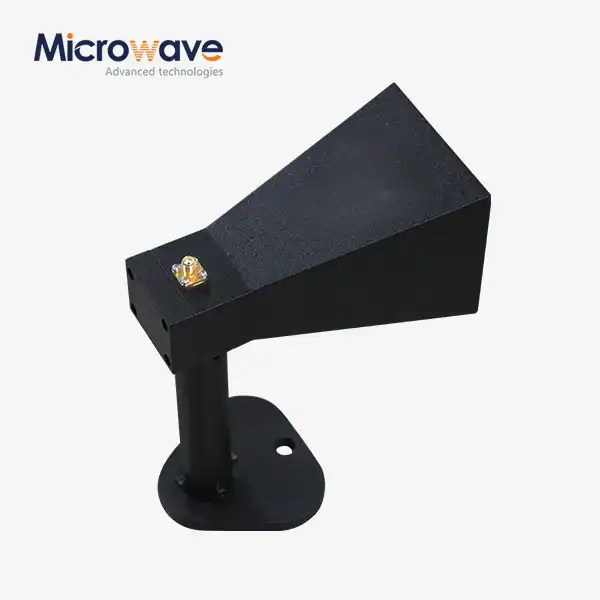 VIEW MOREMini Wideband Double-ridged Horn Antenna
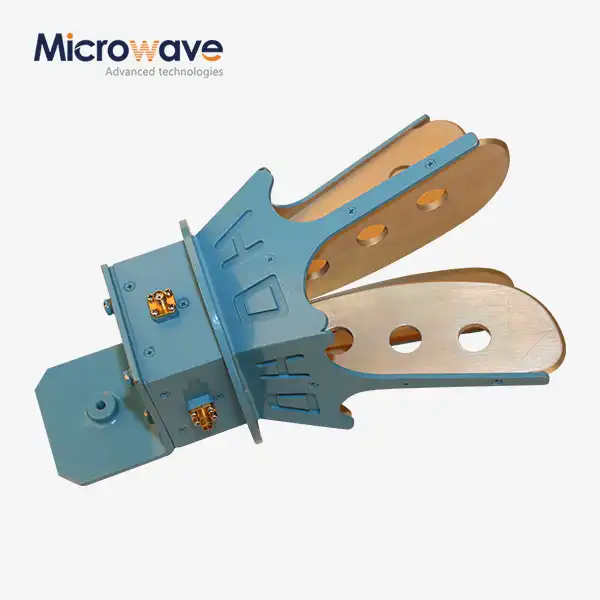 VIEW MOREOpen Boundary Dual Linear Polarization Four Ridged Horn Antenna
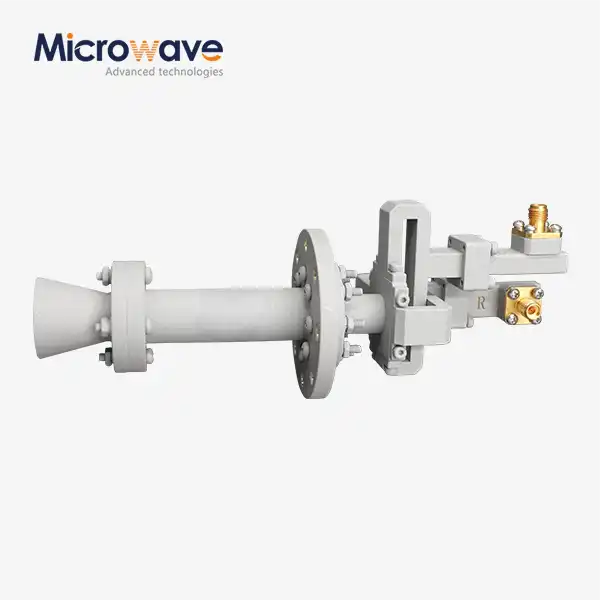 VIEW MOREConical Dual circular Polarization Horn Antenna
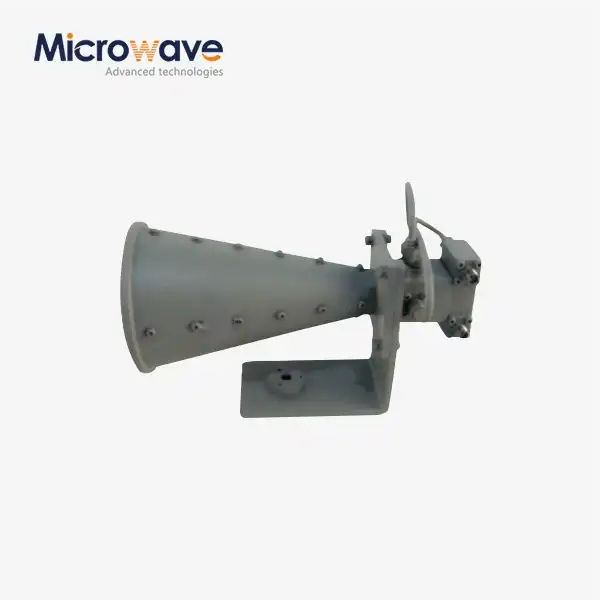 VIEW MOREDual Linear Broadband Dual Circular Polarization Horn Antenna
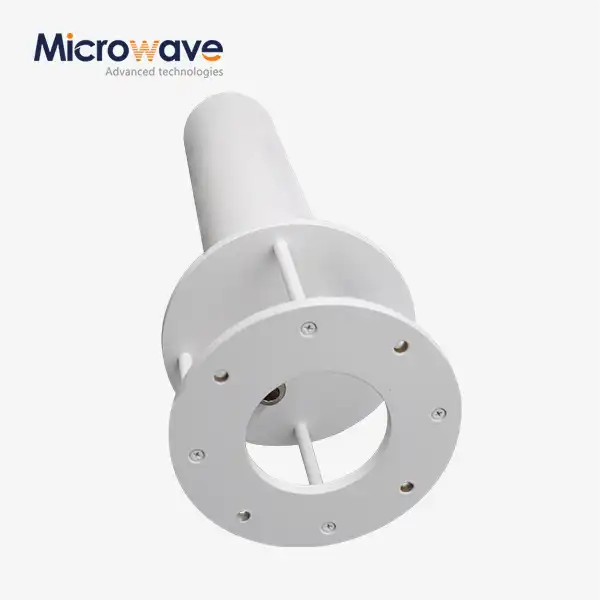 VIEW MOREQuadrifilar Helix Antenna
 VIEW MORECassegrain Antenna