




Pyramidal Horn Antenna Design for 5G Applications
Pyramidal horn antenna design represents a cornerstone technology for 5G network infrastructure, delivering the precision directivity and high-gain performance essential for millimeter-wave communications. As 5G deployments accelerate globally, procurement managers and system integrators increasingly seek antennas that balance electromagnetic efficiency with manufacturing scalability. These aperture antennas seamlessly transition impedance from rectangular waveguide feeds to free space, minimizing reflection losses while providing controlled radiation patterns across critical frequency bands. Their inherent simplicity, combined with predictable performance characteristics, positions them as indispensable tools for base station testing, backhaul systems, and beamforming calibration in next-generation wireless networks.
Understanding Pyramidal Horn Antenna Design Principles for 5G
Core Structural Elements and Operating Mechanisms
As a precisely engineered flare, the pyramidal horn antenna design goes from a rectangular waveguide input to a larger rectangular aperture. The waveguide's confined electromagnetic field changes into a propagating wave with better impedance matching to 377 Ohms in free space as a result of this gradual expansion. In both the E-plane (electric field) and H-plane (magnetic field) dimensions, the shape has controlled curve angles that make the outline pyramidal. This two-plane extension controls the phase spread across the opening, which lowers the effects of diffraction that hurt beam quality. Most of the time, precision-machined aluminum alloys or copper are used, and gold or silver plating is used to keep surface resistance losses to a minimum. Chemical passivation processes that meet ISO 9001:2015 standards are used at Advanced Microwave Technologies Co., Ltd. to make sure that our products don't rust and can be used outside for more than 15 years.
Performance Parameters for 5G Frequency Bands
Gain Characteristics: For modern 5G operations in the n257, n258, and n261 bands (24.25-29.5 GHz), gains of 15 to 25 dBi are needed. The pyramidal horn antenna design does this by controlling the size of its holes. Bigger openings provide more directivity but require tighter production standards.
Beamwidth Control: Half-power beamwidths usually fall between 20° and 60°, which is directly related to the opening size in terms of wavelength. For point-to-point backhaul links, narrow beamwidths work best, while for small-cell deployments, wider patterns work best for sectoral coverage.
Frequency Range and Bandwidth: VSWR stays below 1.5:1 across 20–30% fractional bandwidths for optimized designs. Our ADM engineering team has tested designs that work across 24–40 GHz with gain flatness that stays within ±1 dB. This is important for keeping channel integrity across 5G's wideband allocations.
The antenna's radiation pattern has a predictable main lobe behavior and side lobes that are pushed down, usually reaching -20 dB levels compared to peak gain. Cross-polarization discrimination is higher than 25 dB, which is necessary for MIMO systems that need to separate signals in an orthogonal way.
Material Selection and Impedance Matching Techniques
Waveguide interface design is the first step in advanced impedance matching. Precision-flanged joints connect standard rectangular guides (WR-28 for Ka-band) and keep the electricity flowing. The length of the flare decides how much phase error builds up; the best designs combine electromagnetic efficiency with mechanical constraints. We use computer-aided optimization to figure out flare profiles that keep aperture phase deviations below λ/16 and raise aperture efficiency to 80–90%.
Dielectric loading methods are sometimes used in addition to metal-only systems. Low-loss materials, such as PTFE or Rogers laminates, can be used to make protective radomes or matched pieces that don't affect electrical performance too much. When installing 5G small cells outside, these methods are especially useful for adding pyramidal horn antenna designs to weatherproof enclosures.
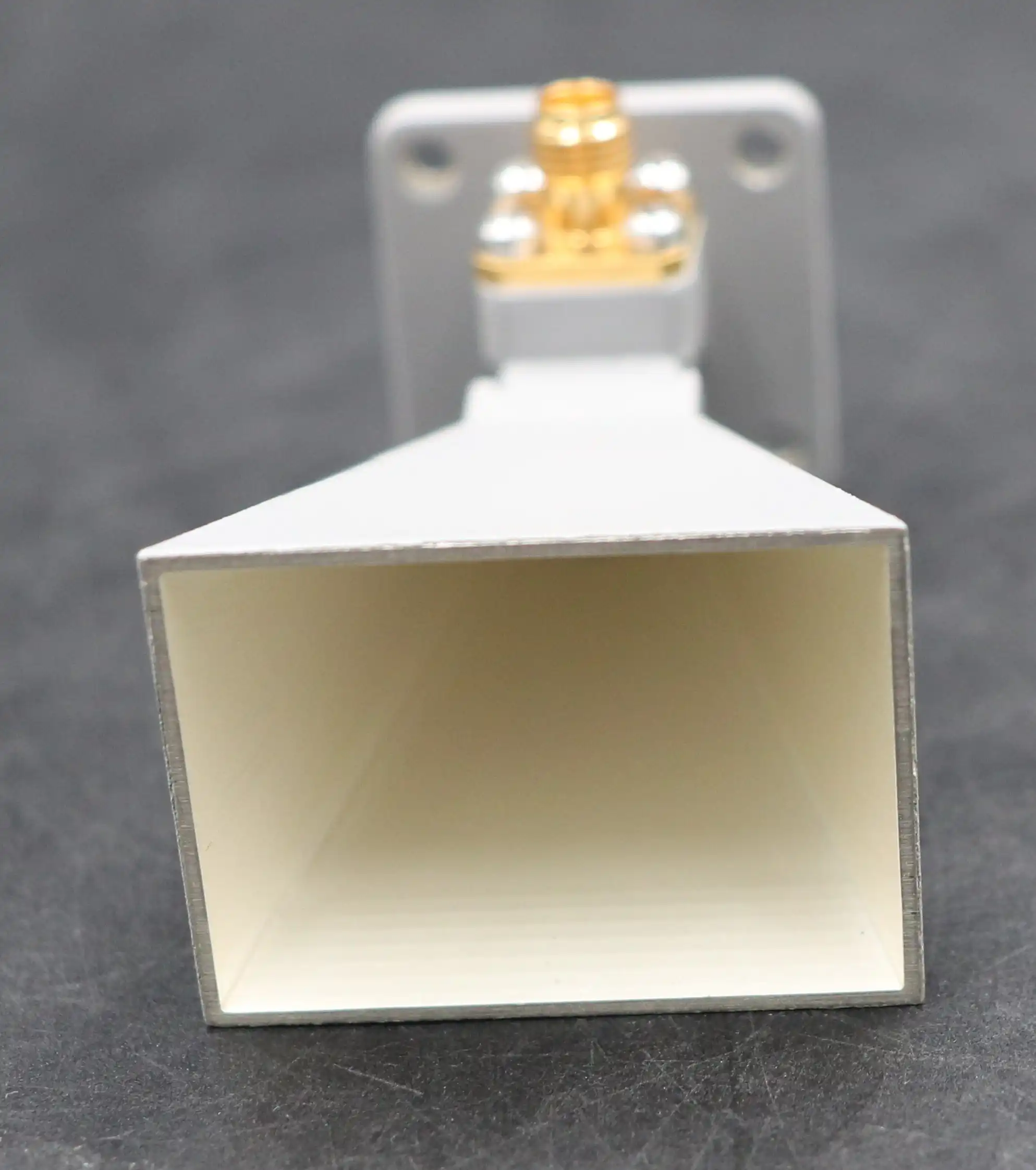
Designing High-Performance Pyramidal Horn Antennas for 5G Applications
Structured Design Workflow for Engineering Teams
The development process starts with a thorough analysis of the needs. The buying teams need to be clear about the frequency ranges that can be used, the minimum gain goals, the allowed beamwidths, and the weather conditions. 5G backup links usually have to work at 26 to 28 GHz, have a gain of 20 dB, and be able to handle temperatures between -40°C and +65°C. Using well-known gain formulas, our design engineers turn these into aperture dimensions. They then use electromagnetic simulation to fine-tune the geometries for high-performance pyramidal horn antenna design.
Adjusting the E-plane and H-plane dimensions over and over again is part of aperture optimization. Asymmetric apertures can change the shape of beamwidths in parallel lines, which is good for covering patterns that are split up into sectors. The choice of flare angle strikes a balance between efficiency and phase error tolerance. Steep angles shorten the length of the flare but increase phase irregularities that make beamwidths wider and gain lower.
Simulation Software and Validation Tools
Full-wave electromagnetic analysis can be done before fabrication with professional tools like Ansys HFSS, CST Microwave Studio, and Altair FEKO. Our results in a 24-meter microwave anechoic room show that these platforms accurately model radiation patterns, input impedance, and far-field properties. Advanced Microwave Technologies Co., Ltd. has a facility for far-field testing from 0.5 to 110 GHz. This lets us directly connect what we predicted would happen based on simulations with what we actually saw.
Usually, simulation workflows include parametric sweeps that change aperture sizes and flare angles. This creates performance curves that help choose the final pyramidal horn antenna design. Transformations from near-field to far-field in modeling settings make measurement sets look like the real thing. This lets virtual validation happen before physical prototyping. This method cuts down development times from months to weeks, which gives us a competitive edge that we stress in our OEM service offers.
Precision Manufacturing and Quality Assurance
Tolerances in manufacturing have a big effect on performance, especially at millimeter-wave frequencies, where errors in size equal to wavelength fractions hurt the electrical properties. An accuracy of ±0.025 mm is reached in CNC cutting for both aperture sizes and flare shapes. Specifications for the surface finish limit roughness to less than 1.6 μm Ra, which keeps circuit losses to a minimum.
Torque-controlled fastening of waveguide flanges is part of the assembly process. This stops RF leakage at surfaces. For quality control, we use network analyzers to make sure that the return loss is less than -20 dB across all operational bands. We also use pattern analyzers to make sure that the gain and beamwidth meet the requirements for the pyramidal horn antenna design. RoHS compliance and environmental stress screening make sure that products are reliable in defense and aerospace applications, where failure would have very bad results.
Comparing Pyramidal Horn Antennas with Alternative Antenna Types for 5G
Horn Antenna Variants: Pyramidal vs. Conical and Sectoral
When conical horn antennas change from a circular waveguide to a circular aperture, they offer axisymmetric shapes that can be useful for some radar uses. 5G infrastructure, on the other hand, mostly uses rectangular waveguide distribution networks. This means that pyramidal horn antenna designs are easier to integrate because they don't have to make circular-to-rectangular changes. Sectoral horns only flare in one direction, so they make fan-shaped beams that work for azimuthal coverage but don't have the controlled elevation patterns that pyramidal horn antenna designs do for small-cell installations.
When they are fed by rectangular waveguides, pyramidal configurations do better at cross-polarization than conical ones, keeping polarization purity above -30 dB. In dual-polarized 5G MIMO systems, where signal orthogonality has a direct effect on channel capacity, this trait is very useful.
Trade-offs with Parabolic Reflectors and Patch Arrays
Parabolic reflector antennas have higher gains (30+ dBi), but they need bigger apertures and to be perfectly aligned mechanically. Because they are so big, they can't be used in cities with limited room because 5G small cells need to be small. Pyramidal horn antenna designs have better gain-to-volume ratios for modest gain needs (15–25 dBi), which makes mounting easier.
Microstrip patch arrays are good for large MIMO base stations because they have smaller profiles and can electronically guide beams. However, compared to pyramidal horn antenna designs, individual patch elements have narrower bandwidths and can't handle as much power. Because their gain characteristics can be calculated, pyramidal horn antenna designs are often used as measures for measuring patch array performance. Which technology to use depends on the details of the job. Horns work best for test equipment, backhaul feeds, and situations where stability is more important than electronic speed.
Procurement Insights: Sourcing and Customizing Pyramidal Horn Antennas for 5G
Evaluating Manufacturers and OEM Partners
When looking for trusted providers, you need to look at more than just unit price. Certification to ISO 9001 quality management systems shows that the process is mature, and compliance with ISO 14001 environmental standards shows that the company is making responsible products. Advanced Microwave Technologies Co., Ltd. has both of these certifications, as well as ISO 45001:2018 for occupational health, which shows that they are very good at everything they do.
The technical skills deserve close examination. Manufacturers who use anechoic chambers with enough far-field distances (our 24-meter facility can handle accurate measurements above 3 GHz) validate pyramidal horn antenna design performance in the real world instead of just using simulations. You can trust published specs if they can be traced back to national measurement standards, have recorded calibration histories, and include third-party testing results.
After global problems, supply chain resilience has become more important. Taking a look at different ways to get materials, how to keep track of supplies, and relationships for logistics can help lower buying risks. We keep strategic stockpiles of parts and build ties with many raw material sources to make sure that our business can keep running even when the market is unstable.
Custom Design Advantages and Cost Considerations
Off-the-shelf antennas don't always work perfectly with specific 5G deployment situations. Custom pyramidal horn antenna designs can fit different frequency bands, mounting options, or ratings for environmental protection. Our engineering team works closely with clients to turn system-level needs into the best possible antenna specs. Through early design involvement, this consultative method often finds ways to improve performance or cut costs.
Costs are affected by things like technical hours used for research, the time it takes to make a prototype, and the money spent on tools for mass production. Engineering fees that don't happen again usually range from $5,000 to $20,000, based on how complicated the project is. However, after 100 pieces are made, the cost per unit drops a lot. To get correct total-cost-of-ownership estimates, procurement teams should ask for detailed quotes that break down NRE and unit costs for the pyramidal horn antenna design.
At ADM, it usually takes between 4 and 6 weeks from the time the design is finalized until the samples are ready for testing. Our in-house machining and testing facilities and our ability to do rapid iterations help shorten development schedules compared to providers who outsource fabrication or testing.

Future Trends and Performance Optimization in 5G Pyramidal Horn Antenna Design
Emerging Technologies and Integration with Advanced Systems
New wideband materials, like low-loss ceramic composites and metamaterial shapes, offer better performance over a wider range of frequencies for pyramidal horn antenna design. Additive manufacturing research looks into making horns with complex internal shapes that can't be done with traditional cutting. This could cut weight by 30–40% while keeping electrical performance the same. These improvements are especially helpful for aerospace and unmanned aerial vehicle (UAV) uses where weight restrictions are strict.
A new area of growth is integrating with Massive MIMO designs. In over-the-air (OTA) test systems that make sure 5G base station beamforming techniques work, pyramidal horn antenna designs are used as array elements. Because their patterns are steady and predictable, they produce controlled electromagnetic environments that allow readings to be made over and over again. This helps with certification testing that is needed by regulatory bodies.
Horn elements are being used more and more in phased array systems as feed networks for reflector antennas or as single radiators in sparse arrays. When you put electronic beam steering agility and robust pyramidal horn antenna design together, you get systems that can be used for mobile satellite communication terminals and adaptive 5G backhaul links.
Optimization Techniques for Next-Generation Deployments
Computational optimization methods now look into multi-objective design spaces while reducing trade-offs between mass, cost, and electricity performance. Iteration cycles that have to be done by hand are cut down by genetic algorithms and machine learning methods that speed up convergence toward Pareto-optimal solutions for pyramidal horn antenna design. We use these techniques in simulation environments to come up with design options that are then ranked by the client against a list of competing needs.
Power loss is taken care of by optimizing thermal control in high-transmit-power systems. Finite element analysis models how heat moves through pyramidal horn antenna designs, helping with where to put fins or how to incorporate heat sinks so that joint temperatures stay safe during continuous operation.
The market for 5G antennas is expected to grow at a rate of 10 percent per year until 2030. This is because more mmWave deployments and private network installations are expected. Setting up preferred supplier relationships with manufacturers that show consistent quality, technical responsiveness, and capacity scalability are all part of strategic procurement for pyramidal horn antenna design. More and more, buyers want turnkey options that include antenna design, mounting hardware, and measurement records.
Conclusion
Pyramidal horn antenna design is still very important for improving 5G infrastructure because it provides unmatched dependability and performance predictability that are necessary for mission-critical communications. In this guide, we've looked at basic design principles, useful engineering processes, comparing current technologies to alternative ones, and strategic buying issues. These antennas are made with precision and are tested in state-of-the-art facilities to make sure they meet the strict requirements of modern wireless networks. As 5G moves toward higher frequencies and more complicated deployment situations, the success of providing next-generation connectivity will depend on how well procurement teams work together with experienced manufacturers like Advanced Microwave Technologies Co., Ltd.
FAQ
What frequency ranges do pyramidal horn antennas typically support for 5G applications?
Pyramidal horn antenna designs made for 5G usually work between 24 and 40 GHz, which covers the n257, n258, n260, and n261 frequency bands that are used for millimeter-wave 5G services around the world. Depending on the needs of the application, custom designs can go into lower frequency ranges below 6 GHz or higher frequencies in the Ka-band and V-band. The working bandwidth is usually between 20 and 30 percent of the center frequency, but some broad designs can reach octave bandwidths by matching the impedances more closely.
How does aperture size influence gain and beamwidth performance?
Fundamental aperture theory says that gain and beamwidth are directly related to the size of the aperture for pyramidal horn antenna design. Radiated energy is focused into narrower beams when apertures are bigger. This makes directivity and gain higher. The relationship is pretty close to the formula for gain: aperture size divided by wavelength squared. Beamwidth and aperture size are negatively related; when aperture sizes are doubled, beamwidth angles are cut in half. This trade-off lets engineers make antennas that meet specific coverage needs.
Why choose pyramidal horn antennas over other horn types for 5G deployments?
Because pyramidal horn antenna designs naturally connect to rectangular waveguides, which are common in 5G transmission systems, conical horns don't need the complicated mode converters that they otherwise would. They let you control the E-plane and H-plane patterns separately, which lets you shape the beam in a way that fits the needs of each sector. In dual-polarized MIMO setups, signal orthogonality is maintained by better cross-polarization discrimination. These features, along with performance traits that can be calculated, make pyramidal horn antenna designs better for test tools, backup systems, and reference antennas.
Partner with Advanced Microwave Technologies Co., Ltd for Custom Pyramidal Horn Antenna Solutions
Advanced Microwave Technologies Co., Ltd is ready to help you with your 5G rollout by designing a pyramidal horn antenna that fits your exact needs. With more than 20 years of experience making microwave parts and ISO 9001, ISO 14001, and ISO 45001 certifications, you can be sure of the quality and dependability of our work. Our technical team can help you with everything from the initial consultation to production and delivery, whether you're looking for a pyramidal horn antenna design for sale or need custom OEM development.
Email our technical experts at craig@admicrowave.com to talk about the needs of your project. We can make quick prototypes, confirm measurements in our 24-meter anechoic chamber, and offer competitive pricing for large-scale production. As a top maker of pyramidal horn antenna designs for the defense, aircraft, telecommunications, and research industries around the world, we offer turnkey solutions that shorten your time to market and make sure you meet all international standards.
References
1. Balanis, C. A. (2016). Antenna Theory: Analysis and Design (4th ed.). Hoboken: John Wiley & Sons.
2. Milligan, T. A. (2005). Modern Antenna Design (2nd ed.). Hoboken: John Wiley & Sons.
3. Olver, A. D., Clarricoats, P. J. B., Kishk, A. A., & Shafai, L. (1994). Microwave Horns and Feeds. London: IET Press.
4. Rappaport, T. S., Xing, Y., MacCartney, G. R., Molisch, A. F., Mellios, E., & Zhang, J. (2017). Overview of Millimeter Wave Communications for Fifth-Generation (5G) Wireless Networks. IEEE Transactions on Antennas and Propagation, 65(12), 6213-6230.
5. Silver, S. (1984). Microwave Antenna Theory and Design (Radiation Laboratory Series). London: Peter Peregrinus Ltd.
6. Stutzman, W. L., & Thiele, G. A. (2012). Antenna Theory and Design (3rd ed.). Hoboken: John Wiley & Sons.