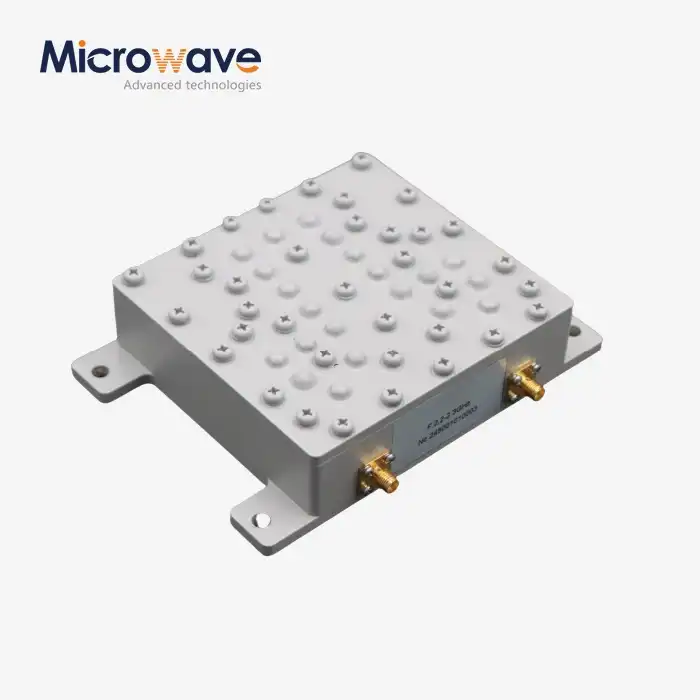





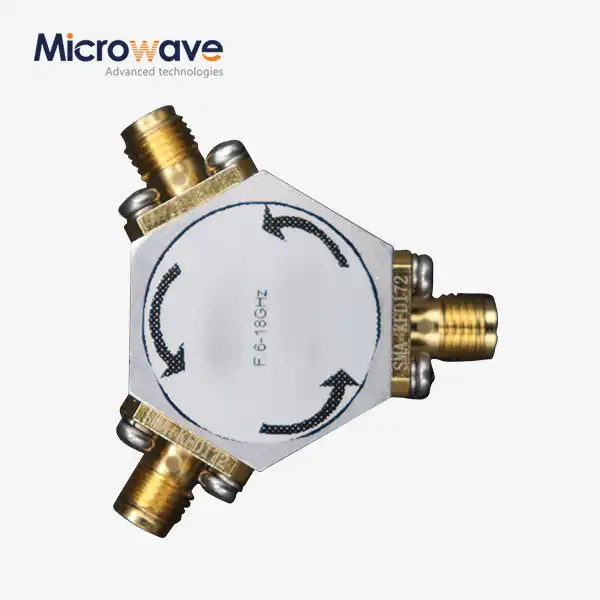
Coaxial Broadband Circulator
Coaxial Broadband Circulator — Wide Frequency Range RF & Microwave Devices
The Coaxial Broadband Circulator is designed and made by Advanced Microwave Technologies Co., Ltd (ADM). It works with frequencies from 10 MHz to 20 GHz and can handle up to 500 W of power on average. Each unit is a passive RF device with three ports that doesn't work the other way around. It is made of ferrite materials and broadband impedance matching networks. ADM has a 24 m Microwave Darkroom on-site that can test from 0.5 GHz to 110 GHz. This helps with testing during development and production. You can choose your own frequency bands, connector types, and power setups.
What Is a Coaxial Broadband Circulator?
A product sends microwave energy in one direction through three ports: signals that go into Port 1 leave through Port 2, signals that go into Port 2 feed Port 3, and signals that go into Port 3 feed Port 1. With high isolation, signals going in the opposite way are weakened. It is different from passive splitters or couplers, which don't have a choice for direction, because it doesn't work the other way around.
Narrowband circulators only work at one resonant frequency. Broadband models have ferrite matching networks and magnetic biasing architectures that keep insertion loss low and isolation high across many frequency ranges, like 2–6 GHz or 6–18 GHz, all in one unit.
Core Technical Functions
Protection for Power Amplifiers
When a 50-ohm load is connected to Port 3 and left open, the circulator acts as an isolator. Power that is reflected because of load mismatches is sent away from the amplifier stage, which makes it less vulnerable to stress caused by VSWR.
Coverage of Frequencies in Wideband Systems
In Electronic Warfare and wideband communication systems, switching from a bank of narrowband circulators to a single broadband unit cuts down on the number of connectors, the buildup of insertion loss, and the complexity of the mechanical parts in the RF front end.
Simultaneous Transmit and Receive
The circulator lets Tx and Rx work on the same antenna with little interference between the send and receive paths. This is useful for radar and satellite communication systems that need to use spectrum efficiently.I don't know what to say.


Product Specifications
Parameter | Specification |
Frequency Range | 10 MHz – 20 GHz |
Average Power Handling | Up to 500 W |
Number of Ports | 3 |
Impedance | 50 Ohm |
Device Type | Non-reciprocal passive RF device |
Operating Temperature | -55°C to +100°C |
Connector Type | Coaxial |
Power Testing | CW and peak power verified |
Custom frequency bands, connector types, and power ratings are available. Contact ADM with your specific requirements.
Key Performance Features
Low Insertion Loss Across Full Bandwidth
ADM chooses the ferrite material mixtures and broadband impedance matching networks for a Coaxial Broadband Circulator so that the insertion loss stays flat across the whole band. This keeps the response from dropping as it does in designs that don't match up well.
High Isolation Between Ports
Each unit is designed to keep more than 20 dB of isolation across the operating bandwidth. This keeps upstream parts safe from reflected energy and limits signal bleed between the send and receive paths.
Design That Accounts for Temperature
When ferrite is heated or cooled, its magnetic properties change. The temperature-compensated magnets and controlled ferrite doping in ADM's circulators keep the isolation stable from -55°C to +100°C, which is the temperature range that the circulators are rated for.
Blocking Magnetic Fields
Magnetic shielding is built into standard units to keep ferrite from becoming detuned by outside fields. For places with a lot of magnetic interference, there are choices for better shielding.
Application Scenarios
Electronic Warfare and Wideband Signal Systems
To find and block signals, EW platforms scan over a wide frequency range. Broadband circulators let powerful broadcasters work on several bands at the same time, without the antennas losing their tune or reflected energy getting to the amplifier.
Check and Measure
Broadcast circulators separate the test device from the signal source in vector network analysis and automated test equipment. This keeps source mismatch errors from affecting the accuracy of measurements across the whole frequency range of the instrument.
AES Wideband Radar
In active electronically scanned array radars, the transmit and receive pulses are kept separate by broadband circulators inside the T/R modules. Target tracking and radar resolution are both affected by how well you can handle high peak power while keeping performance over a wide band.
Satellite Communication
Broadband circulators allow Tx and Rx to be separated at the same time even when the frequency allocation changes in long-distance satellite lines.
Quality Control and Testing
Before it is shipped, every ADM Coaxial Broadband Circulator goes through a number of inspection steps.
The VNA S-Parameter Sweep test checks each unit for S21 (insertion loss), S12 (isolation loss), and S11/S22 (return loss) over the whole band that was given. Criteria for passing or failing make sure that there are no performance spikes at any frequency point in the bandwidth.
Passive intermodulation (PIM) testing is done in communication applications to make sure that the junctions between ferrites and connectors don't send out interference signals that lower the receiver's sensitivity.
Environmental Stress Screening: Thermal shock cycle between -55°C and +100°C checks the stability and reliability of the solder joint and the ferrite. MIL-STD-202 guidelines are used for vibration and shock tests to make sure that the internal magnets and ferrite discs stay in the right place when the device is under mechanical stress.
Power Handling Verification: The CW and peak power ratings are checked to make sure they can handle heat without going out of whack or losing their magnetic properties permanently.
ADM has its own 24 m Microwave Darkroom and can test from 0.5 GHz to 110 GHz, which helps with accurate measurements during development and production.
FAQ
Q: What does a broadband repeater give up in exchange for its bandwidth?
A: This is because ferrite materials tend to spread out, it gets harder to keep separation above 20 dB and insertion loss low as bandwidth increases. To make these reaction curves flat, broadband designs use complicated impedance matching networks. Ultra-wideband configurations might have a little more insertion loss than narrowband configurations of the same type.
Q: Can this circulator also be used as an isolator?
A: Yes. When you connect a 50-ohm load to the end of Port 3, it turns into an isolator. Port 1 sends signals to Port 2, and Port 3 takes in echoes that come in through Port 2.
Q: How does the temperature change how well something works?
A: The magnetic properties of ferrite change as the temperature changes. ADM controls ferrite doping and temperature-compensated magnets to keep frequency drift to a minimum. If you use the device outside of its recommended temperature range, isolation may decrease or insertion loss may rise.
Q: What limits the amount of power that can be handled?
A: Peak power is limited by the breakdown voltage of the connector, and CW power is limited by the thermal dissipation of the ferrite plus housing. When an isolator is set up, too much power being reflected into the terminal load could damage the load before it damages the circulator.
Q: Can these gadgets pick up on magnetic fields from outside?
A: Strong fields from the outside can make the ferrite resonance lose its tune. Magnetic shielding is built into standard machines. When there is a lot of magnetic interference, you may need to add more shielding or be careful about where you put things.
Q: What kinds of customisation options are there?
A: ADM can work with custom frequency bands between 10 MHz and 20 GHz, as well as custom connector types, power ratings of up to 500 W, and changed housing sizes. Send your specifications to the ADM engineering team so they can look them over.
_1733809032116.webp)
_1733738410152.webp)