




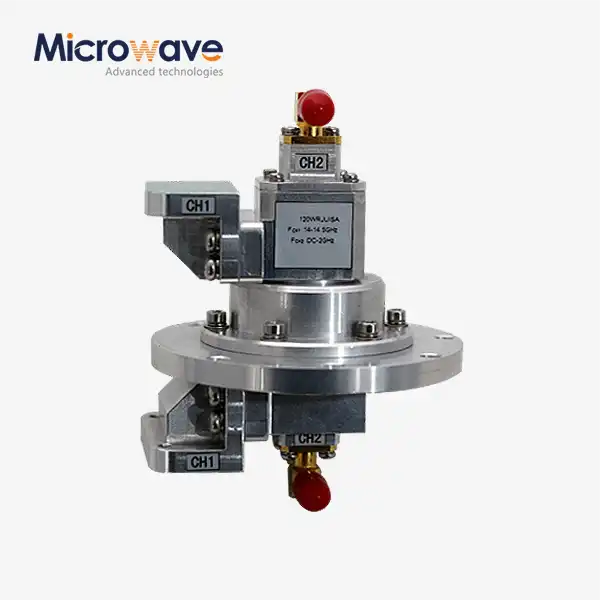
WG Dual-Channel Rotary Joint
WG Dual-Channel Rotary Joint for Radar & SATCOM Systems
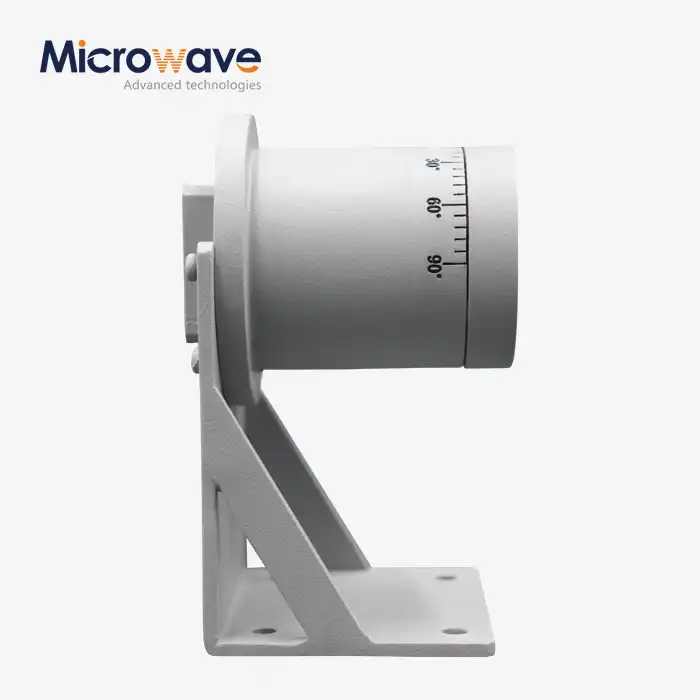
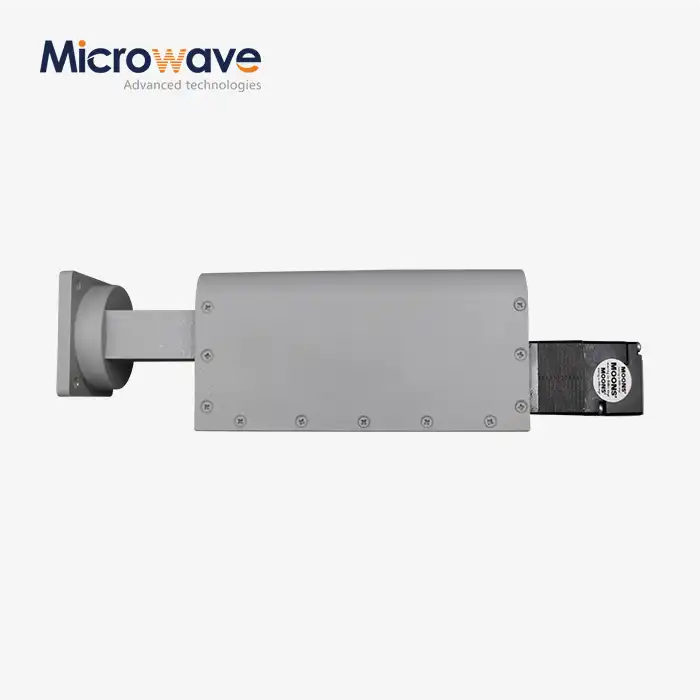
Advanced Microwave Technologies Co., Ltd. (ADM) designs and manufactures the WG Dual-Channel Rotary Joint as a precision electromechanical component built to transfer microwave energy between a fixed transmission line and a continuously rotating assembly. Each unit delivers VSWR below 1.25:1, insertion loss under 0.3 dB per channel, and inter-channel isolation exceeding 70 dB. ADM's engineering capability spans 0.5 GHz to 110 GHz, supporting radar, satellite communication, aerospace, and defense applications.
What Is a WG Dual-Channel Rotary Joint?
A waveguide dual-channel rotary joint is an electromechanical RF component that allows two independent microwave signals to pass between a stationary structure and a rotating assembly simultaneously, without interruption.
Unlike single-channel designs, a dual-channel version separates two signal paths inside a single housing. Each channel is impedance-matched independently, so different frequency bands or signal types can run on each path at the same time.
This configuration suits systems where both transmit and receive functions — or two polarization states — must operate through a single rotating interface.
Key Technical Specifications
Parameter | Specification |
Frequency Range | Custom per band (e.g., L-Band: 1.0–2.0 GHz, X-Band: 8.0–12.0 GHz) |
VSWR | < 1.25:1 per channel |
Insertion Loss | < 0.3 dB per channel |
Insertion Loss Variation (WOW) | < 0.05 dB during rotation |
Inter-Channel Isolation | > 70 dB |
Peak Power Handling | Megawatt class |
Average Power Handling | Kilowatt class |
Operational Life | > 10 million rotations |
Pressurization Support | SF6 or dry nitrogen compatible |
Housing Material | High-grade aluminum or copper alloy, silver-plated |
Surface Treatment | Chemical conversion coating (Alodine) or silver plating |
Environmental Standard | MIL-STD-810 compliant |
Core Performance Features
Non-Contacting Choke Design
The WG Dual-Channel Rotary Joint waveguide rotary joints from ADM don't use sliding metal contacts, but instead use a choke structure that doesn't touch anything. This gets rid of rotational noise, micro-arcing, and contact wear, which makes the service life longer than 10 million rotations.
Ultra-Low Changes in Insertion Loss
One of the most difficult conditions for radar applications is that the signal must stay the same while it rotates. WOW (insertion loss variation) is kept below 0.05 dB, which keeps the signal stable even as the antenna keeps turning.
High Peak Power with Help for Pressurisation
Dielectric breakdown is a real risk for radar and defence devices that are used at high altitudes. To stop voltage arcing, these joints can be pressurised on the inside with SF6 or dry nitrogen. This means they can be used with megawatt-class transmitters.
Independent Dual-Channel Architecture
Every channel works on its own. Channel 1 can be set up to work best with the X-Band (8–12 GHz), and Channel 2 works with the L-Band (1–2 GHz). There is no performance trade-off between the two channels because they are impedance-matched separately.
Applications
Air Traffic Control and Surveillance Radar
When ATC systems are on all the time, Channel 1 handles high-power send pulses and Channel 2 gets low-power echo returns at the same time. No matter what the weather is like, the joint can handle high peak power without arcing and keep turning.
SATCOM Terminals That Can Move (SOTM)
Mobile SATCOM devices have two-channel rotary joints that send both RHCP and LHCP signals at the same time. This keeps the link stable when the vehicle moves and the polarisations change. In these situations, MIL-STD-810 shaking compliance is used.
Defence Turrets for EO/IR
Electro-optical and infrared gimbal systems use two channels. The first channel handles RF command and control signals, and the second channel handles high-bandwidth video data from rotating devices. The two-channel shape fits into small gimbal cases that don't have a lot of room.
Quality Control Process
Every WG Dual-Channel Rotary Joint produced at ADM goes through a structured inspection process before shipment.
VNA Dynamic Sweep Testing — A Vector Network Analyzer verifies VSWR and insertion loss across the full frequency band while the unit is physically rotating. This identifies any dynamic WOW or modulation spikes that static testing would not catch.
Isolation Verification — Each unit is tested to confirm channel separation meets or exceeds the 70 dB threshold under operating conditions.
High-Power Breakdown Test — Units are subjected to peak power loads in a vacuum chamber to check for multipactor effects and corona discharge at simulated high-altitude conditions.
Pressurization and Leakage Test — O-rings and dynamic seals are pressure-tested at 15 PSI of nitrogen to confirm seal integrity.
Environmental Stress Screening (ESS) — Vibration and thermal cycling tests per MIL-STD-810 simulate the full operational life of the component before delivery.
ADM's test infrastructure covers 0.5 GHz to 110 GHz, supporting accurate performance validation for each unit shipped.
Customization Options
Standard catalog designs cover common radar and SATCOM frequency bands, but most projects require a tailored configuration. ADM's engineering team can adjust:
· Frequency band per channel (independent optimization)
· Flange interface type and mechanical footprint
· Pressurization port placement for SF6 or dry nitrogen
· Surface treatment (Alodine conversion coating or silver plating)
· Environmental rating and sealing level
Send ADM your system requirements to receive a custom design proposal.
FAQ
Q: How do you stop chatter between the two channels?
A: ADM uses highly accurate, concentrically shaped designs with shielding structures inside. As a minimum, inter-channel isolation must be greater than 70 dB.
Q: Can the two channels carry different bands of frequencies at the same time?
A: Yes. The channels don't depend on each other electrically. Channel 1 can be set up for X-Band (8–12 GHz) and Channel 2 can be set up for L-Band (1–2 GHz). Each channel has its own impedance-matched geometry.
Q: How long do you think the rotational service will last?
A: These joints are made to last more than 10 million rotations under normal conditions. This was proven by accelerated life tests.
Q: Can the joint send data and power on different channels at the same time?
A: Yes. It is usual for RF power to go to one channel and high-frequency data to go to the other. It is important to know the peak and average power ratings right away so that the right dielectric materials can be chosen.
Q: What causes spinning noise, and how can it be stopped?
A: Most of the time, dynamic contact resistance or micro-arcing at the signal interface cause rotational noise. The non-contacting choke design from ADM gets rid of the physical contact point completely, keeping the electrical path stable while the motor is turning.
Q: Can the joint work in places with pressure?
A: Yes. It is possible to pressurise the joint from the inside with SF6 or dry nitrogen. It has been tried at 15 PSI nitrogen to make sure the seal is strong and to keep the dielectric from breaking down in high-altitude or high-power radar systems.
Contact Us
Send your radar or SATCOM requirements for WG Dual-Channel Rotary Joint to ADM's engineering team at craig@admicrowave.com to request a custom design proposal.