




Broadband RF Circulator vs Isolator: What Is the Difference?
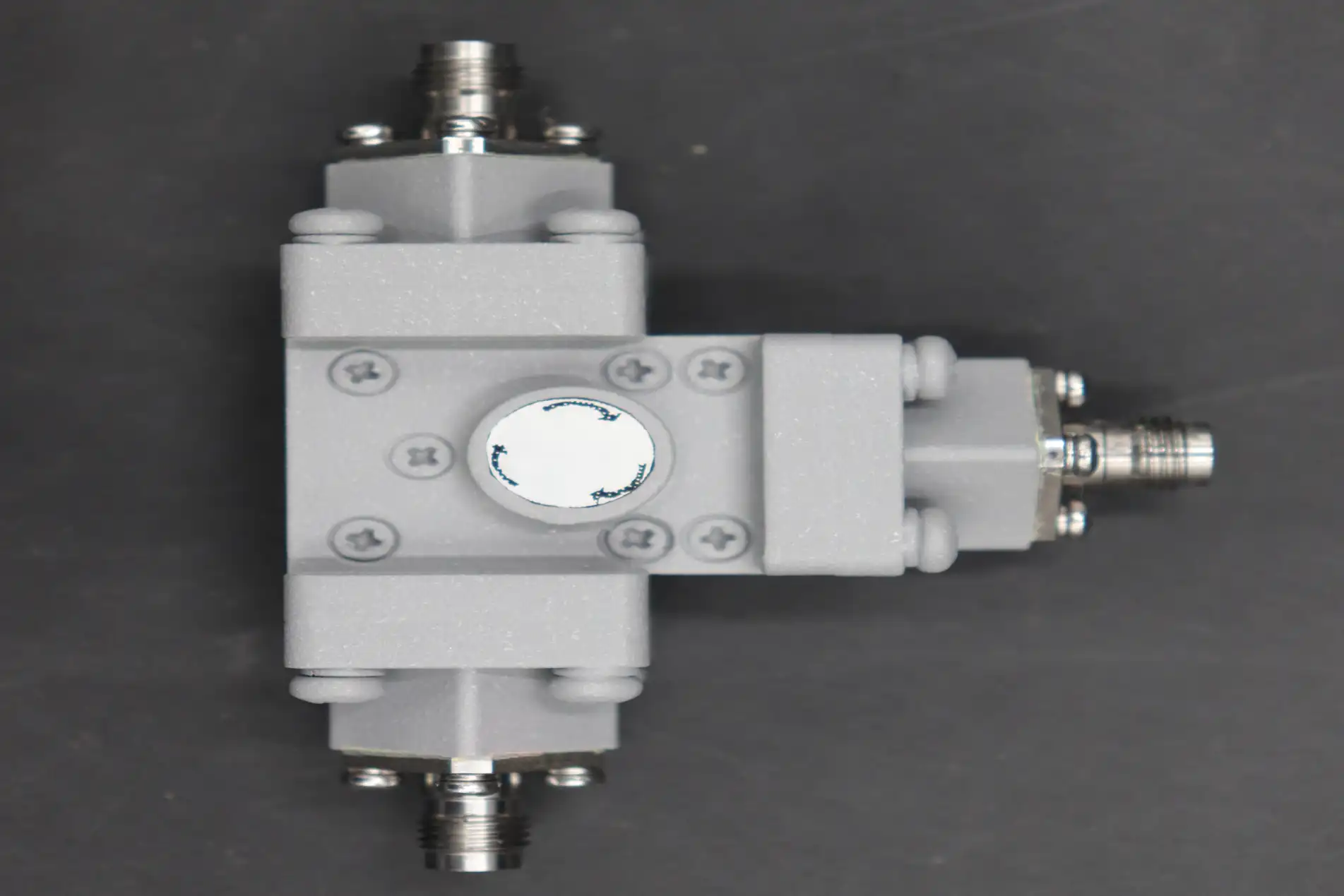
When sourcing passive RF components for high-reliability systems, understanding the functional distinction between a broadband RF circulator and an isolator is critical. Simply put, a circulator directs RF energy sequentially through three or more ports—signal entering Port 1 exits Port 2, and signal entering Port 2 exits Port 3—while an isolator is essentially a two-port device (or a circulator with one port terminated) that allows signal flow in only one direction. Both leverage ferrite materials and magnetic biasing to achieve non-reciprocal behavior, but their port configurations and signal routing architectures serve fundamentally different roles in RF system design.
What Is a Broadband RF Circulator and How Does It Work?
A broadband rf circulator is an inactive part that doesn't work the other way around and controls data flow across multiple ports over a wide frequency range. Broadband models work across many octaves of frequencies, like 2–18 GHz or even DC to 110 GHz in more advanced designs. They do this by using complex impedance matching networks and carefully engineered ferrite junctions, while narrowband models are tuned to a single resonance.
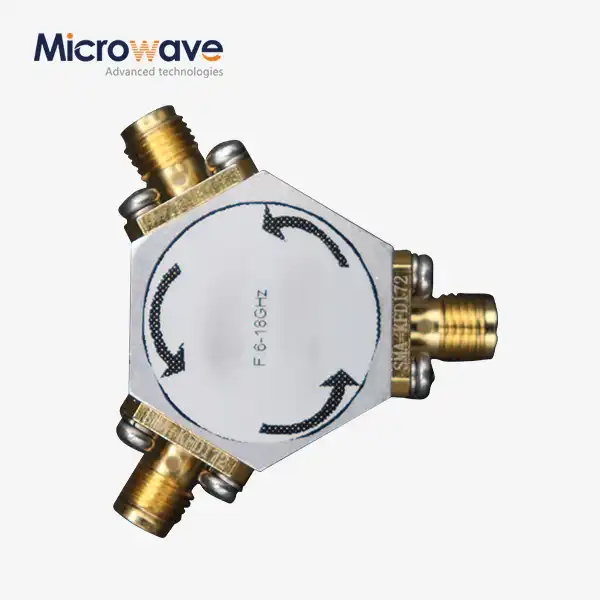
The main idea behind how it works depends on the gyromagnetic properties of ferrite materials that are put in a steady magnetic field that is made by permanent magnets. In a three-port setup, this magnetic biasing makes a spinning magnetic field that lets RF energy flow in a set direction, usually from Port 1 to Port 2, Port 2 to Port 3, and Port 3 back to Port 1. This direction control keeps echoes to a minimum and keeps sensitive parts away from backward signals that could damage them.
How Signal Routing Works in Practice
Inside the circulator, the ferrite disk is where two communication lines meet. When RF energy comes in through Port 1, the ferrite's magnetic features direct it toward Port 2 with little loss. Any reflected energy that tries to go back through Port 2 is sent to Port 3 instead, which gives high reverse isolation.
Why Broadband Coverage Matters
Broadband is important for current uses like 5G infrastructure, electronic warfare, and wideband radar, where systems need to be able to handle multiple frequency bands at the same time without using moving parts. To do this, you need temperature-compensated magnetic circuits and gradient impedance transitions at the input/output ports to make the performance curves flat across the whole operating range.
Key Technical Differences Between Broadband RF Circulators and Isolators
Both devices use ferrite-based non-reciprocal transmission, but their functional designs and performance measures are very different. For buying teams, knowing these differences helps them choose the right part for each system's needs.
Port Configuration and Signal Flow
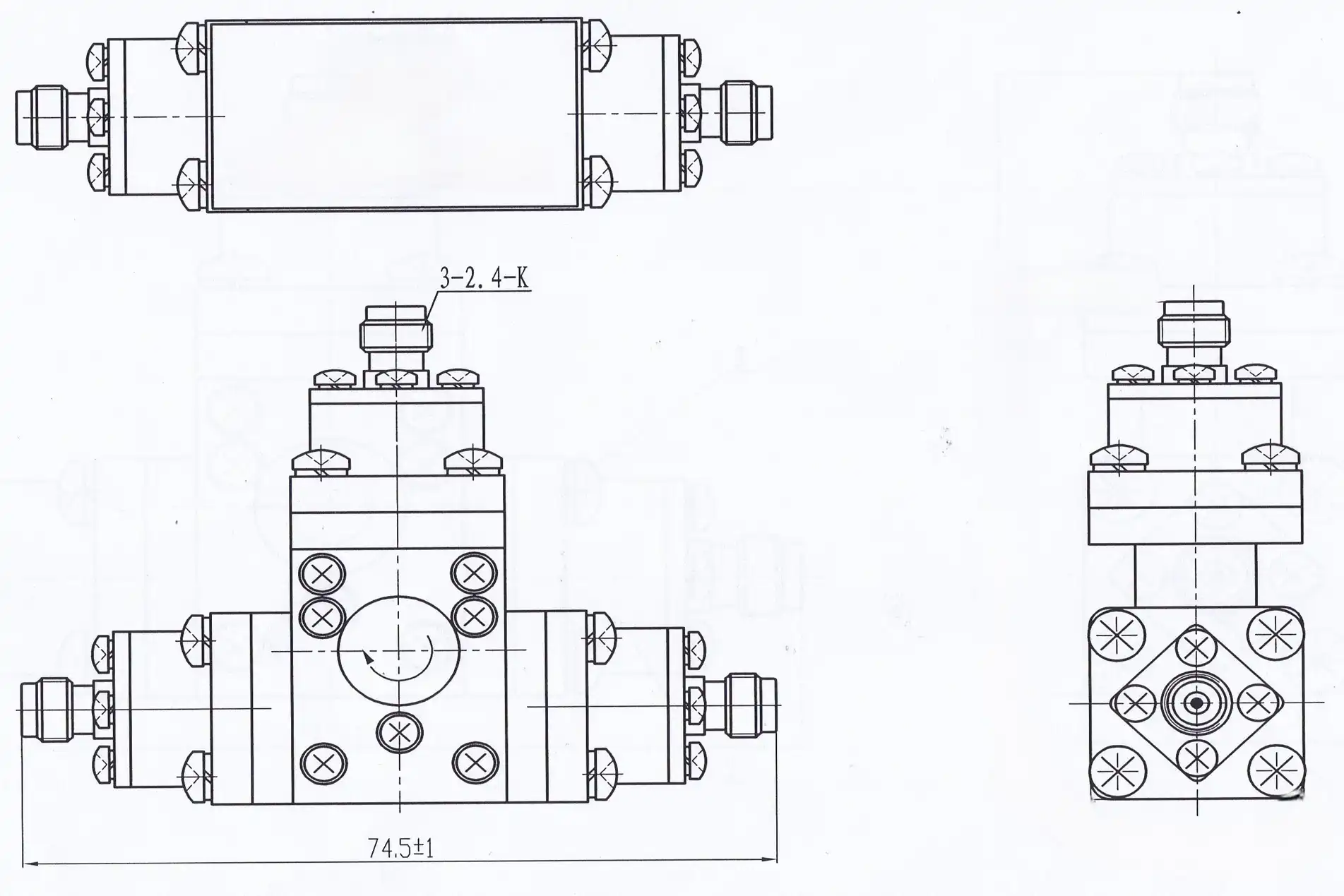
Circulators typically feature three or four ports arranged to route signals in a circular pattern. This multi-port architecture enables simultaneous transmit/receive operations in shared antenna systems or signal routing in complex RF chains. Engineers like circulators because they can tell the difference between forward and reflected signals without switching them from the outside.
Isolators, by contrast, are two-port devices that permit signal transmission in only one direction. In a technical sense, an isolator is a circulator with a matched load (usually 50 ohms) on Port 3. This load takes reverse energy instead of sending it somewhere else. This setup keeps load mismatches and echoes from hurting amps or oscillators that are sensitive.
Critical Performance Metrics
Several important criteria determine the suitability of a component:
- Insertion Loss: Measures how weak the data is going forward. Quality broadband rf circulators have an insertion loss of less than 0.5 dB, which means that the signal doesn't change much across the frequency range.
- Isolation: Measures the amount of reverse signal blocking. Isolators can go over 40 dB by cutting off the third port, while circulators usually provide ≥20 dB of separation between ports that are not nearby.
- VSWR (Voltage Standing Wave Ratio): Shows how well the impedance matching works. Low VSWR values (≤1.2 at input ports) show that power is transferred efficiently and there are fewer echoes.
- Power Handling: Sets the limits of how things can work. The average amount of power it can handle is between 10 and 500 W, and its peak power can reach 1 to 10 kW in standard designs and up to 50 kW in high-power versions made for radar and jamming uses.
Design Considerations for Broadband Performance
It is hard for engineers to make sure that performance stays the same across wide bandwidths. Broadband designs use multi-stage impedance transformers and carefully managed magnetic field distributions to keep performance from dropping with frequency. Temperature compensation mechanisms keep the ferrite properties stable over a wide temperature range, from -40°C to +85°C. This is very important for applications in space and outside.
Choosing the Right Component: Circulator or Isolator for Your Application
Choosing between a circulator and an isolator relies on how the system is set up, how much frequency is needed, and how much safety is needed. Both devices help with signal management, but they are best used in different situations.
When to Specify a Circulator
Circulators work great when two-way signal splitting is needed within the same frequency band:
Shared Antenna Systems: In shared antenna systems, radar installations and satellite ground stations use circulators to keep sensitive receivers from being affected by high-power transmitters that are sharing the same antenna. The circulator sends signals that are being sent to the antenna and receives signals that are being sent to the receiver without mixing them up.
Test and Measurement Equipment: Vector network analyzers use circulators to split signals that come in and signals that bounce back. This lets them accurately characterize S-parameters over a wide frequency range without contaminating the source.
Wideband Communication Systems: 5G base stations and electronic warfare platforms use broadband rf circulators to handle multiple frequency channels at the same time, which lowers the number of parts needed and makes the system simpler.
When an Isolator Is the Better Choice
Isolators offer better security in signal lines that only go in one direction:
Amplifier Protection: Putting isolators at the outputs of amplifiers stops load mismatches and changes in antenna VSWR from making power amplifiers unstable or hurting them, especially in high-power emitters.
Oscillator Stabilization: Isolators protect oscillators from changes in the load that could cause phase noise or frequency pulling. They are used by frequency sources and signal generators.
Signal Chain Optimization: Isolators between stages in receive chains stop reflections between stages, which lower the noise figure and dynamic range.
Comparing Cost and Complexity
Because they only have two ports, isolators usually cost less than circulators. This makes them the better choice when one-way safety is enough. When multi-port signal switching gets rid of the need for extra switches or diplexers, circulators are useful because they save money at the system level, which makes up for their higher unit cost.
Procurement managers should ask for specific S-parameter data across the full working bandwidth and make sure the product meets outdoor testing standards like MIL-STD-202 for resistance to vibration and thermal shock.
Performance and Application Case Studies
Real-world examples show how choosing the right parts can affect the performance and dependability of a system.
Case Study: 5G Massive MIMO Base Station
A major company that makes telecommunications equipment needed to improve signal separation in a 64-element active antenna array that works at frequencies between 3.3 and 4.2 GHz. The first designs that used narrowband isolators had performance problems at the band edges and needed to be tuned a lot. It was possible to get a constant insertion loss of less than 0.4 dB and separation of more than 25 dB across the whole band by switching to broadband RF circulators with gradient impedance matching. This led to better signal-to-noise ratios at cell edges and less intermodulation distortion, which directly increased the network's capacity.
Case Study: X-Band Radar Front-End Protection
A defense contractor working on an X-band fire-control radar had problems with reliability when antenna mismatches during rapid scanning caused power amplifiers to fail. Putting in a high-power isolator that could handle up to 50 kW of peak power between the amplifier and the antenna stopped damage from happening. The ≥40 dB reverse isolation of the circulator kept the 500 W amplifier from getting reflected energy while beam steering, and the ≒0.5 dB insertion loss kept the target detection range.
Case Study: Laboratory RF Signal Source Stability
A research center that was measuring wideband spectral ranges needed to be able to make stable signals between 2 and 18 GHz. Changes in load impedance from different test fixtures caused frequency pulling in their signal generators, which led to mistakes in the measurements. By adding broadband isolators to each generator output, load reflections were absorbed, phase noise was cut by 8 dB, and the output frequency was stabilized to within ±1 ppm, which was very important for accurate calibration work.
These examples show a very important idea: insertion loss and separation performance have a direct effect on system-level parameters such as sensitivity, dynamic range, and component life. Engineers shouldn't just look at average or center-frequency values when judging specs; they should also look at full-band S-parameter data.
Conclusion
Broadband rf circulators and isolators can be distinguished by their port design and signal routing needs. Circulators let signals flow sequentially through multiple ports, which is great for transmit/receive separation and complex RF architectures. Isolators, on the other hand, protect amplifiers and sources in a single direction. Both devices use the non-reciprocal properties of ferrite, but for broadband designs to keep low insertion loss and high isolation across multi-octave bandwidths, they need to be very good at matching impedance. When making a purchase choice, you should think about the needs of the application, such as frequency coverage, power handling, and environmental resilience, along with the performance standards that have been proven through thorough testing. In mission-critical defense, aircraft, and telecommunications applications, picking the right component has a direct effect on system stability, signal integrity, and operating efficiency.
FAQ
Can a circulator function as an isolator?
Yes. If you connect a 50-ohm load to the third port of a three-port circulator, it turns into an isolator. Signals go through Port 1 and out of Port 2. Any reflections that come in through Port 2 are absorbed by the load at Port 3, which protects the source at Port 1.
What frequency ranges do broadband models typically cover?
Depending on the purpose, broadband RF parts cover a wide range of frequencies. Bands like 0.5 to 18 GHz are used for electronic warfare, 2 to 40 GHz are used for satellite communications, and DC to 110 GHz are used for millimeter-wave study and test tools.
How does temperature affect performance?
The magnetic properties of ferrite change with temperature, which could lead to center frequency drift and less isolation. Temperature-compensated magnets and specific ferrite doping are used in high-quality designs to reduce these effects as much as possible across the rated operating ranges, which are usually -40°C to +85°C.
What limits power handling capacity?
Connector breakdown voltage (which limits peak power) and the thermal dissipation capacity of the ferrite and housing (which limits continuous wave power) are the two most important factors. If you go over these limits, the magnetic properties could change permanently, or internal structures could be damaged.
Partner with ADM for Precision Broadband RF Circulator Solutions
Advanced Microwave Technologies Co., Ltd. (ADM) has been making high-performance RF and microwave parts for complex defense, aircraft, and telecommunications uses for more than 20 years. Our wideband circulators and isolators work from DC to 110 GHz and have ≤0.5 dB insertion loss and ≥40 dB isolation. They are certified by ISO 9001 and have been through strict environmental testing.
If you need special circulator designs for AESA radar modules, ruggedized isolators for satellite ground stations, or OEM-ready parts with full documentation for system integration, our engineering team can help you from the prototype stage all the way through mass production. Our 24-meter microwave darkroom lets you precisely measure antenna patterns and make sure that components work as they should, according to your exact needs.
As a reliable company that makes broadband rf circulators, we offer low prices for large orders, help with shipping around the world, and quick response times for unique designs. Email our technical sales team at craig@admicrowave.com to talk about your particular needs and ask for complete datasheets that include full S-parameter data across your working bandwidth.
References
1. Pozar, David M. Microwave Engineering, 4th Edition. Wiley, 2012.
2. Helszajn, Joseph. The Stripline Circulators: Theory and Practice. Wiley-IEEE Press, 2008.
3. Ishii, T. K. Handbook of Microwave Technology: Components and Devices, Volume 1. Academic Press, 1995.
4. Adam, J. D., et al. "Ferrite Devices and Materials." IEEE Transactions on Microwave Theory and Techniques, vol. 50, no. 3, 2002, pp. 721-737.
5. Linkhart, Douglas K. Microwave Circulator Design, 2nd Edition. Artech House, 2014.
6. "MIL-STD-202: Test Method Standard for Electronic and Electrical Component Parts." U.S. Department of Defense, 2016.