Elliptical Waveguide Design and Signal Performance
When engineers have problems with high-frequency microwave systems, like those used for defense radar, satellite ground stations, or internet infrastructure, the type of waveguide technology they choose has a direct effect on the dependability and purity of the signals. When it comes to adjustable transmission, the elliptical waveguide stands out because it is both low-loss and mechanically adaptable. Instead of fixed rectangular waveguides that need complicated installation with many flanges and bends, this curved design lets cables run continuously through tower structures and equipment racks, which cuts down on reflection points and installation work by a large amount. We at Advanced Microwave Technologies Co., Ltd. have seen how the right design and choice of materials in these parts can improve performance in mission-critical situations.
Understanding Elliptical Waveguide Fundamentals
Depending on the needs of the application, waveguide transmission lines have very different structures. Because they can handle mode behavior and power with ease, rectangular waveguides are the best choice for short-distance, high-power situations. For some radio feeds, rotary symmetry is useful, and circular waveguides offer it. But the elliptical cross-section meets a specific need: it combines the performance of a waveguide with the freedom of a coaxial wire.
Electromagnetic Wave Propagation in Elliptical Structures
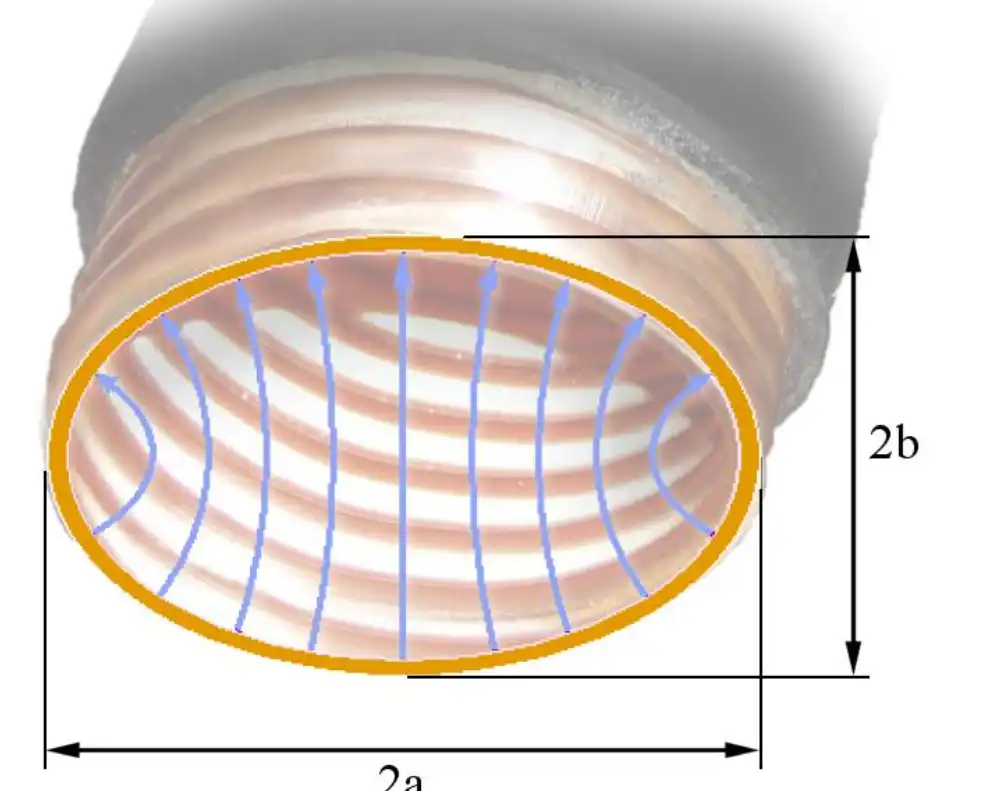
TE₁₁ is the primary mode in these devices. It operates from 3 to 40 GHz and can reach 110 GHz with specific configurations. Perforated copper tubes maintain resistance, allowing the structure to flex around things. The accordion-like flexibility can withstand thermal expansion and mechanical stress without impairing electrical performance. Outdoor tower locations with daily temperature changes of above 60°C will benefit greatly from this.
Mode Pattern Characteristics and Frequency Compatibility
First, calculate the cutoff frequency using major and minor axis measurements to establish the operational frequency range. As expected, oval forms block undesired higher-order modes better than circles with the same cross-sectional area. Broad applications where several frequency bands must function together without intermodulation confusion require mode purity. Satellite ground station engineers utilise this function to clear all C-, X-, and Ku-band emissions simultaneously.
Key Performance Advantages Over Traditional Solutions
Properly built elliptical waveguide units have attenuation values of less than 0.05 dB per metre at 10 GHz, far lower than large-diameter coaxial lines. Due to the lack of internal insulation, dampness does not affect signal loss. Humid coastal locations always have this issue. VSWR is always better than 1.15:1 across all working bands when the correct connection ports are utilised. These results result in longer communication lengths and fewer amplifiers in system design.
Elliptical Waveguide Design Considerations for Optimal Signal Performance
The quality of the signal in radio communication systems varies a lot on how well they are made and what materials are used. The end electrical and mechanical performance profile is affected by all the design parameters, from the corrugation pitch to the jacket composition.
Cross-Sectional Geometry and Dimensional Tolerances
Keep the main and minor axes within 0.1mm to ensure consistent impedance matching across the line. We create products using precision-drawn corrugated copper tubing. We manage corrugation depth and spacing with special instruments. Impedance variations that might reflect and impair VSWR are prevented by this regularity. Oval shapes protect cables better than circular designs with the same electrical performance when crushed. This helps install cables in tight cable boxes and ducts.
Material Selection and Surface Finish Quality
Copper is the typical wire material because it transmits electricity effectively and is flexible. The interior surface finish affects high-frequency skin effect losses. Our manufacturing process creates smooth corrugation slopes that prevent current flow congestion. Exterior black UV-resistant plastic jacket protects against weather, electricity, and wear. The jacket material has survived over 2,000 hours of strong UV exposure without splitting or altering colour. It's suitable for exterior telecom tower installations.
Strategies for Reducing Mode Coupling and Signal Distortion
Mode coupling occurs when geometry faults or abrupt bends allow energy to transfer from the dominant mode to undesirable modes. Bending in the E-plane (against the minor axis) allows narrower curves than in the H-plane. Field installation guidelines require a 150-mm E-plane turn radius and a 300-mm H-plane turn radius for most designs. Crossing these limitations creates persistent corrugation distortion and resistance alterations. Maintaining mode neutrality along the signal route requires proper cable placement, ample support space, and no sudden shifts.
Comparative Analysis: Rectangular vs. Circular vs. Elliptical Designs
Engineers look at several things when deciding what type of waveguide to use:
Loss Performance: Theoretically, rectangular waveguides have the lowest loss, but they need to be mounted rigidly. Our elliptical designs have loss rates that are within 20% of hard rectangular designs while still being fully flexible.
Bandwidth Capability: Elliptical waveguides can handle wider operating bandwidths than circular waveguides of the same size. This means that multi-band radio systems can use a single wire.
Installation Flexibility: Rectangular waveguides need to be perfectly aligned and have many flanged joints, each of which can cause leaks. These weaknesses are fixed by a single ongoing circular run.
Power Handling: At 18 GHz, a normal 1-5/8-inch elliptical waveguide can safely handle more than 10 kW of average power when it is properly compressed. This is more power than any coaxial wire in that frequency range can handle.
Microwave backhaul networks have made this technology the standard for connecting base stations to antennas because it has so many benefits over other technologies.
Real-World Performance in Satellite Ground Stations
These ideas are shown by a new structure at a C-band earth station. From the room with the high-power amplifier to the 9-meter parabolic dish, a 45-meter wire had to be run for the system to work. The placement got a total insertion loss of 0.15 dB and a VSWR of 1.12:1 across the 5.85–6.425 GHz uplink band using our custom-made elliptical waveguide with precision connections. The continuous run got rid of eight flange pairs that would have been needed with a rigid waveguide. Each pair would have added about 0.03 dB of loss and could have caused long-term maintenance problems. The sealed system has worked well for five years, even when exposed to high and low temperatures and salt air from the coast.
Procurement Insights: Choosing and Buying Elliptical Waveguides
To choose the right provider, you need to look at their professional skills, quality processes, and help infrastructure. Elliptical waveguides that are built often stay in use for decades, so choices about what to buy in this area have long-term effects.
Critical Supplier Qualifications and Certifications
Electrical performance uniformity depends on manufacturing precision. Advanced Microwave Technologies Co., Ltd. is ISO 9001:2008 certified, demonstrating its quality control throughout manufacturing. Vector Network Analysers in our labs test performance up to 110 GHz. We can thoroughly characterise each production lot. RoHS compliance ensures compliance with all worldwide markets for climate responsibility. Defence and aircraft users need these certifications to trace materials and follow prescribed quality standards.
Customization Capabilities for Specialized Requirements
Many purposes can be handled by basic store products, but complex systems require customised solutions. OEM services include custom length cuts, connection types, and corrugation patterns for frequency optimisation. A defence contractor requested a version with enhanced electromagnetic compatibility for RF-heavy locations. While maintaining flexibility, we added conductive layers to the jacket design. This provided 100 dB above 1 GHz protection. For this level of customisation, engineers and manufacturers must collaborate and be adaptable. Only experienced suppliers may give them.
Cost Analysis and Lead Time Considerations
The price of high-quality waveguide systems indicates their craftsmanship. Our products are cheaper than name-brand ones yet operate just as well electrically and mechanically. Standard setups normally arrive two weeks after the order. Engineering review and sample clearance might add four to six weeks, depending on plan complexity. Large orders save money due to economies of scale. We put up blanket orders with planned releases with buying teams to improve inventory management.
Logistics and Global Supply Chain Management
Our well-established supply chain ensures on-time delivery to North America, Europe, and the Asia-Pacific. We package to prevent breakage during delivery. For instance, we safeguard connections with rigid tubes and wind them carefully to avoid exceeding the bend radius. International shipments include customs documentation. Every order includes a technical data package with test findings, measurement certificates, and installation instructions. When commodities are introduced to larger systems that need official acceptance testing, this documentation is crucial.
Initiating Technical Inquiries and Sample Requests
The initial stage in buying is listing system demands, including frequency range, power levels, weather conditions, and mechanical constraints. Our technical team works with application engineering to meet these demands with the proper product settings. To ensure it works in your system, test a sample before ordering. We propose that users utilise their own tools for sweeping VSWR and insertion loss experiments to verify performance claims. Openness fosters trust and ensures project success.
Practical Usage: Installation, Maintenance, and Troubleshooting
If academic ability turns into real success, it depends on how well things are done in the field. Even the best goods won't work as well if they aren't installed correctly.
Step-by-Step Installation Guidelines
Careful planning is the first step to a successful installation. Plan the wire path before opening to find any possible problems and make sure the bend radius is correct. When running the wire, support the unit every 1.5 meters or so to keep it from falling too much and going past the minimum turn requirements. To prepare the curved tube for connector connection, you need to use certain tools to bend it and get rid of any internal burrs. We include curving tools that work with our junction kits and step-by-step instructions on how to use them. When flaring, the shift to the plug contact needs to be smooth. If flaring isn't done right, impedance discontinuities show up as VSWR loss.
Pressurization System Setup and Maintenance
Most setups use dry air or nitrogen pressurization at 3–7 PSI to keep moisture out and raise the voltage levels for failure. There is a pressure source, a control valve, a dehydration unit, and a tracking scale in the pressurization system. After the first pressurization, keep an eye on the pressure for 24 hours to make sure the seal is still good. A drop in pressure means there is a leak that needs to be fixed right away. As part of regular care, we suggest checking the pressure every three months. Monitoring pressure is especially important near the coast, where humidity and salt air speed up rusting if water gets inside the waveguide.
Routine Inspection and Cleaning Procedures
Every six months, the outside jacket should be inspected to see if it has any UV damage, physical damage, or a bad connecting seal. Use water and a light cleanser to clean the outside of things; stay away from agents based on petroleum, as they break down polyethylene. Connector surfaces need to be checked for rust or wear and tear. To stop galvanic rusting between metals that are not the same, we suggest putting on a thin layer of electrical contact grease during installation. When systems are properly compressed, they rarely need to be cleaned on the inside, but this may be necessary after pressure loss events. Cleaning the delicate, curved inner surface is done with special tools that keep it from getting damaged.
Troubleshooting Common Performance Issues
Signal decline shows up as a higher VSWR or more insertion loss. Systematic analysis helps find the issue:
- Sudden Performance Change: Indicates physical damage, a failed connection, or water getting in. Check for damage that can be seen, make sure the pressure is right, and use time-domain reflectometry to find breaks.
- Gradual Performance Degradation: This means that the connection is rusting or the jacket is breaking down. Check the connection ports for rust and think about replacing them to avoid problems.
- Temperature-Dependent Problems: This could mean that the system isn't ready for thermal growth. Make sure that the placement lets the wire move a little as it grows and shrinks.
Our technical support team can help with online testing and suggest ways to fix problems based on test results and pictures of the installation.
Advanced Performance Optimization Strategies
To get the most out of your system, you need to pay attention to things beyond the basics of settings.
Material Innovations and Manufacturing Refinements
New developments in the way copper alloys are made make them more resistant to stress during heat cycles. Our newest line of products uses oxygen-free copper with a controlled grain structure. This lowers the creation of microfractures that can happen after years of changing temperatures. Connector plating technology has changed from simple silver plating to multi-layer systems that combine areas that don't conduct electricity and prevent rusting. These changes make the service life longer in tough settings without affecting how well the electricity works.
Precision Engineering for Minimal Signal Degradation
Controlling the manufacturing process has a direct effect on the uniformity of electricity. We use statistical process control to keep an eye on the corrugation dimensions during production runs. If the data start to move toward tolerance limits, we instantly change the tools used. This proactive method stops the making of units that are just barely good enough to pass review but don't meet the requirements. Our 24-meter microwave lab lets us measure far-field antenna patterns that prove system-level performance with the elliptical waveguide installed. This shows that high-quality manufacturing leads to successful application.
Verification Procedures and Performance Metrics
Swept frequency VSWR measurements should be done across the whole operating band as part of acceptance testing. The resolution bandwidth should be 10 MHz or higher so that narrow impedance anomalies can be found. To get accurate results every time, measuring insertion loss needs precise reference standards and the right amount of connection force. To help customers with the acceptance process, we give them thorough test methods and performance areas that are expected. For things like phased array radar, where matching wire lengths to within a few hundredths of a degree is important, phase stability detection is very important. When asked, our production method can match wire lengths to within ±2° at 10 GHz.
Conclusion
The quality and design of the transmission line parts have a big impact on how well radio communication systems work. Elliptical waveguide technology strikes the best balance between electrical performance, mechanical freedom, and ease of placement for a wide range of uses, from military radar to satellite communications. To make the right choice, you need to know how physical form, material qualities, and production accuracy all work together. Advanced Microwave Technologies Co., Ltd has been working in this field for more than 20 years and has ISO-certified production methods and full testing powers up to 110 GHz. Because we care about tailoring, expert help, and quality control, we are a trusted partner for customers around the world who need high-quality microwave components.
FAQ
Q1: What advantages do elliptical waveguides offer compared to circular designs?
The oval cross-section is better for mode purity than circular shapes because it naturally blocks out unwanted higher-order modes better. This leads to less mode coupling and better signal transfer. The form also makes it harder to crush during installation, which keeps the curved structure safe when it has to go through small areas. The uneven shape helps with polarization control, which is why elliptical waveguides are better for uses that need to handle polarization precisely over a wide range of frequencies.
Q2: What lead times should we expect for custom orders?
Standard stock configurations usually ship 10 to 14 business days after the order is confirmed. Custom designs that need different sizes, special fittings, or a different frequency optimization go through engineering review and sample proof, which can take an extra 4 to 6 weeks, based on how complicated the design is. Orders in large quantities may be able to be rushed through the production process. We suggest getting in touch with our technical team as soon as possible so that project timelines are in line with manufacturing capabilities.
Q3: Can these waveguides support broadband frequency applications?
Of course. When compared to circular waveguides of the same size, elliptical waveguides can naturally handle bigger operating bandwidths. Most of the time, our designs cover whole transmission bands. For example, a single cable setup can cover the whole C-band (3.7–4.2 GHz downlink and 5.85–6.425 GHz uplink). X-band and Ku-band users can use systems with higher frequencies. The main restriction is making sure that the waveguide size and connection ports are correct for the entire frequency range that your application needs.
Partner with ADM for High-Performance Elliptical Waveguide Solutions
Advanced Microwave Technologies Co., Ltd is ready to help you with your next project by making waveguide systems that are carefully designed and built to high standards. Our circular, curved copper tube and UV-resistant black plastic jacket have been used successfully in satellite, defense, military, and telecommunications uses. Our expert team is here to help you every step of the way, from the initial proposal to installation advice, whether you need standard setups or solutions that are specially made to meet your electrical needs. We are an experienced elliptical waveguide maker that is certified by ISO 9001:2008 and follows RoHS rules. We offer low prices and quick response times. You can email our engineering team at craig@admicrowave.com to talk about your needs, get technical specs, or set up a free review. Let our 20 years of experience with microwaves and advanced testing tools improve the performance of your system.
References
1. Marcuvitz, Nathan. Waveguide Handbook. Institution of Engineering and Technology, 1986.
2. Pozar, David M. Microwave Engineering, 4th Edition. John Wiley & Sons, 2011.
3. Collin, Robert E. Foundations for Microwave Engineering, 2nd Edition. IEEE Press, 2001.
4. Balanis, Constantine A. Advanced Engineering Electromagnetics. John Wiley & Sons, 2012.
5. International Electrotechnical Commission. IEC 60153 Series: Hollow Metallic Waveguides. IEC Standards, 2016.
6. Clarricoats, P.J.B. and Olver, A.D. Corrugated Horns for Microwave Antennas. Peter Peregrinus Ltd., 1984.