




What is the difference between VFD and digital phase shifter?
Knowing the difference between a Vector Frequency Divider (VFD) and a digital phase shifter is very important when dealing with the complicated world of RF and microwave parts. A digital phase shifter is a precise part that changes the transmission phase angle of an RF signal by small amounts, which are managed by digital logic states. This gadget changes the phase of a signal without changing its frequency, which makes it essential for beamforming and phased array uses. On the other hand, a VFD divides frequencies while keeping vector information, which means that it keeps both amplitude and phase relationships while dividing. There are important roles for both parts in current RF systems, but they handle data processing in very different ways. The digital phase shifter works best for tasks that need exact phase control for beam steering, while VFDs work best for frequency synthesis and clock generation tasks that need to keep the signal's integrity during division.
Introduction
In today's competitive RF procurement market, choosing the appropriate specialised parts may make or break a system. Defence, satellite, and telecom OEM engineers and procurement managers are finding it tougher to identify parts that function well, endure long, and are affordable. VFDs and digital phase shifters are crucial to RF signal chains, yet they accomplish distinct things.
Not only a school task to comprehend these variances. Your decision impacts system design, performance variables including insertion loss and phase noise, and your product's competitiveness in 5G infrastructure, aviation radar, and satellite ground stations. The complex demands of modern phased array antennas, SATCOM on-the-go systems, and AESA radar require the correct phase adjustment and frequency control technology.
Sometimes buying teams have problems communicating with vendors when the primary distinctions between these elements are unclear. This article details these distinctions and provides scientific data and real-world examples to help you decide. This research shows you how to match technical requirements with operational demands when buying parts for a next-generation beamforming network or a frequency synthesis subsystem.
Understanding the Core Principles: VFD vs Digital Phase Shifter
Operating Principle of Digital Phase Shifters
A digital phase shifter that is managed digitally changes the phase of an RF signal by using delay lines that can be switched electrically. The device gets a digital control word, which usually comes through a TTL or CMOS logic link and turns on certain internal settings. In these setups, switching delay lines, high-pass/low-pass filter networks, or reflection-type designs with PIN diodes or FET switches could be used. There is predictable phase control because each binary state is matched to an exact phase shift increase.
The main benefit is that it can be used again and again. Digital phase shifters stay in stable phase states no matter the quality of the control signal, while analog voltage-controlled phase shifters can be affected by noise coupling and heat drift. When your phased array antenna has hundreds of elements, this digital control stops the calibration drift that would make the beam direction less accurate when temperatures change.
Operating Principle of Vector Frequency Dividers
VFDs do something technically unique: they split an input frequency while keeping the vector link between the in-phase (I) and quadrature (Q) signal components. In transmission systems where modulation information is stored in both amplitude and phase, this retention is very important. A regular frequency divider might give you output at half the input frequency, but a VFD keeps the phase relationship between the I and Q channels the same while it divides.
This ability is very important in frequency synthesis designs, especially for making local oscillator signals in superheterodyne receivers, where phase noise and spurious performance have a direct effect on how sensitive the receiver is. The VFD can keep the coherence of the vectors while they are being divided, which results in better spectral output compared to other divider topologies.
Key Functional Distinctions
What makes them different is what each part changes. Phase shifters change the timing delay, which is the amount of time it takes for a signal to travel through the device, but they don't change the frequency content. While trying to keep signal clarity and vector connections the same, VFDs change the frequency itself. These are two very different ways of processing signals that are used for different design purposes in RF systems.
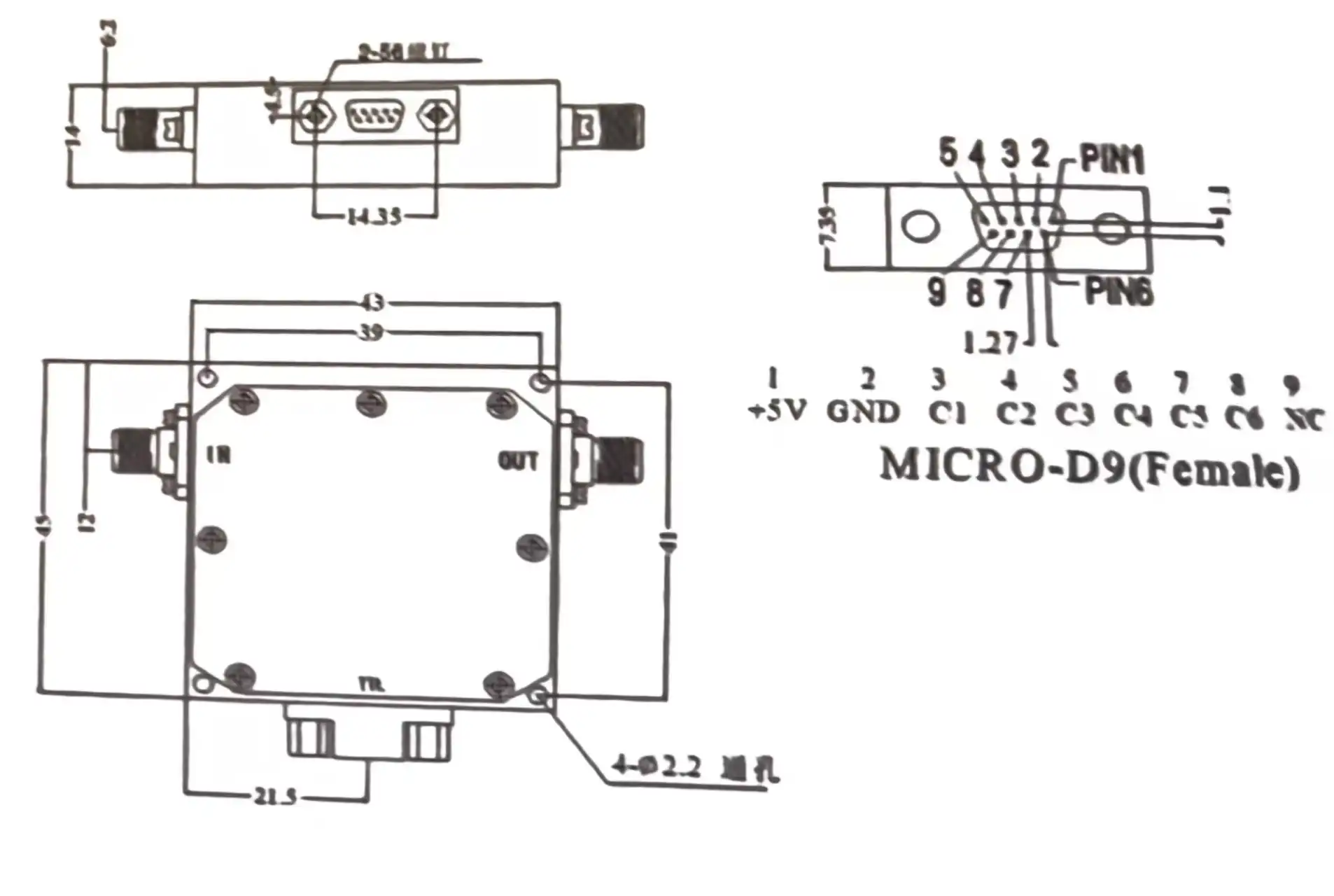
Technical Comparison: Digital Phase Shifter vs VFD
Phase Accuracy and Precision Metrics
Digital phase shifters are renowned for their bit accuracy, which shows the tiniest phase change possible. A 6-bit device's resolution is 5.625 degrees (360°/2^6), whereas an 8-bit machine can resolve 1.406 degrees. For excellent devices, the RMS phase error is between 2 and 5 degrees, indicating how well the real phase states match the theoretical values for all bit pairings and operating frequencies. We emphasise this criterion during seller assessment since phase errors among array elements immediately increase sidelobe levels in radiation patterns, which degrade communication and radar link signal-to-interference ratios.
However, VFDs are rated on how effectively they manage phase noise at off-center frequencies. For low-jitter clocks and clean local oscillators, a decent VFD may only boost the input signal's phase noise floor by 1-2 dB, maintaining its spectral purity. Satellite systems need this approach because phase noise sidebands raise the noise floor and lower carrier-to-noise ratios.
Insertion Loss and Signal Integrity
These systems exhibit insertion loss in various ways. Digital phase shifters demonstrate state-dependent loss variation, or attenuation change, when switching phase states. In all states, high-quality devices maintain insertion loss at ±0.5 dB. This eliminates amplitude modulation issues that need complex gain compensation circuitry. We evaluated devices in our ISO 9001:2015-certified labs at Advanced Microwave Technologies Co., Ltd., and discovered that insertion loss flatness affects system predictability.
Due to signal mixing and division, VFDs have 6–10 dB conversion loss. This loss is structure- and frequency-dependent. This loss is constant regardless of working conditions; it must be considered when establishing the system's link budget.
Frequency Range and Bandwidth Considerations
Modern digital phase shifters cover DC to millimeter-wave frequencies with generally accessible systems covering 0.5 to 40 GHz and specialised versions reaching 110 GHz. The frequency parameter indicates phase shift and insertion loss performance over the range. Wide instantaneous bandwidth units maintain phase homogeneity across several octaves for radar pulse compression and wideband transmission.
Certain frequency-generating activities benefit from VFDs' reduced fractional bandwidths. They are best for phase-coherently obtaining lower-frequency reference signals from higher-frequency sources. Multiple radar and MIMO communication systems require this.
Practical Applications and Use Cases
Digital Phase Shifters in Beamforming Networks
Active electronically scanned arrays are where digital phase shifters are most often used. Take a look at a normal AESA radar panel. It has 1,024 radiating elements, and each one is fed through its own phase changer. By changing the phase relationships across the opening, the system automatically moves the beam without moving any parts. This lets it track multiple targets at the same time and makes it harder to see.
We've helped defense companies put these systems together. The switching speed of the radar affects how quickly it can move beams between different azimuth and elevation angles. For solid-state devices, this speed is usually given in the 20-500 nanosecond range. Being able to connect directly to FPGAs through parallel digital connections lets the beam change in real time to changing danger environments in a matter of microseconds. Companies like MACOM and Analog Devices have made solutions that combine phase shifters, attenuators, and LNAs in a single unit. These solutions are smaller, lighter, and use less power.
Digital Phase Shifters in 5G Massive MIMO
Millimeter-wave beamforming is being used more and more in telecommunications systems to provide multi-gigabit speeds. Here, phase shifter arrays point narrow beams at specific user equipment, making the most of spectral efficiency in operations in crowded cities. Keeping phase synchronization across 64 or 128 antenna elements while quickly changing beam patterns as users move through service areas is hard from a technical point of view.
It's important that digital control can be used over and over again. If analog drift happened, the system would have to be constantly recalibrated, which would use up network resources and lower its useful capacity. Mini-Circuits and other companies sell integrated beamformer ICs that have digital control ports that are best for baseband integration and multiple phase shifter channels built in.
VFD Applications in Frequency Synthesis
Phase-locked loop designs need low-phase-noise local oscillators that are made from high-frequency reference sources. This is where VFDs come in handy. VFDs are often used in frequency synthesis chains at satellite ground stations to split reference frequencies while keeping the low phase noise that is needed for demodulating weak signals from geostationary satellites in an orderly way.
The vector retention feature makes sure that quadrature relationships stay the same when the signal is divided. This is very important for complex modulation schemes like 256-QAM, where the accuracy of the constellation directly affects the data rates that can be achieved and the performance of error vector magnitudes.
Procurement Considerations for B2B Clients
Critical Specifications to Evaluate
When buying teams, look for digital phase shifters; they should put a high priority on several important factors that go beyond the basic frequency range. For beam steering uses, the update rate is set by the switching speed. The P1dB compression point shows the most power that can be handled before nonlinear distortion shows up. This is especially important in send chains with a lot of RF power. Return loss (VSWR) affects how well impedance matching works in larger systems. Usually, standards call for better than 15 dB return loss across all working bands.
Details about phase precision should be carefully looked over. On some datasheets, the ideal or average numbers are given without any statistical limits. By demanding RMS phase error standards along with temperature factors, you can be sure that you know the worst-case performance in all operating conditions. MIL-STD-883 weather screening is often needed for military and aircraft uses. This checks the performance from -55°C to +85°C by temperature cycle.
Supplier Landscape and Sourcing Strategy
COTS firms like Mini-Circuits and Analogue Devices offer conventional items with short lead times. Specialised development companies can create application-specific designs. Large-scale telecommunications operations sometimes allow economies of scale to lower COTS prices. Defence and space programs typically demand custom solutions that meet form factors, power budgets, and environmental standards.
Early source involvement in planning is beneficial. When Advanced Microwave Technologies Co., Ltd. defines design, our engineering team works with buying partners to match component requirements to system demands. This strategy has saved firms a lot of money on redesigns when their first pieces fail integration testing. Our 24-meter microwave lab enables us to test entire antenna patterns, so we don't need component datasheets to verify phase changer performance in arrays.
Customization and OEM Capabilities
Standard stock parts seldom fulfil complicated RF system demands. Customisation might involve modifying control interfaces, replacing package kinds for heat management, or improving displays for dependable apps. We can alter phase shifters in waveguides for satellite ground stations and develop specific coaxial designs for airborne radar upgrades.
Knowing a source's production capacity is as crucial as their brochure. Can two-week samples be made for design accuracy testing? Does their manufacturing capacity meet your demand without causing wait times that disrupt your program schedules? Our ISO 14001:2015 environmental accreditation and ISO 45001:2018 workplace health standards demonstrate our commitment to sustainable, effective production that protects supply chain stability.
Future Trends and Innovation Outlook
Semiconductor Technology Advances
Digital phase shifter powers are changing as we move toward gallium nitride and silicon germanium technologies. GaN devices are better at handling and using power, which means that send arrays can work at kilowatt levels of power without having to use complicated cooling systems. SiGe CMOS integration lets single-die beamformer ICs with phase shifters, variable gain amplifiers, and control logic work together. This makes commercial 5G equipment much smaller and cheaper.
These new materials are making working frequencies higher. Phase shifters that can work at 110 GHz are opening up new uses in car radar, point-to-point backup lines, and trial systems for beyond-5G. We're keeping a close eye on these changes and keeping our testing tools up to 110 GHz in our labs so that we can help our companies adopt next-generation technologies.
Integration with Artificial Intelligence
New designs use machine learning in beamforming controllers to optimise phase state combinations depending on real-time channel performance. These systems learn the ideal beam patterns for interference sources, numerous pathways, and changing user groups instead of employing codebooks. This approach alters the phase shifter switching speed and regulates the link bandwidth.
Strategic Procurement Recommendations
Smart procurement methods require suppliers with technical expertise and production flexibility in a changing market. Check how much a supplier spends on R&D and enquire if their approach aligns with your long-term platform ambitions. Can they accommodate additional frequency bands when standards bodies distribute spectrum? Are they testing speed verification tools for you?
Identifying vendors that can provide comprehensive technical assistance, from design tool training models to production ramp integration, reduces program risk. We've invested much in application development to support clients throughout the product lifecycle, not only when parts are delivered.
Conclusion
The difference between VFDs and digital phase shifters comes from the fact that they play very different roles in RF designs. For beamforming and array systems that need precise, repeated control of signal phase, digital phase shifters are the best choice. They offer the security and integration benefits of digital control. VFDs are used for frequency synthesis when keeping the purity of the vectors during division is important for keeping the signal quality high in coherent radar systems and communication terminals.
To be successful at procurement, you need to understand these functional differences and match the skills of components to the needs of the system as a whole. Specifications like phase precision, insertion loss variation, switching speed, and phase noise all tell you something about performance, but the best way to choose is to do a full review in the context of your particular application.
FAQ
Q1: What determines whether my application needs a digital phase shifter or a VFD?
The answer depends on whether you're changing the frequency or the phase. Digital phase shifters are required to control phase connections between array elements in beamforming networks, phased array antennas, and systems that need beam steering. VFDs are often used to get lower frequencies while keeping the spectral purity and vector relationships in frequency creation, clock generation, and local oscillator distribution.
Q2: How do I verify component quality before committing to volume orders?
Ask for full S-parameter readings across the whole working temperature range, not just the usual numbers at room temperature. Ask for readings of phase accuracy across all bit states for phase shifters or plots of phase noise for VFDs. This information comes from standardized test tools that can be traced back to national guidelines from reputable sources. Make sure that the external screening meets your needs for reliability. Testing for reliability in aircraft applications is much stricter than testing for reliability in business infrastructure.
Q3: Can digital phase shifters handle the amount of power in my send chain?
How power is handled changes a lot between methods. Most of the time, MEMS-based designs can handle more power than solid-state FET or PIN diode designs. Always compare the P1dB compression standard to the maximum power your system needs, making sure to include a safety cushion for transients. For transmit uses, it's common to need special designs or extra safety circuits.
Partner with ADM for Precision Phase Control Solutions
Advanced Microwave Technologies Co., Ltd has been developing, making, and providing high-reliability RF components for mission-critical uses for more than 20 years. We offer a wide range of unique digital phase shifter kits, waveguide networks, and full feed systems that are made to your exact specs. We help buying teams at defense companies, satellite operators, and telecommunications OEMs all over North America and the world. Our products are certified by ISO 9001:2015, comply with RoHS, and can measure up to 110 GHz.
Our combined manufacturing and R&D skills mean that we can help you quickly, whether you need samples to test your idea or large quantities of products delivered on time. Our engineering team gives you in-depth technical advice and helps you find the best digital phase shifter supplier for your program needs by guiding you through tricky specification trade-offs. Contact craig@admicrowave.com today to discuss your phase control needs and to see our full line of products, which have been used for decades in business, military, and aerospace satellite communications.
References
1. Bahl, I. J. (2009). Fundamentals of RF and Microwave Transistor Amplifiers. Hoboken: John Wiley & Sons.
2. Pozar, D. M. (2011). Microwave Engineering (4th ed.). New York: John Wiley & Sons.
3. Mailloux, R. J. (2005). Phased Array Antenna Handbook (2nd ed.). Boston: Artech House.
4. Skolnik, M. I. (2008). Radar Handbook (3rd ed.). New York: McGraw-Hill Education.
5. Rohde, U. L., & Poddar, A. K. (2012). Microwave and Wireless Synthesizers: Theory and Design. Hoboken: John Wiley & Sons.
6. Hansen, R. C. (2009). Phased Array Antennas (2nd ed.). Hoboken: John Wiley & Sons.