




What are the benefits of using a low-phase-noise amplifier?
As an example, low-phase-noise amplifiers are a type of RF component that is intended to keep signal integrity and reduce time jitter while amplification is happening. The spectrum clarity of these devices is very high, and their phase noise is usually better than -165 dBc/Hz at a 10 kHz shift. At this level of performance, they are essential for mission-critical uses in satellite communications, radar systems, and high-precision test tools, where the quality of the signal directly affects the success of operations.
Introduction
Signal quality has a direct effect on performance, dependability, and data accuracy in today's high-frequency security and communication systems. Low-phase-noise amplifiers (LPNAs) have become important parts that keep the spectral purity of radio frequency data while providing the required gain. These specialized devices are different from regular amplifiers because they focus on keeping time accurate and lowering noise. These are important factors in complex applications like phased array radar and quantum computing control systems.
At Advanced Microwave Technologies Co., Ltd., we've seen buying teams have a hard time choosing the right amplification options. It can be hard to figure out the small technical differences between LPNAs and other low-noise amplifiers or high-gain blocks. We've been working with defense companies, satellite system developers, and research institutions for 20 years, and we've learned that understanding the basic benefits these parts offer is the first step in making smart buying decisions.
This detailed guide talks about how LPNAs improve system performance, where they provide the most benefit, and what purchasing professionals should look for when locating these precise parts. Our goal is to give buying managers and tech teams useful information that will help them make better decisions about systems and build stronger relationships with vendors.
Understanding Low-Phase-Noise Amplifiers
Design Philosophy and Core Architecture
The circuit design and choice of components in a low-phase-noise amplifier make it significantly different from general-purpose RF amplifiers. Flicker noise, also called 1/f noise, is kept to a minimum in these devices by using advanced transistor technologies, mainly Heterojunction Bipolar Transistors in Silicon Germanium or Gallium Arsenide processes. This design goal makes sure that the amplifier doesn't mess up the time of the carrier signal too much, so phase relationships stay the same even when the frequency shift from the carrier gets close.
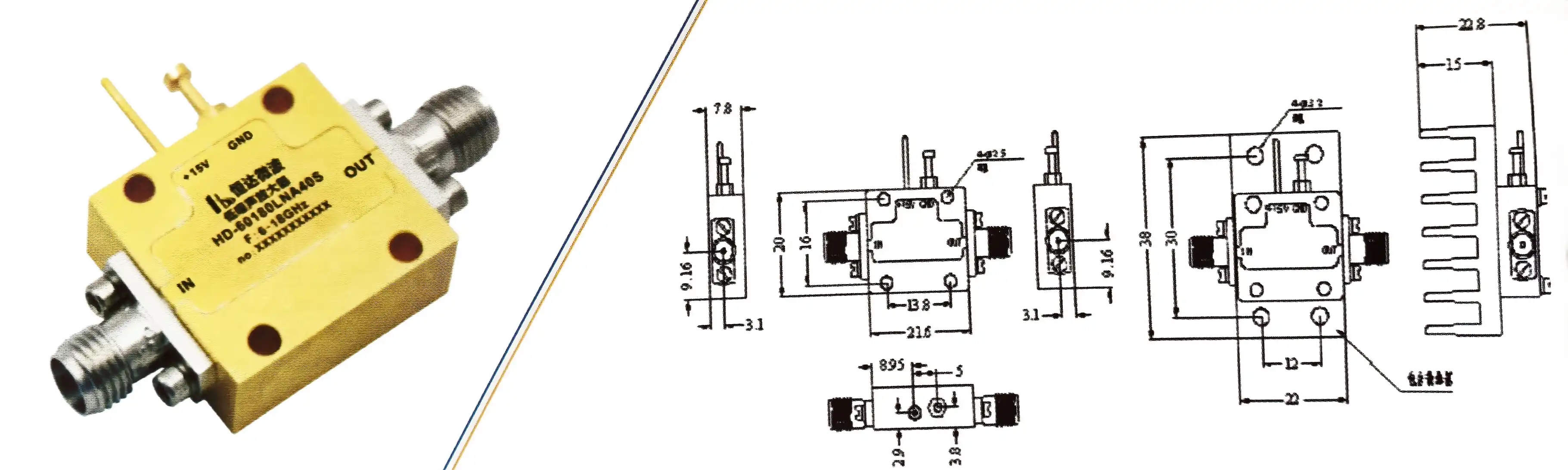
Technical Differentiation from Standard Amplifiers
Noise figure, which measures the addition of thermal noise across a frequency band, is what standard amps try to get the best. LPNAs, on the other hand, only work on phase noise, which is the time instability that shows up as spectrum spreading around the carrier frequency. This difference is very important in situations where the system's ability depends on things like Doppler precision, signal array accuracy, or frequency stability. Most low-phase-noise amplifiers keep 1/f corner frequencies in the low kilohertz range. This makes sure that the system works well where it means the most.
Application Domains and Performance Impact
These amplifiers are used in frequency generators, local oscillator distribution networks, and reference clock chains in the defense and aerospace industries. They are needed to keep Error Vector Magnitude standards for high-frequency communications like millimeter-wave backhaul and satellite transponders. Stability is important for precision instruments like spectrum scanners and atomic clocks. There is a clear link between phase noise and measurement accuracy, sensing range, or data flow in all of these situations. This means that choosing the right amplifier is a system-level performance choice.
Key Benefits of Using a Low-Phase-Noise Amplifier
Enhanced Signal-to-Noise Ratio and System Sensitivity
Low-phase-noise amplifiers keep the carrier purity while they boost the signal, which makes the signal-to-noise ratio better. In radar uses, this means that targets can be picked out more easily from background noise. This makes it possible to find low-cross-section items like robotic aerial vehicles or stealth platforms. Satellite ground stations gain from wider link gaps, which let them work even when the weather is bad or when their radio openings are small. The improvement in efficiency comes from keeping unwanted spectral components below key limits, which increases the amount of signal energy that can be used.
Compatibility with Advanced Modulation Schemes
High-order modulation is used in modern phone standards, like 1024-QAM in 5G backhaul, where cluster points are close together in signal space. When there is too much phase noise, these cluster points move around, which raises the number of bit errors and forces the speed to drop. LPNAs let you get the most out of the spectrum economy by keeping the phase stable. As networks move toward 6G technologies that work in millimeter-wave bands, where phase noise problems get worse with frequency, this feature becomes even more useful.
Simplified System Design and Cost Efficiency
Better phase noise performance at the amplifier step means that less signal filtering is needed further down the line. Engineers can get rid of extra filtering steps, make local oscillator distribution networks easier to use, and loosen the rules on some other chain parts. This design simplification has real benefits: fewer parts mean less complexity in production, higher dependability because there are fewer places where things can go wrong, and lower power use. Over the lifetime of a product, these benefits save a lot of money and make it easier to keep.
Operational Reliability in Mission-Critical Environments
For defense and aircraft uses, parts need to work the same way even when they are exposed to high or low temperatures, vibrations, and long periods of use. Good LPNAs made for these areas have strong heat control, airtight packing, and strict screening processes. At ADM, our test labs make sure that performance is stable from -40°C to +85°C, so that it doesn't matter what the launch conditions are. This dependability is very important in systems where fixing things in the field is not possible, and the task's success rests on how well the parts work.
Comparison Insights: Low Phase Noise Amplifier vs Other Amplifier Types
Performance Parameter Trade-offs
When choosing an enhancement method, you have to weigh a lot of different factors. High-gain amps make the most power available, but they usually suffer from worse noise performance. Standard low-noise amps improve noise figure, which includes thermal noise, but they don't focus on phase noise. Low-distortion amplifiers focus on linearity, which is measured by third-order intercept points and is important for multi-carrier uses, but not the same as phase stability. Low-phase-noise amplifiers are used in a specific situation where time accuracy and spectral clarity are more important than other factors.
Application-Specific Selection Criteria
Buying choices are based on knowing which type of booster is best for a given task. Most of the time, standard LNAs that boost sensitivity work best for receiver front ends. Blocks with high gain and good uniformity are often needed in transmitter chains. Local oscillator lines, frequency reference distribution, and test instrument signal sources, on the other hand, need the phase noise performance that only LPNAs can provide. By understanding this application mapping, you can avoid overspecifying (and overpaying for) features that aren't needed, while also making sure that important paths get the right parts.
Vendor Landscape and Product Selection
There are options on the market from well-known companies like Analog Devices, Texas Instruments, and Mini-Circuits. Each has its own benefits. Some sellers focus on wideband coverage, while others work with very high or very low frequency bands or make custom designs. When purchasing, teams look at different sources; they should not only look at the specs on the data sheets, but also at how reliable the deliveries are, how much expert help they offer, and how much they can customize the products. ADM's work with defense and satellite systems has taught us that the quality of the vendor partnership is often more important than the specs of the parts.
Procurement Considerations and Best Practices
Defining Technical Requirements Accurately
For sourcing to work, the application needs must be clearly defined. In addition to basic factors like frequency range and gain, buyers should be clear about how much phase noise they need at certain offset frequencies. 10 kHz and 100 kHz are typical examples of these. The options are limited by things like the amount of power they can use, their size, and environmental requirements (like MIL-STD-883 compliance). We suggest making application-specific requirement papers that possible sellers can look at and compare their product lines to.
Evaluating Supply Chain Reliability
Availability of parts can make or break project plans. During recent global supply problems, companies with a wide range of suppliers were able to keep producing while others had to wait. Buyers should look at how vendors handle supplies, how long they promise to deliver, and how they handle allocation gaps. At ADM, our supply chain includes many different sources of parts, which lets us stick to delivery dates even when the market is unstable. This toughness is especially useful in security projects that last more than one year and have big fines for missing deadlines.
Datasheet Interpretation and Validation
Specifications for phase noise need to be read carefully. Some datasheets show average performance instead of specified limits, which makes it hard to tell which parts are qualified. The measurement frequency, reference resistance, working temperature, and input level all have an effect on the numbers that are made public. Instead of depending only on curves on a chart, we tell buying teams to ask for test results from real production lots. At ADM, we can measure up to 110 GHz, which lets us check the claims of vendors on our own and make sure that the parts we give meet the needs of the low-phase-noise amplifier application.
Best Practices for Implementing Low-Phase-Noise Amplifiers in RF Systems
PCB Layout and Grounding Strategies
Realized low-phase-noise amplifier performance is greatly affected by how it is implemented physically. When there isn't enough grounding, current loops form that bring noise from digital parts into sensitive RF routes. If the power source bypassing isn't good enough, ripple can change the bias points, which changes changes in amplitude into changes in phase through AM-to-PM processes. Our engineers suggest using separate ground planes, star-point grounding to spread the power, and many bypass capacitors with various values to handle a wide range of frequencies. Even though these techniques make creation more difficult, they are necessary to reach the performance levels shown in the datasheet.
Power Supply Management and Filtering
Power source changes can't hurt phase noise because the amplifier bias circuits are fed by ultra-low noise linear controllers. We have measured cases where the phase noise floor was raised by 10 dB or more because the power source filtering wasn't good enough, which canceled out all the benefits of high-end amps. We select controllers with noise levels below 1 microvolt and add extra LC filters for important uses. Investing in good power control parts pays off in the form of better system performance.
Validation Testing and Acceptance Criteria
To check phase noise performance, you need special measuring tools, usually cross-correlation signal source analyzers that cancel out source noise to separate the amplifier's input. It is important to test components at the right offset frequencies, at different temperatures, and at real working drive levels to make sure they meet the needs of the application. At ADM, our labs use methods for measuring leftover phase noise that give us sensitivity below -180 dBc/Hz. This means that even the best market components can be used. Customers can be sure that the parts they buy will work as expected because they can measure them.
Conclusion
In situations where data time and spectral clarity decide how well a system works, low-phase-noise amplifiers are very helpful. These specialized parts solve problems that regular amplifiers can't, like making radar detection ranges longer and letting higher-order modulation methods work in modern telecommunications. In addition to better technical performance, the benefits include easier system designs, fewer parts, and higher operating stability in tough settings.
To do a good job of buying, you need to know the technical differences between amplifier types, be clear about what you need them for, and work with sellers who can provide both quality products and reliable delivery. To get the performance benefits these parts offer, implementation needs careful attention to plan details, power source design, and thorough validation testing.
FAQ
Q1: What phase noise performance distinguishes quality low-phase-noise amplifiers?
Most high-end LPNAs can get additive phase noise below -165 dBc/Hz at 10 kHz offset and below -175 dBc/Hz at 100 kHz offset. These specs show how much noise the amplifier adds to the signal coming in. They are calculated using methods that get rid of source contributions to leftover phase noise. For uses that need very pure spectral lines, the 1/f corner frequency (where flicker noise meets thermal noise) should be low in the kilohertz range for a quality low-phase-noise amplifier.
Q2: Can low-phase-noise amplifiers improve existing system performance without redesign?
Adding better amplifiers to local oscillator chains or reference distribution networks can often make radar precision, transmission bit error rates, or measurement accuracy better in a way that can be seen. But to get the most out of them, you might need to pay attention to the quality of the power source, how you ground them, and how the PCB is laid out. We suggest that you do performance modeling before you buy to make sure that the changes to the amplifiers fix real system problems and not just slowdowns in other parts of the signal chain.
Q3: How do environmental factors affect amplifier phase noise?
Temperature changes can change the way transistors work by moving bias points and junction capacitances. Even though good LPNAs use adjustment methods to keep temperature coefficients as low as possible, there will still be some performance difference. When parts aren't properly attached, vibration can cause microphonic effects that change mechanical energy into phase modulation. Hermetic packing and strong mechanical design are no longer nice-to-haves for aircraft and defense uses; they are required requirements.
Elevate Your RF Systems with ADM's Low Phase Noise Amplifier Solutions
Advanced Microwave Technologies Co., Ltd has been making precise RF parts for more than 20 years and can help you with your most difficult projects. Our engineering team focuses on making unique low-phase-noise amplifier systems that work best for high-frequency equipment, security, and satellite communications. We guarantee quality with ISO 9001:2015 approval and thorough testing in our 110 GHz labs, whether you need off-the-shelf parts or plans made just for your purpose.
As a reliable manufacturer, we can do more than just sell products. We can also provide full expert help. With our 24m Microwave Darkroom and advanced measurement systems, we help with developing specifications, guiding design integration, and performing validation testing. Our global shipping network makes sure that orders are delivered on time, and our flexible manufacturing can handle both small batches for prototypes and large production runs. Get in touch with craig@admicrowave.com right away to talk about how our boosting options can improve the performance of your system and shorten the time it takes to complete your job.
References
1. Pozar, David M. "Microwave Engineering, Fourth Edition." John Wiley & Sons, 2011.
2. Rohde, Ulrich L. and Poddar, Ajay K. "Low Phase Noise Microwave Oscillator Design: Fundamentals and Best Practices." IEEE Microwave Magazine, 2005.
3. Defense Advanced Research Projects Agency. "Phase Noise Requirements in Modern Radar and Communication Systems." Technical Report DARPA-RF-2019.
4. International Telecommunication Union. "Characteristics of Radio-Frequency Components for Satellite Earth Stations." ITU-R SM Series Recommendations, 2020.
5. Rubiola, Enrico. "Phase Noise and Frequency Stability in Oscillators." Cambridge University Press, 2008.
6. IEEE Microwave Theory and Techniques Society. "Standards for Phase Noise Measurement in RF and Microwave Components." IEEE MTT-S Technical Committee Publications, 2018.
_1733809032116.webp)