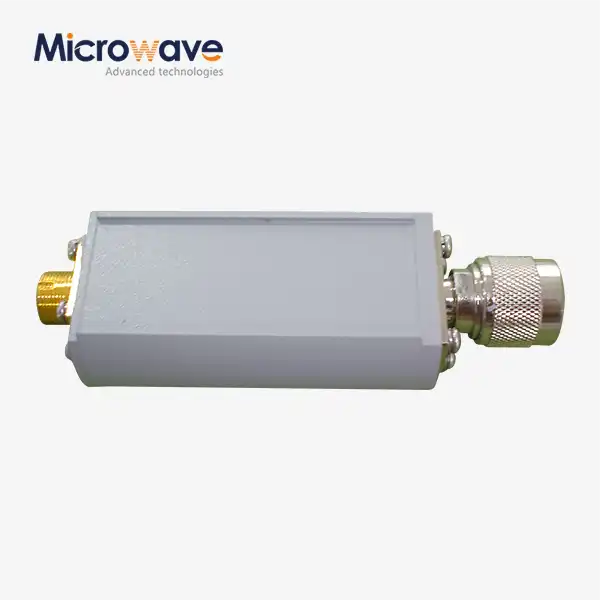





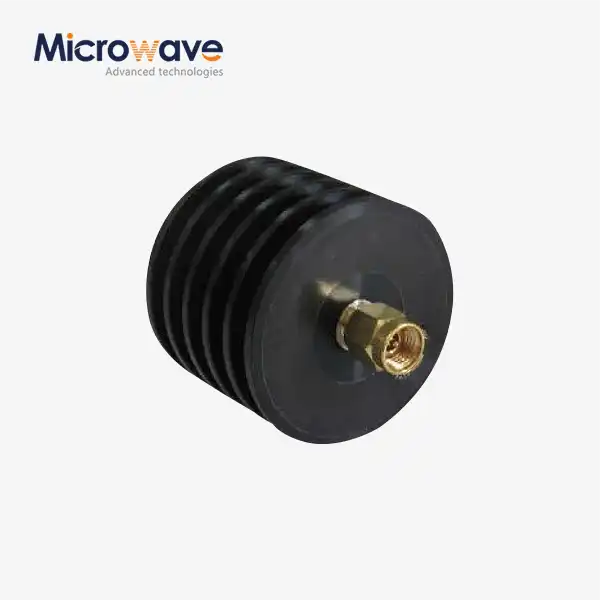
Coaxial Fixed Attenuator
Coaxial Fixed Attenuator for RF & Microwave Systems
Advanced Microwave Technologies Co., Ltd. (ADM) creates and offers Coaxial Fixed Attenuator items for tough RF and microwave settings. There is a fixed dB number for each unit, which ranges from DC to 110 GHz and keeps the characteristic impedance at 50 or 75 Ohms. Most of the time, VSWR is less than 1.2:1, and the accuracy of the attenuation is within ±0.5 dB. These passive parts keep sensitive test instruments safe, help match impedances, and make sure that signals stay stable in aerospace, telecom, and measurement systems.
What Is a Coaxial Fixed Attenuator?
A product is a precise passive part that lowers the amplitude of an RF signal by a set, steady amount, which is measured in decibels (dB). It does this without changing the data waveform or adding phase distortion.
The gadget has a resistive network inside a coaxial transmission line. The network can be set up as a T-pad or a Pi-pad. This network gets rid of extra RF energy as heat, which reduces signals in a clean and controlled way with little reflection.
It can be used to fix signal saturation, impedance mismatch, and receiver safety in a lot of different RF systems because it has a characteristic impedance of 50 Ohm or 75 Ohm.

Key Technical Specifications
Parameter | Specification |
Frequency Range | DC to 18 GHz / 40 GHz / up to 110 GHz |
Characteristic Impedance | 50 Ohms or 75 Ohms |
Attenuation Accuracy | ±0.5 dB |
VSWR | ≤ 1.2:1 |
Power Handling | 1 W (SMA / 2.92 mm) to 1000 W (N-type / 7-16 DIN with heatsink) |
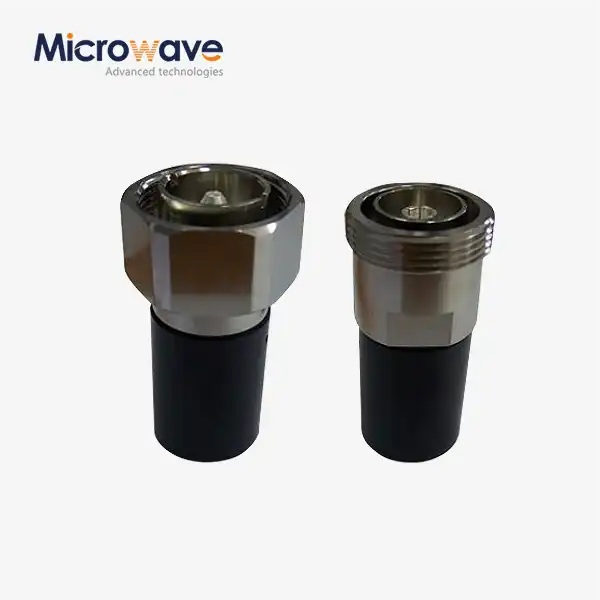
Connector Types | SMA, 2.92 mm, N-type, 7-16 DIN |
Operating Temperature | −55°C to +125°C |
Connector Mating Cycles | 500–1000 cycles (precision connectors) |
Resistive Element Technology | Thin-Film (precision / high frequency) or Thick-Film (high power) |
Substrate Material | Aluminum Nitride (AlN) or Beryllium Oxide (BeO) |
Body Material | Passivated Stainless Steel |
Standards Compliance | MIL-DTL-3933 |
Material and Construction
The main part of the Coaxial Fixed Attenuator is made from passivated stainless steel, which doesn't rust even after many joining cycles in the field. Depending on the type of connector, it is rated to last between 500 and 1000 cycles.
Either Thin-Film or Thick-Film technology is used to make the internal resistive elements. For high-frequency and precise uses, thin film is the best choice. Thick film can handle the higher heat loads that come with high-power setups.
Aluminium Nitride (AlN) and Beryllium Oxide (BeO) substrates are chosen because they are good at transferring heat, which is very important for high-power action that never stops.
Frequency Range and Power Handling
The accuracy of measurements is directly affected by attenuation that stays the same over a wide frequency range. Attenuators from ADM are available from DC to millimetre waves and up to 110 GHz, so they can be used for both older communication systems and test applications that need higher frequencies.
Power handling depends on how the connectors are set up. About 1 W can be sent through SMA and 2.92 mm precision connections, which works with lab equipment and test benches. You can use up to 1000 W with N-type and 7-16 DIN types that have convection heatsinks. These can handle the power needs of base stations and high-power RF infrastructure.
ADM can measure from 0.5 GHz to 110 GHz in-house, and they have a 24-meter Microwave Darkroom set up for both near-field and far-field testing.
Application Scenarios
Test & Measurement Laboratories
In R&D and calibration settings, attenuators connect straight to oscilloscopes, spectrum analysers, and vector network analysers (VNAs). They lower the amount of high-level signals coming from the devices being tested, which keeps front-end parts from getting too busy. They also cut down on source match errors, which makes S-parameter measurements more accurate in situations where signal flatness and phase linearity are very important.
Telecommunications Infrastructure
Signal levelling between high-power amplifiers and downstream parts of cellular base stations and distributed antenna systems (DAS) makes sure that the system stays within its intended dynamic range. In RF environments with a lot of elements, where level control is needed at several points in the signal chain, fixed attenuators are a common passive part.
Aerospace and Defense
For airborne radar and satellite transmission systems to work, the attenuators need to be able to handle changes in temperature from −55°C to +125°C, as well as changes in altitude and mechanical vibration. When these conditions are met, stable attenuation helps keep link budget estimates consistent in operational settings.
Why Work With ADM?
ADM has been designing and selling microwave parts for more than 20 years, and their Coaxial Fixed Attenuator products are just one example. The main office of the company is in Xi'an, and it also has branches in Chengdu, Beijing, Tianjin, and Shijiazhuang. The main office also has an R&D lab on-site.
The 24-meter Microwave Darkroom can test antennas and parts from 0.5 GHz to 110 GHz using both near-field and far-field techniques. You can use this testing infrastructure to help with custom development and production verification.
Engineers at ADM work directly with customers to set the frequency bands, attenuation values, connector types, and power ratings that meet the needs of each system. There are custom configurations that can be made; call ADM to talk about your needs.
FAQ
Q: How does temperature change the way attenuation works?
A: As the working temperature rises, the resistance values of the parts inside change. Attenuators made for professionals have a set Temperature Coefficient of Attenuation (TCA) specification. Power derating above the baseline operating temperature is a standard way to keep efficiency at a certain level.
Q: What's the difference between peak power and average power?
A: The unit can handle a continuous wave (CW) load of average power before it breaks down from heat. Peak power is the highest level of short-term pulse loads—usually in the microsecond range—that the unit can handle without breaking down the dielectric. Depending on the type of signal and duty cycle, both ratings are useful.
Q: Why does VSWR matter when selecting an attenuator?
A: A high VSWR causes signal reflections that mess up measurements and could put stress on the signal source. If the VSWR is 1.2:1 or less, reflections are low enough to be useful for precise RF work. This is especially important when the attenuator is put right in front of a receiver or measurement port that is sensitive.
Q: Can a 50 Ohm attenuator be used in a 75 Ohm system?
A: No, mixing impedances leads to impedance mismatch, which causes signal echoes and changes insertion loss. The attenuator needs to match the impedance of your system, or an impedance-matching pad needs to be used between the parts.
Q: What changes the service life of a connector?
A: Precision connectors are designed to connect and disconnect 500 to 1000 times. Over-torquing during fitting is the most common reason for early wear. This can damage the center pin or deform the dielectric. For precision connector types, it is best to use a torque wrench that has been calibrated.
Q: What types of connectors and attenuation settings are there?
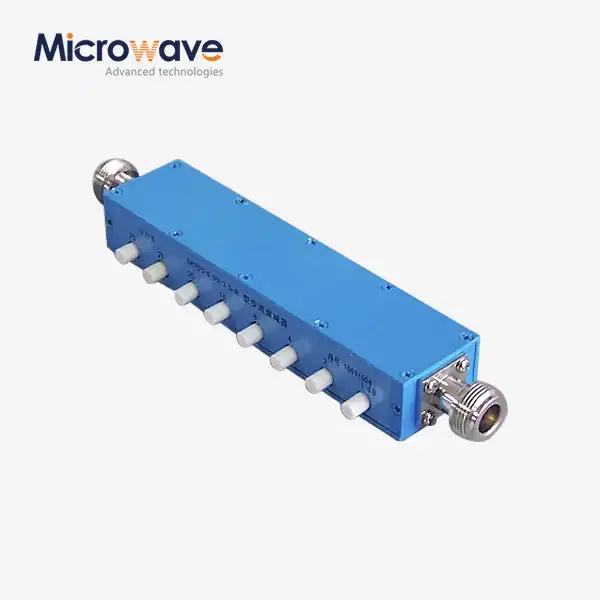
A: ADM offers different set attenuation values and connector types, such as SMA, 2.92 mm, N-type, and 7-16 DIN. Get in touch with ADM directly to make sure they can meet your frequency range, power level, and resistance needs.
_1733738410152.webp)