




Waveguide Cable Selection Guide for Microwave Engineers
When it comes to microwave transmission systems, the cost-effectiveness of the project, how well the system works, and how well the data stay together depend on the waveguide wire that is chosen. An arrangement of waveguide cables is a flexible and effective way for electromagnetic waves to move. That way, engineers can keep low insertion loss and good power handling from 0.5 GHz to 110 GHz. The best way to solve integration problems in radar, satellite ground stations, and 5G infrastructure is with flexible parts instead of hard waveguide plumbing or lossy cables. This is because alignment error, mechanical movement, and exposure to the environment need parts to be both reliable and accurate.
Understanding Waveguide Cables: Fundamentals & Types
Waveguide cables work by keeping electromagnetic energy inside a hollow metal frame. They send messages in controlled TE or TM modes instead of the TEM mode that most coaxial transmission lines use. Because of this basic difference, these systems can keep signals more intact, especially at millimeter-wave frequencies where coaxial lines can't work because they lose too much power or data.
Rectangular, Circular, and Ridged Configurations
Because their cutoff frequencies are easy to predict and they are easy to make, rectangular waveguides are still the standard for most microwave uses. The WR numbering system, like WR-90 for X-band (8.2–12.4 GHz) or WR-28 for Ka-band (26.5–40 GHz), sets exact internal measurements that determine the working frequency. When you need to be able to change the polarization, like with dual-polarized satellite feeds, circular waveguides are a good choice because they are rotationally symmetric. Ridged versions have metal grooves inside to lower the cutoff frequency. This lets them work over a wider range of frequencies while having a smaller cross-section.
Waveguide Pipes Versus Flexible Assemblies
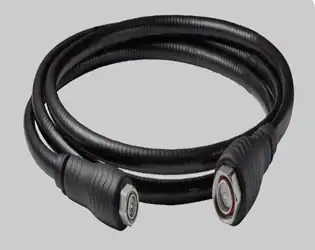
Rigid waveguide pipes have the lowest insertion loss and can handle the most power, but they are not mechanically flexible. Flexible assemblies fill in this gap by having an overlapping, complex core made of copper or brass that is silver-plated. This core allows the assembly to bend in both the E-plane and H-plane directions while keeping the electrical continuity. Twistable designs let you turn them, which is important for connecting gimbaled radar antennas or multi-axis tracking systems. Because of this, there is a small amount of insertion loss, which is usually less than 0.5 dB per meter based on the frequency and bend radius.
Performance Advantages Over Coaxial and Twisted Pair Cables
When working at frequencies above 18 GHz, coaxial lines lose power, and loss rates rise exponentially. At 40 GHz, a waveguide system usually has a tenth of the insertion loss of high-grade coaxial cable and can handle power levels of more than 1 kilowatt for continuous waves. Since there is no middle wire, there are no dielectric losses or heat hotspots, which are problems with coaxial systems. Since twisted pair wires can't handle microwave frequencies, waveguides are the only real choice for millimeter-wave uses like tracking radar targets, satellite transfer chains, and wireless backup links.
Industrial Applications Driving Demand
In defense systems, phased array radars use waveguide units to connect tens of thousands of transmit/receive modules to antenna elements. Target precision is directly affected by how stable the phase is during mechanical scans. Satellite earth stations use Ka-band assemblies to send strong signals from traveling wave tube amplifiers to parabolic reflector feeds. These assemblies can work in temperatures ranging from -40°C to +70°C outside. As 5G millimeter-wave infrastructure is put in place, there is a need for small, weatherproof systems that connect radio heads that are far away to antenna clusters on cell towers and roofs.
How to Choose the Best Waveguide Cable for Your Project (Decision Support Approach)?
Selecting an appropriate assembly begins with defining operational parameters and system constraints that shape technical requirements.
Defining Use Cases and Frequency Requirements
Standardized bands tell waveguide cable waveguide size what operating frequency it needs to be. WR-75 assemblies are usually used for a Ku-band satellite terminal that works at 14 GHz, while WR-28 assemblies are needed for a Ka-band ground station that works at 30 GHz. The chosen waveguide needs to be able to handle the frequency that is wanted, with enough room above and below its cutoff frequency to stop modal dispersion and higher-order mode transmission, respectively. For multi-octave uses, ridged forms or various units that cover different sub-bands may be needed.
Environmental Conditions and Power Capacity
For outdoor uses, you need coats that are weather-sealed and rated to IP65 or higher. These jackets are usually made of neoprene or rubber and have pressure adjustment features to keep wetness out. For marine and aerial uses, military standards like MIL-DTL-3922 describe how to resist shock, shaking, and salt fog. Peak and average power handling must be able to handle the output levels of the transmission while still allowing for enough derating for heat management. This is especially important in continuous wave radar or jammer systems where duty cycles are close to 100%.
Essential Technical Metrics
Insertion loss, which is usually between 0.2 dB/m at X-band and 1.5 dB/m at W-band, is still the best way to measure performance. VSWR, or return loss, measures how well two impedances fit. For the working band, specs below 1.25:1 make sure that there isn't too much mirrored power that could hurt emitters or lower receiver sensitivity. In phased arrays and vector network analyzer measures, phase stability during flexure is very important. Premium parts keep phase variation within ±2 degrees throughout the bend radius they are designed for. To make sure the RF seal stays strong and high power levels don't cause arcing, flange interface standards like UG, CPR, or CPRG labels must match the hardware that's already in the system.
Waveguide Versus Fiber Optic and Coaxial Alternatives
Fiber optics are great for sending data over long distances, but they need to be converted from radio frequency to optical signals, which adds delay and complexity that makes them unsuitable for analog radar or real-time spectrum monitoring. Coaxial lines have a wider frequency and a smaller size, but they aren't useful above 26 GHz because they lose signal and cost a lot. Waveguide systems work best for short to medium runs, usually less than 10 meters, where their bigger size and higher unit cost are justified by their low loss and high power handling.
Customized and Scalable Solutions for OEMs
System developers and original equipment manufacturers (OEMs) often need non-standard designs, such as systems with different types of flanges, special jacket materials for vacuum chambers, or pressure windows built in for cases that are completely sealed. Our engineering team at Advanced Microwave Technologies Co., Ltd. works with clients to make sure that the systems they create meet all of their exact mechanical and electrical needs. Optimized tools and efficient quality control help with volume production, which lowers the cost per unit for orders over 50 parts while still allowing prototypes of single units to be made within two weeks.
Installation & Maintenance Best Practices for Waveguide Cables
Proper handling during installation and scheduled maintenance directly influence long-term reliability and measurement accuracy.
Pre-Installation Preparation and Alignment
Before connecting an assembly, inspect flange faces for scratches, burrs, or corrosion that compromise RF sealing. Use a precision straightedge to verify planarity within 0.025 mm across the flange surface. Clean mating surfaces with isopropyl alcohol and lint-free wipes to remove particulates that could cause leakage or voltage breakdown. Position assemblies to respect minimum bend radius specifications—typically 10 to 15 times the waveguide width—and avoid twisting non-twistable designs beyond their rated angular limits.
Mounting and Connection Techniques
Secure flanges using precision alignment pins and torque fasteners to manufacturer specifications, typically 40 to 60 inch-pounds depending on flange size. Over-tightening distorts flange faces, while under-tightening permits RF leakage detectable as elevated VSWR. For outdoor installations, apply corrosion-resistant compounds to threads and use stainless steel hardware. Route assemblies to avoid sharp bends, mechanical stress from wind loading, or contact with hot surfaces such as power amplifiers.
Common Pitfalls and Avoidance Strategies
Exceeding minimum bend radius permanently deforms the convoluted core, causing impedance discontinuities visible as VSWR spikes in vector network analyzer sweeps. Misalignment between rigid waveguide sections and flexible assemblies of waveguide cable generates modal conversion losses and increases return loss. Outdoor assemblies lacking pressure equalization vents accumulate condensation inside the waveguide, degrading electrical performance and accelerating corrosion. Always specify pressurization options for systems exposed to thermal cycling or humidity.
Maintenance Protocols and Troubleshooting
Establish quarterly inspection schedules for critical systems, checking flange connections for loosening due to vibration and examining jacket integrity for cracks or UV degradation. Perform full-band VSWR measurements annually using a calibrated vector network analyzer, comparing results against baseline acceptance data to detect gradual performance drift. Unexplained insertion loss increases often indicate moisture ingress; pressurize the assembly with dry nitrogen to 5 psi and monitor pressure decay over 24 hours to identify leaks. Phase stability degradation under flexure suggests internal core damage requiring assembly replacement.
Procurement Insights: Buying Waveguide Cables for B2B Clients
Sourcing high-reliability assemblies demands careful evaluation of supplier capabilities, product certifications, and total cost of ownership.
Verifying Supplier Credibility and Product Certification
Leading manufacturers maintain ISO 9001 quality management systems and environmental compliance under ISO 14001 and RoHS directives. Request certification documentation, including material traceability reports, insertion loss test plots across the full frequency band, and flange dimensional inspection records. Suppliers with in-house measurement capabilities—such as our 24-meter microwave darkroom supporting antenna measurements from 0.5 to 110 GHz—can provide validated performance data rather than relying on third-party test houses.
Cost Considerations and Budget Planning
Waveguide assembly pricing varies from $200 per meter for standard X-band designs to over $1,500 per meter for custom Ka-band configurations with exotic materials. Bulk orders typically qualify for 15–30% discounts when quantities exceed 25 units. Total cost of ownership includes installation labor, which can match or exceed hardware costs for complex phased array installations requiring hundreds of phase-matched assemblies. Faster delivery options—such as our expedited prototyping service providing samples within 10 business days—carry premium charges but accelerate project timelines and reduce idle equipment costs.
Delivery Logistics and Custom Order Options
International shipments of precision microwave components require careful packaging to prevent mechanical damage during transit. Our supply chain team coordinates FedEx and DHL priority shipping for time-critical projects, with typical lead times of 4–6 weeks for standard configurations and 8–10 weeks for custom designs involving new tooling. Custom assemblies can integrate features such as non-standard flange rotations, extended flex sections, or embedded temperature sensors for thermal monitoring. Integrated cable assemblies combining waveguide cable, waveguide sections with coaxial transitions or rotary joints simplify system integration and reduce assembly errors at customer facilities.
Conclusion
Selecting and deploying waveguide assemblies requires balancing electrical performance, mechanical constraints, environmental resilience, and procurement considerations. By understanding operational frequency requirements, insertion loss budgets, and installation environments, engineers can specify assemblies that optimize system reliability while controlling project costs. Proper installation techniques and proactive maintenance schedules extend service life and preserve measurement accuracy across the decades-long operational lifetimes typical of defence and satellite communication infrastructure. Partnering with experienced suppliers offering customization capabilities, validated testing, and responsive technical support streamlines procurement and accelerates time-to-deployment for mission-critical microwave systems.
FAQ
1. What frequency ranges do waveguide assemblies typically support?
Standard rectangular waveguides cover discrete bands from 0.5 GHz (WR-2300) through 110 GHz (WR-10), with each size optimized for approximately 1.5:1 bandwidth. Custom ridged designs extend usable bandwidth to 2:1 or beyond, accommodating multi-band applications within a single assembly.
2. How much signal loss advantage do waveguides offer compared to coaxial cables?
At 40 GHz, a flexible waveguide assembly exhibits roughly 0.8 dB/m insertion loss compared to 8–12 dB/m for premium coaxial cables. This tenfold reduction in attenuation translates to dramatically improved link budgets and power efficiency in millimeter-wave systems.
3. Can waveguide assemblies be customized for specialized industrial applications?
Manufacturers routinely develop custom solutions incorporating non-standard flange interfaces, vacuum-compatible materials with low outgassing rates, integrated pressure windows, or specialized jacket compounds for chemical resistance. Prototyping services validate designs before committing to production tooling, minimizing risk for unique requirements.
Partner with ADM for Your Waveguide Cable Needs
Advanced Microwave Technologies Co., Ltd brings over two decades of expertise as a trusted waveguide cable manufacturer, delivering precision-engineered assemblies that meet the demanding requirements of defense, aerospace, and satellite communication sectors. Our ISO 9001-certified production facilities and RoHS-compliant processes ensure every assembly undergoes rigorous testing in our 24-meter microwave darkroom, providing validated performance data from 0.5 to 110 GHz. Whether you need standard configurations with rapid turnaround or fully customized OEM solutions tailored to unique mechanical and electrical specifications, our engineering team collaborates closely to optimize designs for reliability and cost-efficiency. Contact craig@admicrowave.com to discuss your project requirements, request technical datasheets, or obtain volume pricing for bulk waveguide cable assemblies. We deliver the quality, flexibility, and support that keep your microwave systems performing at peak levels.
References
1. Pozar, David M. Microwave Engineering, 4th Edition. Hoboken: John Wiley & Sons, 2012.
2. Harvey, A. F. Microwave Engineering Handbook, Volume 1: Microwave Components. London: Institution of Engineering and Technology, 1992.
3. Saad, Theodore S. Microwave Engineers' Handbook, Volume Two. Dedham: Artech House, 1971.
4. Marcuvitz, Nathan. Waveguide Handbook. London: Peter Peregrinus Ltd., 1986.
5. Clarricoats, P. J. B., and A. D. Olver. Corrugated Horns for Microwave Antennas. London: Institution of Engineering and Technology, 1984.
6. Balanis, Constantine A. Advanced Engineering Electromagnetics, 2nd Edition. Hoboken: John Wiley & Sons, 2012.