




How Does a Planar Spiral Antenna Achieve Wideband Performance?
A planar spiral antenna achieves wideband performance through its frequency-independent geometry. Whether Archimedean or equiangular in form, the spiral structure radiates from an "active region" whose physical location shifts along the arms as frequency changes. This means the antenna maintains consistent impedance, gain, and radiation characteristics across an extremely wide bandwidth — often spanning ratios of 10:1 or greater. The inherent circular polarization, self-complementary layout, and flat dielectric substrate combine to deliver stable, multi-octave RF performance that resonant antenna types simply cannot replicate.
Understanding the Fundamentals of Planar Spiral Antenna Design
The Geometry Behind Frequency Independence
There are two main types of spiral shapes: the Archimedean spiral, in which the distance between the arms stays the same, and the equiangular (logarithmic) spiral, in which the angle between the arms stays the same with respect to any radial line. One important thing that both geometries have in common is that the active radiation region grows as the wavelength does. The active zone gets smaller toward the feed center as the working frequency goes up, and it gets bigger toward the edge as the frequency goes down. This self-scaling behavior gets rid of the bandwidth limits that make resonant designs hard to use.
Polarization and Radiation Pattern Stability
There is circular polarization (CP) because of the spiral's rotational symmetry. Depending on whether the antenna is wound clockwise or counterclockwise, it will produce circular polarization on the right or left hand. The radiation pattern stays the same across the operating band: it's a wide, hemispherical beam with a half-power beamwidth that is usually between 70° and 90°. This wide-angle coverage is very useful in aerospace and satellite applications where the platform's orientation with respect to the signal source changes all the time.
Key Factors Contributing to Wideband Performance
Several well-thought-out tech decisions work together to keep performance stable across multiple octave ranges. Knowing about these things helps procurement engineers decide if a design really meets the needs of the mission.

Here are the main technological tools that you should look at:
- Substrate dielectric selection: Rogers or Taconic laminates, which are low-loss and dimensionally stable, keep the signal's integrity at high frequencies. Because the dielectric constant affects phase velocity along the spiral arms directly, it is necessary to have very tight material limits that meet IPC-6012 Class 3 standards for defense-grade uses.
- Integrated wideband balun: The planar spiral antenna makes a balanced transmission line, while most RF systems use coaxial feeds that aren't balanced. The radiation pattern doesn't change as a narrow microstrip or "infinite balun" moves between the two. When a balun isn't designed well, it can cause pattern squint and lower the purity of circular polarization, especially above 18 GHz.
- Cavity backing with RAM: When you use cavity backing with RAM, an unbacked Planar Spiral Antenna spreads out evenly from both faces. For a one-way system integration, a hole lined with radar-absorbent material (RAM) blocks rear radiation, making the front-to-back ratio better while the antenna keeps the VSWR low across the band.
The material quality, the balun architecture, and the cavity treatment are the three design choices that determine whether the antenna delivers its intended bandwidth in real-world deployment situations. Any shortcuts taken on any of them lead to measurable performance drops that aren't always clear from datasheets until after the integration tests are done.
Comparative Analysis: Why Planar Spiral Antennas Excel Against Other Designs
A lot of the time, procurement engineers compare Planar Spiral Antennas to patterns like microstrip patch, helix, and log-periodic dipole array (LPDA). There are real trade-offs between each option that can be measured.
Microstrip patch antennas are small and cheap, but they don't have a bandwidth that goes above 5% without complex matched networks. Log-periodic designs have wider bandwidths, usually 10:1, but they are heavier and more complicated to integrate, which makes them incompatible with platforms that are limited by space and weight. Helical antennas have good axial-mode gain and circular polarization, but they take up a lot of space, which means they can't be used for conformal or flush-mount setups.
The Planar Spiral Antenna is at a different performance level. Its 10:1 to 30:1 bandwidth ratio, flat profile, and circular polarization make it the best choice for wideband signal intelligence systems, electronic warfare receivers, and satellite uplink/downlink terminals. When a defense OEM adds a radar warning device to an airframe, switching from multiple narrowband antennas to a single spiral aperture cuts down on weight and failure points.
Practical Applications and Case Studies in B2B Markets
Aerospace and Defense Deployment
Wideband Planar Spiral Antennas pick up enemy radar signals across many octaves without the need for mechanical steering. They are used in electronic warfare and radar warning receiver (RWR) systems. These antennas work reliably from -55°C to +85°C and can handle high-G maneuver loads. They are used as a core sensing aperture on fixed-wing aircraft, rotorcraft, and UAV platforms.
Satellite and Telecommunications Infrastructure
For their telemetry and command links, CubeSat and LEO satellite projects often choose Planar Spiral Antennas. The flat shape fits into normal ISIPOD deployment envelopes, and the circular polarization makes up for the Faraday rotation caused by the ionosphere, which weakens links that are linearly polarized during orbital passes. Wideband Planar Spiral Antenna feeds are also used by ground station managers in reflector systems where a single feed needs to cover more than one frequency reservation at the same time.
R&D and Ground Penetrating Radar
Ground-penetrating radar (GPR) systems use ultra-wideband planar spiral antennas. These antennas are used by research institutions and civil engineering firms. The antenna's time-domain pulse fidelity—minimal noise and clean impulse response—directly translates into depth resolution, which lets utilities and structural holes be found to within centimeters.
Procurement Guide for Planar Spiral Antennas: Finding the Right Supplier
To find a good wideband Planar Spiral Antenna supplier, you need to look deeper than the stated specs. Four verification checkpoints protect the honesty of procurement:
- VSWR and return loss sweep: A vector network analyzer must sweep across the whole working band and confirm VSWR < 2.0:1. High-end units must meet < 1.5:1 as well.
- Axial ratio measurement: Testing with a rotating source in a soundproof room confirms the uniformity of circular polarization. An axial ratio that stays below 3 dB across the band shows real CP performance instead of weak elliptical polarization.
- Etch precision and AOI documentation: Deviations in Planar Spiral Antenna trace geometry on the micron level hurt high-frequency performance at frequencies above 18 GHz. Any order for defense should come with automated eye inspection records.
- Environmental compliance records: MIL-STD-810 test reports for vibration, thermal shock, and rain/icing show that performance in the field matches what was measured in the lab.
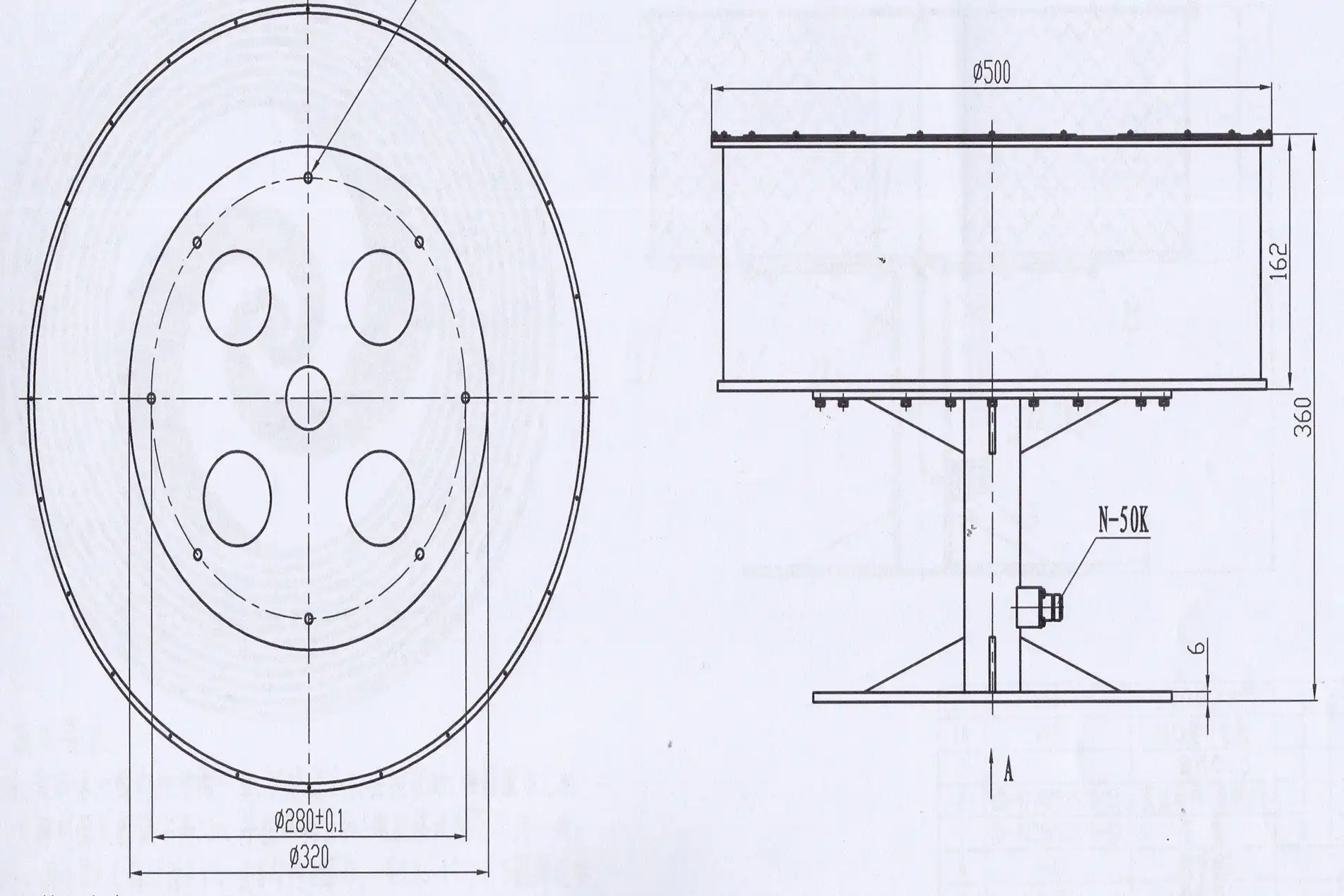
The Planar Spiral Antenna from ADM works from 1 GHz to 40 GHz and has a 50-ohm impedance, circular polarization, gain from 3 dBi to 8 dBi, and low VSWR across the whole range. Size and material can be changed, and an easy-mount kit can be built in. It is made in a way that is compliant with ISO 9001:2015 and RoHS, and system installers can get full OEM paperwork.
Conclusion
Wideband success in a planar spiral antenna is not a coincidence; it comes from careful material choice, exact geometry, and well-thought-out feed design all working together. Understanding these processes turns procurement from meeting requirements into a technically sound choice for business-to-business buyers in defense, aerospace, satellite communications, and research. With more than 20 years of experience making microwaves and a 24-meter anechoic darkroom that can measure up to 110 GHz, ADM's Planar Spiral Antenna platform gives engineering teams the verification depth and customization freedom that mission-critical programs need.
FAQ
What limits the lowest operating frequency of a spiral antenna?
The minimum frequency for low frequencies is set by the Planar Spiral Antenna's outer width. At the target frequency, the antenna starts to radiate well when the outer circumference gets close to one wavelength. By making the outer circle bigger, the cutoff frequency goes down, but the antenna takes up more space.
Can this antenna type handle high-power transmission?
These antennas are mostly designed to receive signals or send signals with little power. The balun's thermal limits and the small trace lengths near the inner feed point make it hard to handle a lot of power. For high-power microwave applications, you need special high-temperature substrates and unique balun designs.
How does weather exposure affect performance?
When water or ice builds up on the Planar Spiral Antenna tracks, it changes the local effective dielectric constant, which changes the resistance and lowers the axial ratio. In systems that are used in the field, this degradation can be stopped by using a hydrophobic radome or a low-loss potting material that has been tested to meet MIL-STD-810 rain and snow standards.
What customization options does ADM offer?
ADM lets you choose your own frequency bands, substrate materials, connection types, and physical sizes. For both OEM and mass production orders, we offer full integration support, prototype quick-turn services, and global supply chain management.
Source Your Wideband Antenna Solution from ADM
You can trust ADM to make and supply high-quality planar spiral antennas. They have been making them precisely for microwaves for over 20 years, are ISO 9001:2015 certified, and follow RoHS rules. Our engineering team is ready to help you with your project from the prototype stage all the way through production, whether you need a standard 1–40 GHz configuration or a fully customized OEM-ready design. You can email craig@admicrowave.com right now to ask for a datasheet or start a purchase question.
References
1. Rumsey, V. H. — Frequency Independent Antennas, Academic Press, 1966.
2. Balanis, C. A. — Antenna Theory: Analysis and Design, Wiley-Interscience, 2005.
3. Stutzman, W. L., & Thiele, G. A. — Antenna Theory and Design, John Wiley & Sons, 2012.
4. IEEE Transactions on Antennas and Propagation — Wideband Spiral Antenna Design and Performance Characterization, IEEE, 2018.
5. Pozar, D. M. — Microwave Engineering, John Wiley & Sons, 2011.
6. Milligan, T. A. — Modern Antenna Design, IEEE Press / Wiley-Interscience, 2005.