




Everything you need to know about Horn Antenna
Microwave horn antennas are one of the most effective and flexible ways to communicate over high frequencies. These very directed devices work in the 1–100 GHz range and have a curved waveguide structure that moves electromagnetic energy from waveguide modes that are confined to free space. Horn antennas have high gain, low standing wave ratios (VSWR), and consistent radiation patterns compared to wide or patch antennas. Different types of horns, like pyramidal, conical, and curved ones, are used for different tasks, such as satellite ground stations, aircraft radar, and antenna measurement calibration. Their strong metal structure, usually made of aluminum or copper alloys, makes them last in harsh settings and keep the integrity of precision signals for use in defense, telecommunications, and industrial research.
What Is a Microwave Horn Antenna and How Does It Work?
When buying, teams know about the basic form and workings of microwave horn antennas, and they can choose parts that meet the strict needs of the project. We at Advanced Microwave Technologies Co., Ltd. have been helping people understand the technical side of these important gadgets for over twenty years.
Structural Design and Wave Propagation
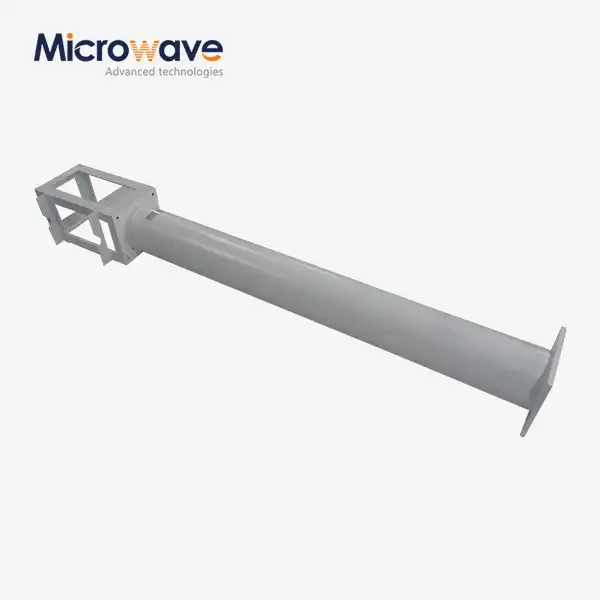
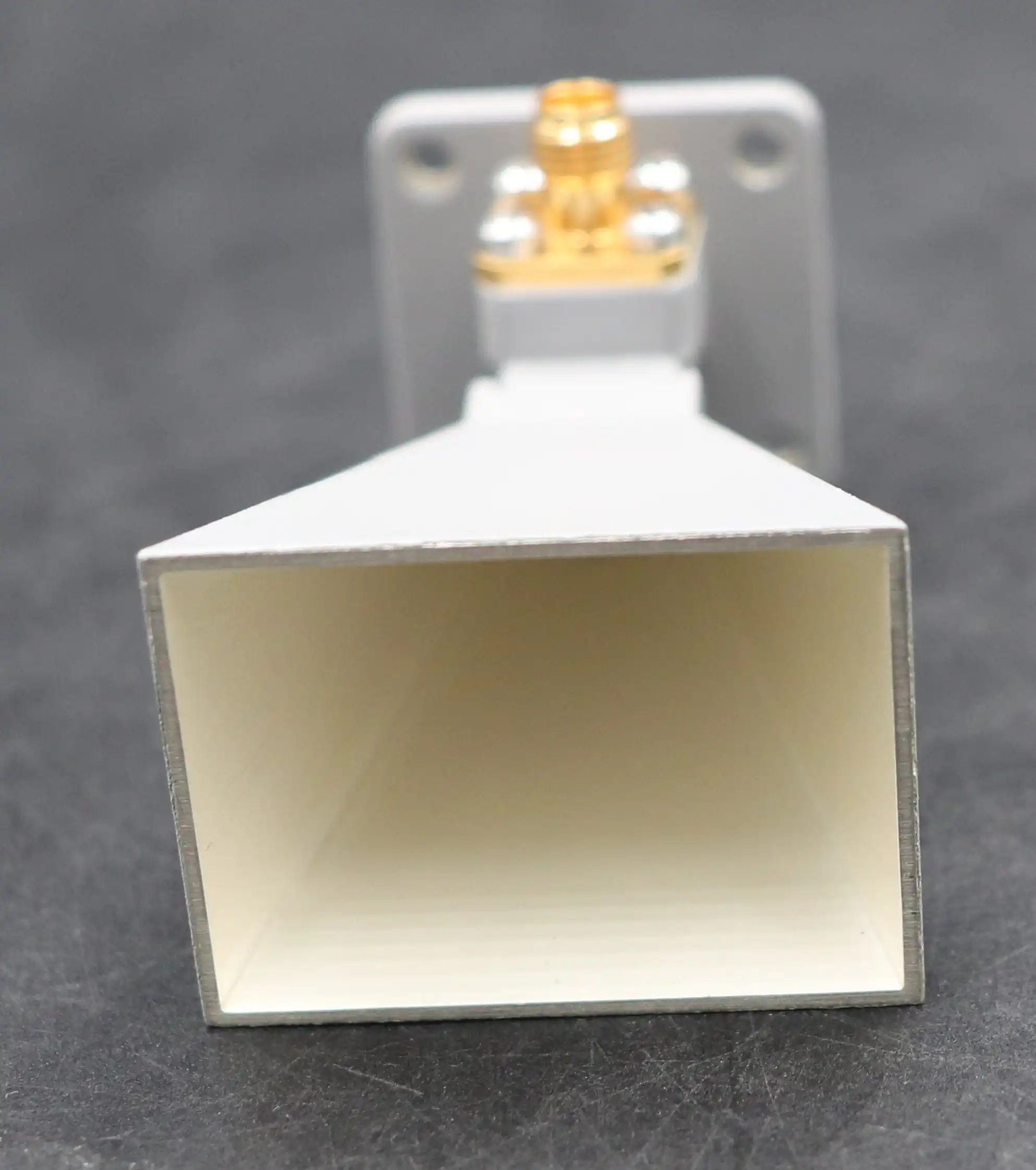
Horn antennas move energy from waveguides that are square or round into empty space through an opening that gets bigger over time. These flared shape changes lead electromagnetic waves into radiated plane waves, which reduces echoes and increases power transfer. Key performance measures, such as gain, beamwidth, and impedance matching, are based on the flare angle, opening measurements, and throat size. High-quality metals, like copper that doesn't contain oxygen or aluminum alloy 6061-T6, are very good at conducting electricity and staying stable. Precision machining on the waveguide feed makes sure that there is low insertion loss and stable phase characteristics across the working bandwidth. It links directly to RF sources or receivers.
Impedance Matching and Radiation Characteristics
To get a low VSWR, usually less than 1.5:1, the waveguide feed and the horn opening must be properly matched in terms of their resistance. The smooth taper reduces the number of breaks that cause signal echoes, which makes energy coupling more effective. Depending on the wavelength, the radiation pattern changes with the size of the aperture. Larger apertures make beamwidths smaller and directivity greater. The waveguide mode and any built-in polarizers determine the type of polarization, which can be linear or circular. At ADM, our engineering team uses high-tech modeling tools and our 24-meter Microwave Darkroom to check near-field and far-field patterns and make sure they meet client requirements across frequencies from 0.5 GHz to 110 GHz.
Operating Frequency Range and Gain
Horn antennas work \ well from L-band (1–2 GHz) to W-band (75–110 GHz), with designs that are designed for bandwidth and gain in each frequency range. Standard gain horns have gain values that can be predicted and calculated for microwave horn antennas. Their gain ranges from 10 to 25 dBi, based on diameter and frequency. This makes them essential as calibration standards in antenna test ranges. Wideband double-ridged horns increase the frequency range, working from 1 to 18 GHz or 18 to 40 GHz in small sizes. This adaptability makes it useful for a wide range of uses, from old-fashioned phone systems to advanced millimeter-wave 5G backup, radar imaging, and EMC testing rooms.
Types and Applications of Microwave Horn Antennas
By choosing the right type of microwave horn antenna, performance traits can be aligned with mission-critical needs. Each version has its own benefits that are best for certain beamwidths, polarization needs, and weather conditions.
Pyramidal Horn Antennas
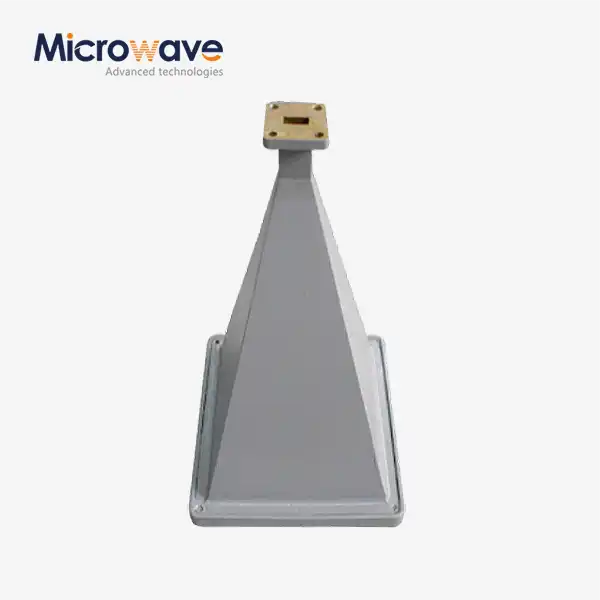
Square waveguides feed pyramidal horns that flare in both the E-plane and the H-plane. This setup gives modest to high gain and good sidelobe suppression, which makes them perfect for measuring radar cross-section (RCS) and setting up point-to-point communication lines. Pyramidal horns are used in X-band (8–12 GHz) and Ku-band (12–18 GHz) systems by defense companies to keep an eye on things from the air and track targets on the ground. When you cut an aperture that is rectangular, you get elliptical beam patterns. These can be tweaked to cover particular areas in satellite earth stations and wireless backup networks.
Conical Horn Antennas
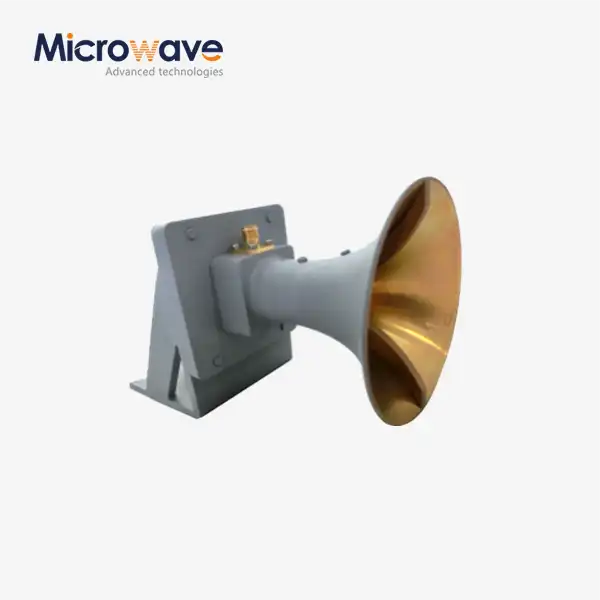
The circular waveguide feeds and radially symmetric openings in conical horns make uniform radiation patterns that are perfect for circular polarization uses. In satellite communication systems, these antennas are the main feeds for parabolic reflector dishes. Axial symmetry makes sure that the antennas work well and provide good lighting. The smooth-wall conical form is both cheap and strong, making it ideal for harsh outdoor settings like those found in marine and aircraft sites. At ADM, we make cylindrical horns with weather-resistant finishes and precision-machined flanges that meet ISO 9001:2015 quality standards and RoHS requirements for use around the world.
Corrugated Horn Antennas
Corrugated horns have grooves that are spaced out evenly along the inside walls, which helps the hybrid HE11 mode move. It has balanced E-plane and H-plane beamwidths, very low cross-polarization (better than -30 dB), and better impedance matching across wide bandwidths thanks to its improved design. For high-throughput systems (HTS) and Deep Space Network (DSN) mirrors, where signal integrity is very important, satellite owners prefer corrugated feeds. Radio astronomy and studies of the cosmic microwave background use curved horns in their work. Tight tolerances are needed to make corrugated structures. Our CNC machining and in-house measuring lab make sure that the dimensions are accurate to within microns, which is proven by careful pattern measures done in our noise-free facility.
Sectoral and Specialized Variants
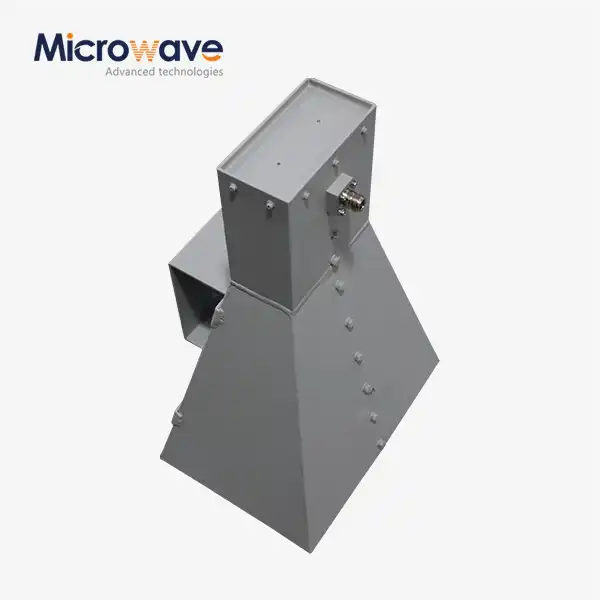
Sectoral horns only flare in one plane, either the E-plane or the H-plane. They make fan-shaped beams that can be used in base station antennas and groups for finding your way. Double-ridged horns have ridges inside them that lower the cutoff frequency and increase the bandwidth. This lets a single antenna cover a range from 1 to 40 GHz. New methods of additive manufacturing, like metal 3D printing, make it easier to make quick prototypes of complicated shapes for specific millimeter-wave uses. ADM helps original equipment manufacturers (OEMs) make unique horn profiles with built-in radomes, coaxial-to-waveguide transitions, Microwave horn antennas, and multi-port feeds for connecting phased arrays.
Real-World Applications Across Industries
In the defense, military, telecommunications, and industrial sectors, horn antennas power devices that are needed to do their jobs. Radar systems need horn feeds to illuminate targets and pick up echoes. This is true for air traffic control on the ground, shipboard guidance, and UAV monitoring. Large reflector dishes are fed by horn antennas at satellite ground stations. This allows for high-gain upload and downlink at C-band, Ku-band, and Ka-band frequencies. Horn antennas are used in point-to-point microwave backhaul lines in telecommunications facilities. These links provide multi-gigabit data rates in both urban and remote areas. EMC test labs use standard gain horns to create measured electromagnetic fields for testing protection and emissions, making sure they follow FCC, CE, and MIL-STD rules.
How to Choose the Right Microwave Horn Antenna for Your Business Needs
Making choices about what to buy depends on how well the technical requirements match up with the practical needs and the supplier's ability to provide a microwave horn antenna. A structured review method cuts down on risk and improves system performance.
Defining Technical Requirements
Start by naming the frequency band that will be used, the gain that will be needed, and the accepted VSWR. For narrow beamwidth uses, like long-distance point-to-point links, bigger openings and higher gain numbers are needed. For most radar and land lines, polarization must be linear, while for satellite connections, it must be circular. For transmission uses, the ability to handle power is very important. Check the continuous-wave (CW) and peak power levels to avoid arcing or thermal damage. Extreme temperatures, humidity, salt fog, and vibrations are some of the environmental factors that affect the choice of materials and protective coatings. Looking at datasheets and asking for test results makes things clear and lowers the risk of merging surprises.
Evaluating Supplier Credentials
Reliable providers show quality that can be measured by having the right certifications, the ability to test, and quick technical help. ISO 9001:2015 certification means that a company has strong quality management systems, and ISO 14001:2015 certification means that a company cares about the environment. RoHS compliance proves the removal of dangerous chemicals, which is necessary for shipping goods across international borders. Check the minimum order quantities (MOQs) and production wait times to make sure they work with the project plan and budget. The warranty and return rules give you options if the parts don't work as expected. Manufacturers that have been around for a while keep track of everything from the raw materials to the final tests. This is necessary for defense and aerospace supply lines that have to follow AS9100 or ITAR rules.

Balancing Cost and Customization
Standard gain horns that you can buy off the shelf work reliably and are priced reasonably. They can be used for general testing and regular tuning. Custom designs can work with special mechanical interfaces, frequency bands, or radiation patterns that aren't offered in standard goods. OEM partnerships allow for the co-development of combined parts, which makes the whole system more reliable and simplifies the assembly process. Custom solutions cost more up front, but they often save money over time by improving performance and lowering the amount of work needed to integrate them. At ADM, our in-house research and development (R&D) team works closely with clients to make prototypes, test them, and start mass production. They do this with the help of high-tech measuring tools that can reach 110 GHz and quickly make changes to designs.
Installation, Calibration, and Maintenance Best Practices
Carefully placing microwave horn antennas makes sure that the system works as planned or even better than planned. Systematic processes cut down on expensive repairs and make things last longer.
Mounting and Alignment Procedures
Use tools that Microwave horn antennas won't rust to attach the horn antenna to a stable mounting base. Use precision levels and alignment lasers to check the mechanical alignment. An angle shift of just a few degrees can lower gain and change beam patterns. Waveguide plates need to fit tightly with conductive O-rings or gaskets to stop leaks and keep the electricity flowing. Tighten screws to the manufacturer's specs, making sure not to over-tighten, which can damage flanges, or under-tighten, which can cause signal loss. When installed outside, weatherproofing includes things like protective radomes, covered joints, and drainage holes to keep water out. Lightning and electric discharge risks can be reduced by attaching grounding straps to the antenna structure.
Calibration and Performance Verification
Calibration sets a standard for performance and finds problems with the way the product was made or how it was installed. Use a vector network analyzer (VNA) to check the VSWR over the whole working span. If it's not what it should be, it means that the impedances don't match or that parts are broken. You can check the gain, beamwidth, sidelobe levels, and cross-polarization discrimination by taking pictures of far-field radiation patterns in anechoic rooms or open test ranges. With better spatial resolution, near-field scanning can find aperture flaws or phase errors. Our 24-meter microwave darkroom has an antenna plane near and far field measuring recombination chamber that lets us do full repairs and certifications based on what the customer needs. Keep track of all measures so that problems can be found and fixed in the future.
Preventive Maintenance and Troubleshooting
Regular checks will help you find early signs of damage. Check for actual damage that could affect how well the electricity works, such as dents, rust, or paint that is wearing off. Check the seals and sockets for damage or wear. Use isopropyl alcohol and lint-free wipes to clean the contacts. If heat cycling has made the flange screws loose, tighten them again. Keep an eye on how the VSWR changes over time; small increases can mean that a problem is starting, like when a link is wearing out or water is getting in. Misalignment can lead to wrong beam aiming, broken dielectric inserts can make power handling worse, and oxidation can make insertion loss worse. Keep extra parts and written repair instructions on hand to keep mission-critical systems running as smoothly as possible.
Conclusion
Microwave horn antennas work better than any other type of antenna in high-frequency tracking, transmission, and measurement tasks. Their curved waveguide design gives them great gain, directivity, and bandwidth, which is why it meets the strict needs of markets in defense, aerospace, satellites, and industry. System integration works best when you know the rules of design, choose the right type, and work with sellers who have a lot of experience. Our 20 years of experience, ISO-certified manufacturing, and state-of-the-art test labs at Advanced Microwave Technologies Co., Ltd. make it easy for procurement teams to find safe, high-performance antenna options. Buying high-quality parts with full engineering support is the best way to make sure missions are successful and operations run smoothly, whether you're using standard gain horns or making your own OEM designs.
FAQ
What frequency range do microwave horn antennas typically cover?
Microwave horn antennas work in the L-band through the W-band, from about 1 GHz to 110 GHz. Specific designs are made to work best in smaller areas for gain and VSWR. Wideband double-ridged horns can cover 1–18 GHz or 18–40 GHz, while standard gain horns work in single waveguide bands like X-band (8.2–12.4 GHz) or Ka-band (26.5–40 GHz).
How is antenna gain calculated and verified?
Using the formula G = (4π A ·) / λ², where A is the opening area, η is the efficiency, and λ is the frequency, you can figure out the gain. For verification, readings are compared to known reference antennas in echoless rooms. The data can be tracked back to national standards like NIST or NPL, which guarantees accuracy within ±0.5 dB.
Can horn antennas be customized for bulk OEM orders?
OEM design is what ADM does best. They can make horn antennas fit specific mechanical connections, frequency bands, power handling needs, and integration requirements. Within weeks, our fast development services deliver test units. After that, we can start making more of them at a higher volume while keeping the quality high. Large operations are made easier by volume savings and flexible wait times. Full technical documentation and help after the sale are also available.
Partner with ADM for Premium Microwave Horn Antenna Solutions
Advanced Microwave Technologies Co., Ltd. can help you improve your RF and microwave projects by giving you the best microwave horn antenna goods and technical advice. We are a maker and provider that is approved by ISO 9001, ISO 14001, and ISO 45001, and we make precision-engineered solutions for defense radar, aircraft navigation, satellite communications, and industrial measurement. Our 24-meter Microwave Darkroom and 0.5–110 GHz test skills make sure that every antenna we ship has been thoroughly checked and approved. Whether you need to find standard gain horns or fully customized OEM parts, our experienced technical team can help you from the design stage all the way through deployment. Email craig@admicrowave.com right away to talk about your microwave horn antenna needs, get full datasheets, and quickly get competitive prices. You can count on ADM to be your strategic partner in getting mission-critical efficiency and dependability.
References
1. Balanis, Constantine A. Antenna Theory: Analysis and Design. 4th ed. Hoboken: John Wiley & Sons, 2016.
2. Goldsmith, Paul F., ed. Quasioptical Systems: Gaussian Beam Quasioptical Propagation and Applications. Piscataway: IEEE Press, 1998.
3. Kraus, John D., and Ronald J. Marhefka. Antennas: For All Applications. 3rd ed. New York: McGraw-Hill, 2002.
4. Love, A. W., ed. Electromagnetic Horn Antennas. Piscataway: IEEE Press, 1976.
5. Rao, J. B. L. "Advances in Horn Antenna Design and Analysis." Proceedings of the IEEE 80, no. 1 (1992): 43–56
6. Stutzman, Warren L., and Gary A. Thiele. Antenna Theory and Design. 3rd ed. Hoboken: John Wiley & Sons, 2012.