





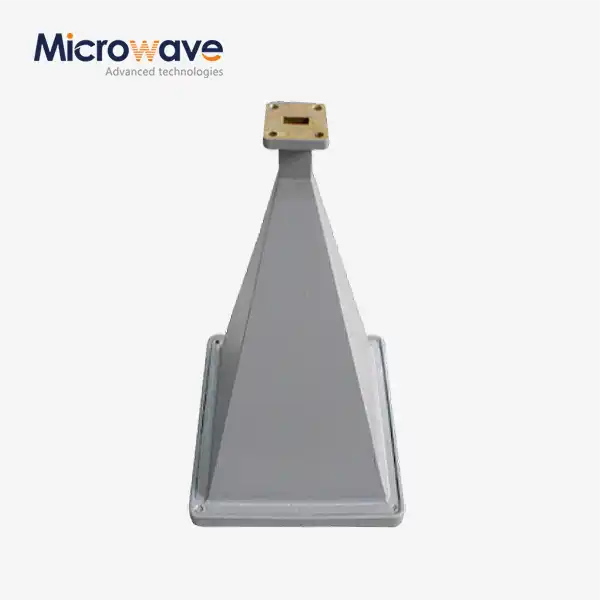
Pyramid Horn Lens Antenna
Pyramid Horn Lens Antenna for mmWave Testing & High-Gain Directional Applications
A Pyramid Horn Lens Antenna integrates a plano-convex dielectric lens at the aperture of a pyramidal horn to convert spherical wavefronts into uniform planar waves. This phase-correction mechanism adds 2–3 dB of gain without extending the physical horn length, making it practical for space-constrained test environments. ADM designs and tests these antennas across 0.5 GHz to 110 GHz using a 24m anechoic chamber, with production conforming to IEEE 149-1979 and MIL-DTL specifications.
Why Phase Correction Matters in Pyramid Horn Lens Antenna Design?
Standard pyramidal horns produce spherical phase errors at the aperture because path lengths from the feed to the aperture edge vary across the radiating surface. These errors degrade gain and elevate side-lobe levels — a measurable problem in high-density mmWave environments where adjacent signals interfere with measurements.
The dielectric lens mounted at the horn aperture corrects this distortion. It reshapes the spherical wavefront into a planar one, directly reducing side-lobe interference in 5G/6G mmWave bands and improving aperture efficiency in compact antenna designs, including Compact Antenna Test Range (CATR) setups where physical space is limited.
The antenna achieves gain and side-lobe performance comparable to a much longer standard horn while occupying significantly less axial length.


Technical Specifications
Parameter | Specification |
Gain Range | 25–35 dBi |
Frequency Coverage | X-band to 110 GHz (W-band); D-band for 6G research |
Side Lobe Level (SLL) | Better than −25 dB |
VSWR | < 1.5:1 across full bandwidth |
Cross-Polarization Discrimination | > 30 dB isolation |
Lens Geometry | Plano-convex or meniscus dielectric |
Lens Materials | PTFE (Teflon), Rexolite, TPX |
Horn Body Material | Precision-machined aluminum or copper |
Surface Finish | Silver or gold plating |
Lens Curvature Tolerance | ≤ λ/50 |
Beam Efficiency (Radiometry) | > 90% |
Standards Compliance | IEEE 149-1979, MIL-DTL specifications |
Performance Characteristics
Compact Pyramid Horn Lens Antenna high-gain design. The lens correction allows gains of 25–35 dBi at reduced axial length relative to a standard horn of equivalent gain. This is relevant when rack space or anechoic chamber dimensions impose physical constraints.
Poor results on the side lobes. Broadcast energy is focused by the lens to get SLL better than -25 dB. This level of suppression keeps test signals from getting messed up by equipment around them in 5G/6G OTA test setups and automotive radar calibration settings.
Use of broadband. The plan includes frequencies used in 6G study, from X-band to W-band (110 GHz) and D-band, with K-band (18 GHz) and W-band (110 GHz) in the middle.
wavefront that is flat at the aperture. This antenna is good for near-field scanning probe uses that need accurate phase and amplitude data across the measurement plane because the aperture makes the phase distribution uniform.
Lens Material Selection
Lens material changes gain, how it reacts to heat, and how stable its dimensions are over time. This is especially true at millimeter-wave frequencies, where even small changes in the dielectric properties can cause noticeable changes in performance.
PTFE, or Teflon, is widely available and has good dielectric qualities. It can handle less power than air, which makes it good for testing and receiving. However, high-power gearbox configurations need to be thermally tested before they can be used.
The low loss slope at mmWave frequencies is what makes Rexolite and TPX stand out. Millimeter-wave energy is absorbed by dielectric materials with higher loss tangents. This lowers gain and can deform the surface over time.
The body of the horn is made of precisely cut copper or aluminium that has been plated with silver or gold to lower surface resistive losses and keep oxidation from happening in the field.
Application Scenarios
OTA Testing for 5G and 6G in CATR Setups.This antenna sends out a quasi-plane wave over short distances. This lets engineers characterise Massive MIMO arrays inside small, soundproof rooms without having to set up standard test setups with far-field distance requirements.
Setting up automotive radar at 77 to 81 GHz.Focused, consistent test signals are needed for end-of-line production testing of sensors for self-driving cars. There is less interference from nearby plant equipment because the test signal is focused on the radar being tested thanks to its high directivity and low side lobes.
Radiometry and remote sensing from space.In orbital radiometers, the phase-corrected beam achieves a beam efficiency of more than 90%. This is useful for measuring the brightness and temperature of the atmosphere, since side-lobe pickup from surface radiation can cause measurement errors.
Quality Control Process
ADM applies Pyramid Horn Lens Antenna electromagnetic and mechanical checks before shipment.
· VSWR Measurement: Each antenna is tested with a Vector Network Analyzer (VNA) to confirm VSWR < 1.5:1 across the full operating bandwidth.
· Radiation Pattern Verification: Far-field testing in ADM's 24m anechoic chamber confirms SLL and Cross-Polarization Discrimination meet specification, including > 30 dB XPD isolation.
· Lens Surface Profile: Laser scanning verifies dielectric lens curvature tolerances at ≤ λ/50 for accurate phase correction.
· Dielectric Homogeneity Check: Material inspection confirms consistent dielectric constant (εr) and loss tangent throughout the lens body to detect impurities before assembly.
FAQ
Q: For what reason would you use a product instead of a regular conical horn?
A: The lens fixes phase errors at the aperture, making it shorter than a standard horn of the same gain but with higher gain and lower side lobes.
Q: What range of frequencies do these antennas work with?
A: They work best between 18 GHz (K-band) and 110 GHz (W-band). D-band versions are available for 6G research uses.
Q: Does the dielectric lens change how power is handled?
A: Yes, PTFE and other dielectrics like it have a lower breaking point than air. Most of the time, testing and receiving applications are not affected. However, high-power gearbox setups need to be analysed thermally.
Q: How does the choice of lens material affect how well it works?
A: People like TPX and Rexolite because they have low loss tangent at mmWave frequencies. Materials with higher losses take in millimeter-wave energy, which lowers gain and increases the chance of thermal distortion over time.
Q: Can this antenna be used to measure the near field?
A: Yes. Because the wavefront at the aperture is flat, it can be used as a near-field scanning probe when accurate phase and amplitude spread across the measurement plane is needed.
Q: What rules do ADM follow when they make and test things?
A: ADM follows IEEE Standard 149-1979 for antenna test procedures and MIL-DTL specifications for environmental resilience, covering dielectric stability across operating temperature ranges.