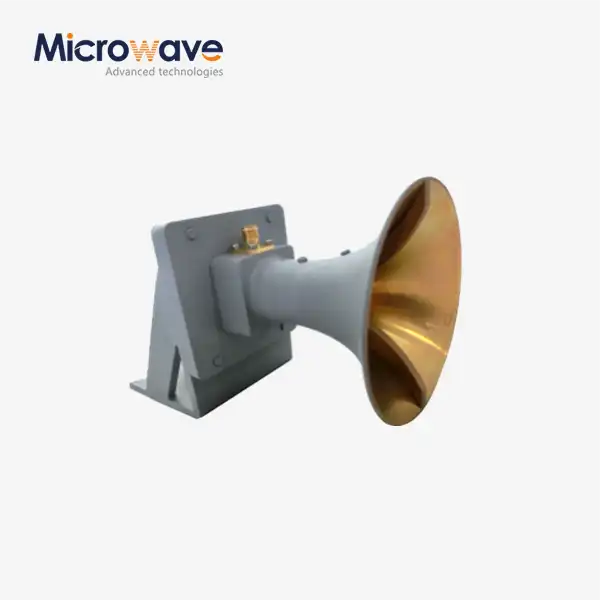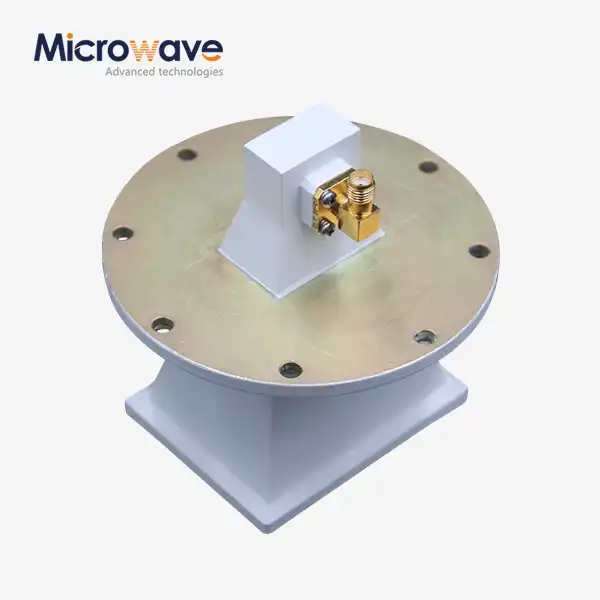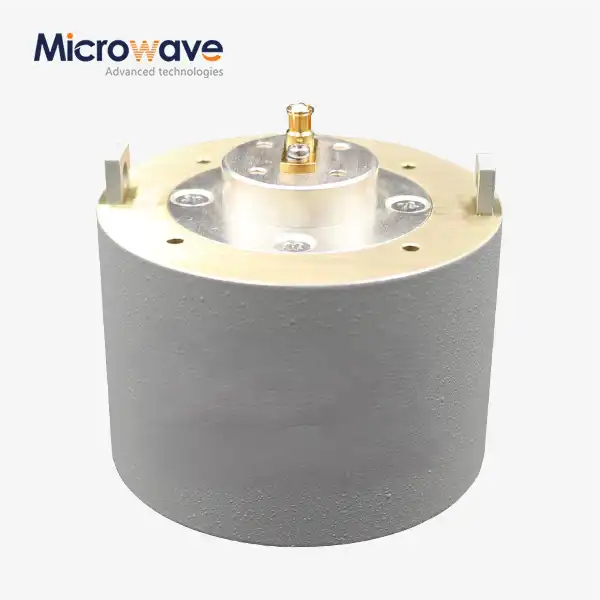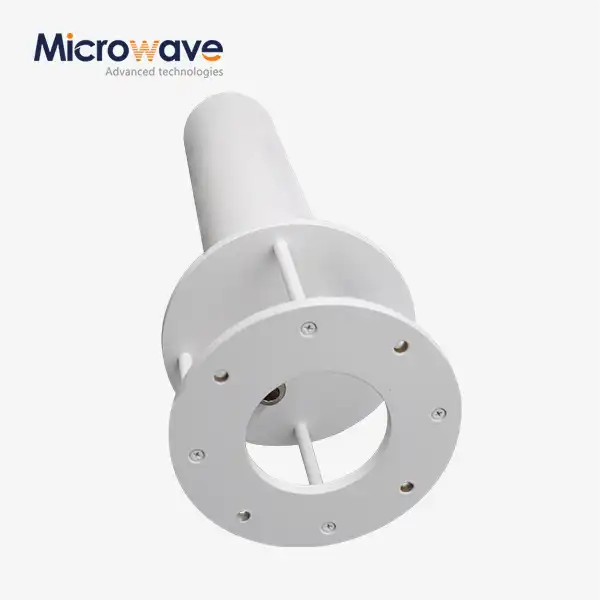





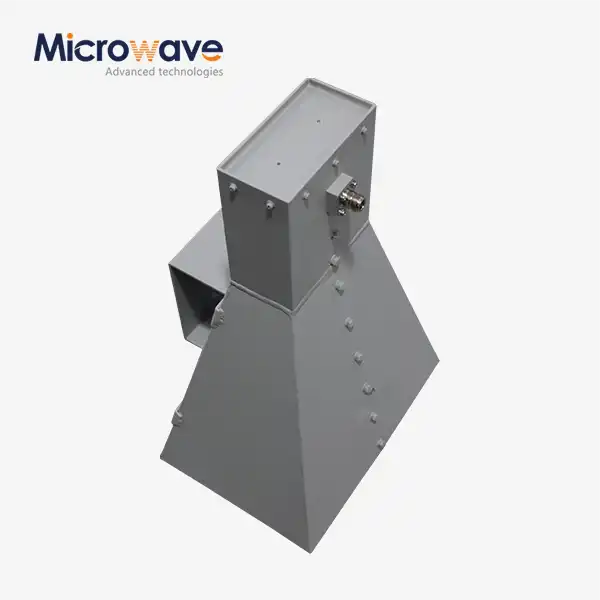
Wideband Double-ridged Horn Antenna
Wideband Double-ridged Horn Antenna for EMI Testing & Broadband RF Measurement
Advanced Microwave Technologies (ADM) designs and manufactures a full line of Wideband Double-ridged Horn Antennas spanning 0.2 GHz to 40 GHz. These antennas combine linear polarization, gain ranging from 6 to 18 dBi, and VSWR typically below 2.5:1 — characteristics that make them practical for EMI/EMC compliance testing, radar cross-section measurement, and antenna gain calibration. Each unit is verified in ADM's 24 m Microwave Darkroom before shipment. ADM has over 20 years of experience in microwave component design and production.
What Is a Wideband Double-ridged Horn Antenna?
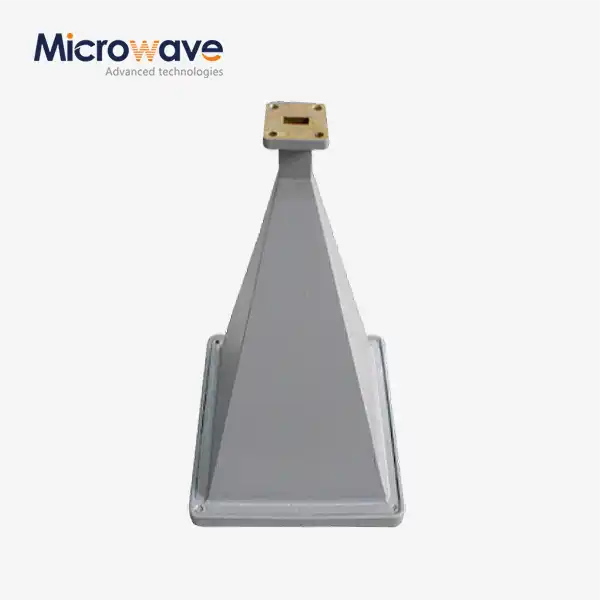
A double-ridged horn antenna is a directional microwave antenna with metallic ridges mounted on the top and bottom inner surfaces of a flared waveguide structure. These ridges lower the cutoff frequency of the fundamental TE10 mode and suppress higher-order modes, extending the usable bandwidth from a single octave to multi-octave ranges — for example, 1 GHz to 18 GHz or 18 GHz to 40 GHz.
Standard pyramidal horn antennas are typically limited to a narrow percentage of their center frequency. The ridged design removes that constraint and provides a smooth 50-ohm impedance transition, which reduces signal reflection and keeps VSWR-related measurement errors low across the full operating band.


Key Technical Specifications
Parameter | Specification |
Frequency Range | 0.2 GHz – 40 GHz (model dependent) |
VSWR | < 2.5:1 typical; < 1.5:1 on optimized models |
Gain | 6 dBi – 18 dBi |
Power Handling (CW) | 50 W – 800 W (connector and frequency dependent) |
Impedance | 50 Ohms |
Polarization | Linear |
Material | High-grade aluminum |
Surface Finish | Alodine conversion coating or powder coating |
Connector Options | N-Type (up to 18 GHz), SMA, 2.92 mm (K-type) |
Cross-Polarization Discrimination | > 20 dB |
Specifications vary by model. Contact ADM at craig@admicrowave.com to confirm which configuration matches your frequency range and connector requirements.
Design Features and Construction
The Wideband Double-ridged Horn Antenna ridged waveguide input section works with coaxial feed lines over a wide frequency range. It does this by managing the flow of energy from the coaxial connector to the horn aperture. This change stops the creation of higher-order modes that would change the radiation pattern otherwise.
It is easy for the phase center to move along the antenna shaft as the frequency changes. This behaviour is important for near-field calibration work because phase center instability is a known source of measurement error. The ridged design makes this movement consistent across the whole band.
Each antenna is made from aluminium that doesn't rust and is finished with either an Alodine conversion coating or a protected powder coat. This makes sure that the electricity stays connected and the antennas don't break down in the lab or the field.
Mini Double-ridged Horn Antenna Option
ADM makes a smaller version of this antenna for engineers who work in small shielded enclosures, portable EMC kits, or small anechoic chambers. Depending on the type, the product works from 1 GHz to 40 GHz and meets the same electrical performance standards as full-size units.
The Mini version can handle 50 W to 300 W CW and comes with connectors for SMA, K-type, or 2.92 mm. Gain goes up steadily from 6 to 15 dBi across the band, and antenna factors stay the same the whole time.
This setup works well in test rooms with limited space where switching between several narrowband antennas would be difficult or impossible.
Application Scenarios
EMC/EMI Compliance Testing—This is done in rooms with no noise to test for radiated immunity and radiated emissions. One antenna can cover a range from 1 GHz to 18 GHz all at once, which cuts down on the time needed to reconfigure when testing medical devices, consumer electronics, or car parts.
RCS Measurement and Broadband Characterization—These are antennas that are used as sources to measure radar cross-section and make broadband fields. When the test setup calls for it, high-intensity field levels can be supported by high power handling.
Surveys of the site and calibration of antenna ranges—Portable units are used as standard antennas for measuring gain transfer. Field engineers use them to find interference and keep an eye on the spectrum across all frequencies, such as 5G, Wi-Fi, and satellite uplink bands.
ADM Testing Capability
ADM has a 24 m Microwave Darkroom that can measure both near-field and far-field of a Wideband Double-ridged Horn Antenna that works from 0.5 GHz to 110 GHz. It is easy to switch between near-field and far-field configurations at this facility.
Each antenna is checked for gain, radiation pattern, VSWR, and far-field performance before it is sent out. At this level of in-house verification, ADM can be sure that every unit meets the published specs before sending it out.
Customization
ADM lets you make your own configurations based on your frequency range, connector type, power handling needs, or limited space. You can choose the frequency band, connector type (N, SMA, 2.92 mm), and surface finish.
For special needs, email the ADM engineering team at craig@admicrowave.com with information about your application.
FAQ
Q: What range of frequencies does a horn antenna with two ridges cover?
A: Depending on how they are set up, ADM types can be used from 0.2 GHz to 40 GHz. Most of them work between 1 GHz and 18 GHz, but millimeter-wave models can work up to 40 GHz.
Q: How well does the VSWR work across the whole band?
A: Standard models keep the VSWR below 2.5:1 throughout the working range. When models are optimised, they get <1.5:1 in key frequency parts. This makes measurements more accurate by lowering signal reflection.
Q: Do you know why you should use a double-ridged horn instead of a log-periodic antenna?
A: In log-periodic antennas, the phase center moves with frequency in a way that isn't always expected. This can cause problems in setups for near-field calibration. Because it has two ridges, the design keeps the phase center moving smoothly and consistently along the antenna axis, which is helpful for measuring things very precisely.
Q: How much power can these antennas handle?
A: When it comes to frequency band and connector type, full-size models can handle 300 W to 800 W CW. These little models can handle 50 W to 300 W CW. N-type connections can handle more power at lower frequencies, while 2.92 mm connectors are used for bands with higher frequencies.
Q: Can ADM make custom antenna arrangements?
A: Yes, you can change the frequency range, connector type, surface finish, and physical dimensions with ADM. If you email craig@admicrowave.com with your application needs, the engineering team will help you choose the right configuration.
Q: What kinds of tests does ADM do before sending out packages?
A: In ADM's 24 m Microwave Darkroom, each antenna is checked for gain, VSWR, radiation pattern, and far-field performance over a frequency range of 0.5 GHz to 110 GHz.
Contact Us
For questions about the Wideband Double-ridged Horn Antenna or to request a custom quote, contact ADM at craig@admicrowave.com.