





Double-bend Waveguide vs Single Bend: Key Performance Differences
When evaluating waveguide configurations for demanding microwave applications, understanding the performance distinctions between double-bend and single-bend designs becomes critical for system optimization. Double-bend waveguides consistently outperform single-bend alternatives in reflection reduction, signal integrity preservation, and compact routing capabilities. The dual-bend architecture minimizes impedance discontinuities while enabling superior signal control in space-constrained environments. Single-bend configurations, while simpler and more cost-effective, typically exhibit higher insertion losses and increased reflection coefficients, making them less suitable for precision applications requiring exceptional electromagnetic performance.
Understanding Waveguide Bend Fundamentals
Fundamental Physics and Single-Bend Waveguide Design
Waveguide twists serve as fundamental components in advanced microwave frameworks, empowering flag steering through complex pathways whereas keeping up electromagnetic field astuteness, as the essential material science overseeing twist execution relates straightforwardly to mode coupling impacts and field conveyance changes when electromagnetic waves explore bended sections. Single-bend waveguides join one directional alter, ordinarily utilizing H-plane or E-plane arrangements, and these plans divert electromagnetic vitality through a single span bend, making a direct move between input and yield introductions, while the twist sweep specifically impacts execution characteristics, with littler radii for the most part creating higher losses.
Double-Bend Advantages and Electromagnetic Behavior
Double-bend waveguides feature two successive directional changes, regularly arranged in S-shaped or counterbalanced designs, as this engineering gives upgraded directing adaptability whereas dispersing electromagnetic field moves over numerous bend areas, and the conveyed approach diminishes top field concentrations that commonly happen in sharp single-bend configurations. Modern electromagnetic recreation devices reveal noteworthy contrasts in field behavior between these setups, since single twists concentrate field moves inside a localized locale, possibly making impedance bungles, whereas twofold twists convey these moves, coming about in smoother field advancement and diminished reflection phenomena, so if you require greatest directing adaptability with negligible flag debasement, at that point double-bend arrangements demonstrate more suitable for your application requirements.
Electrical Performance Comparison Analysis
Comprehensive testing information illustrates quantifiable execution contrasts between single and double-bend waveguide setups over different recurrence ranges, as research facility estimations conducted with high-precision arrange analyzers uncover particular characteristics for each plan approach.
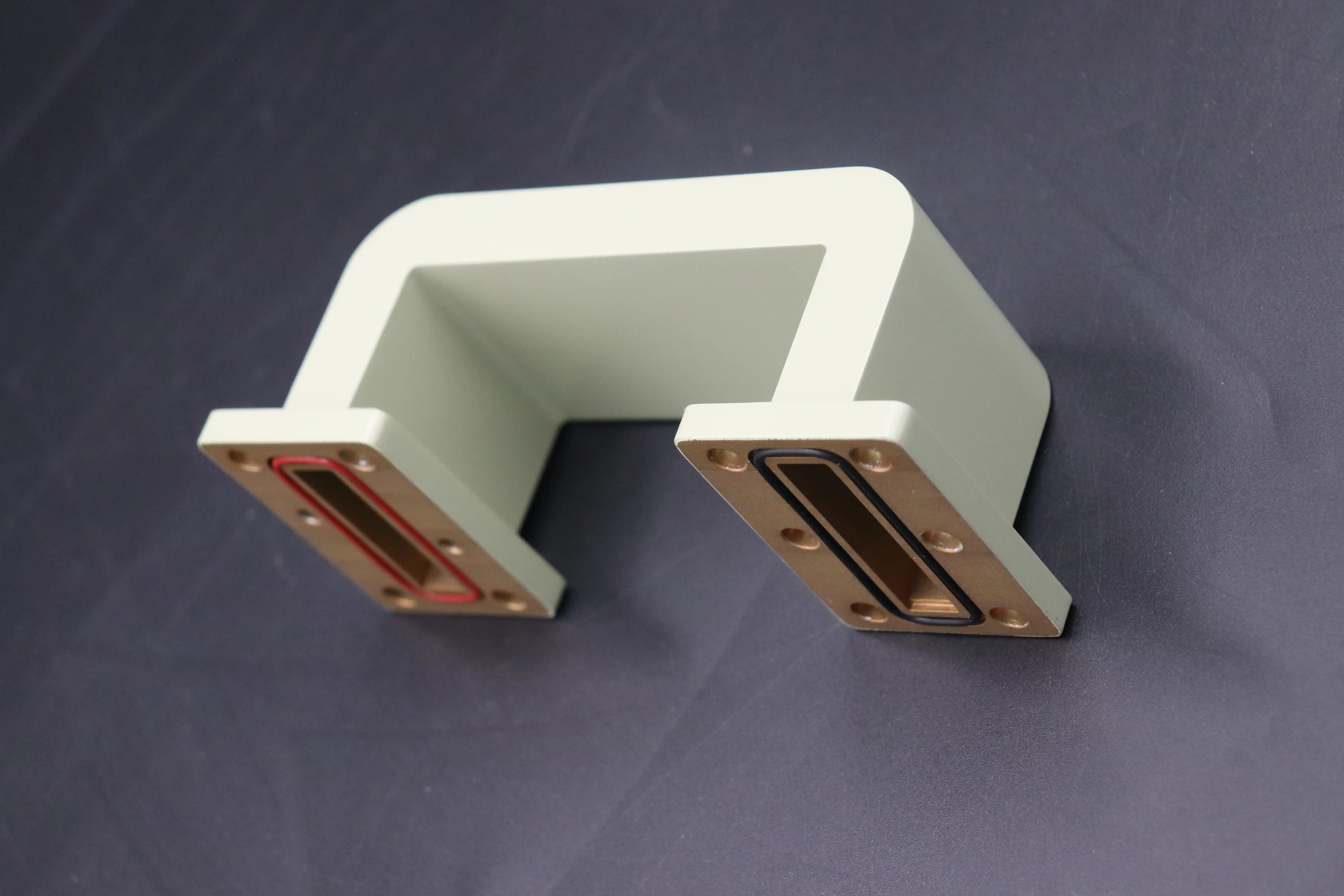
Three core electrical performance differences:
- Return Loss Performance: Double-bend waveguides typically achieve return loss values exceeding 20 dB, while single-bend designs commonly range between 15-18 dB
- Insertion Loss Characteristics: Single bends exhibit 0.15-0.25 dB typical insertion loss, whereas double bends maintain 0.1-0.2 dB across equivalent frequency ranges
- VSWR Stability: Double-bend configurations demonstrate superior VSWR consistency, maintaining values below 1.2 across broader frequency bands
Recent test information from Progressed Microwave Innovations Co., Ltd offices appears their ADM-HT180WEEB12.34X49.58X6.12T1 double-bend show accomplishing exceptional determinations, as the unit keeps up VSWR underneath 1.1 over the 19.2-21.2 GHz recurrence extend whereas constraining addition misfortune to most extreme 0.1 dB values. Signal reflection examination uncovers crucial contrasts in electromagnetic behavior, since single twists make unexpected field moves, producing higher-order mode excitation that shows as expanded reflection, whereas twofold twists give progressive field advancement, stifling undesirable mode era and progressing generally transmission characteristics. Phase reaction estimations demonstrate prevalent linearity in double-bend plans, as the disseminated twist engineering minimizes stage twisting impacts that commonly debase flag quality in exactness applications such as lackey communication frameworks and high-resolution radar platforms, so if you require remarkable return misfortune execution with negligible stage twisting, at that point double-bend waveguides offer prevalent electrical characteristics for requesting applications.
Mechanical Design and Space Utilization
Mechanical Design and Spatial Efficiency
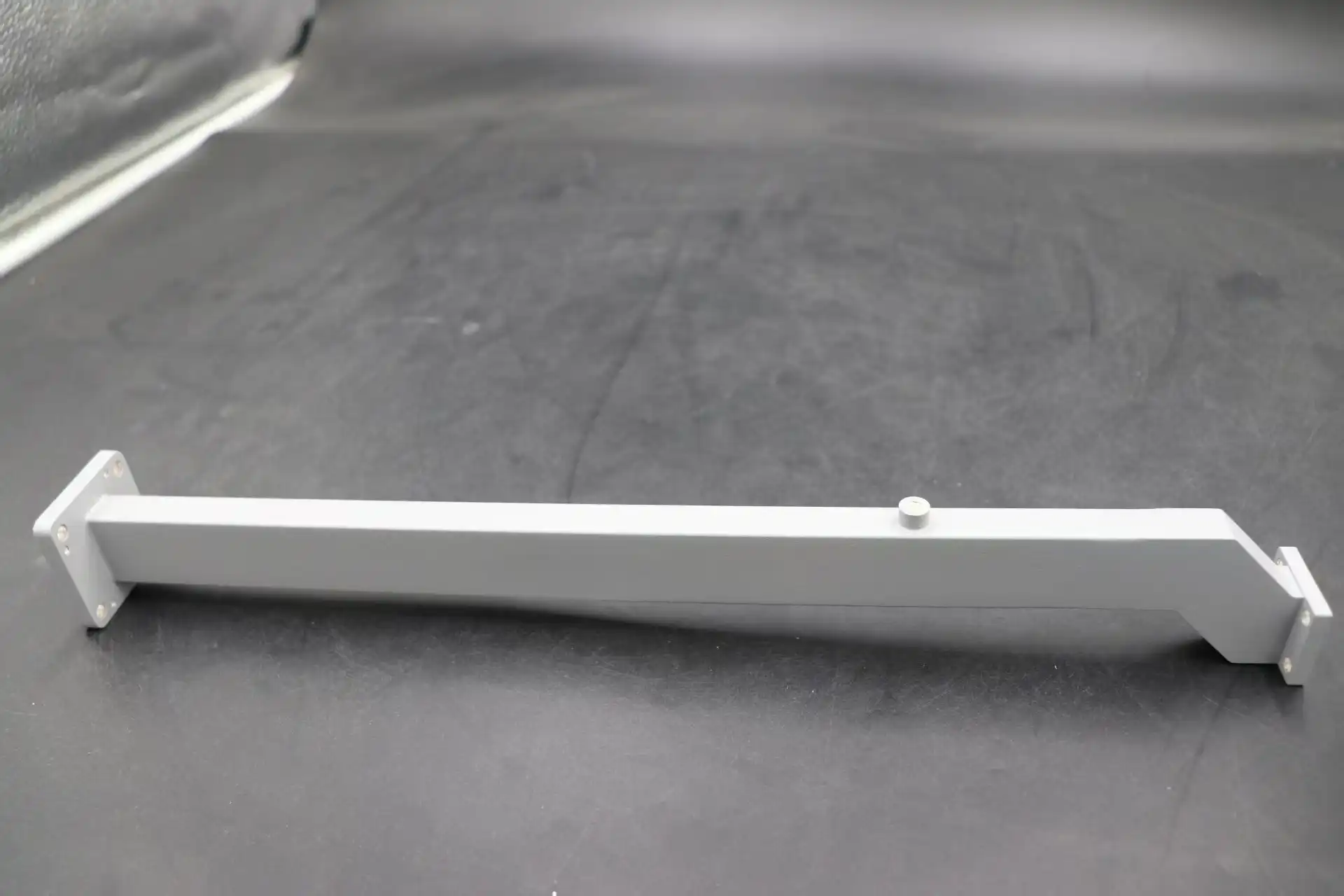
Physical usage contemplations essentially affect waveguide choice choices, especially in space-constrained situations where each millimeter checks, as mechanical plan contrasts between single and double-bend setups make unmistakable focal points for particular establishment scenarios. Single-bend waveguides require straight input-to-output moves, constraining steering choices in compact congregations, and the direct geometry disentangles mechanical plan but compels situation adaptability when exploring around deterrents or fitting inside foreordained envelope constraints. Double-bend setups exceed expectations in compact steering applications, as the S-shaped profile empowers parallel input-output arrangement whereas consolidating essential directional changes, and this capability demonstrates priceless in lackey communication frameworks, radar gatherings, and aviation applications where space optimization drives plan decisions.
Manufacturing, Materials, and Integration Advantages
Manufacturing contemplations vary significantly between setups, as single twists utilize easier tooling and machining operations, possibly decreasing generation costs for high-volume applications, whereas twofold twists require more advanced fabricating forms but convey improved execution defending the extra complexity. Material utilization efficiency shifts between plans, since double-bend setups ordinarily require somewhat more crude fabric due to amplified way lengths, yet the progressed electromagnetic execution frequently legitimizes this humble fabric increment, especially in mission-critical applications where flag keenness supersedes taken a toll considerations. Mounting and integration angles favor double-bend plans in numerous scenarios, as the parallel input-output arrangement rearranges framework integration by killing precise offsets that complicate association arranging and mechanical push management, so if you require extreme steering adaptability inside tight spatial imperatives, at that point double-bend waveguides give predominant mechanical preferences for complex framework integration requirements.
Advanced Manufacturing and Quality Control
Precision Machining and Surface Finishing Excellence
Precision fabricating strategies recognize high-performance waveguide components from standard options, especially when tending to the complex geometries inborn in double-bend arrangements, as Progressed Microwave Advances Co., Ltd utilizes advanced CNC machining capabilities and specialized wrapping up forms to accomplish extraordinary dimensional accuracy. The fabricating handle for double-bend waveguides demands exact span control over numerous bend areas, and computer-controlled machining guarantees reliable twist radii whereas keeping up basic dimensional resistances that specifically affect electromagnetic execution, while quality control methods incorporate arrange measuring machine confirmation of all basic dimensions. Surface wrapping up altogether impacts flag transmission characteristics, as ADM employs specialized cleaning methods on oxygen-free copper and high-conductivity aluminum amalgams to minimize surface unpleasantness impacts, and gold plating forms give extra conductivity upgrade whereas guaranteeing long-term natural stability.
Comprehensive Testing and Environmental Validation
Testing conventions at ADM offices join comprehensive electrical confirmation utilizing organize analyzers calibrated to NIST benchmarks, as each component experiences full S-parameter characterization over indicated recurrence ranges, guaranteeing compliance with archived execution specifications. Environmental testing approves component unwavering quality beneath extraordinary working conditions, since temperature cycling, vibration testing, and mugginess presentation conventions reenact real-world arrangement scenarios experienced in aviation, defense, and toady communication applications. The quality confirmation preferences of ADM double-bend waveguides are planned to guarantee prevalent execution and unwavering quality, as our progressed 24-meter microwave darkroom testing capabilities permit for exact characterization and approval of waveguide components over a wide recurrence extend, up to 110 GHz.
Quality Certifications and Comprehensive Support
With an ISO 9001:2015 certified quality administration framework in put, we guarantee that each item meets exacting quality benchmarks, advertising reliable execution all through its lifecycle, and in expansion, our waveguides are RoHS compliant, illustrating our commitment to natural duty by following to fabric security standards. We give comprehensive S-parameter documentation for all our waveguides, guaranteeing nitty gritty execution information is accessible for approval and integration, and our custom OEM plan capabilities empower us to meet particular client prerequisites, conveying custom fitted arrangements for a wide extend of applications. All through the item lifecycle, we offer master specialized bolster, directing clients from beginning plan through to long-term upkeep and optimization, guaranteeing ideal execution in requesting environments, so if you require fabricating exactness with comprehensive quality approval, at that point ADM's progressed generation capabilities guarantee dependable execution for basic applications.
Application-Specific Performance Considerations
Satellite, Defense, and Aerospace Application Advantages
Real-world arrangement scenarios uncover particular execution characteristics that impact waveguide determination choices over assorted industry applications, as understanding these application-specific prerequisites empowers ideal component determination for most extreme framework performance. Satellite communication ground stations advantage altogether from double-bend waveguide usage, since the upgraded return misfortune execution specifically deciphers to made strides signal-to-noise proportions, basic for keeping up solid communication joins with orbital resources, and the compact directing capability empowers productive recieving wire bolster arrange plans inside space-limited radome environments. Defense radar frameworks require uncommon stage solidness and moo addition misfortune characteristics, as double-bend setups give prevalent stage linearity, fundamental for keeping up coherent flag handling in progressed radar applications, and the diminished reflection characteristics minimize wrong target era that might compromise reconnaissance effectiveness. Aerospace applications request components competent of solid operation beneath extraordinary natural conditions, since double-bend waveguides illustrate prevalent mechanical solidness whereas keeping up electrical execution over wide temperature ranges, and the vigorous plan withstands vibration and stun stacking experienced amid flight operations.
Telecommunications, R&D, and Selection Considerations
Telecommunications framework progressively depends on millimeter-wave recurrence ranges for 5G and future 6G usage, as double-bend waveguides give the low-loss transmission characteristics basic for keeping up flag quality over amplified recurrence groups required for high-speed information transmission. Research and advancement applications advantage from the improved estimation precision empowered by prevalent return misfortune execution, since exact electromagnetic characterization requires negligible reflection artifacts, making double-bend arrangements best for research facility instrumented and logical estimation systems. If you require application-specific optimization with demonstrated unwavering quality, at that point cautious thought of sending prerequisites guides ideal waveguide arrangement selection.
ADM Double-bend Waveguide Advantages
Manufacturing Excellence and Technical Capabilities
Advanced Microwave Technologies Co., Ltd. has established industry leadership through innovative double-bend waveguide solutions that address the most demanding performance requirements across diverse applications, as our comprehensive approach combines advanced manufacturing capabilities with rigorous quality control procedures to deliver exceptional electromagnetic performance. We operate a state-of-the-art 24-meter microwave darkroom facility, enabling precise far-field antenna measurements and comprehensive component characterization, and our advanced CNC machining centers offer sub-micron precision, ensuring critical dimensional accuracy across complex double-bend geometries. We utilize specialized surface finishing processes, incorporating oxygen-free copper and high-conductivity aluminum alloys, with gold plating options for enhanced conductivity, and our comprehensive electromagnetic simulation capabilities support custom design optimization for specific frequency ranges and performance requirements, while backed by an expert engineering team with over 20 years of collective experience in microwave component design and system integration challenges, we are able to tackle the most complex design demands.
Quality Assurance and Certification Standards
Our ISO 9001:2015 certified quality management system ensures consistent manufacturing processes and comprehensive documentation procedures, and we also hold ISO 14001:2015 certification for environmental management, demonstrating our commitment to sustainable manufacturing practices and environmental responsibility. Our adherence to ISO 45001:2018 occupational health and safety standards further guarantees employee welfare while maintaining exceptional production quality, and we are RoHS compliant, ensuring environmental compatibility and global regulatory adherence for international market deployment, while comprehensive testing protocols, including network analyzers calibrated to NIST standards, provide full S-parameter characterization capabilities to verify product performance.
Technical Performance and Customer Support
Our double-bend waveguides deliver industry-leading insertion loss performance, with typical values below 0.1 dB across specified frequency ranges, and the exceptional return loss characteristics, exceeding 20 dB, ensure superior signal integrity in critical applications, while our VSWR performance consistently stays below 1.1 across wide frequency bands, ensuring optimal impedance matching. We offer custom OEM design services to support application-specific requirements, with rapid prototyping capabilities to meet urgent project needs, and comprehensive technical support is available, including installation guidance, system integration assistance, and troubleshooting expertise, while with global supply chain capabilities and efficient manufacturing processes, we can provide fast delivery schedules to meet demanding project timelines.
Innovation and Research Leadership
We continuously invest in advanced measurement equipment supporting frequency ranges up to 110 GHz for next-generation applications, and our collaborative research partnerships with leading aerospace, defense, and telecommunications organizations drive industry advancement, while we employ proprietary design methodologies that optimize electromagnetic performance while minimizing physical footprint requirements. Our advanced materials research explores next-generation conductor technologies and specialized alloy compositions to enhance overall performance, and committed to technology leadership, we continuously improve our engineering development and manufacturing processes, so if you need industry-leading performance with comprehensive technical support, then ADM's double-bend waveguide solutions provide unmatched capabilities for mission-critical applications.
Cost Analysis and Return on Investment
Economic considerations significantly influence waveguide selection decisions, particularly when balancing initial component costs against long-term system performance benefits. Understanding the total cost of ownership requires careful evaluation of multiple factors beyond simple component pricing.Initial procurement costs typically favor single-bend configurations due to simpler manufacturing requirements and reduced material consumption. However, this advantage diminishes when considering system-level performance implications and potential downstream costs associated with suboptimal electromagnetic characteristics.Performance-related cost benefits emerge from improved signal integrity characteristics of double-bend designs.
Reduced insertion loss translates to enhanced system efficiency, potentially eliminating requirements for additional amplification stages. Lower reflection coefficients minimize signal processing complications that could necessitate costly correction mechanisms.Maintenance and lifecycle costs favor double-bend implementations in demanding applications. The superior environmental stability and mechanical robustness reduce replacement frequency and associated maintenance expenses. This advantage becomes particularly significant in remote installations where service accessibility presents logistical challenges.System integration costs vary depending on application requirements. Double-bend configurations often simplify mechanical integration through parallel input-output alignment, reducing assembly complexity and associated labor costs. The compact routing capability may eliminate requirements for additional mechanical supports or custom housing modifications.If you need optimal long-term value with superior performance characteristics, then double-bend waveguides provide compelling return on investment for demanding applications.
Conclusion
The performance distinctions between double-bend and single-bend waveguide configurations extend beyond simple electromagnetic characteristics to encompass mechanical design flexibility, manufacturing precision, and long-term reliability considerations. Double-bend designs consistently demonstrate superior return loss performance, reduced insertion loss, and enhanced routing capabilities essential for demanding applications. While single-bend configurations offer cost advantages for simpler implementations, the enhanced performance characteristics of double-bend solutions justify their selection for mission-critical systems requiring exceptional signal integrity and compact packaging. Advanced Microwave Technologies Co., Ltd continues leading industry innovation through comprehensive engineering expertise and rigorous quality standards that ensure optimal performance across diverse application requirements.
Expert Waveguide Solutions from Leading Double-bend Waveguide Manufacturer
Advanced Microwave Technologies Co., Ltd stands ready to address your most challenging waveguide requirements with industry-leading double-bend solutions backed by over two decades of engineering excellence. Our comprehensive OEM services encompass custom design, rapid prototyping, and volume production capabilities tailored to your specific application needs. Contact our technical specialists at sales@admicrowave.com to discuss how our proven expertise can optimize your next microwave system deployment with superior performance and reliability.
References
1. Pozar, David M. "Microwave Engineering, 4th Edition." John Wiley & Sons, 2012. Chapter 3: Transmission Lines and Waveguides.
2. Collin, Robert E. "Foundations for Microwave Engineering, 2nd Edition." McGraw-Hill Education, 2000. Chapter 7: Rectangular Waveguides and Cavity Resonators.
3. Ramo, Simon, John R. Whinnery, and Theodore Van Duzer. "Fields and Waves in Communication Electronics, 3rd Edition." John Wiley & Sons, 1994. Chapter 8: Guided Electromagnetic Waves.
4. Marcuvitz, Nathan. "Waveguide Handbook." Institution of Engineering and Technology, 1986. Section 3.2: Rectangular Waveguide Discontinuities.
5. IEEE Standard 149-1979. "IEEE Standard Test Procedures for Antennas." Institute of Electrical and Electronics Engineers, 1979. Section 4: Waveguide Measurements.
6. Bhat, Bharathi, and Shiban K. Koul. "Analysis, Design and Applications of Fin Lines." Artech House, 1987. Chapter 2: Waveguide Bend Analysis and Design Considerations.
YOU MAY LIKE
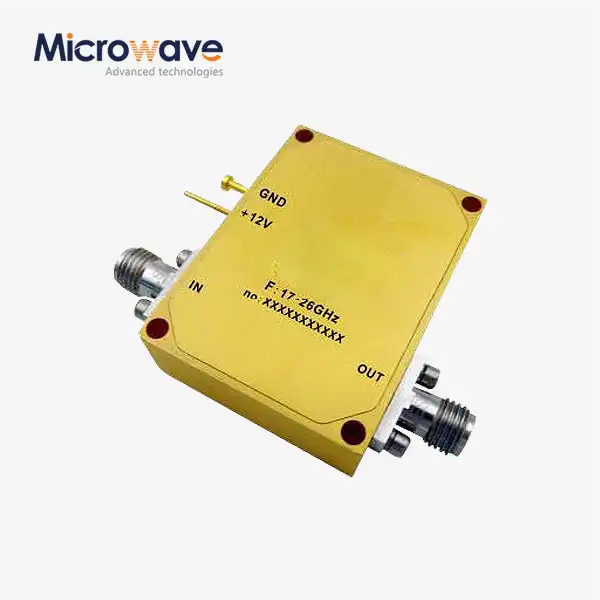 VIEW MORELow Phase Noise Amplifier
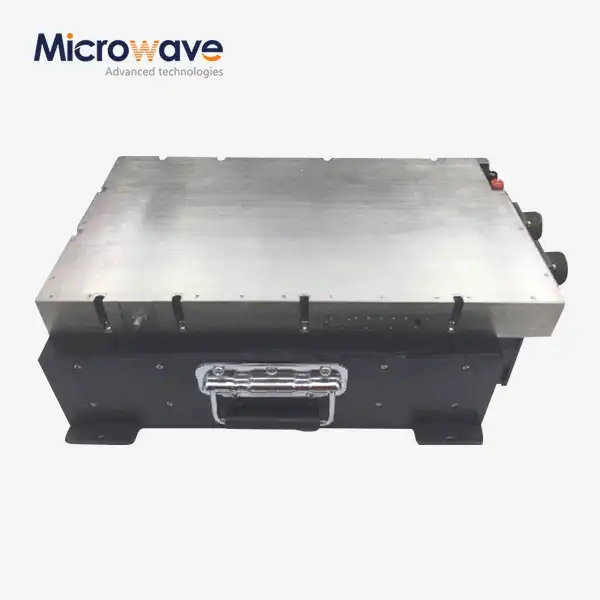 VIEW MOREAc Power Amplifier
 VIEW MOREActive Limiter
 VIEW MOREVoltage Controlled Phase Shifter
 VIEW MORECorrugated Horn and Multimode Horn Antenna
 VIEW MOREWideband Double-ridged Horn Antenna
 VIEW MOREMini Wideband Double-ridged Horn Antenna
 VIEW MOREUltra Double-ridged Horn Antenna