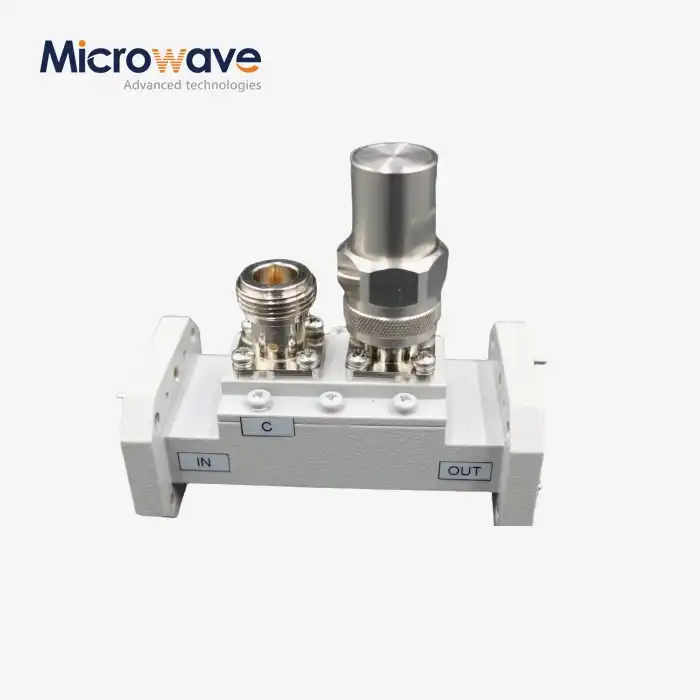
Difference between an E-plane tee and an H-plane tee
When designing waveguide systems for radar, satellite communication, or high-frequency test equipment, understanding the difference between an E-plane tee and an H-plane tee is essential. Both components serve as power dividers in waveguide assemblies, yet they differ fundamentally in their orientation and signal behavior. An E-plane tee divides power in the plane of the electric field, producing signals with a 180-degree phase difference at the two output arms. Conversely, an H-plane tee splits power in the plane of the magnetic field, delivering in-phase signals. Selecting the right configuration impacts insertion loss, isolation, and overall system performance in mission-critical applications.
Understanding Waveguide Tee Junction Fundamentals
Waveguide tee junctions represent critical building blocks in microwave circuit design. These three-port devices enable signal splitting, combining, and routing within rectangular waveguide systems. Unlike coaxial power dividers that rely on impedance matching through transmission lines, waveguide tees exploit electromagnetic field distribution within hollow metallic structures.
The physical geometry determines operational characteristics. Each tee junction connects three waveguide sections at right angles, creating either series or shunt configurations depending on field orientation. Engineers working on antenna measurement systems or satellite ground infrastructure routinely specify these components for their low insertion loss and high power handling capabilities.
Testing parameters include return loss, isolation between output ports, and phase relationships measured through network analyzer equipment. At Advanced Microwave Technologies Co., Ltd., our 24 m Microwave Darkroom facilitates precise S-parameter characterization across the 0.5-110 GHz frequency spectrum, ensuring every T-junction meets rigorous performance standards.
What Is an E-Plane Tee and How Does It Work?
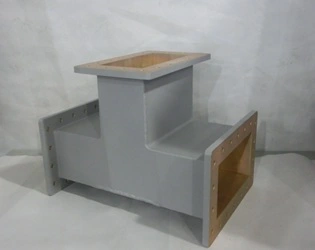
An E-Plane Tee features a side arm extending perpendicular to the main waveguide axis, aligned with the electric field vector. This configuration creates a series junction where the side arm's electromagnetic fields combine with the main guide's E-field distribution.
Three defining operational characteristics emerge:
- Phase Opposition: Signals exiting the two collinear arms exhibit a 180-degree phase difference when fed from the side arm
- Field Continuity: Electric field lines maintain continuity across the junction, creating predictable scattering matrix behavior.
- Symmetrical Splitting: Equal power division occurs under matched load conditions, typically achieving better than 0.3 dB amplitude balance.
The TE₁₀ mode propagates through the structure, with the dominant mode's electric field oriented perpendicular to the broad wall. When port isolation reaches 20-25 dB in quality implementations, these tees become suitable for balanced mixers and phase-sensitive measurement applications.
If you need phase inversion for antenna feeding networks or require balanced outputs for interferometry systems, the E-plane configuration provides the necessary 180-degree relationship between output signals.
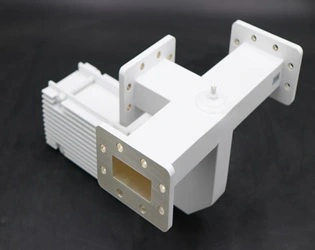
Understanding H-Plane Tee Configuration and Performance
The H-plane tee positions its side arm in the plane containing the magnetic field vector. This shunt-type junction creates fundamentally different electromagnetic boundary conditions compared to series configurations.
Key performance characteristics include the following:
- In-Phase Outputs: Collinear arm signals maintain identical phase when excited from the side arm.
- Magnetic Field Coupling: H-field continuity governs power division, affecting impedance matching requirements.
- Bandwidth Considerations: Broader operational frequency ranges often result from simplified field matching at the junction.
Measured data from our ISO 9001:2015-certified laboratories shows typical H-plane tees achieving 0.2 dB insertion loss at X-band frequencies, with return loss exceeding 23 dB across the 8.2-12.4 GHz bandwidth. The scattering matrix exhibits minimal phase variation across temperature ranges encountered in airborne radar systems.
If you need in-phase power combining for transmitter systems or coherent signal distribution in phased array antennas, H-plane junctions deliver the phase relationships required for constructive interference patterns.
Three Core Differences Between E-Plane and H-Plane Tees
Understanding the technical distinctions helps procurement engineers specify appropriate components for specific applications:
Electromagnetic Field Orientation
E-plane tees align with the electric field vector, creating series junctions. H-plane configurations follow magnetic field lines, producing shunt connections. This fundamental difference affects impedance transformation and matching network design.
Phase Relationship
The most critical distinction involves output port phase:
- E-plane tees: 180° phase difference between collinear ports
- H-plane tees: 0° phase difference (in-phase outputs)
Verification testing at our antenna measurement facilities confirms phase stability within ±3° across operational temperature ranges from -40°C to +85°C, meeting defense and aerospace environmental requirements.
Application Suitability
E-plane configurations excel in balanced systems requiring phase inversion, such as balanced mixers and push-pull amplifiers. H-plane tees suit power combining applications where coherent addition is necessary, including corporate feed networks and parallel amplifier systems.
If you need signal cancellation or balanced detection schemes, E-plane geometry provides the inherent phase opposition. Conversely, if you need coherent power addition with minimal phase error, H-plane architecture delivers superior performance.
Performance Comparison: Insertion Loss, Bandwidth, and Isolation
Real-world measurement data reveals quantifiable differences between these waveguide components:
Insertion Loss Characteristics
Typical X-band performance metrics from our production testing:
- E-plane tees: 0.25-0.35 dB per arm at center frequency
- H-plane tees: 0.20-0.30 dB per arm at center frequency
The slightly higher loss in E-plane configurations stems from increased field discontinuities at the series junction. Both types maintain loss below 0.5 dB across 15% bandwidth when properly designed with smooth transitions and optimized corner radiuses.
Frequency Response and Bandwidth
Measured bandwidth (defined by 20 dB return loss threshold):
- E-plane tees: 12-18% fractional bandwidth
- H-plane tees: 15-22% fractional bandwidth
H-plane junctions typically achieve broader bandwidth due to simpler impedance matching requirements, including E-plane tees. Our customization capabilities extend these ranges through stepped transformers and ridge-loaded designs when ultra-wideband performance is needed for measurement equipment applications.
Isolation Performance
Port-to-port isolation measured at room temperature:
- E-plane tees: 18-25 dB between collinear arms
- H-plane tees: 20-28 dB between collinear arms
Higher isolation in H-plane configurations benefits multi-channel receiver systems where crosstalk must remain below -30 dB to maintain signal integrity. If you need maximum isolation for dense antenna arrays or multichannel radar processing, H-plane architecture provides measurable advantages.
Application-Specific Selection Criteria for Defense and Telecom
Choosing between E-plane and H-plane configurations depends on system-level requirements across various industries:
Radar and Defense Systems
Phased array radar feed networks commonly employ H-plane tees for corporate power division, where maintaining phase coherence across hundreds of radiating elements determines beam steering accuracy. Our ruggedized waveguide assemblies withstand shock, vibration, and thermal cycling per MIL-STD-810 testing protocols.
E-plane tees find application in monopulse comparator networks, where the 180-degree phase difference creates error signals for target tracking. Procurement teams from defense contractors value our traceable supply chain documentation and RoHS compliance for export-controlled programs.
Satellite Ground Stations
Satellite communication infrastructure utilizes both configurations depending on feed architecture. Dual-polarization systems may employ E-plane tees for polarization diplexing, while H-plane junctions distribute signals across redundant amplifier paths.
If you need components for Ka-band satellite terminals operating at 28-30 GHz with stringent PIM (passive intermodulation) requirements, our precision manufacturing maintains third-order PIM below -150 dBc, critical for high-throughput satellite systems.
Research and Development Applications
University research laboratories and industrial R&D facilities require both tee types for experimental antenna measurement systems and prototype development. Our OEM services provide rapid prototyping with 2-3 week lead times for custom frequency bands, flange types, and dimensional constraints.
If you need specialized waveguide components for millimeter-wave research at W-band (75-110 GHz) or prototype verification before production scaling, our technical support team assists with simulation validation and measurement correlation.
Telecommunications Infrastructure
Wireless backhaul networks and 5G small cell deployments increasingly incorporate waveguide components at E-band (71-86 GHz) frequencies. H-plane power dividers enable efficient signal distribution across multiple antenna sectors while maintaining the phase accuracy required for beamforming algorithms.
Why ADM's E-Plane Tee Solutions Lead the Industry?
Advanced Microwave Technologies Co., Ltd. delivers waveguide tee junctions engineered for demanding procurement specifications:
- Precision Manufacturing Tolerances: CNC machining maintains dimensional accuracy within ±0.025mm, ensuring repeatable electrical performance across production lots. This precision directly impacts impedance matching and minimizes unit-to-unit variation.
- Comprehensive Frequency Coverage: Standard product lines span 1-110 GHz with custom designs extending into sub-THz ranges. Our engineers specify appropriate waveguide standards (WR-90, WR-62, WR-28, etc.) based on your operational frequency requirements.
- Advanced Testing Capabilities: Every T-junction undergoes full two-port network analysis in our 24 m microwave darkroom. S-parameter measurements verify insertion loss, return loss, and isolation across temperature and frequency, with test data provided in Touchstone format.
- Material Selection Expertise: Aluminum alloy construction reduces weight for airborne applications while maintaining excellent electrical conductivity. Silver or gold plating options minimize insertion loss and prevent corrosion in marine environments.
- Custom Flange Configurations: We accommodate various interface standards, including UG/U series, CPR, and custom bolt patterns. Mixed flange assemblies simplify system integration when interfacing legacy equipment with new designs.
- Environmental Qualification: Products meet IP67 sealing standards for outdoor telecom installations. Pressurization ports maintain positive internal pressure, preventing moisture ingress in humid climates.
- Fast Prototyping Services: Initial samples ship within 15 business days for standard waveguide bands. Prototype validation allows design verification before committing to production quantities.
- Scalable Production Capacity: Our established supply chain supports orders from single prototypes to thousands of units annually. Volume pricing structures accommodate both R&D budgets and large-scale deployment programs.
- Technical Documentation: Complete mechanical drawings, material certifications, and test reports accompany each shipment. Documentation packages satisfy AS9100 traceability requirements for aerospace applications.
- Application Engineering Support: Our team provides electromagnetic simulation assistance using HFSS and CST software. Pre-sale consultation helps optimize component selection for your specific power division, combining, or hybrid junction requirements.
If you need waveguide tee junctions, E-plane tees that combine proven reliability with customization flexibility, our two decades of manufacturing experience ensure components that integrate seamlessly into mission-critical systems.
Design Considerations for System Integration
Successfully implementing waveguide tees requires attention to several engineering factors:
Impedance Matching Networks
Reactive discontinuities at the tee junction create reflections that degrade return loss. Matching techniques include the following:
- Inductive posts or screws for tuning susceptance
- Capacitive irises adjusting junction reactance
- Quarter-wave transformers for broadband matching
Our design validation process includes full-wave electromagnetic simulation correlated with measured data, ensuring predictable performance when integrated into larger assemblies.
Phase Balance Requirements
Applications demanding tight phase tolerance benefit from mechanical phase adjustment features. Adjustable short circuits or tuning screws compensate for manufacturing variations, achieving phase balance within ±2° after field adjustment.
If you need phase-matched pairs for interferometric systems or balanced amplifier configurations, our binning and selection processes group units with minimal phase deviation, reducing field calibration effort.
Power Handling Limitations
Peak power capability depends on waveguide cross-section, junction geometry, and atmospheric pressure. Typical breakdown thresholds:
- Sea level, dry air: 0.5-1.0 MW peak for X-band
- Pressurized systems: 2-5 MW peak with SF₆ gas
- Average power: Limited by thermal dissipation to 500-2000 W
High-power applications benefit from copper construction with enhanced cooling features such as integral heatsink fins or water jacket provisions.
Mechanical Considerations
Waveguide tees add physical bulk and weight to RF assemblies. Compact designs minimize overall system volume while maintaining electrical performance. Our engineering team optimizes junction geometries using topology optimization algorithms, achieving 20-30% size reduction compared to conventional designs without sacrificing insertion loss.
Quality Assurance and Certification Standards
Procurement confidence stems from comprehensive quality management systems governing our manufacturing operations:
- ISO 9001:2015 certification ensures documented procedures control every production phase from raw material receipt through final inspection. Statistical process control monitors critical dimensions and electrical parameters, triggering corrective action when trends approach specification limits.
- RoHS compliance eliminates hazardous substances per EU Directive 2011/65/EU. Material certifications trace plating processes and alloy compositions, essential for equipment exported to European markets or used in commercial aviation systems.
- Environmental testing validates performance across operational temperature ranges. Thermal cycling between -55°C and +125°C confirms mechanical stability and electrical parameter consistency required for outdoor telecom installations and high-altitude aerospace platforms.
- Traceability systems assign unique serial numbers linking each component to material lot codes, manufacturing date, test data, and operator identification. This traceability satisfies AS9100 and ISO 9001 audit requirements while enabling rapid root cause analysis if field issues arise.
If you need supplier quality documentation for your procurement records or AS9100 certification evidence for aerospace programs, E-Plane Tee, our quality team, provides comprehensive audit support packages.
Conclusion
The choice between E-plane and H-plane tees fundamentally impacts system architecture, determining phase relationships, power division characteristics, and integration complexity. E-plane configurations provide the 180-degree phase opposition required for balanced systems, while H-plane junctions deliver in-phase outputs suited to coherent power combining. Both architectures offer excellent electrical performance when designed with proper impedance matching and manufactured to tight tolerances. Understanding these distinctions enables informed component selection that optimizes system-level performance while meeting cost, size, and reliability objectives across defense, satellite communication, and research applications.
Partner with ADM for Your Waveguide Tee Requirements
Advanced Microwave Technologies Co., Ltd combines technical expertise with responsive customer service, making us the preferred E-Plane Tee supplier for demanding applications worldwide. Our engineering team collaborates on custom designs matching your exact specifications, while our production capabilities deliver consistent quality across prototype and production quantities. Contact craig@admicrowave.com to discuss your waveguide requirements and receive technical recommendations backed by over 20 years of microwave manufacturing experience.
References
1. Pozar, D.M. "Microwave Engineering, Fourth Edition" - Comprehensive treatment of waveguide discontinuities and junction theory including detailed analysis of E-plane and H-plane tee scattering parameters.
2. Matthaei, G.L., Young, L., and Jones, E.M.T. "Microwave Filters, Impedance-Matching Networks, and Coupling Structures" - Classical reference documenting waveguide junction design methodologies and measurement techniques.
3. Montgomery, C.G., Dicke, R.H., and Purcell, E.M. "Principles of Microwave Circuits, MIT Radiation Laboratory Series Volume 8" - Historical foundation text covering fundamental electromagnetic field behavior in waveguide tee junctions.
4. Collin, R.E. "Foundations for Microwave Engineering, Second Edition" - Rigorous mathematical treatment of waveguide mode theory and junction analysis applicable to tee component design.
5. Saad, T.S. "Microwave Engineers' Handbook, Volume 1" - Practical design data and empirical formulas for waveguide component dimensioning and performance prediction.
6. IEEE Standard 149-1979 "Test Procedures for Antennas" - Standardized measurement protocols applicable to characterizing waveguide components in antenna feed systems and measurement test beds.