





Broadband Coaxial Circulator Selection Guide for Radar and 5G Front Ends
Choosing the right broadband coaxial circulator for radar and 5G front-end applications is more consequential than most procurement teams initially anticipate. These non-reciprocal passive devices route microwave signals unidirectionally across multiple ports—protecting sensitive receive chains, enabling full-duplex operation, and maintaining signal integrity under demanding conditions. With frequency coverage extending from DC to 40 GHz and power handling spanning 0.5 W to 500 W, selecting the wrong device can compromise an entire RF subsystem. This guide walks RF engineers and procurement managers through every critical decision point, from fundamental operating principles to supplier evaluation and compliance requirements.
Understanding Broadband Coaxial Circulators: Fundamentals and Working Principles
What Makes a Circulator "Broadband"?
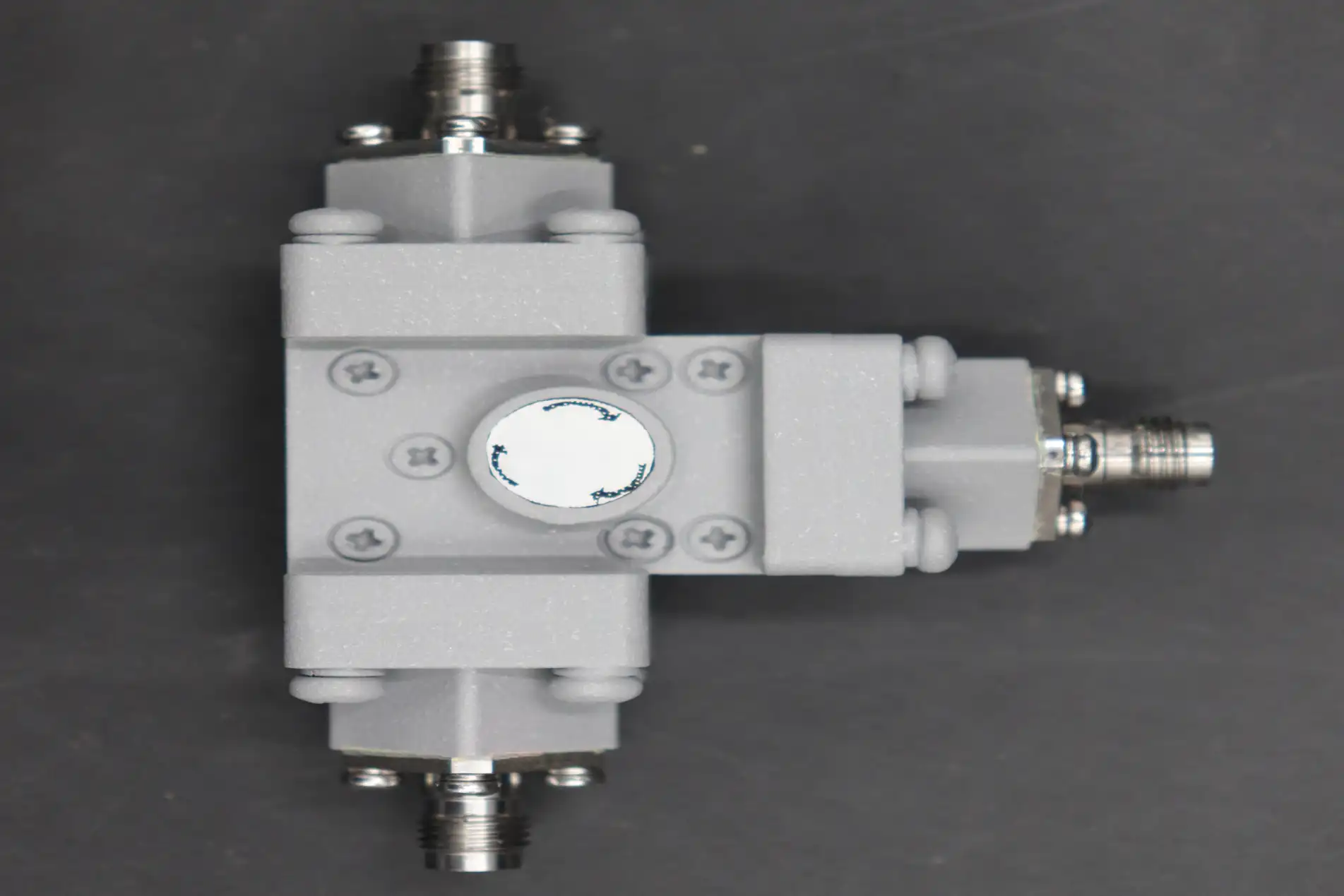
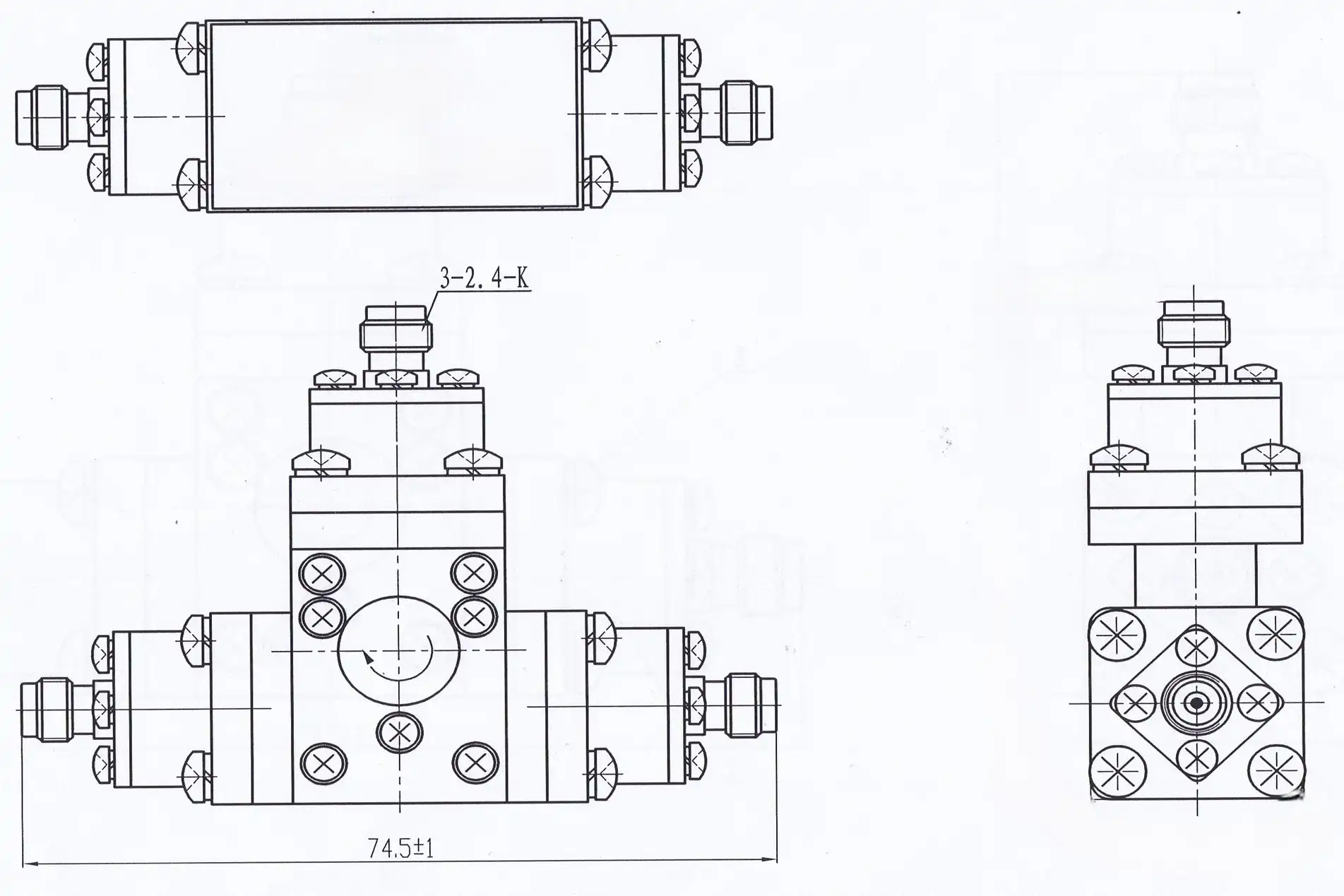
There are three ports on a broadband coaxial circulator. A signal that goes into Port 1 leaves through Port 2, a signal that goes into Port 2 leaves through Port 3, and so on. The non-reciprocal behavior is caused by a ferrite joint that is magnetically skewed. Broadband designs use complex impedance matching networks and low-loss, high-saturation ferrite cores to keep performance stable across multiple octaves, while narrowband designs use ferromagnetic resonance at a single frequency. The end result is a device that can work with a wide range of frequencies, from DC to 40 GHz, without having to retune or switch out parts.
Key Performance Parameters to Understand
Before comparing goods, every RF expert should understand the four factors that directly affect how they work in a system:
- Insertion loss measures forward signal attenuation. The ADM broadband coaxial circulator has a rejection rate of −0.3 dB from DC to 10 GHz, ≒0.5 dB from 10 to 20 GHz, and ≒0.8 dB from 20 to 40 GHz. These rejection rates keep the signal quality even at millimeter-wave frequencies.
- Isolation determines how well the device blocks reverse-path signals. At least -20 dB blocks reflected energy that would otherwise hurt receiver sensitivity or power amps.
- Power handling decides whether the gadget can withstand high-peak transmit pulses. Coaxial systems with a 50 W CW rating (and high-power versions that can hit 500 W) can meet the needs of both 5G base stations and pulsed radars.
- VSWR and return loss change how impedance matching works throughout the signal chain, which has a direct effect on how well the system works as a whole.
Coaxial designs are better at balancing integration density, weight, and wideband performance than broadband coaxial circulators, which can handle more power but take up more space. This makes them the best choice for small radar T/R modules and 5G RF front ends.
Critical Factors for Selecting the Best Broadband Coaxial Circulator
Matching Device Specifications to Your System Architecture
There are different needs for each application, and the selection process needs a structured method. Here are the main evaluation criteria that every procurement engineer should always look at:
- Frequency band alignment: Make sure the device covers your operational band plus some extra space. A radar system that works in the X-band (8–12 GHz) needs a device that is rated well above 12 GHz so that performance doesn't drop off near the band edge.
- Power budget verification: Tell the difference between peak pulse power and continuous-wave (CW) power. In radar uses, parts are often exposed to high levels of power all at once. Make sure that the thermal dissipation and voltage values of the connectors can handle your peak levels.
- Environmental qualification: For military and space applications, it must be able to work in temperatures between -45 °C and +85 °C and be resistant to shaking and shock (MIL-STD-202). The aerospace-grade models from ADM have permanent magnets that are temperature-compensated and maintain isolation throughout this range.
- Impedance and connector compatibility: Standard 50 Ω coaxial interfaces with SMA, N-type, or 2.92 mm connectors make drop-in integration easier. Check the gender and torque requirements of the connectors against the assembly you already have.
- EMI shielding: Magnetic fields from the outside can't detune the ferrite junction because of the double-layer metal casings. This is very important in dense multi-module RF systems.
These factors, taken together, tell us if a gadget works as expected in the field, not just on the bench. If procurement teams skip this review, they often have to pay a lot of money to rethink the project in the middle of it.
Practical Applications of Broadband Coaxial Circulators in Radar and 5G Systems
Radar T/R Modules and 5G Base Station Front Ends
Each transmit/receive (T/R) module in a phased-array radar, such as an Active Electronically Scanned Array (AESA) architecture, needs a broadband coaxial circulator to separate the high-power pulses that go out from the low-level return signals that come in. The coaxial form factor makes it possible to integrate many elements into one package while still providing the separation that is needed to keep low-noise amplifiers (LNAs) safe from broadcast bleed-through. Studies that look at how well AESA radars work always find that circulator separation is what limits how sensitive the receiver is to targets close up.
The move to sub-6 GHz massive MIMO and mmWave bands above 24 GHz in 5G has increased the need for wideband RF front-end components. A single broadband coaxial circulator that covers multiple 5G NR bands gets rid of the need for switched filter banks, which lowers the number of parts needed and the amount of insertion loss that builds up. The ADM device works with both sub-6 GHz and mmWave 5G frequencies in a single part. Its frequency range is from DC to 40 GHz.
Beyond these two primary applications, the same device is also used in electronic warfare (EW) wideband antennas, satellite ground station duplexers, and RF test benches where accurate power measurement rests on separating reflected signals from the source path.
Procurement and Purchasing Guide for Broadband Coaxial Circulators
Evaluating Suppliers and Interpreting Datasheets
A datasheet promises performance, but only experienced buyers can correctly interpret it. Others will find compliance gaps during the incoming inspection. Make sure that the numbers given for insertion loss and separation are correct across the whole frequency range, not just at the center frequency. Ask the Vector Network Analyzer to look at S-parameter values (S21, S12, and S11) across the whole rating range.
When judging sellers, give the following qualities the most weight:
- ISO 9001 certification proves that quality management systems are documented and that manufacturing records can be tracked.
- RoHS compliance ensures materials meet international environmental standards, a non-negotiable requirement for most European and North American system integrators.
- Environmental stress screening (ESS) data, such as thermal shock cycling and vibration test results, prove how reliable something is in the field instead of just depending on rated specs.
- OEM customization capability is important when normal catalog measurements or connection combinations don't work with your PCB or chassis plan.
ADM has supplied precise RF and microwave parts to the defense, satellite, and telecommunications industries for over twenty years. Our engineering team helps with full paperwork packages for prototype evaluation, custom form-factor development, and large-scale OEM production. Our team talks directly with you about lead times and minimum order numbers so that we can help you with both R&D purchases and large-scale production purchases.
Conclusion
To choose the best broadband coaxial circulator, you need to make sure that the electrical performance, environmental qualification, and supplier reliability all match the needs of your radar or 5G front-end architecture. With insertion loss below 0.8 dB and isolation above 20 dB, devices that cover DC to 40 GHz can be used in the widest range of modern RF applications without having to switch out parts in the middle of a project. In the same way, suppliers with ISO 9001 approval, strict ESS testing, and quick tech help lower buying risk throughout the whole lifecycle of a product. Your team will be able to make a confident, defensible buying decision if they follow a methodical approach to each selection factor in this guide.
FAQ
What is the typical frequency range of a broadband coaxial circulator?
Broadband coaxial circulators typically have multi-octave lengths. ADM's product works with frequencies from DC to 40 GHz, so it can handle sub-6 GHz 5G, X-band radar, Ka-band satellite, and mmWave uses all in one device.
How does a circulator differ from an isolator?
If you connect a 50 Ω load to the end of Port 3 of a circulator, it turns into an isolator. Signals go from Port 1 to Port 2, and any echoes backward that come in through Port 2 are absorbed at Port 3, which keeps the source safe.
What are the key selection criteria for 5G front-end applications?
Make sure the insertion loss is less than 0.5 dB across your operating band, the isolation is at least 20 dB, and the connector link works with your front-end module. Band-switched assemblies are not needed because wideband coverage does the job.
Can these devices be customized for specialized radar configurations?
Yes. ADM can customize products for OEMs by changing form factors, offering different types of connectors, and increasing power levels. Our engineering team works directly with your technical requirements to come up with solutions that meet all of your needs.
How does temperature affect circulator performance?
The magnetic properties of ferrite change with temperature, which could make separation worse or increase insertion loss. For stable performance across a temperature range of −45 °C to +85 °C, ADM's aerospace-grade models use permanent magnets that are temperature-compensated.
Partner with ADM for Your Broadband Coaxial Circulator Requirements
ADM makes RF parts that are precisely designed and built to meet the strict standards needed for your radar and 5G front-end projects. We are a reliable company that makes broadband coaxial circulators. We have ISO 9001 approval, RoHS compliance, and over 20 years of experience designing microwave components. We can help with everything from prototyping to large-scale OEM production. Get in touch with our research team right away to get samples, datasheets, or unique quotes. You can email us at craig@admicrowave.com to see our full selection of RF components.
References
1. Pozar, D. M. Microwave Engineering, 4th ed. — John Wiley & Sons, 2011.
2. Helszajn, J. Waveguide Junction Circulators: Theory and Practice — John Wiley & Sons, 1998.
3. Matthaei, G., Young, L., & Jones, E. M. T. Microwave Filters, Impedance-Matching Networks, and Coupling Structures — Artech House, 1980.
4. IEEE Transactions on Microwave Theory and Techniques. "Wideband Ferrite Circulator Design for Phased-Array Radar Applications" — IEEE, 2019.
5. Collin, R. E. Foundations for Microwave Engineering, 2nd ed. — IEEE Press / Wiley-Interscience, 2001.
6. International Telecommunication Union (ITU). IMT-2020 (5G) Radio Interface Technical Performance Requirements — ITU-R M.2410, 2017.
YOU MAY LIKE
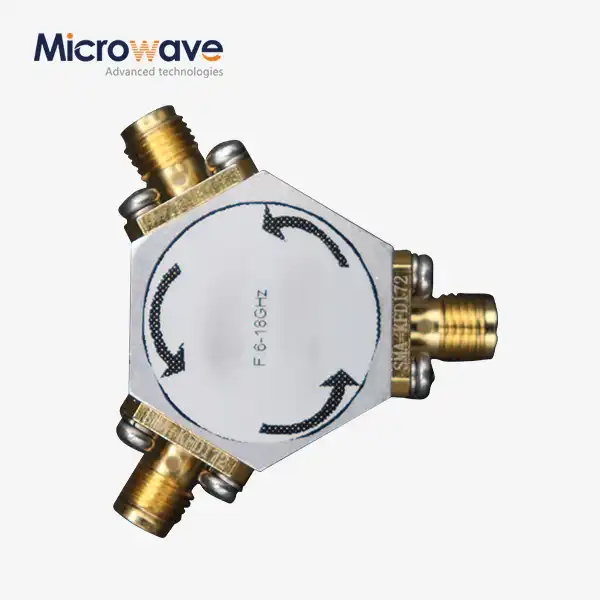 VIEW MOREBroadband Coaxial Circulator
 VIEW MORECustom WG to Coaxial Adapter
 VIEW MOREWG Termination
 VIEW MOREWaveguide Offset Short
 VIEW MOREDouble Ridged WG To Coaxial Adapter
 VIEW MORECoaxial Directional Coupler
 VIEW MOREConical Horn Lens Antenna
 VIEW MORELow Side Lobe Diagonal Linear Polarization Horn Antenna