




Why Use a Broadband RF Circulator in RF Systems?
Engineers and procurement professionals working with mission-critical RF systems increasingly face a common challenge: how to manage complex signal paths across multiple frequency bands without compromising system integrity. A broadband rf circulator addresses this need directly by enabling unidirectional signal flow across wide frequency spectra—typically spanning multiple octaves—while maintaining exceptional isolation and minimal insertion loss. Unlike narrowband alternatives that operate effectively at only specific frequencies, these sophisticated passive components leverage ferrite materials and advanced magnetic biasing to route RF energy efficiently across diverse bands. This versatility makes them indispensable in applications ranging from radar and satellite communications to electronic warfare, where system designers must accommodate multiple overlapping frequencies without installing separate circulators for each band.
Understanding Broadband RF Circulators
Before choosing these parts for your purpose, we at Advanced Microwave Technologies Co., Ltd. know how important it is to understand how they work on a basic level.
What Defines Broadband Operation
Broadband RF circulators are fundamentally different from narrowband circulators because they can keep performance parameters constant over a wider frequency range. A narrowband device might work well within a 5–10% bandwidth, but a broadband unit can work across whole frequency ranges, like 2–18 GHz or even DC to 110 GHz in some more advanced setups. This large operating range is made possible by intricate impedance matching networks and carefully designed ferrite assemblies that account for the way magnetic materials scatter across frequency.
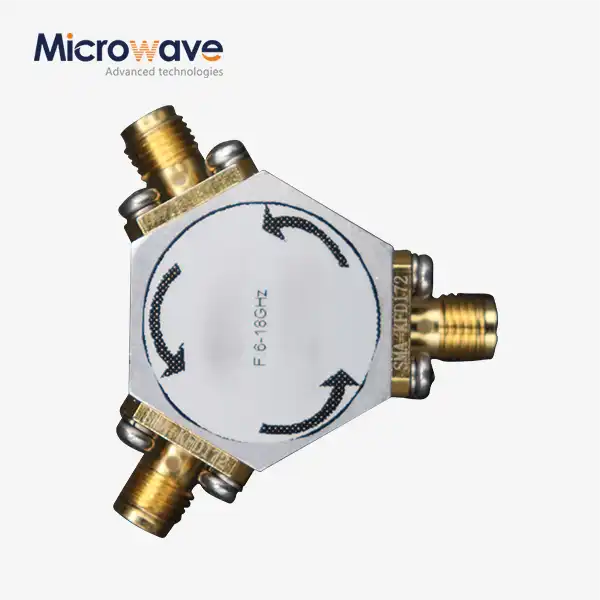
Our waveguide and coaxial circulators use the non-reciprocal electromagnetic features of ferrite materials in static magnetic fields to move energy in a certain way without using extra power. In the most common configuration, signals going into Port 1 leave through Port 2, and signals going into Port 2 leave through Port 3. Signals going in the opposite direction experience high attenuation, usually ≥40 dB isolation.
Critical Performance Parameters
When assessing these devices, procurement teams should pay attention to a number of specification measures. Insertion loss—ideally ≤0.5 dB—affects signal power levels and receiver sensitivity in communication chains in a direct way. VSWR, or Voltage Standing Wave Ratio, shows how well the impedance matching works. Values ≤1.2 at the input ports mean that there is almost no reflection, which could make amplifiers or transmitters unstable. Power handling capacity varies a lot depending on the type of construction. For example, coaxial models can handle 10–500 W of average power and 1–10 kW of peak power, while high-power waveguide variants can handle up to 50 kW of peak power thanks to better thermal management and toughened ferrite cores.
In aerospace and security uses, the operating temperature range is also very important. Our units go through a lot of temperature cycles, going from -40°C to +85°C. This makes sure that they work well in harsh environments that would break down cheaper parts.
Core Advantages of Using Broadband RF Circulators in RF Systems
For system engineers, these parts are strategic assets that offer more than just simple signal routing.


Enhanced System Flexibility and Reduced Complexity
When you use a single broadband unit, you don't need switching banks with many narrowband circulators. This merger directly addresses the limitations of Size, Weight, and Power (SWaP), which are very important for airborne radar, satellite packages, and portable electronic warfare gear. If a transmission system needs to work with frequencies from L-band to Ku-band, using separate narrowband circulators would mean making complicated RF switching matrices. These would add extra insertion loss at each switch junction and create possible failure points. A properly specified broadband solution makes the RF architecture a lot easier to understand.
When defense companies switched from narrowband to broadband designs in multi-function RF systems, we saw procurement engineers cut the complexity of their bill of materials by 40%. This simplifies the whole supply chain, which lowers the costs of buying things, keeping track of inventory, and getting spare parts for the field.
Superior Signal Integrity Across Multi-Band Applications
Modern communication protocols, like those used in 5G infrastructure and next-generation satellite terminals, need to be able to work at the same time across frequency bands that are not adjacent. Broadband rf circulators keep their isolation performance the same across their full working range. This stops the intermodulation distortion that happens when strong transmit signals get into weak receiver chains. Our precise magnetic circuit design includes permanent magnets with an even field distribution. This makes sure that the ferrite core works in its best magnetic state at all frequencies.
Low VSWR is achieved by the gradient impedance transition structures at the input/output ports across the whole working band. This is very important in Active Electronically Scanned Array (AESA) radar systems because phase linearity has a direct effect on beam steering accuracy and target precision. This phase stability is needed for military fire-control radars and civilian weather monitoring systems to tell the difference between targets that are close together or to correctly measure the rate of precipitation.
Protection of High-Value Components
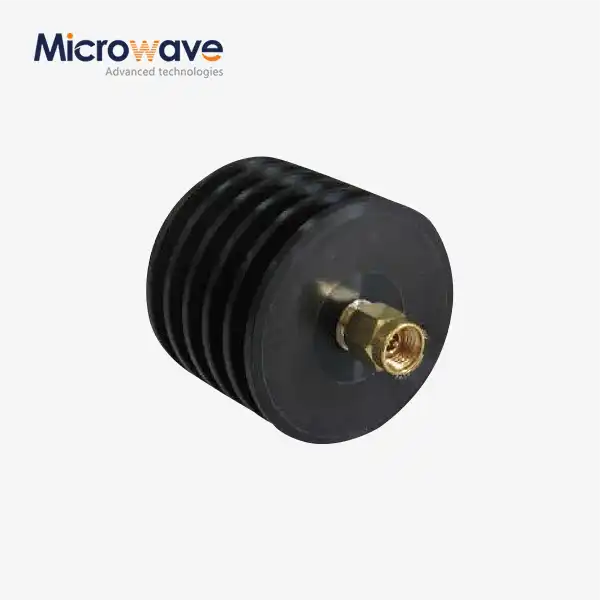
Redirected energy from antenna mismatch or target backscatter can kill solid-state power amplifiers that cost tens of thousands of dollars. This can happen in high-power radar transmitters and electronic countermeasure systems. These circulators send signals that have been reflected to loads that are matched, which keeps sensitive broadcast chains safe. Our high-power models have cavities made of aluminum alloy or copper alloy with better thermal dissipation structures, some of which include heat sinks, to handle the heat load from absorbed and reflected power during long-term high-duty-cycle operations.
This protection feature is very useful for satellite ground station operators because replacing broken traveling wave tube amplifiers (TWTAs) in remote installations is very expensive and causes service interruptions.
Comparing Broadband RF Circulators with Alternative RF Components
Knowing the differences in how passive RF components work helps procurement teams make smart decisions about where to get things.
Circulators Versus Isolators
Even though both devices use ferrite materials and don't work in a mutual way, their designs are for different reasons. An isolator has two ports and protects a source from mirrored power by sending it to a terminal inside the device. A circulator has three or more ports, which lets you set up more complex signal routing scenarios. A three-port circulator can be turned into an isolator by connecting a 50-ohm load to the third port. Because they are more adaptable, circulators are better for prototyping when the system architecture may change, but isolators are usually cheaper when only two ports are needed.

Duplexers and Diplexers in System Context
Using resonant filter structures, duplexers split send and receive signals based on how they differ in frequency. They work well when the transmit and receive bands are far enough apart, but they have trouble with wideband or frequency-agile systems. Broadband rf circulators let you send and receive signals at the same time across the same antenna aperture, even if the frequencies are far apart. This is why they are so important in radar systems that use pulse-Doppler waveforms, where signals are sent and received quickly and at different frequencies.
Competitive Landscape Considerations
Well-known companies like Krytar, Pasternack, and HUBER+SUHNER are in the global market, and they all have different lines of products. Checking sources means looking at more than just the specs on a sheet of paper. You need to check how consistently they make things, how stable their supply chains are, and how well they can help with technical issues. Our ISO 9001:2015 certification at ADM makes sure that strict quality control is carried out throughout the entire production process. Before products are shipped, they are tested in our 24-meter microwave darkroom, which has near and far-field measuring recombination chambers.
It is recommended that procurement teams ask for vector network analyzer (VNA) test data that shows stability in S-parameters across production lots. This includes S21 (insertion loss) and S12 (isolation) over the full bandwidth that was defined. Stay away from sellers who only give you standard performance curves and not any statistical process control data.
Procurement Insights: How to Source and Buy Broadband RF Circulators
Getting these specialized parts through the purchase process means combining technical needs with business realities.
Engaging with Suppliers and Technical Evaluation
Start by giving specific details about the application, such as the frequency range, power levels (both average and peak), environmental conditions, and contact needs (for example, connection types for coaxial units and flange standards for waveguide versions). Reliable providers will not only give stock suggestions, but also application-specific advice on how to balance performance needs.
When you can, ask for evaluation samples, especially for new designs or applications that are very specific. Our team offers fast development services that let your tech team test how well the product works in real-world situations before committing to large-scale production. During this evaluation phase, technical support should include help with installation and troubleshooting if problems arise during the initial integration.
Understanding Lead Times and Customization Options
Standard stock items usually ship within two to four weeks. Custom designs, like non-standard frequency ranges, better power handling, or special environmental sealing, may take eight to twelve weeks, depending on how complicated they are. Project delays can be avoided by planning procurement timelines around these facts. One of the things we can make is OEM parts for large customers who need changes that are specific to their needs, like different port arrangements, built-in mounting tools, or different heat management features.
When you buy more than 25 units, the price usually goes down, but there are higher prices for buying 100 or more units and 500 or more units. Think about the total cost of ownership instead of just the unit price. A slightly more expensive gadget with better reliability and technical help is often a better choice for a program than the cheapest one.
Quality Verification and Compliance Documentation
For defense and aircraft use, strict tracking is needed. Make sure that the supplier you choose gives you full test results, such as full four-port S-parameter data, power handling verification, and environmental stress screening results. As part of our quality control process, we test for thermal shock, vibration, and Passive Intermodulation (PIM) to make sure that connection joints and ferrite materials don't send out unwanted signals that could make communication receivers less sensitive.
Depending on the end use and market location, you may need to show proof that your products comply with RoHS rules and do not contain conflict minerals. We keep our environmental management certification ISO 14001:2015 up to date and can give you full material declarations upon request.
Best Practices for Integrating Broadband RF Circulators into Your RF Systems
It's not enough to just put the component in the signal line for deployment to go well.

Installation and Impedance Matching
Making sure the ports are oriented correctly is the first step in a proper installation. If you connect the ports incorrectly, the whole system will fail or get damaged. For coaxial units, use calibrated torque tools to get the torque values recommended by the connector maker. Tightening too much can damage the connector interfaces, while loosening too little can cause connections to break and cause PIM. To keep RF from leaking, waveguide circulators need to have their flanges precisely aligned and the right seal materials used.
When the device is working at close to its maximum power rating, place it on thermally conductive surfaces and make sure there is enough airflow around surfaces that remove heat. Some types of high-power waveguides have threaded mounting holes for adding external heat sinks or forced-air cooling devices for areas with very high temperatures.
Verification Testing and Performance Validation
Once everything is set up, use a calibrated VNA to take swept-frequency readings to make sure that the insertion loss and return loss meet the requirements across the operating band. Comparing the measured isolation to the values given in the datasheet could reveal problems with the installation or damage to the component during handling. Power tests should be done slowly. Start at 10% of the rated power and watch the output signals for distortion. Then slowly raise the power while keeping an eye on the temperature to make sure it doesn't rise too quickly.
Maintenance and Long-Term Reliability
Most passive parts don't need much care, but checking their performance on a regular basis can find problems before they become system failures. Over years of use, thermal cycling and vibration can change the internal magnetic structures. Plan VNA readings once a year as part of preventative maintenance plans. This is especially important for systems where a broken part would cause mission-critical outages.
Units with an IP67 or IP68 rating that are used outside should have their connector interfaces checked once a year for corrosion or water entry. We make these sealed versions especially for radar sites on the ground, systems on ships, and stable satellite stations that are in bad weather.
Conclusion
Broadband rf circulators are an important piece of technology for modern multi-band communication systems, wideband radar platforms, and frequency-adjustable electronic warfare. They are very important in mission-critical RF designs because they protect transmitters and route signals while maintaining constant performance across octave-spanning bandwidths. To be successful at procurement, you need to know the technical factors that affect performance, work with knowledgeable sellers who offer full support, and follow the right merging procedures. ADM has been making devices for over 20 years and has a lot of experience with precise microwave parts. Our devices are backed by advanced measurement tools and strict quality systems. Choosing the right broadband circulator early on in the system design process makes RF architecture easier, cuts down on the number of parts needed, and protects your platform against changing frequency needs.
FAQ
How does temperature affect circulator performance?
The magnetic properties of ferrite change with temperature. High-quality units use permanent magnets that are temperature-compensated and certain ferrite doping formulations to keep center frequency shifts and isolation degradation to a minimum. Careful design of the magnetic circuits in our devices keeps them working at the right temperatures from -40°C to +85°C. When temperatures get too high or too low, insertion loss goes up, and separation goes down. This is because the ferrite gets closer to its Curie temperature, at which is where its magnetic properties weaken a lot.
Can these devices handle both CW and pulsed signals?
Yes, but rates for power handling are different for CW (continuous wave) and pulsed operation. The CW ratings are limited by temperature—the ferrite and housing must constantly release absorbed power. Pulsed ratings show the highest voltage that internal parts and connectors can handle before they break. Most radar systems work in pulsed mode, which has high peak powers but low duty cycles so that the device has time to cool down between bursts. Always make sure that the normal and peak power requirements match the needs of your product.
What limits achievable bandwidth in broadband designs?
Bandwidth is limited by the physics of ferrite scattering and the need to match impedances. As the bandwidth goes up, it gets harder to keep low insertion loss, high separation, and good VSWR all at the same time. As a trade-off for wider frequency coverage, ultra-wideband units might be willing to accept slightly lower specifications, like 0.8 dB insertion loss instead of 0.5 dB. When compared to simple narrowband resonant structures, gradient impedance matching networks that make broadband operation possible are more complicated and cost more.
Partner with a Trusted Broadband RF Circulator Supplier
Advanced Microwave Technologies Co., Ltd. has been making high-quality broadband rf circulator for more than 20 years. Our ISO 9001:2015-certified facilities have testing tools that can go up to 110 GHz, so we can be sure that every part meets your exact requirements before it is shipped. No matter if you need standard catalog items or OEM solutions that are made just for you for defense, aerospace, satellite communications, or telecommunications uses, our engineering team is there to help you every step of the way. We keep a ready supply of common configurations on hand and offer fast development for unique needs. Our technical sales team can be reached at craig@admicrowave.com to talk about your unique application needs, get evaluation samples, or get full technical documents. Our global logistics network makes sure that deliveries happen on time, and our after-sales support team is always available to help with integration and provide long-term technical advice.
References
1. Helszajn, J. (2008). Ferrite Circulators and Isolators for Microwave Systems. London: Institution of Engineering and Technology Press.
2. Linkhart, D. K. (2014). Microwave Circulator Design, 2nd Edition. Norwood: Artech House Publishers.
3. Pozar, D. M. (2011). Microwave Engineering, 4th Edition. Hoboken: John Wiley & Sons, Chapter 9: Passive Microwave Devices.
4. Adam, J. D., Davis, L. E., Dionne, G. F., Schloemann, E. F., & Stitzer, S. N. (2002). Ferrite devices and materials. IEEE Transactions on Microwave Theory and Techniques, 50(3), 721-737.
5. Schloemann, E. F. (1970). Circulators for microwave and millimeter-wave integrated circuits. Proceedings of the IEEE, 58(8), 1174-1182.
6. Fay, C. E., & Comstock, R. L. (1965). Operation of the ferrite junction circulator. IEEE Transactions on Microwave Theory and Techniques, 13(1), 15-27.