





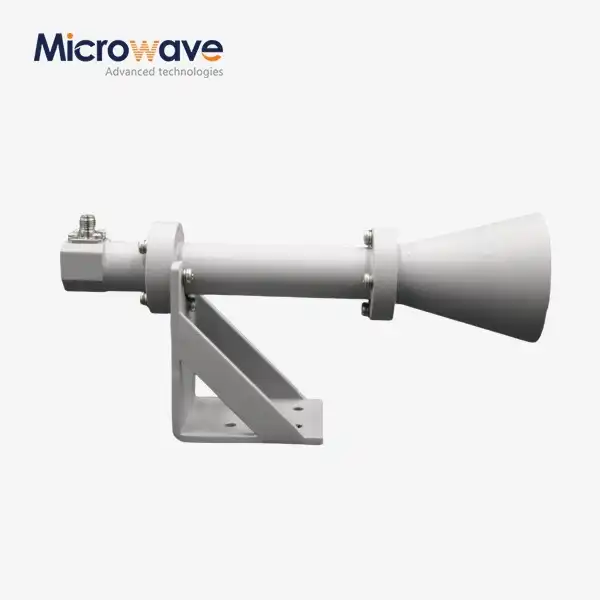
Dual Linear Broadband Circular Polarization Horn Antenna
Dual Linear Broadband Circular Polarization Horn Antenna
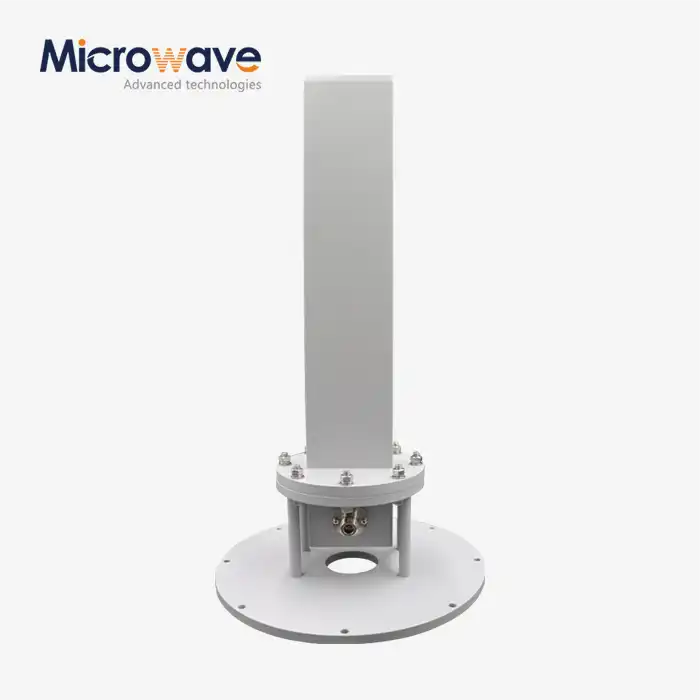
The Dual Linear Broadband Circular Polarization Horn Antenna from Advanced Microwave Technologies is a quad-ridged horn design with two orthogonal feed ports that natively support vertical and horizontal linear polarization. When connected to a 90° hybrid coupler, it generates RHCP and LHCP from the same aperture. Operating across 1 GHz to 40 GHz in octave or three-octave configurations, it suits EMC testing, satellite TT&C, and radar measurement workflows where polarization flexibility matters.
How It Works?
This antenna uses a quad-ridged waveguide feed structure. The two orthogonal ports deliver independent V and H linear components. Adding a 90° hybrid coupler — either external or integrated — introduces the phase relationship between ports that produces circular polarization. Switching between linear and circular modes requires no mechanical adjustment to the antenna itself; you reconfigure at the coupler level.
Port isolation between the V and H inputs keeps the two channels orthogonal, which is necessary for accurate polarization vector calculations and scattering matrix measurements.
Key Features
· Frequency range: 1 GHz to 40 GHz; octave and three-octave bandwidth options
· Polarization modes: Dual linear (V and H) plus RHCP/LHCP via external or integrated 90° hybrid coupler
· Antenna type: Quad-ridged broadband horn
· Axial ratio: < 1–3 dB in CP mode
· VSWR: < 2.0 (return loss > 10 dB)
· Connectors: N-type or SMA (specify at order)
· Phase center calibration data: Available on request
· Form factor: Compact relative to operating bandwidth; contact us for dimensional drawings
Compared to spiral antennas across the same frequency range, quad-ridged horn designs generally offer higher gain and greater power-handling capacity, while also retaining the option to operate in linear polarization mode.


Technical Specifications
Parameter | Value / Description |
Frequency Range | 1 GHz – 40 GHz |
Polarization | Dual Linear (V & H) / RHCP & LHCP (with 90° hybrid coupler) |
Antenna Type | Quad-Ridged Broadband Horn |
Axial Ratio | < 1–3 dB (CP mode) |
VSWR | < 2.0 (Return Loss > 10 dB) |
Bandwidth Configuration | Octave / Three-Octave |
Phase Center Data | Available upon request |
Connector Type | N-type / SMA (specify at order) |
Size | Compact — contact us for dimensional drawings |
Custom frequency ranges and connector configurations are available. Contact us at craig@admicrowave.com to discuss your requirements.
Application Scenarios for Dual Linear Broadband Circular Polarization Horn Antenna
Satellite TT&C and Signal Monitoring
Faraday rotation happens to signals as they travel through the ionosphere. This moves the polarisation plane and can lead to link fading. Operating the Dual Linear Broadband Circular Polarization Horn Antenna in circular polarization mode keeps reception consistent regardless of that rotation, without requiring mechanical reorientation of the antenna.
Tests for EMC
This antenna can be used in a wide range of anechoic chambers to test for radiated immunity and emissions in line with standards like CISPR 25 and MIL-STD-461. With broadband coverage, you don't have to switch antennas as often between frequency bands. The CP mode also lets you find the highest emission levels no matter what angle the device being tested is facing, which is something that a linear-only antenna might miss.
Over-The-Air (OTA) Tests for 5G and 6G
For studying MIMO efficiency and polarisation diversity in mobile devices, this antenna can be used as a measuring tool to get a full 3D picture of the radiation pattern. Cross-polarization discrimination (XPD) in complex antenna arrays can be studied independently when circular polarisation is synthesised.
Analysis of the Radar Cross Section (RCS)
In the same hardware setup, both V and H components can be recorded at the same time. This lets you measure a target's full scattering matrix and reconstruct any polarisation state afterward, without having to change the setup of the measurement system between takes.
Quality Control
Every unit is tested in ADM's 24 m microwave darkroom, which is equipped with an Antenna Plane Near and Far Field Measuring Recombination Chamber. The facility covers 0.5 GHz to 110 GHz.
Inspection items include:
· Axial ratio verification — Measured via rotating source method; confirmed below the 1–3 dB target to avoid elliptical polarization degradation
· VSWR and return loss sweep — Full-band VNA sweep; return loss must exceed 10 dB (VSWR < 2.0)
· Port isolation testing — S21 measured between both input ports to confirm orthogonality
· Gain and pattern calibration — Compared against standard gain horns using the 3-Antenna Method; 3D radiation patterns reviewed for main lobe symmetry and sidelobe levels
· Mechanical tolerance check — Ridge gaps and connector interfaces inspected to a machining tolerance of 0.01 mm to prevent impedance discontinuities at higher frequencies
About ADM
Advanced Microwave Technologies has over 20 years of experience in microwave component and Dual Linear Broadband Circular Polarization Horn Antenna development, with offices in Xi'an, Chengdu, Beijing, Tianjin, and Shijiazhuang and a dedicated R&D laboratory. The in-house 24 m darkroom and 0.5–110 GHz measurement range support design validation and production testing for each product.
FAQ
Q: What kind of circular polarisation does this antenna give off on its own?
A: Not really. The horn is dual linear in and of itself. You connect it to an external or built-in 90° hybrid coupler to make RHCP or LHCP. When you place your order, let us know if you need an integrated polariser.
Q: How should I handle power levels during immunity testing?
A: The amount of power it can handle depends on the type of connection (N-type or SMA) and the size of the internal ridge gap. Before you finalise your setup for high-field-strength EMC work, make sure you get the CW and peak power levels for the hybrid coupler subassembly.
Q: Can it be used to measure polarisation diversity?
A: Yes. When you connect a receiver to both ports at the same time, it records the full vector content of the incoming wave, including the magnitude and phase for both V and H. This means that any polarisation state can be recovered after the fact.
Q: How stable is the phase center across the band?
A: As the frequency goes up, the phase center moves along the antenna axis in quad-ridged horns. You can use the phase center calibration data that ADM gives you to apply correction factors directly in your measurement software.
Q: Can I change the frequency range?
A: Yes, ADM can set custom frequency ranges, with options for octave and three-octave bandwidths. Email craig@admicrowave.com to talk about your particular need.
Contact Us
For quotes or custom configurations for the Dual Linear Broadband Circular Polarization Horn Antenna, email craig@admicrowave.com. We will follow up with specifications and pricing based on your requirements.
YOU MAY LIKE
 VIEW MOREPoint Focusing Horn Lens Antenna
 VIEW MOREFeed Fired Lens Antenna
 VIEW MOREWideband Double-ridged Horn Antenna
 VIEW MOREUltra Double-ridged Horn Antenna
 VIEW MORELadder Membrane Conical Dual circular Polarization Horn Antenna
 VIEW MOREPlanar Spiral Antenna
 VIEW MOREQuadrifilar Helix Antenna
 VIEW MOREAntenna Near Field Measurement Probe