




Which antenna is best excited from a waveguide?
Waveguide Horn Antennas are clearly the best choice when looking for the antenna that works best with waveguide stimulation. Through their carefully designed curving structure, these specialised aperture antennas are very good at turning guided electromagnetic waves into radiation that can travel through space. When compared to other antenna designs, horn antennas have better impedance matching, less signal loss, and better gain characteristics. Their form naturally fits the square or round shape of waveguides, so they don't need the complicated transitions that other types of antennas do. Because they work so well with other parts, horn antennas are the standard for high-frequency uses that need accuracy, dependability, and performance.
Introduction
Modern high-frequency communication systems are built around waveguide technology, which sends electromagnetic information across microwave and millimeter-wave spectrums more efficiently than any other method. Choosing the right antenna systems excited from waveguides has a direct effect on system performance, operational costs, and the difficulty of integration for procurement professionals working on complex B2B projects. This in-depth analysis looks at basic waveguide excitation principles, different antenna configurations that can be used with waveguide feeds, and gives engineering teams in the defence, aerospace, satellite communications, and telecommunications sectors useful information. By learning about these technologies, you can make smart purchasing decisions that will get you the best return on your investment and meet mission-critical performance standards. The guide talks about important things to think about when choosing an antenna, such as impedance matching, frequency compatibility, gain requirements, and environmental constraints. We also talk about the pros and cons of the different kinds of antennas. This gives procurement managers the detailed information they need to compare suppliers and find the best solutions for their needs.
Understanding Waveguide Excitation and Antenna Types
Defining Horn Antenna Technology
Waveguide Horn Antennas are very complex impedance transformers that change guided waves that are moving through metal structures into radiation that travels through empty space. The flaring geometry gradually increases the waveguide cross-sectional area, which allows controlled impedance transformation from the waveguide's characteristic impedance to the 377-ohm impedance of free space. This impedance-matching ability sets horn antennas apart from other configurations, allowing energy to be transferred efficiently without the big losses that come with sudden changes. These antennas are especially useful for high-power applications where efficiency has a direct effect on system performance and running costs. This is because the smooth transformation reduces reflection losses while keeping signal integrity across a wide frequency range.
Alternative Antenna Configurations
While horn antennas are most common in waveguide-fed applications, other kinds of antennas have their own benefits in certain situations. Patch antennas come in small sizes that work well for array setups, but they need complicated feed networks to connect to waveguides. Slot antennas are cut directly into waveguide walls and can be mounted flush, but they don't have as much bandwidth as horn configurations. Dipole antennas are useful for many situations, but they need balun transformers to connect to waveguides, which adds complexity and potential failure points. A lot of the time, horn antennas are used as feed elements in parabolic reflector systems. This is because they combine the benefits of horn stimulation with the high-gain directivity that comes from reflector focusing.
Critical Design Parameters
How well a horn antenna works depends on its frequency range, which in turn depends a lot on its opening size, flare angle, and length-to-width ratio. Larger openings usually give a wider antenna frequency range, but they need longer horn lengths to keep phase errors as low as possible across the radiating surface. The flare angle changes both the impedance and the radiation pattern. The best angles balance sidelobe suppression with gain maximisation. Waveguide dimensions must match standard sizes to make sure electromagnetic modes propagate properly, and higher-order modes are generated as little as possible. Together, these parameters decide important performance metrics like gain, bandwidth, polarisation purity, horn antenna frequency range, and radiation pattern shape. This lets engineers choose the best configurations for each application.
How Waveguide Horn Antennas Work: Core Principles
Electromagnetic Wave Propagation
Controlled electromagnetic wave transmission from confined waveguide modes to radiating aperture fields is what makes horn antennas work. Electromagnetic energy moves through the waveguide section as guided waves with clear field distributions set by the waveguide geometry and operating frequency. As the waves enter the flaring horn section, the gradually expanding cross-section lets field patterns change smoothly while keeping phase coherence across the aperture. This controlled growth keeps the field from breaking up in sudden places, which could cause unwanted reflections or change the way radiation patterns are spread.
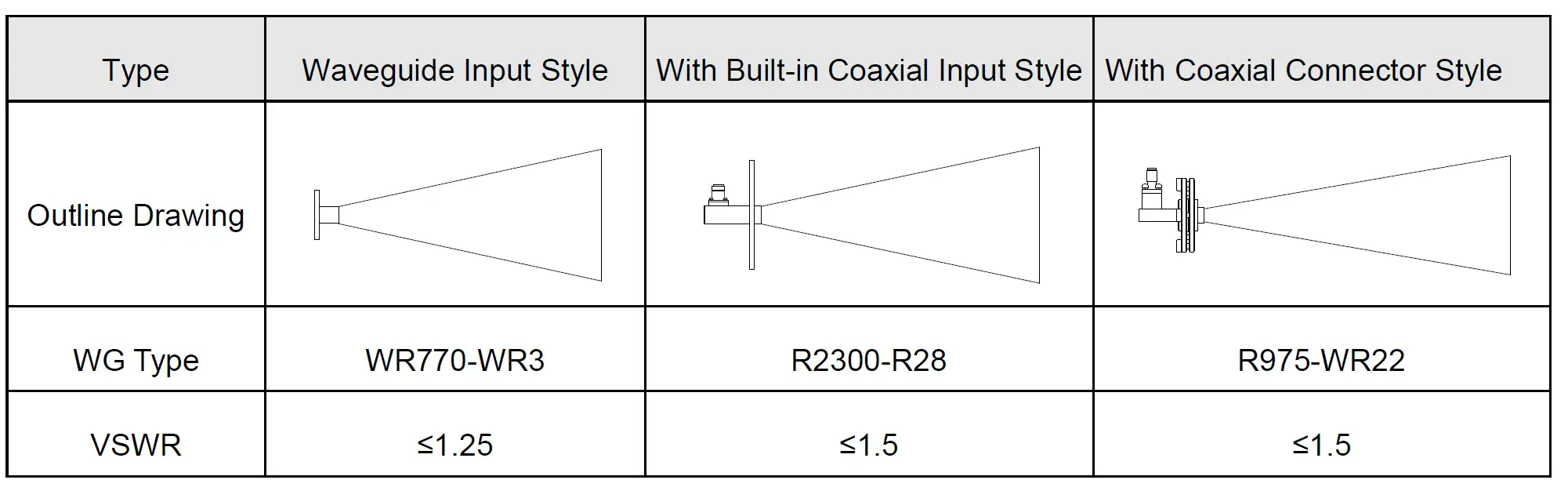
Frequency Range Capabilities
Microwave frequencies from about 1 GHz to millimeter-wave frequencies above 100 GHz can be successfully used with waveguide horn antennas. The frequency range is determined by the size of the waveguides that connect them; each standard waveguide size supports a certain frequency band. Waveguide cutoff characteristics determine the lower frequency limits; below these limits, propagation stops, and radiation efficiency drops dramatically. The highest frequency limits are usually set by manufacturing tolerances and the properties of the material, not by basic electromagnetic limits. This means that these antennas can support new millimeter-wave applications like 5G communications and automotive radar systems.
Radiation Pattern Characteristics
Horn antennas send out radiation in very specific directions and have gain and beamwidth features that can be predicted. When compared to the operating wavelength, the size of the aperture determines the shape of the radiation pattern. Larger electrical apertures produce narrower beamwidths and higher directivity. Sidelobe levels and pattern symmetry can be controlled by tapering the aperture and optimising the horn geometry. Harness antennas are very useful for uses that need to precisely control the beam, produce little interference, and have consistent coverage patterns.
Comparing Waveguide Horn Antennas with Alternative Antennas
Horn vs. Patch Antenna Configurations
Some patch antenna parts aren't as good as horn antennas in terms of gain and bandwidth. While patch antennas are great for low-profile groups, each element can only provide gains of 6–9 dB. Horn setups, on the other hand, can provide gains of 10–25 dB. When it comes to broadband uses, horn antennas are better than patch antennas because they can cover a wider frequency range with just one element. Because they are easy to install, patch antennas work better in small spaces. Horn antennas, on the other hand, don't need the complicated corporate feed networks that high-gain patch arrays do. It is easier to work with high-power devices when they are cool because this lowers input loss and makes them more reliable.
Comparison with Dipole and Slot Antennas
For waveguide integration, dipole antennas need balun transformers, which add extra insertion loss and possible failure points. Horn antennas let you directly integrate waveguides without adding any extra parts. This makes the system more reliable while lowering its complexity. Slot antennas are better for flush mounting than horn antennas because they have a smaller bandwidth and less gain. For slot antennas in waveguide walls, manufacturing needs to be very precise. This is especially true at millimeter-wave frequencies, where dimensional margins are very important.
Parabolic and Reflector System Integration
Large parabolic reflector systems frequently employ horn antennas as feed elements, capitalizing on the controlled radiation patterns and high efficiency of horn configurations. The feed horn illuminates the reflector surface with an optimized taper to maximize antenna efficiency while minimizing spillover loss. This combination enables extremely high-gain systems suitable for satellite communications and radio astronomy applications. The horn feed approach provides flexibility in polarization control and frequency coverage while maintaining excellent cross-polarization isolation.
Conical vs. Pyramidal Horn Geometries
Conical horn antennas interface naturally with circular waveguides and support both linear and circular polarization modes depending on feed configuration. These antennas produce symmetric radiation patterns ideal for applications requiring circular beam coverage. Pyramidal horn antennas connect directly to rectangular waveguides, preserving linear polarization purity without requiring mode converters. The asymmetric aperture enables independent control of horn antenna frequency range and beamwidth in perpendicular planes, allowing optimization for specific coverage requirements.
Practical Applications and Advantages of Waveguide Horn Antennas for B2B Clients
Critical Application Sectors
Waveguide Horn Antennas serve essential roles across multiple high-technology sectors demanding exceptional performance and reliability. Radar systems utilize these antennas for weather monitoring, air traffic control, and military surveillance applications where accurate target detection and tracking capabilities are paramount. Satellite communication ground stations rely on horn antennas as feed elements for large parabolic dishes, enabling reliable long-distance communications for telecommunications, broadcasting, and data transmission services. The predictable gain characteristics and excellent polarization isolation make these antennas ideal for preventing interference between multiple satellite links. Microwave link systems connecting cellular tower sites and providing backhaul connectivity depend on horn antennas for point-to-point communications. The high gain and narrow beamwidth characteristics enable spectrum reuse while maintaining link reliability across challenging propagation environments.
The following advantages make horn antennas particularly attractive for demanding B2B applications:
- Environmental Robustness: All-metal construction withstands extreme temperature variations, humidity, and mechanical stress without performance degradation
- High Power Handling: Absence of internal dielectric components enables kilowatt-level power transmission without breakdown risks
- Predictable Performance: Theoretical gain calculations provide accurate performance predictions, facilitating system design and optimization
- Broad Bandwidth: Single antenna elements cover entire waveguide bands, reducing component count and system complexity
These characteristics translate directly into reduced maintenance costs, improved system availability, and simplified procurement processes for B2B customers managing complex installations.
Real-World Performance Examples
A big European weather service updated its weather radar with horn antenna arrays, which increased the accuracy of detecting rain by 30% and lowered the number of false alarms. The better performance made it possible to make more accurate weather predictions, which helped the farm and transportation sectors' economies in big ways. Defence companies have successfully used horn antenna systems in harsh environments like the desert and the Arctic, where the temperatures changed by more than 100°C without losing their effectiveness. These sites show why mission-critical applications should pay more for higher levels of reliability.
Buying Guide: How to Choose and Procure the Best Waveguide Horn Antenna
Technical Specification Requirements
To successfully buy a horn antenna, you must first clearly define the frequency range you need. This is usually done by giving waveguide band names like X-band, Ku-band, or Ka-band. Specifications for gain must take into account both basic performance needs and coverage area limits, since antennas with higher gains have narrower beamwidths. When choosing an antenna, polarisation plays a big role. For linear polarisation, pyramidal horns work best, while for circular polarisation, conical configurations or special feed networks may be needed. Materials and building needs are based on environmental factors such as temperature range, humidity exposure, and mechanical loading. Power handling must be able to handle both average and peak power levels, taking into account things like operating at high altitudes, where air density changes affect breakdown limits. Size and weight limitations affect the choice of horn geometry, especially in aerospace uses, where every gram affects how well the system works.
Supplier Evaluation Criteria
Leading global suppliers, including Keysight Technologies, Pasternack, Flann Microwave, Waveguide Horn Antennas, and Communications & Power Industries, offer comprehensive horn antenna product lines with varying specializations. Keysight excels in precision measurement applications, providing calibrated standard gain horns with traceable performance documentation. Pasternack focuses on commercial applications with competitive pricing and rapid delivery capabilities, while Flann Microwave specializes in high-frequency millimeter-wave products serving research and development markets. Evaluation criteria should include technical support capabilities, customization options, and delivery timeline consistency. Quality verification requires examining detailed datasheets, requesting sample units for evaluation, and reviewing third-party test reports. ISO 9001 certification and military standard compliance indicate robust quality systems, while RoHS compliance ensures environmental regulatory adherence.
Procurement Strategy Considerations
Most of the time, lead times are between a few days for stock items and eight to twelve weeks for custom designs. When you make a budget, you should include both the cost of getting something and the cost of keeping it in good shape over time. But horn antennas generally don't need much care. Custom manufacturing is helpful when you need frequency ranges that aren't standard, different mounting choices, or extra protection from the environment that standard products don't provide. If you include providers early on in the system design process, you can find ways to make it work better and save money on the project as a whole.
Conclusion
When you need an efficient waveguide input, Waveguide Horn Antennas are the best choice because they give you the best performance in terms of gain, bandwidth, and reliability. Radar, satellite communications, and microwave links in the aerospace, defence, and telecommunications businesses can't work without them because they make it easy to change directed waves into free-space radiation. When you put together reliable performance, resistance to weather damage, and a large frequency range, you get strong benefits that help you make B2B buying decisions. When engineering teams understand the technical principles, comparative benefits, and application needs, they can make decisions that enhance system performance while minimizing risks and costs.
FAQ
1. What frequency ranges are optimal for waveguide horn antennas?
Horn antennas operate effectively across microwave frequencies from approximately 1 GHz to millimeter-wave frequencies exceeding 100 GHz. The specific operational range depends on the connecting waveguide dimensions, with each standard waveguide size supporting a defined frequency band. X-band applications typically operate from 8-12 GHz, while Ka-band systems cover 26-40 GHz ranges commonly used in satellite communications.
2. Are waveguide horn antennas suitable for 5G wireless infrastructure?
Yes, horn antennas provide excellent performance for 5G infrastructure applications, particularly in millimeter-wave bands above 24 GHz. Their high gain and narrow beamwidth characteristics enable precise beam forming required for 5G small cell deployments. The broad bandwidth capabilities support the wide channel bandwidths specified for 5G systems while maintaining excellent pattern stability across the operating range.
3. How do different horn antenna types affect radiation characteristics?
Pyramidal horns produce asymmetric beam patterns, allowing independent control of beamwidth in perpendicular planes, making them ideal for applications requiring specific coverage shapes. Conical horns generate symmetric patterns suitable for applications needing circular coverage areas. The choice between configurations depends on specific beam shape requirements, with pyramidal horns typically providing better sidelobe suppression in one plane while conical horns offer more uniform coverage patterns.
Partner with ADM for Premium Waveguide Horn Antenna Solutions
Advanced Microwave Technologies Co., Ltd (ADM) stands ready to support your Waveguide Horn Antennas procurement requirements with over 20 years of specialized manufacturing experience. Our state-of-the-art 24m microwave darkroom enables precise antenna characterization up to 110 GHz, ensuring every product meets stringent performance specifications. As a leading waveguide horn antenna manufacturer, we provide ISO 9001:2015 certified products with comprehensive customization capabilities tailored to your exact technical requirements.
Our expert engineering team offers complete OEM services, rapid prototyping, and technical support throughout your project lifecycle. Contact craig@admicrowave.com today to discuss your specific application needs and receive detailed quotations backed by our proven track record in defense, aerospace, and satellite communication markets.
References
1. Balanis, Constantine A. "Antenna Theory: Analysis and Design." John Wiley & Sons, Fourth Edition, 2016.
2. Milligan, Thomas A. "Modern Antenna Design." IEEE Press Series on Electromagnetic Wave Theory, Second Edition, 2005.
3. Orfanidis, Sophocles J. "Electromagnetic Waves and Antennas." Rutgers University Press, 2016.
4. Stutzman, Warren L. and Gary A. Thiele. "Antenna Theory and Design." John Wiley & Sons, Third Edition, 2012.
5. IEEE Standards Association. "IEEE Standard for Definitions of Terms for Antennas." IEEE Std 145-2013, Institute of Electrical and Electronics Engineers, 2013.
6. Collin, Robert E. "Foundations for Microwave Engineering." IEEE Press Series on Electromagnetic Wave Theory, Second Edition, 2001.