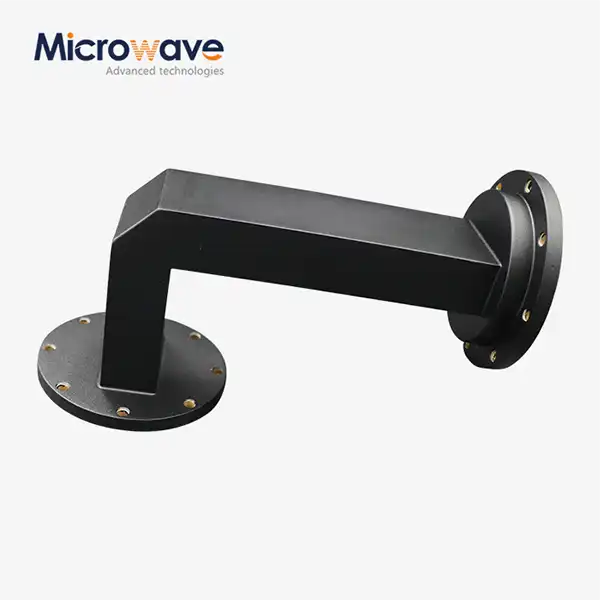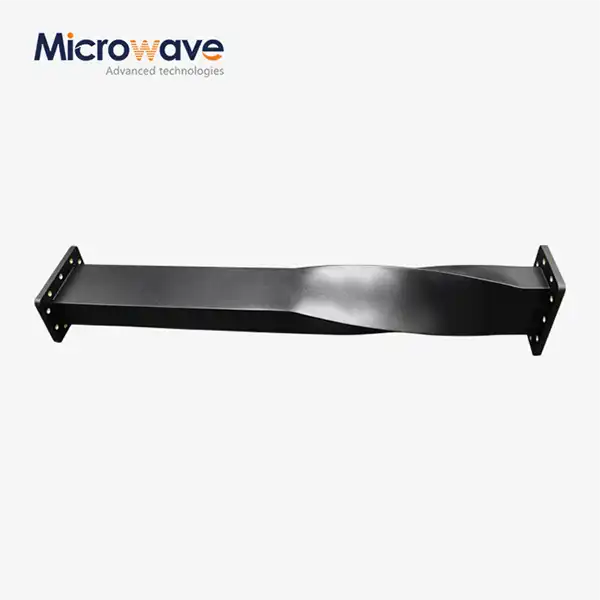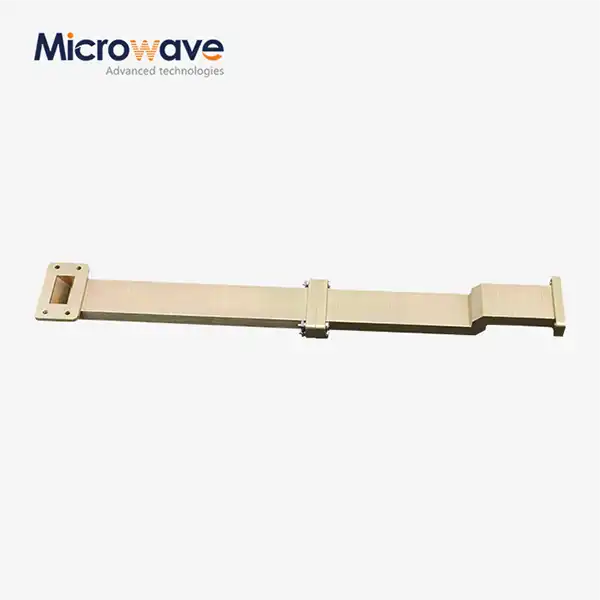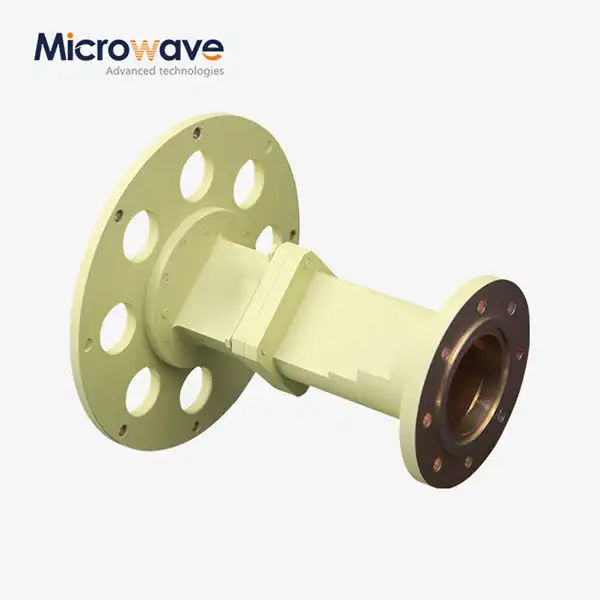





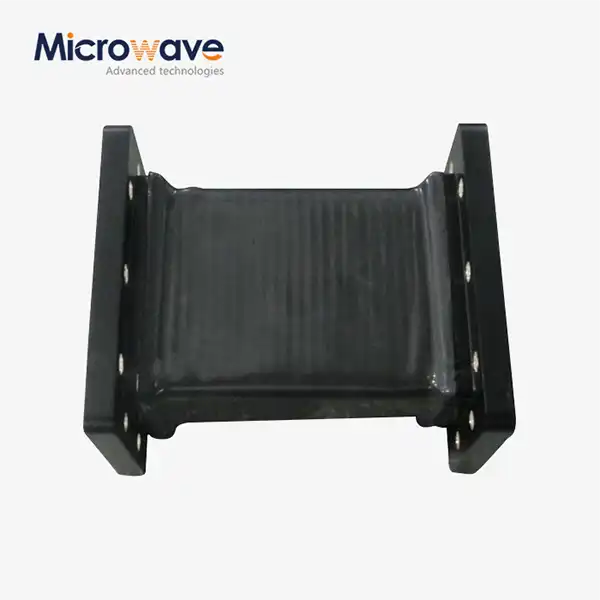
Flexible Seamless Waveguide
Flexible Seamless Waveguide for RF Systems
Flexible Seamless Waveguide from Advanced Microwave Technologies (ADM) is machined from a single corrugated metallic tube with no joints or interlocking strips. This construction delivers hermetic sealing, shielding effectiveness above 100 dB, and VSWR as low as 1.05:1. Standard lengths run from 100 mm to 1000 mm, covering WR650 through WR10 (1.12 GHz to 110 GHz). ADM has supplied waveguide components for satellite communication, aerospace radar, and medical accelerator programs for over two decades, manufacturing to MIL-DTL-28837 and IEC 60153.
What Is a Flexible Seamless Waveguide?
Unlike flexible-twistable waveguides assembled from interlocking metal strips, a product is formed from a single thin-walled metallic tube — typically phosphor bronze, brass, or beryllium copper — mechanically corrugated to introduce flexibility while maintaining a fully sealed RF path.
This continuous structure addresses three engineering challenges that interlocking designs cannot resolve:
· Hermetic sealing for pressurized or high-vacuum environments
· PIM elimination by removing metal-to-metal friction contact points
· Vibration and thermal decoupling to absorb mechanical stress between rigid waveguide sections
The corrugated tube can be bent in both E-plane and H-plane orientations. Seamless designs are not natively twistable; axial rotation requires a separate rotating flange mechanism.

Technical Specifications
Parameter | Specification |
Frequency Range | 1.12 GHz – 110 GHz (WR650 to WR10) |
VSWR | 1.05:1 to 1.15:1 (length and frequency dependent) |
Pressurization Capability | 30 – 45 psi (wall thickness and jacket dependent) |
Shielding Effectiveness | > 100 dB |
Standard Lengths | 100, 200, 300, 500, 600, 900, 1000 mm |
Tube Materials | Phosphor Bronze, Brass, Beryllium Copper |
Jacket Options | Neoprene, Silicone, Metal Braid |
Compliance Standards | MIL-DTL-28837, IEC 60153 |
Flange Interface Standards | UG/U, CPR |
Flexibility Configuration | E-plane / H-plane bend |
Material and Construction Details
The material of the tube has a direct effect on how well it works electrically and mechanically. Phosphor bronze has a good balance of how well it conducts electricity and how long it can bend. When price is the most important thing, brass is often chosen. Beryllium copper is better at resisting fatigue in dynamic applications that bend over and over again.
Neoprene is usually used for the outer jacket because it is good for general field protection. Silicone can handle high heat and UV light. A second layer of metal braid can be added to make it more resistant to wear in rough deployment settings, like those on ships or in the air.
Coordinate Measuring Machines (CMM) are used to check each flange interface against UG/U or CPR standards to make sure it is flat and that the bolt holes are lined up correctly. This makes sure that the interfaces always fit properly with rigid waveguide sections.
Key Application Scenarios
Satellite Earth Station Uplinks
When installed outside, these waveguides connect High Power Amplifiers (HPAs) to antenna feeds. The seamless design allows for pressurisation with dry nitrogen or dehydrated air. This keeps moisture out and lowers the risk of arcing when it's humid or raining a lot.
Medical Linear Accelerators (LINACs)
RF power delivery to the structure that speeds things up works in a very dry environment. A flexible seamless waveguide provides a vacuum-tight connection while accommodating gantry movement during treatment — a condition that interlocking-strip designs cannot meet due to their inherent leakage paths.
Airborne and Naval Radar Systems
Rigid waveguide plates are stressed over and over again by constant vibrations from engines or the sea. This waveguide is put between the transmitter and the antenna array. It works as a mechanical buffer, spreading out the stress at the flange joints and keeping the signal transmission steady even when the mechanical load is high.
Quality Control and Testing Protocol
Each waveguide goes through inspection at multiple production stages before shipment.
VSWR and Insertion Loss Sweep — A Vector Network Analyzer (VNA) sweeps the full operating frequency band. Anomalies in the trace indicate corrugation inconsistencies or impedance mismatches.
Pressure and Leakage Testing — The waveguide is pressurized to the rated level and monitored for pressure decay over 24 hours, confirming the integrity of the brazed flanges and the seamless tube wall.
Dimensional Inspection — Flange flatness and bolt-hole alignment are measured by CMM to verify compliance with UG/U or CPR interface standards.
Flex-Life Cycling Test — Random samples undergo repeated bending cycles per MIL-DTL-28837 flexure requirements to confirm the tube metal will not fatigue or crack under operational use.
ADM's testing laboratory covers frequency measurements from 0.5 GHz to 110 GHz, and the facility includes a 24-meter microwave darkroom for high-precision RF performance evaluation.
Customization and Supply Options
Standard lengths cover the majority of system integration requirements. ADM also supports custom lengths and configurations. You can specify tube material, jacket type, flange standard, and operating frequency band when submitting an inquiry.
For high-power applications, unjacketed versions are available to improve heat dissipation. This configuration is relevant for ground-based satellite systems running continuous high-duty-cycle transmission.
If your project involves non-standard frequency bands or unusual mechanical constraints for a flexible seamless waveguide, ADM's engineering team can provide direct technical consultation before you place an order.
FAQ
Q: What is the main difference between bendable waveguides that are seamless and those that can be twisted?
A: The seamless type is a single corrugated tube that is vacuum and pressure tight and doesn't have a natural path for RF leakage. The type that can be twisted is made of interlocking metal strips. This type of insulation can rotate axially but isn't airtight by nature and can make passive intermodulation (PIM) noise when metals touch.
Q: Can these waveguides be used in uses that are always moving?
A: They do a good job of blocking vibrations and aligning static positions. For long-term dynamic bending, like in a moving radar arm, the bend radius needs to stay within the minimum dynamic bend radius so that the metal doesn't wear out over time.
Q: What's the difference between the bend radius for an E-plane and an H-plane?
A: When you bend along the wide dimension (H-plane), you change the shape of the tube wall more than when you bend along the narrow dimension (E-plane). Each plane has a specific minimum bend radius. If you operate below either value, the device will permanently deform and the VSWR will rise.
Q: What kinds of materials are there for jackets?
A: Standard choices include Neoprene for all-around protection, Silicone for high-temperature and UV areas, and an outer layer made of metal braid to protect against wear and tear in rough field operations.
Q: How do high-power setups deal with heat?
A: The continuous metal path moves heat more effectively than designs that fit together. For high peak-power uses, models without jackets are a good place to start. Pressurisation and air cooling from the outside can help with thermal management, but it depends on the duty cycle and the shape of the installation.
Q: How can I be sure that the construction is seamless before I buy?
A: Ask for the report on the pressure decay test and the full-band VNA sweep that shows the VSWR and insertion loss for the whole working band. The flange interfaces' CMM dimension records show that they fit together correctly. To get documentation for a certain part number or setup, email ADM at craig@admicrowave.com.
Contact Us
Send your specifications, custom length requirements, or application questions about the Flexible Seamless Waveguide to craig@admicrowave.com.