




How to Choose a Waveguide Flange Gasket for Pressurized Systems
Choosing the right waveguide flange gasket for a pressurized system requires more than picking a standard seal. These components serve as the critical interface between mating waveguide flanges, simultaneously providing electromagnetic continuity and hermetic sealing. In pressurized RF systems — typically charged with dry nitrogen to prevent arcing — a poorly selected gasket can cause RF leakage, elevated VSWR, or pressure loss. This guide walks through material properties, dimensional tolerances, compliance standards, and procurement considerations to help engineering and sourcing teams make confident, specification-driven decisions.
Understanding Waveguide Flange Gaskets and Their Role in Pressurized Systems
The Dual Function That Makes Selection Non-Negotiable
A waveguide flange gasket does two things at the same time. It keeps an airtight pressure seal between the flange faces and maintains electrical continuity across the joint. This keeps the RF energy inside the waveguide path. A gap of just a few thousandths of an inch can cause signal bounce and impedance mismatch that can be measured, which lowers the system's VSWR too much.
In pressurized waveguide systems, dry nitrogen or dry air is usually used to keep the inside surroundings at a slight positive pressure. This keeps the dielectric from breaking down at high power levels and stops water from getting in. That pressure line is held by the seal. When it fails, whether because of worn-out materials, bad installation, or choosing materials that don't work well together, the effects can be anything from slowing down performance over time to the system failing completely in mission-critical situations.
Understanding this two-in-one mechanism is the first step in making a good decision about which gasket to buy.
Key Criteria for Selecting Waveguide Flange Gaskets
Material Composition: The Starting Point
When choosing a material for a waveguide flange gasket, you can directly affect its temperature stability, chemical resistance, conductivity, and how it behaves in long-term compression set. These are the main types of materials that are used to make precision RF gaskets:
- Silicone-based conductive elastomers can usually handle temperatures from -55°C to +125°C, which means they can be used for most ground-based and flying tasks. To ensure the volume resistance is less than 0.005 ohm-cm, they are filled with electrical particles like nickel-graphite (Ni/C) or silver-plated aluminum (Ag/Al).
- Fluorosilicone-based gaskets are required when jet fuel, hydraulic fluids, or strong chemicals are present in the sealing environment. When exposed to hydrocarbons, regular silicone swells and breaks down, but fluorosilicone keeps its shape and electrical properties.
- Expanded PTFE with conductive fillers is often used in high-power SATCOM ground station waveguide systems that need to be both pressure-tight and have low RF contact resistance at high current levels.
Most of the time, design mistakes happen when people pick the wrong grid material. Once the temperature range, chemical exposure, and frequency band for the application are known, choosing the right material is a lot easier.
Dimensional Compatibility and Flange Standards
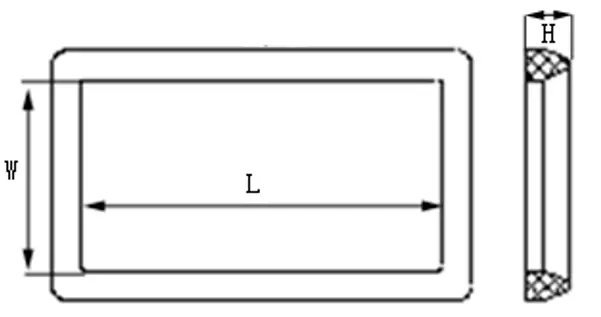
The shape of the gasket has to exactly match the opening in the waveguide. A hole that is too small gets in the way of the waveguide, working as an iris that causes a lot of signal bounce. To make sure the apertures are lined up correctly, precision die-cut or molded seals are made for common waveguide sizes like WR-90 (8.2 to 12.4 GHz) or WR-137 (5.85 to 8.2 GHz). These are made to within ±0.005 inches of the actual size.
The shape of the flange face is also important. Different types of flanges, UBR (UG/cover) and CPR (choke/groove), have different closing surface shapes, so the thickness of the gasket needs to be the right one. Standard widths of 0.027" and 0.032" are designed to achieve the 10–15% compression deflection that is suggested without the chance of deflection into the waveguide path or blowout under pressure.
Compliance and Quality Standards
Teams that buy things for defense, aerospace, and satellite systems can't accept items that aren't properly recorded. MIL-DTL-83528 is the standard specification for conductive elastomer gaskets used for EMI shielding and sealing against the environment. Products that meet this standard are tested to make sure they meet the requirements for shielding efficiency (IEEE-STD-299), volume resistance (ASTM D991), and compression set performance.
For projects that need galvanic compatibility, silver-aluminum filled silicone is designed to keep aluminum waveguide flanges from rusting. This is a common problem in marine and outdoor systems where water acts as an electrolyte between metals that are not compatible.
Comparing Waveguide Flange Gaskets with Alternative Sealing Solutions
When procurement teams look at different ways to seal waveguide assemblies, O-rings and foam gaskets are sometimes suggested as cheaper options. Each can be useful in some situations, but neither is as good as a properly specified conductive elastomeric waveguide flange gasket when it comes to electromagnetic and pressure performance.
O-rings are great at sealing against pressure, but they don't block electromagnetic waves. If you don't include the electrical seal path in a high-frequency waveguide joint, RF can leak out. This is especially true as the frequencies get closer to millimeter-wave bands. For basic environmental protection, foam gaskets work, but they break down quickly when compressed for a long time, and they don't conduct electricity well enough to keep signals intact across the flange interface.
Conductive waveguide gaskets, on the other hand, have shielding efficiency greater than 100 dB across the 10 MHz to 10 GHz range when made to MIL-DTL-83528. This makes them the best choice when both sealing and RF continuity are needed at the same time.
Practical Guide to Procurement and Installation
Sourcing Considerations for B2B Buyers
Getting precision conductive waveguide flange gaskets reliably depends on the supplier's skills, not just the catalog's supply. Important sourcing factors include:
- Material traceability that has been documented (batch-level approvals for MIL-DTL-83528 compliance)
- Optical or CMM-verified measurement inspection records are sent with the goods.
- Customization options for waveguide apertures that aren't standard or OEM integration needs
- Minimum order amounts that are reasonable and meet the needs of both prototypes and production volumes
Installation Best Practices
The long-term success of a seal depends on how well it was installed. The goal is to get the compression deflection that the manufacturer says should happen, which is usually between 10 and 15 percent, all the way across the flange face. To keep things from loading unevenly, which can lead to RF leakage routes, bolts should be torqued in a cross-pattern order. When the torque is too high, the conductive filler particles get crushed, and material is pushed into the waveguide opening. When the torque is too low, both the EMI seal and the pressure limit become less stable.
As a general rule, the gasket should be replaced every time the flange is opened. When conductive elastomers are first torqued, they go into a permanent compression set. Reusing them causes unpredictable changes in both their ability to block and seal.
Real-World Applications Across Critical Industries
Waveguide flange gaskets work well in some of the harshest RF environments used today. In aircraft radar systems, fluorosilicone conductive covers keep the electricity flowing even when the temperature changes from -55°C to +125°C. They also keep hydraulic fluid from getting into the engine bay. In high-power SATCOM uplink stations, kilowatt-class amplifiers are fed by pressurized waveguide runs that are sealed by strengthened conductive gaskets. Arcing avoidance is just as important as signal purity. In naval communication arrays, silicone gaskets filled with silver-aluminum protect against galvanic corrosion when exposed to salt spray for a long time. This extends the time between maintenance checks for antenna arrays that are hard to get to at sea.
Each of these deployments shows a careful process for choosing the right materials and sizes. The one thing they all had in common was that the gasket standard was made as a technical choice, not as an afterthought during the buying process.
Conclusion
The process of choosing a waveguide flange gasket for a pressurized system is very scientific and involves material science, measuring dimensions, and making sure the system is compliant. For as long as the waveguide system is in use, the right gasket will protect both the RF integrity and the pressure limit. If you treat it like any other seal, it could fail at the system level, which would be much more expensive to find and fix. Your waveguide system will work as planned if you focus on written compliance, checked dimensional tolerances, and material fit with your particular working environment.
FAQ
Can a waveguide flange gasket be reused after a flange is reopened?
No, conductive elastomers have a permanent compression set after they are first torqued. Reusing shielding makes it hard to predict how well it will work and can cause pressure leakage. Every time the flange joint breaks, you have to get a new waveguide flange gasket.
What is the difference between silicone and fluorosilicone gaskets?
Silicone can be used for many things and in a lot of different temperatures. Fluorosilicone is used when the seal will be near fuels, oils, or solvents, which are places where regular silicone breaks down and grows.
How does gasket thickness affect RF performance?
The thickness changes the length of the electrical path across the joint and the chance that material will push through into the waveguide opening. Standard engineered thicknesses, which are usually 0.027" or 0.032", are the best way to balance compression performance with dimensional stability.
What causes galvanic corrosion at waveguide flange joints?
Galvanic corrosion happens when metals that are not the same touch each other and there is moisture present. Silver-aluminum-filled silicone is the best filler for aluminum flanges because it reduces the difference in electrochemical potential and makes the parts last longer in wet or salty environments.
Partner with ADM for Precision Waveguide Flange Gasket Solutions
High-reliability RF and microwave parts are made by ADM, which has been in the business for more than 20 years. ADM is a reliable waveguide flange gasket seller that is ISO 9001:2015 certified and RoHS compliant. They offer custom-engineered gasket solutions, clear material tracking, and quick OEM support. Get in touch with our technical team to talk about your needs, get a price, or look at our full range of waveguide assemblies. Visit email craig@admicrowave.com to get in touch with us.
References
1. IEEE Standard 299-2006: Standard Method for Measuring the Shielding Effectiveness of Enclosures and Boxes Having All Dimensions Between 0.1 m and 2 m — IEEE, 2006.
2. MIL-DTL-83528: Detail Specification — Gasketing Material, Elastomeric, Electrically Conductive — U.S. Department of Defense, 2021.
3. ASTM D991: Standard Test Method for Rubber Property — Volume Resistivity of Electrically Conductive and Antistatic Products — ASTM International, 2014.
4. Pozar, D.M. — Microwave Engineering, 4th Edition — Wiley, 2011.
5. Parker Hannifin Corporation — EMI Shielding Design Guide: Conductive Elastomers and Gaskets — Parker Chomerics Division, 2019.
6. Laverghetta, T.S. — Practical Microwaves — Prentice Hall, 1996.