





How Much Isolation Does Your Broadband Coaxial Circulator Need?
When specifying a broadband coaxial circulator for your RF system, isolation is the one parameter you cannot afford to underestimate. In simple terms, isolation measures how well the device blocks a signal from leaking backward between ports. For most commercial applications, 20 dB is the accepted floor. Defense radar, satellite ground stations, and precision test benches routinely demand 30 dB or higher. ADM's broadband coaxial circulator covers DC to 40 GHz with a guaranteed isolation of ≥20 dB, making it a solid starting point for a wide range of signal routing requirements.
Understanding Isolation in Broadband Coaxial Circulators
There is more to isolation than just a number on a datasheet. It directly affects how well your RF system works when it's loaded.
What Isolation Actually Measures
Isolation measures the loss of signal strength, measured in decibels, of a signal going the other way through a circulator port. A signal that goes into Port 1 should leave through Port 2 in a three-port device. Any power that gets into Port 3 from the back path lowers the receiver's sensitivity and can damage parts further down the line. It is better for the gadget to stop that annoying leakage if the dB number is higher.
Why It Matters in Wideband RF Systems
Engineers can tune the ferrite joint very closely in narrowband designs to separate the peaks at a single center frequency. It is technically harder for broadband devices to keep up that level of performance across multiple octaves. When Tx and Rx chains share a single coaxial broadcast line, like in 5G base stations or satellite duplexers, small loss of isolation at the band edges can cause interference between channels.
Industry Baseline: 20 dB to 40 dB
According to published IEEE and MIL-SPEC documents, most commercial RF systems can handle 20 dB of isolation. However, sensitive receive chains, like those in AESA radar T/R modules, need 30 dB to 40 dB. If you pick the wrong grade, you could lose performance and damage the amplifier if power from the reflection goes back to a source port.
Key Technical Factors Influencing Isolation Requirements
How much isolation a certain broadband coaxial circulator can actually provide across its working band is controlled by a number of factors that work together.
Frequency Range and Bandwidth
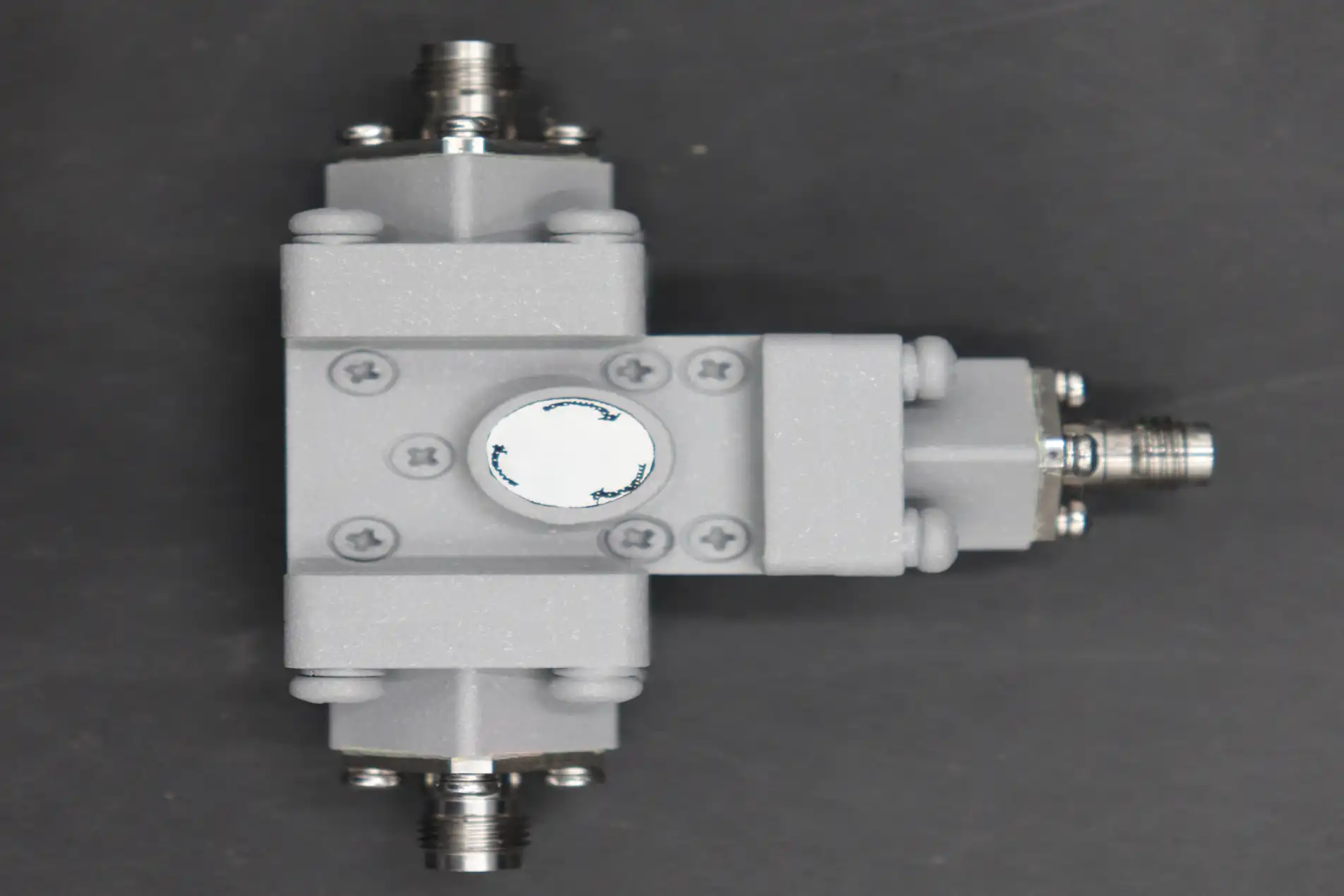
Dispersive magnetic behavior is shown by ferrite materials, which means that their separation reaction changes naturally with frequency. For a device to work from DC to 40 GHz, the permanent magnet assemblies must be carefully calibrated, and the cavity geometry must be optimized so that the isolation stays the same from the low end to the millimeter-wave edge. If there is an impedance difference in the coaxial hollow structure, there will be isolation dips at certain frequencies in the band.
Insertion Loss and the Isolation Trade-Off
The terms "isolation" and "insertion loss" are related. Forward insertion loss can go up when aggressive impedance matching is used to improve separation across a wide band. Through careful oxygen-free copper cavity cutting and choosing a low-loss ferrite core, ADM's design keeps insertion loss at ≒0.3 dB (DC–10 GHz), ≒0.5 dB (10–20 GHz), and ≒0.8 dB (20–40 GHz). This shows that the trade-off can be handled.
Temperature and Environmental Stability
Temperature changes how permeable ferrite is. Isolation can drop a lot when a system gets hot during high-power operation if there is no magnetic field stability control. ADM solves this problem with temperature-compensated permanent magnet systems that keep the isolation constant over a working range of -45 °C to +85 °C. This is a requirement that is directly relevant to aircraft and outdoor telecom deployments.
Selecting the Right Isolation Level for Your Application
To match an isolation grade to a certain use, you need to know what happens when that grade isn't met.
20 dB: General Commercial and Industrial Use
When the transmit-to-receive power ratio is reasonable, and the receiver is not overly sensitive, a standard of ≥20 dB works well. In this group are things like industrial RF equipment, broadcast cable TV signal splitting, and standard test bench setups. The circulator stops large amounts of signal loss without making the manufacturing cost higher by making the specs stricter.
30 dB: Telecommunications and Satellite Infrastructure
Satellite ground stations and 5G relay nodes have receiver noise floors that are delicate enough to be harmed by even a small amount of signal loss. A 30 dB separation grade acts as a buffer, making sure that the Tx chain doesn't mess up the Rx line when transmitting and receiving at the same time. This is the grade that telecom systems integrators most often ask for when they are looking for coaxial RF circulators today.
40 dB and Above: Radar, Defense, and Precision Measurement
This is the most difficult part of the spectrum: AESA radar T/R units and electronic warfare devices. At an isolation level of 40 dB, the reverse signal power only makes it through the joint 0.01% of the time. Some high-power radar emitters can put out hundreds of watts of power at their peak. They need this level of protection to keep the sensitive low-noise amplifiers on the receive side from overloading or getting permanently damaged.
How to Verify and Test Isolation in Broadband Coaxial Circulators
On paper, it's easy to describe isolation. A disciplined test approach is needed to make sure it works in hardware before putting the whole system together.
S-Parameter Measurement with a VNA
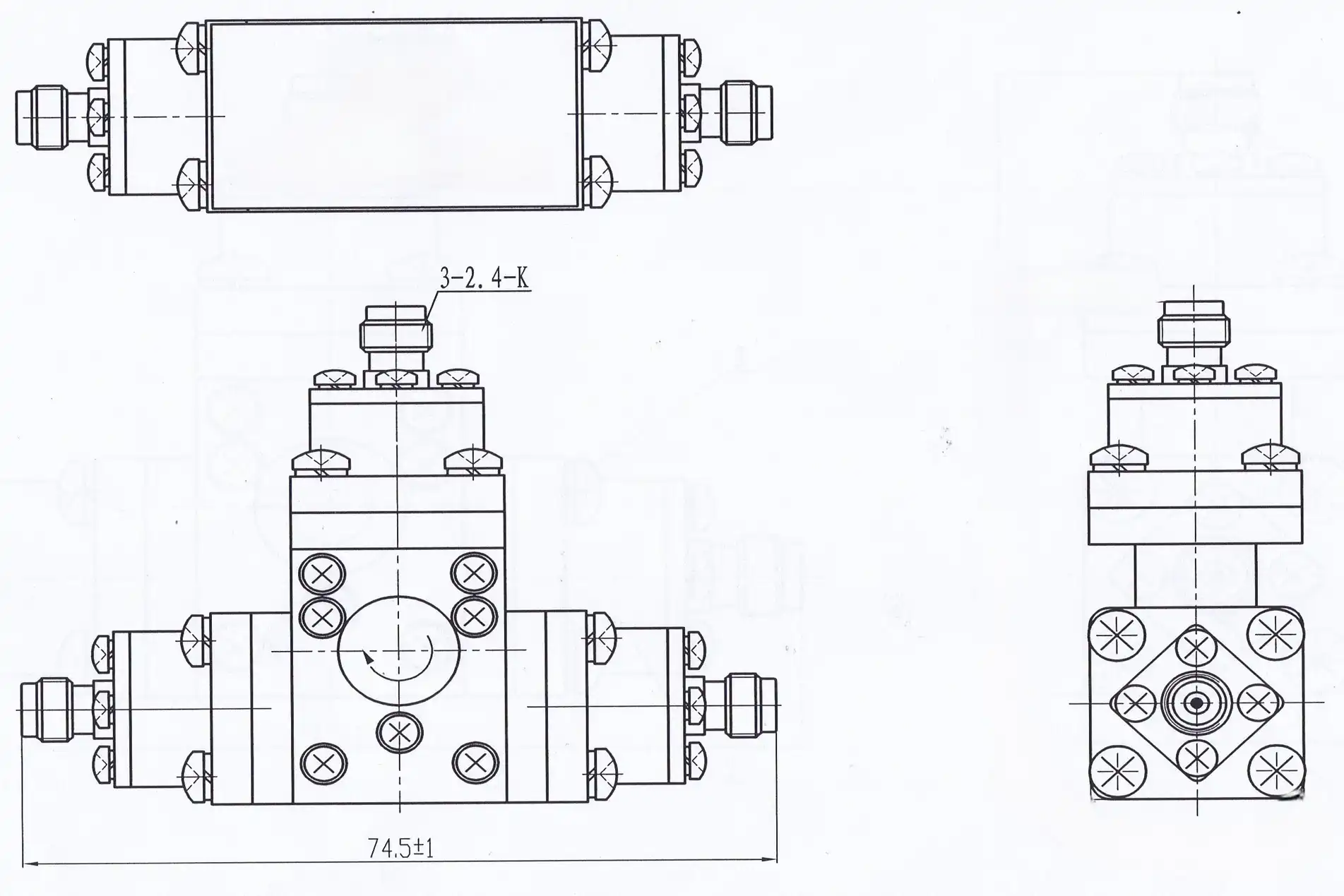
A vector network tester checks S-parameters over the whole frequency range. For a three-port circulator, S31 (or S12, based on how the ports are labeled) directly shows that the device is isolated. At the factory, a full-band S-parameter sweep is done on every ADM unit. The pass/fail criteria are applied to all frequencies in the band, not just the center frequency. This way, there are no hidden isolation drops at the band edges.
Calibration and Environmental Controls
To get a correct measurement of isolation, you need a VNA that has been properly calibrated and has had a full two-port SOLT or TOSM calibration performed before the measurement run. The effects of the test fixture, cable losses, and the repeatability of the connectors all add to the uncertainty. When the broadband coaxial circulator works near the top of its band (20–40 GHz), even one SMA or 2.92 mm connection that isn't properly installed can add insertion loss that makes the true isolation figure look different.
Datasheet Review and Third-Party Validation
Ask for a test result as well as a public specification before you buy. Broadband coaxial circulator providers you can trust will give you test results for each unit that can be tracked back to calibrated standards. Validation by a third party from a recognized RF laboratory adds another level of trust, especially for defense procurement programs that need proof of traceability. This level of documentation is standard for ADM's quality management system, which is ISO 9001:2015 certified.
Brands, Suppliers, and Procurement Tips for High-Isolation Circulators
There are a lot of well-known brands in the blender market. Catalog broadband isolators with documented S-parameter files are sold by Pasternack and Mini-Circuits. Defense systems can get ruggedized units from Smiths Interconnect and Raditek. Each brand has a range of frequency sub-bands and power levels. Instead of depending on the main specification, you should compare their published isolation curves to the frequencies you will be using.
Before you place an order, here are the most important things to think about when buying something:
- Isolation flatness across the band: A specification of ≥20 dB means the minimum; ask for the typical curve across the full frequency range to identify any band-edge degradation.
- Power handling under continuous wave conditions: Thermal dissipation at high CW power is limited by the ferrite and housing design. ADM's standard 50 W model uses copper heat-sink integration to manage this safely.
- Custom configurations and lead time: Many projects require non-standard connector types, flange mounting, or extended temperature ratings. Confirm whether the supplier can deliver custom units within your project schedule.
- Compliance documentation: ISO 9001 and RoHS certifications are baseline requirements for most defense and telecom procurement programs. Verify these are current and cover the specific product line.
Documentation for compliance: ISO 9001 and RoHS certifications are basic needs for many defense and telecom buying programs. Make sure these are up-to-date and cover the right product line.
Conclusion
Not every situation needs to be isolated in the same way. Most telecom and satellite applications need 30 dB, while defense radar chains usually need 40 dB or more. Commercial systems can work reliably at 20 dB. It's easy to get the right answer if you look at your Tx-to-Rx power ratio, receiver sensitivity, and frequency range. The ADM broadband coaxial circulator works from DC to 40 GHz and has insertion loss as low as 0.3 dB and separation of ≥20 dB. It gives a strong base that can be set up to meet stricter requirements. Make sure the specs fit your machine, check them with the right VNA measurements, and buy from a seller who gives you test instructions that you can follow.
FAQ
What is the minimum isolation I should specify for a 5G base station application?
It is usually best to have at least 30 dB of isolation in 5G RF front-ends where the send signal power is much higher than the receive sensitivity level. This gives enough room for error so that Tx leaking doesn't lower the receiver noise figure when everything is working normally.
Can I use a broadband coaxial circulator as an isolator?
Yes, connecting a 50-ohm load to Port 3 ends the three-port circulator and turns it into a two-port isolator. Signals go from Port 1 to Port 2, and any echoes coming back into Port 2 are thrown off into the load at Port 3, which keeps the source amplifier safe.
Does temperature affect isolation performance over time?
It might be able to if the blower doesn't have the right magnetic field correction. ADM's design uses permanent magnet assemblies that are temperature-compensated and keep their isolation fixed from -45 °C to +85 °C, which is enough for most industry and aircraft duty cycles.
How do I confirm isolation before system integration?
- Ask the maker for test data on the S-parameters for your particular unit. Before you install, use a calibrated VNA to check the S31 value across your whole working band. Do not depend on the stated minimum specification alone; look at the real measurement curve as well.
Partner with ADM for Your Broadband Coaxial Circulator Requirements
ADM delivers broadband coaxial circulator solutions with DC–40 GHz coverage, ≥20 dB isolation, and full ISO 9001:2015 and RoHS compliance. As a trusted broadband coaxial circulator manufacturer with over 20 years of production experience, ADM supports OEM customization, fast prototype turnaround, and dedicated technical engineering assistance. Contact our team directly at craig@admicrowave.com to request a datasheet or discuss your application specifications today.
References
1. Pozar, D. M. Microwave Engineering, 4th ed. Wiley, 2011.
2. Helszajn, J. Ferrite Phase Shifters and Control Devices. McGraw-Hill, 1989.
3. IEEE Standard 1785-2012: IEEE Standard for Rectangular Metallic Waveguides and Their Interfaces for Frequencies of 110 GHz and Above. IEEE, 2012.
4. Collin, R. E. Foundations for Microwave Engineering, 2nd ed. IEEE Press / Wiley-Interscience, 2001.
5. Balanis, C. A. Advanced Engineering Electromagnetics, 2nd ed. Wiley, 2012.
6. Microwave Journal — "Wideband Circulator Design for Modern EW and Radar Systems." Horizon House Publications, 2019.
YOU MAY LIKE
 VIEW MORECircular Waveguide To Coaxial Adapter
 VIEW MOREWaveguide Power Divider
 VIEW MOREBroadwall Directional Coupler
 VIEW MOREWaveguide Probe Coupler
 VIEW MOREWaveguide Coupling Fixed Attenuator
 VIEW MOREDouble Ridge Waveguide Transition
 VIEW MOREDouble Ridge Twist Waveguide
 VIEW MORESingle Channel Coaxial Rotary Joint