





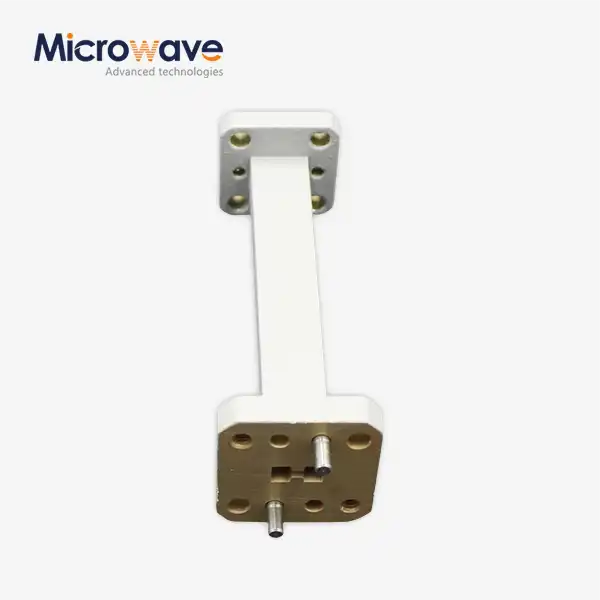
Double Ridge Waveguide Transition
Double Ridge Waveguide Transition – Broadband Coaxial-to-Waveguide Interface for High-Frequency Systems
Advanced Microwave Technologies (ADM) manufactures Double Ridge Waveguide Transition products covering standard WRD bands and custom multi-band configurations for extended frequency ranges. These passive components convert the 50-ohm characteristic impedance of a coaxial line to the frequency-dependent impedance of a ridged waveguide. The symmetrical ridge geometry enables multi-octave bandwidths — such as 3:1 or 4:1 ratios — across ranges like 6.5–18 GHz (WRD-650) or 18–40 GHz (WRD-180), with VSWR typically below 1.30:1 or 1.50:1 across the full operating band.
How a Double Ridge Waveguide Transition Differs from Standard Transitions
Standard rectangular waveguide transitions operate within a single frequency band, typically offering 40–50% operational bandwidth. Covering a 6–40 GHz spectrum with standard components would require three separate waveguide assemblies.
A product addresses this by using symmetrical ridge geometry to lower the cut-off frequency of the fundamental mode while raising the frequency of higher-order modes. The result is a single component capable of multi-octave coverage, which reduces hardware count in broadband systems.
Technical Specifications
Parameter | Specification |
Frequency Range | WRD-650: 6.5–18 GHz; WRD-180: 18–40 GHz; custom multi-band options available |
Bandwidth Ratio | Multi-octave, typically 3:1 to 4:1 |
VSWR | ≤ 1.30:1 or ≤ 1.50:1 (full band) |
Impedance | 50 Ohm coaxial to ridged waveguide |
Body Material | Aluminum 6061, Copper, or Brass |
Surface Finish | Silver or Gold plating; Chromate conversion coating |
Connector Interface | SMA, N-Type, or custom coaxial connectors |
Flange Type | FPWRD series double-ridge flanges |
Waveguide Types Supported | Rectangular, flat rectangular, medium flat rectangular, square, circular, single ridge, double ridge |
Materials and Construction
Each transition is made by ADM from metals with a high conductivity. When weight is an issue, aluminium 6061 is used. When electrical contact is important, copper or brass is chosen.
After machining, surface treatment is done. When microwave waves are used, silver or gold plating lowers ohmic losses. Chromate conversion coatings protect parts from corrosion when they are used outside or in damp places.
The most important mechanical factor is the ridge gap dimension. Impedance matching is affected by small changes across the whole band. ADM checks this dimension on every output batch with a coordinate measuring machine (CMM) to within a few microns.
Application Scenarios
Electronic Warfare (EW) and ECM Systems
In airborne jamming systems, limited room makes it best to use a single product that feeds a broadband antenna across multiple threat bands, like 6.5–18 GHz, without having to switch mechanically between different waveguide assemblies.
How to Measure Radar Cross Section (RCS)
When engineers set up an anechoic room, they use ridge transitions to connect VNA coaxial ports to wideband gain horn antennas. For wide frequency sweeps, this keeps the calibration the same, so hardware changes don't have to be made in the middle of a test.
Ground Station Amplifiers for SATCOM
In ground stations, Travelling Wave Tube Amplifiers (TWTAs) often send their output to ridged waveguide ports. Double Ridge Waveguide Transitions connect these outputs to coaxial distribution systems so that signals can be monitored and sent to the right places.
Microwave Measurement and Lab Testing
The 24-meter Microwave Darkroom at ADM can test from 0.5 GHz to 110 GHz, which means that ADM-made transitions can be used for accurate measurement setups in the lab or out in the field.
Quality Control Process
Every transition assembly that ADM makes goes through a structured inspection process.
Full-Band VNA Sweep
A calibrated Vector Network Analyser is used to test each unit over the whole working bandwidth. Engineers look for VSWR spikes or mode patterns that show problems with the way the waveguide structure was machined.
Verification of the CMM Ridge Gap
The ridge gap distance directly affects how well the impedance works. Before a unit moves on to the plating step, it is checked with a CMM to make sure that the dimensions are correct to within a few microns.
Plating Stickiness and Check of the Surface
Arcing can happen in high-power situations when plating is not properly joined. When thermal shock testing is done after plating, blistering or peeling is looked for.
Validation of Power Handling
For requests from the military and high-reliability groups, Hi-Pot testing checks the dielectric strength at the coaxial-to-waveguide launch point. This makes sure that the transition can handle the right amount of power without breaking.
Customization Options
ADM supports full customization to match specific system requirements for Double Ridge Waveguide Transition. Configurable parameters include:
· Frequency band and waveguide type (rectangular, square, circular, single ridge, double ridge, flat variants)
· Body material and plating finish
· Connector type (SMA, N-Type, or others)
· Flange pattern matched to your WRD number (e.g., WRD-750)
· Multi-band transition designs covering extended frequency ranges beyond standard WRD configurations
To discuss a custom design, contact ADM's engineering team with your frequency range, connector, flange, and material requirements at craig@admicrowave.com.
FAQ
Q: What is the main benefit of a product over a regular rectangular transition?
A: The major benefit is the amount of bandwidth. A standard rectangular transition can only work with one band, but a double ridge design, like the WRD-650, can work with multiple octaves. In broadband devices, this means that fewer waveguide parts are needed overall.
Q: When it comes to power, how does a double ridge transition compare to a coaxial connector?
A: It can handle more power than just the coaxial cable, but not as much as a regular rectangular waveguide because the ridge gap has a bigger concentration of electric fields. The maximum power that can be used is determined by the type of coaxial connector that is connected to the transition (SMA, N-Type, or something else).
Q: Can these transitions be used in space or a vacuum?
A: Yes, but they need to be marked for use with thermal vacuum (TVAC). This needs holes for air flow to keep air from getting stuck and materials and finishes that don't give off gases all over the assembly.
Q: Why do VSWR spikes show up at certain frequencies?
A: Spikes usually mean that the center conductor probe isn't lined up right with the ridge gap, or that higher-order modes are spreading when the working frequency goes above the single-mode bandwidth of the particular ridge profile.
Q: What kinds of flanges work with double rib transitions?
A: FPWRD series flanges are used for double ridge transitions, which are different from standard UG or CPR flanges. Before you place your order, make sure that the bolt pattern and alignment pin settings match your WRD number.
Q: Can ADM make custom multi-band transitions that go beyond what is required by WRD?
A: Yes, ADM makes custom multi-band changes that go beyond the usual overlapping band arrangements. You can choose the frequency range, waveguide type, material, and connector interface that work best for your system.
Contact Us
For quotes or technical inquiries about Double Ridge Waveguide Transition products, reach ADM's engineering team at craig@admicrowave.com.