




How Does RF Contact & Choke Design Influence Waveguide Single Channel Rotary Joint Performance?
When radar systems fail during critical operations or satellite communications experience signal degradation mid-transmission, the culprit often lies in poorly designed RF contacts and choke structures within the Waveguide Single Channel Rotary Joint. These precision-engineered components serve as the critical bridge between stationary and rotating waveguide sections, and their design directly determines whether your system maintains signal integrity or suffers from devastating power losses, electromagnetic leakage, and premature component failure. Understanding the intricate relationship between RF contact mechanisms and choke designs is essential for engineers seeking to optimize performance in satellite communications, defense radar systems, aerospace applications, and navigation equipment where reliability is non-negotiable.
The Critical Role of RF Contact Design in Waveguide Single Channel Rotary Joint Performance
RF contact design represents one of the most challenging engineering aspects of Waveguide Single Channel Rotary Joint construction. The fundamental challenge lies in maintaining consistent electrical continuity across a mechanical interface that must rotate continuously while transmitting high-frequency microwave signals with minimal loss. Traditional contacting rotary joints rely on physical sliding contacts, typically implemented using spring-loaded configurations with silver-graphite composite materials on touching surfaces. These contact-based designs must balance competing requirements of maintaining low electrical resistance while providing smooth mechanical rotation with acceptable wear characteristics over extended operational lifetimes. The electrical performance of contact-based Waveguide Single Channel Rotary Joint designs depends critically on contact pressure, surface finish, material selection, and contamination control. Insufficient contact pressure results in increased electrical resistance and signal reflection, while excessive pressure accelerates mechanical wear and increases rotational torque requirements. Surface oxidation, particulate contamination, and fretting corrosion at contact interfaces progressively degrade electrical performance over time, making contact-based designs particularly vulnerable in harsh environmental conditions. Advanced Microwave Technologies addresses these challenges through precision-engineered contact geometries and carefully selected contact materials that optimize the trade-off between electrical performance and mechanical reliability.
Modern high-performance Waveguide Single Channel Rotary Joint designs increasingly favor non-contacting approaches that eliminate physical sliding contacts entirely. These contactless designs maintain electrical continuity through carefully engineered electromagnetic coupling across small air gaps, eliminating wear-related degradation and extending operational lifetime significantly. The transition to non-contacting designs requires sophisticated RF engineering to maintain signal integrity across the gap while preventing electromagnetic leakage that would degrade performance. Advanced Microwave Technologies implements multi-stage impedance matching networks and precision gap control mechanisms that ensure contactless Waveguide Single Channel Rotary Joint designs achieve insertion loss below 0.3 dB while maintaining VSWR specifications better than 1.25:1 across operating frequency ranges extending to 40 GHz.
Understanding Choke Section Engineering for Superior Isolation Performance
Choke sections represent one of the most sophisticated engineering solutions employed in Waveguide Single Channel Rotary Joint construction, functioning as distributed electromagnetic structures that prevent RF energy leakage at the critical junction between rotating and stationary waveguide sections. The fundamental principle underlying choke design involves creating resonant cavity structures with carefully calculated dimensions corresponding to specific wavelengths of the operating frequency band. When properly designed, these choke structures establish virtual short circuits at the mechanical interface, effectively containing electromagnetic energy within the intended signal path while permitting mechanical rotation with minimal clearance. The engineering of effective choke sections for Waveguide Single Channel Rotary Joint applications requires extraordinarily precise manufacturing tolerances, particularly for systems operating at higher frequencies where dimensional accuracy directly impacts electromagnetic performance. Quarter-wavelength choke designs create impedance transformations that present high impedance to propagating modes at the mechanical interface, effectively blocking energy leakage through gaps that would otherwise allow signal escape. Multi-stage choke configurations employed by Advanced Microwave Technologies provide enhanced isolation performance across broader frequency bands compared to single-stage designs, with properly implemented multi-stage chokes achieving isolation specifications exceeding 60 dB in high-performance Waveguide Single Channel Rotary Joint assemblies.
The physical geometry of choke structures must accommodate thermal expansion effects, manufacturing tolerances, and mechanical alignment variations while maintaining consistent electromagnetic performance throughout the operational temperature range from -40°C to +85°C. Advanced choke designs incorporate specialized geometries that create distributed capacitance and inductance networks, functioning as integrated filter structures that attenuate unwanted modes while maintaining low insertion loss for desired propagating modes. The effectiveness of these choke sections directly influences overall system performance metrics including return loss, insertion loss, and isolation between channels in multi-channel configurations.
Configuration Options and Their Impact on RF Performance
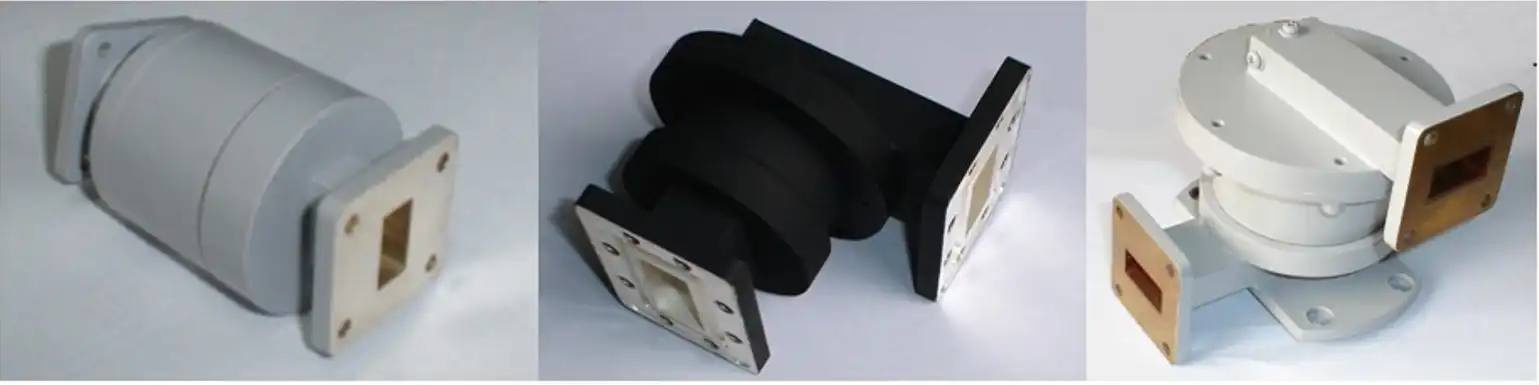
Advanced Microwave Technologies manufactures Waveguide Single Channel Rotary Joints in three distinct configuration styles, each optimized for specific installation requirements and RF performance characteristics. The I-Type configuration features both linear arms aligned with the axis of rotation, providing the most compact axial profile and simplified integration for applications where space along the rotation axis is constrained. This configuration excels in applications requiring minimal rotational inertia and straightforward waveguide routing, making it particularly suitable for tracking antenna systems and surveillance radar platforms where mechanical simplicity translates to enhanced reliability. The L-Type Waveguide Single Channel Rotary Joint configuration positions one waveguide arm perpendicular to the rotation axis while maintaining the other arm in-line with rotation, creating an elbow-style geometry that facilitates flexible system integration. This configuration proves advantageous in installations where space constraints or waveguide routing requirements necessitate right-angle transitions between stationary and rotating sections. The L-Type design maintains excellent RF performance characteristics while providing mechanical advantages for specific mounting scenarios, particularly in shipboard radar systems and weather monitoring installations where equipment layout dictates non-collinear waveguide paths.
U-Type configurations feature both waveguide arms positioned perpendicular to the rotation axis, creating a geometry particularly well-suited for applications requiring offset mounting or specific spatial relationships between input and output waveguide sections. This configuration style finds extensive application in direction-finding systems, UAV communication links, and security scanning equipment where system architecture benefits from the unique mounting geometry. Regardless of configuration type, Advanced Microwave Technologies ensures that each Waveguide Single Channel Rotary Joint maintains consistent electrical performance specifications including insertion loss below 0.3 dB, VSWR better than 1.25:1, and high isolation across the full operating frequency range extending from sub-GHz frequencies to 40 GHz.
Frequency-Dependent Design Considerations for Optimal Performance
The design optimization of Waveguide Single Channel Rotary Joint assemblies requires careful consideration of frequency-dependent electromagnetic phenomena that become increasingly challenging as operating frequencies increase toward millimeter-wave bands. At lower microwave frequencies, waveguide dimensions remain relatively large compared to manufacturing tolerances, providing some design margin for mechanical clearances and assembly variations. However, as operating frequencies approach and exceed 40 GHz, the reduced wavelengths demand correspondingly tighter dimensional control, with mechanical tolerances often required in the micrometer range to maintain acceptable electrical performance specifications. Choke section dimensions scale directly with operating wavelength, requiring different physical geometries across the broad frequency spectrum from 0.5 GHz to 110 GHz served by Advanced Microwave Technologies' measurement capabilities. Quarter-wavelength choke structures operating at X-band frequencies (8-12 GHz) require fundamentally different physical dimensions compared to equivalent structures operating at Ka-band frequencies (26.5-40 GHz), necessitating frequency-specific design optimization for each application. The relationship between choke dimensions and operating frequency creates inherent bandwidth limitations for resonant choke designs, although multi-stage configurations and carefully optimized geometries can extend usable bandwidth to accommodate modern wideband communication and radar systems.
Mode suppression represents another frequency-dependent challenge in Waveguide Single Channel Rotary Joint design, particularly for circular waveguide sections used at the rotating interface. The circularly symmetric TE01 mode provides excellent rotational symmetry for contactless operation, but higher-order modes can propagate at higher frequencies, potentially degrading performance if not properly suppressed. Advanced Microwave Technologies implements mode filters and carefully optimized transition structures that maintain single-mode propagation across the entire operating band while minimizing insertion loss and maximizing return loss performance. These frequency-dependent design considerations ensure that Waveguide Single Channel Rotary Joint assemblies maintain specifications whether operating in legacy communication systems at lower frequencies or supporting bleeding-edge 5G and future 6G technologies at millimeter-wave frequencies.
Integration of Advanced Materials and Manufacturing Techniques
Material selection plays a crucial role in determining both the electrical and mechanical performance characteristics of Waveguide Single Channel Rotary Joint assemblies. Waveguide body construction typically employs high-conductivity aluminum alloys or copper materials that provide excellent electrical performance while maintaining acceptable mechanical properties and manageable weight. Surface treatments including silver plating or gold plating enhance electrical conductivity while providing corrosion resistance critical for long-term reliability in harsh environmental conditions encountered in aerospace, maritime, and outdoor communication installations. Precision bearing systems within Waveguide Single Channel Rotary Joint assemblies demand specialized materials capable of providing smooth rotation with minimal torque while maintaining precise alignment tolerances over extended operational lifetimes. Advanced Microwave Technologies selects bearing materials and lubrication systems specifically optimized for the demanding requirements of continuous rotation under varying load conditions and wide temperature ranges. The bearing assembly must provide mechanical stability sufficient to maintain RF alignment within micrometers while accommodating thermal expansion effects that could otherwise degrade electrical performance as ambient temperatures vary across the specified -40°C to +85°C operational range.
Modern manufacturing techniques including precision CNC machining, electrical discharge machining (EDM), and advanced metrology systems enable the extraordinarily tight tolerances required for high-frequency Waveguide Single Channel Rotary Joint production. Advanced Microwave Technologies' 24m Microwave Darkroom and Antenna Plane Near and Far Field Measuring Recombination Chamber provide comprehensive verification capabilities, allowing full characterization of RF performance parameters including insertion loss, return loss, isolation, and pattern stability across the full 0.5-110 GHz frequency capability. This integration of precision manufacturing with comprehensive test capabilities ensures that every Waveguide Single Channel Rotary Joint meets stringent specifications before shipment to customers in satellite communications, defense, aerospace, and navigation applications worldwide.
Conclusion
RF contact and choke design fundamentally determine Waveguide Single Channel Rotary Joint performance through their influence on insertion loss, isolation, and long-term reliability across diverse operating conditions.
Cooperate with Advanced Microwave Technologies Co., Ltd.
Partner with a China Waveguide Single Channel Rotary Joint manufacturer renowned for excellence. As a leading China Waveguide Single Channel Rotary Joint supplier and China Waveguide Single Channel Rotary Joint factory, Advanced Microwave Technologies offers High Quality Waveguide Single Channel Rotary Joint solutions at competitive Waveguide Single Channel Rotary Joint price points. With over 20 years of expertise, ISO 9001:2015, ISO 14001:2015, and ISO 45001:2018 certifications, plus advanced testing capabilities up to 110 GHz, we deliver China Waveguide Single Channel Rotary Joint wholesale solutions and premium Waveguide Single Channel Rotary Joint for sale globally. Our OEM services include rapid prototyping, custom frequency designs, and comprehensive technical support. Contact craig@admicrowave.com today to discuss your requirements and experience why industry leaders trust our innovative microwave solutions for mission-critical applications.
References
1. Zhang, L., Wang, Y., & Chen, M. "High-Power Waveguide Rotary Joint Design Using Multi-Stage Choke Structures" IEEE Transactions on Microwave Theory and Techniques, 2021.
2. Thompson, R.J. & Davidson, K.A. "RF Contact Technologies for Rotating Waveguide Systems: A Comprehensive Review" Journal of Electromagnetic Waves and Applications, 2020.
3. Mueller, D., Schmidt, H., & Weber, F. "Optimization of Quarter-Wave Choke Sections in Circular Waveguide Rotary Joints" International Journal of RF and Microwave Computer-Aided Engineering, 2019.
4. Anderson, P.L. "Contactless Rotary Joint Designs for Ka-Band Satellite Communication Systems" Microwave Journal, 2022.
5. Nakamura, T., Sato, K., & Yoshida, H. "Electromagnetic Analysis and Performance Optimization of Waveguide Rotary Couplers" IET Microwaves, Antennas & Propagation, 2020.
_1733738410152.webp)