





Dual Channel Coaxial Rotary Joint Buying Checklist for SATCOM Terminals
There are five things that you should check before buying a dual channel coaxial rotary joint for SATCOM terminals. These are the rotation profile of the terminal, the RF performance of each channel, the power and thermal limits, the mechanical and environmental protection, and the supplier's test records and delivery terms. A dual-channel coaxial rotary joint sends two separate RF signals from the fixed base to the rotating antenna section. This means that a weak spot anywhere can lower the quality of the link. For RF engineers, procurement teams, integrators, and OEM buyers who want a clear list before they ask for quotes, I wrote this guide. We've been making microwave products at ADM for more than 20 years, and our labs can measure up to 110 GHz. Application comes first, then RF data, and finally supplier proof. This is the order that most buyers use.
Confirm Application, Rotation, and Mechanical Requirements
Define the Terminal Type and Rotation Profile
Go to the place where the terminal will work first. When it comes to size, vibration, and service life, a fixed earth station, a vehicle-mounted terminal, a maritime system, and an airborne platform all have their own needs. Then talk about the turn. When an antenna follows a satellite all day, a joint that was made to be moved once in a while can wear out quickly. Write down the antenna's rotation speed, acceleration, expected operating hours, and whether it rotates continuously in azimuth or swings through a limited elevation arc. Before you start, give these numbers to the source. They are used to size and build a dual channel coaxial rotary joint. If you give a vague request, you may end up with a part that fits on paper but doesn't work well in the field.
Map Each Channel to Its Function
Next, give each coaxial channel a job to do. Some common assignments are send and receive, the two polarizations of a dual-polarized feed, or the main path and a spare path. One channel in SATCOM on-the-go terminals may have right-hand circular polarization and the other may have left-hand circular polarization. Check to see if both channels need to be running at the same time. The internal design is based on simultaneous independent operation. It's also possible for the channels to work at different frequencies. As an example, one channel can cover the X-band (8–12 GHz) and the other can cover the L-band (1–2 GHz), as long as the internal geometry is the same for both. Putting these details down early keeps the joint and the rest of the RF chain from not matching up.
Check Bearings, Sealing, and Environmental Protection
How long the RF works in a dual channel coaxial rotary joint is based on the mechanical design. Check the type of bearing, how it is oiled, the preload, the rated number of turns, the starting torque, and the axial and radial loads that the shaft can handle. Your drive motor doesn't have to work as hard when the starting torque is low. Ask how many times the rotation will last. Under normal conditions, high-quality units can turn between 10 and 50 million times. This is proven by accelerated life testing that checks the contact resistance. If the terminal is outside, make sure the ingress protection fits the site. The IP codes are set out in IEC 60529. IP67 covers dust-tight protection and temporary immersion. The ASTM B117 salt spray test and the MIL-STD-810 vibration test provide a solid foundation for use at the coast and on the go.
Evaluate RF and Power Performance
Verify Frequency Range, Insertion Loss, and VSWR
As well as the center frequency, check the whole frequency range of each channel. To use IEEE 521 letter codes, Ku-band is from 12 to 18 GHz and Ka-band is from 26.5 to 40 GHz. It's possible for a joint that works well at one end of a band to drift at the other. Pay close attention to insertion loss. A loss of 0.1 dB takes away 2.3% of the signal power, and a loss of 3 dB takes away half of it. And VSWR is important. At a ratio of 1.5:1, about 4% of the power is sent back to the source. Ask for measured data across frequency and the full 360-degree rotation, along with the lowest and highest values, instead of just one big number.
Check Channel Isolation and Rotational Stability
It shows how much of one channel gets into the other. As a general rule, ADM designs have isolation levels above 50 dB. Customized high-performance models can reach levels above 70 dB by using internal shielding and precision-machined concentric structures. In full-duplex terminals, where a strong transmit signal sits next to a weak receive signal, this is important. Don't forget to ask about rotational variance. A vector network analyzer can keep track of S-parameters as the joint turns. This shows changes in amplitude and phase, which are called phase wow. During our quality checks, we look for changes in the signal that are within ±0.05 dB and ±3 degrees over a full rotation. Contacts made of gold on gold help keep the electrical path stable and reduce noise while the motor is turning.
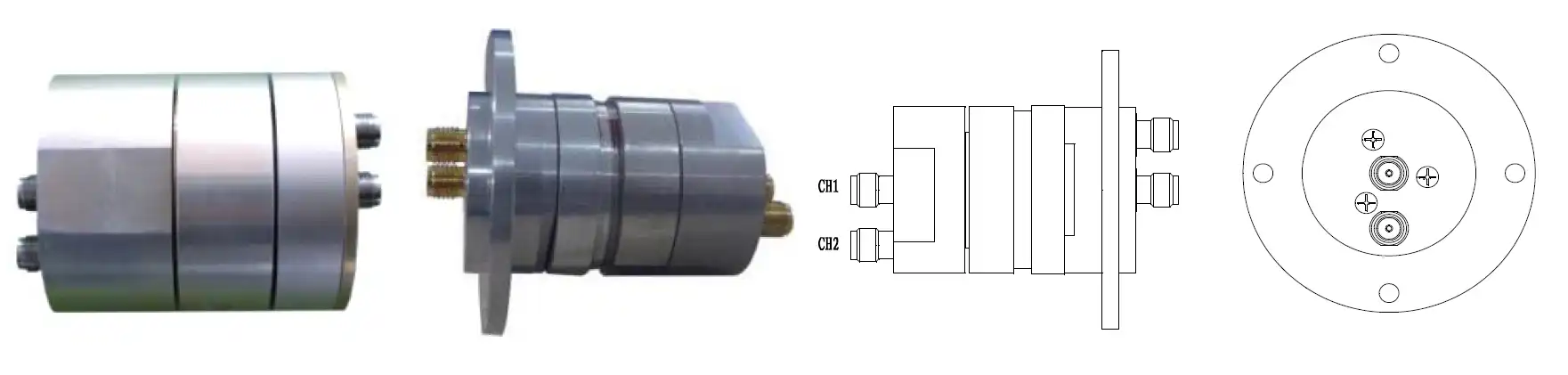
Confirm Power Handling and Thermal Limits
Power ratings need more information. Get the average, peak, pulsed, and continuous power for each channel, as well as the duty cycle and expected mismatch. If you want to know how the rating changes with temperature, VSWR, altitude, and airflow, you should ask. A rating given at room temperature may go down on an antenna that is in the sun. In this case, the dielectric material inside the joint is important. The dielectric has to keep from breaking down when one channel carries high power and the other carries data. See what the housing is made of and how the heat gets out of the unit. RF performance can change because of cold starts, condensation, and changing temperatures over and over again, so ask about screening. Thermal cycling from -40°C to +85°C is part of ADM's environmental stress screening.
Compare Options and Match the Joint to Your Use Case
Dual Channel Versus Two Single-Channel Joints
Most of the time, a dual-channel rotary joint takes up less room than two single-channel units stacked on top of each other. It also cuts down on the mechanical footprint and the load on the rotational torque. But the trade-offs are real. One single-channel joint is smaller than a multi-channel body, and to service one channel, the whole unit may need to be taken apart. This brings us back to isolation data: crosstalk is now a design factor as well. To make sure that your terminal is always ready, two single units might be better. The dual design usually wins when there isn't much room on the rotating axis, like in gimbal-style turrets.
Coaxial Versus Waveguide, Standard Versus Customized
Coaxial joints, including the dual channel coaxial rotary joint, are small, but they can handle a lot of different frequencies. Whenever the power or frequency is very high, waveguide joints are often the best choice. Look at frequency, insertion loss, power handling, and system layout to see which one is better. Then, let the terminal architecture make the choice. Next, pick between a standard model and one that is made just for you. Most of the time, standard models cost less and ship faster. Customization is a good idea when you need unique connectors, a small package, a unique mounting pattern, or a design that is ready for OEM production. ADM has OEM services and quick-turn prototyping, so you can test a sample before making a lot of them. Find out how much the development will cost and when it will be done.
Match the Joint to the SATCOM Use Case
There are different terminals that reward different things. Both fixed and portable terminals value stable RF data, being able to handle bad weather, and being easy to replace. Systems that are mounted on vehicles need to be light, small, and have strong connectors that can handle vibration and a lot of start-stop motion. Maritime and coastal terminals need better sealing, protection against corrosion, and protection from salt spray. For systems with a lot of power or a lot of frequency, it's important to measure the insertion loss, VSWR, isolation, and power derating at the real operating point. The same logic applies to all of ADM's products, whether they're for aviation and aerospace, shipboard systems, UAVs, or finding your way. First, define the environment, and then choose the joint.
Evaluate Suppliers, Cost, and Delivery Risk
Ask for Documents That Prove Performance
A datasheet is not proof; it's just a place to start. You can ask for RF test reports, material information, installation instructions, quality certificates, and outline drawings. A good manufacturer should have worked with RF and microwave rotary joints as well as SATCOM or radar applications before. Find out if there are written records of insertion loss, VSWR, isolation, rotation, dimensional, and visual checks for each production unit. Our products at ADM are certified by ISO 9001 and RoHS. We also have certifications from ISO 14001 and ISO 45001. It is just as important for defense and aerospace buyers to be able to track things and take corrective action.
Compare Total Cost, Not Only Unit Price
The cheapest quote doesn't always mean the lowest price. After putting together quotes based on the same technical details, you should add engineering fees, connectors, testing, packaging, shipping, taxes, and duties. Include things from the whole lifecycle, like expected operating hours, maintenance, spare parts, replacement availability, and the amount of time the system will be down if a joint fails in the field. If you measure RF performance, a unit with better performance and a longer rotation life may cost more at first but less over the life of the terminal. If you are a US buyer importing parts, make sure the supplier spells out the delivery terms clearly so that your finance team doesn't get caught off guard by duties and freight.
Plan Lead Time and Sample Steps
Early on, find out if the part is in stock, made to order, or depends on parts that are hard to find. Custom designs take longer to make because of the need for technical review, approval of drawings, making prototypes, testing them, and starting to mass produce. Before you place a large order, ask for samples and test them on your own computer. ADM offers quick prototyping, OEM production, and technical support that includes help with setup and fixing problems. Check the warranty terms, the minimum order quantity, the export packaging, and the person whose job it is to answer questions after delivery. If your supplier writes these things down, you can use them as proof when you qualify them or place another order.
Final Dual Channel Coaxial Rotary Joint Buying Checklist
Application and Mechanical Items
Before you approve a purchase for a dual channel coaxial rotary joint, you should check with engineering on these points. Write down the type of terminal, what each channel does, the speed and profile of rotation, the service life you want it to last, the size of the mounting, the loads on the shaft, and the weather. Write down how much starting torque you need and what level of ingress protection you need. Feel free to add the temperature range and the profile of the vibration or shock. The supplier can check the fit before giving a quote by seeing the outline drawing that is marked with the space for the connectors and the routes for the cables. One approval document makes sure that engineering and procurement are on the same page and stops substitutions that look good but don't work when they're put to the test.
RF and Power Items
Type of connector, frequency range, and impedance should all be written down for each channel. Put limits on VSWR, isolation, and insertion loss, and say if the limits are for the whole band or just for one rotation. Add up the average, peak, and continuous-wave power for each channel, as well as the duty cycle and ideal temperature. Ask the supplier to mark each value on the datasheet as either the maximum or average value. Also, ask for measured data at your actual operating frequency and power whenever you can. When both sides use the same numbers, acceptance testing stops being a debate and turns into a comparison.
Supplier and Commercial Items
Do the checks on the suppliers last. Check to see if the company has the right manufacturing experience, drawings, test reports, certificates, lead time, warranty, customization options, minimum order quantity, and delivery terms. Ask the supplier how they handle tracking and fixing units that don't pass inspection. Keep the completed checklist with the record of the purchase. It makes it easier for your team to qualify, do audits, and place repeat orders. When you buy the same dual channel coaxial rotary joint again, it cuts down on the review time.
Conclusion
It's important to make sure that the dual channel coaxial rotary joint you choose for a SATCOM terminal works well in real life. What the mechanical needs are is set by the channel function, mounting limits, and rotation profile. The frequency range, insertion loss, VSWR, isolation, and power handling determine if the RF chain stays within its link budget. Design, sealing, and environmental limits that have been tested all help to protect performance over time. It's easy to see where each design fits by comparing dual- and single-channel layouts, coaxial and waveguide options, and standard and custom models. The picture is finished with supplier documents, measured test data, the total cost, and the lead time. They can buy a joint that fits the terminal and lasts in service with the help of a single approval checklist that includes all of these points.
FAQ
Q1: How does a dual channel joint differ from a single channel joint?
It has one rotating interface that carries two separate RF signals. This saves space and torque load compared to two separate units.
Q2: Should I choose 50-ohm or 75-ohm impedance?
Make sure that the rest of your RF chain matches. Most microwave and SATCOM equipment needs 50 ohms, but some video and cable systems need 75 ohms.
Q3: Can each channel run at a different frequency?
Yes. Since the channels are separate, one can handle X-band and the other L-band as long as their impedances are the same.
Q4: How long does a rotary joint last?
Under normal conditions, high-quality units can turn between 10 and 50 million times. This is proven by accelerated life testing that checks the resistance of the contacts.
Request a Dual Channel Coaxial Rotary Joint Specification Review from ADM
ADM can be reached at craig@admicrowave.com with your frequency range, RF power, isolation target, rotation speed, connectors, mounting dimensions, and quantity. After looking over your drawings, our engineers will make a quote or sample plan and suggest either a standard model or a design that is made just for you. We work with buyers from all over the world in SATCOM and defense as a dual channel coaxial rotary joint supplier that offers OEM services, quick prototyping, and technical support.
References
1. Microwave Engineering, 2011
2. IEEE Standard Letter Designations for Radar-Frequency Bands (IEEE Std 521), 2019
3. Degrees of Protection Provided by Enclosures, IP Code (IEC 60529), 2013
4. Environmental Engineering Considerations and Laboratory Tests (MIL-STD-810H), 2019
5. Standard Practice for Operating Salt Spray (Fog) Apparatus (ASTM B117), 2019
6. Satellite Communications Systems, 2009
YOU MAY LIKE
 VIEW MOREParabolic Antenna
 VIEW MOREWaveguide Unmatched Termination
 VIEW MOREH-Plane Tee
 VIEW MOREWG Low Pass Filter
 VIEW MOREDouble Ridged Waveguide Calibration Kits
 VIEW MOREAc Power Amplifier
 VIEW MORELadder Membrane Conical Dual circular Polarization Horn Antenna
 VIEW MOREDual Linear Broadband Circular Polarization Horn Antenna