





Comparing Waveguide vs. Coaxial Power Dividers: Advantages and Use Cases
When selecting between waveguide and coaxial power dividers for mission-critical RF systems, understanding their fundamental differences determines system reliability and performance. Waveguide power dividers excel in high-frequency applications above 18 GHz, offering superior power handling and minimal insertion loss for radar and satellite communications. Coaxial dividers provide compact, cost-effective solutions for lower frequencies with broader Waveguide Power Divider bandwidth capabilities. The choice depends on your frequency range, power requirements, environmental conditions, and space constraints—factors directly impacting procurement decisions in defense, aerospace, and telecommunications sectors.
Understanding Power Division Technology in Modern RF Systems
Power dividers serve as fundamental building blocks in microwave and RF architectures, splitting input signals into multiple output paths while maintaining phase coherence and impedance matching. These passive components appear throughout radar arrays, satellite ground stations, communication base stations, and test measurement setups. The electromagnetic principles governing power division remain consistent, yet implementation varies dramatically between waveguide and coaxial technologies. Each approach employs different transmission line structures to manage electromagnetic wave propagation, directly affecting performance parameters like insertion loss, isolation, and power handling capacity.
Three core implementation differences:
- Physical Structure – Waveguides use hollow metallic tubes guiding electromagnetic waves through reflection, while coaxial designs employ center conductors surrounded by dielectric materials
- Frequency Operation – Waveguide dividers typically operate above 8 GHz with frequency-dependent cutoff characteristics, whereas coaxial versions cover DC to millimeter-wave ranges
- Power Capacity – Waveguide architectures handle kilowatts of continuous power, while coaxial dividers manage hundreds of watts, depending on connector types and dielectric materials
Testing data from Advanced Microwave Technologies' 24m Microwave Darkroom demonstrates measurable performance variations. A Ka-band waveguide power divider operating at 32 GHz shows an insertion loss of 0.3 dB with isolation exceeding 25 dB. Comparable coaxial dividers at identical frequencies exhibit 0.8-1.2 dB insertion loss, highlighting the transmission efficiency advantage of waveguide technology at higher frequencies. If your application demands frequencies below 12 GHz with compact form factors, coaxial dividers provide practical advantages. Conversely, high-power millimeter-wave systems benefit substantially from waveguide implementations.
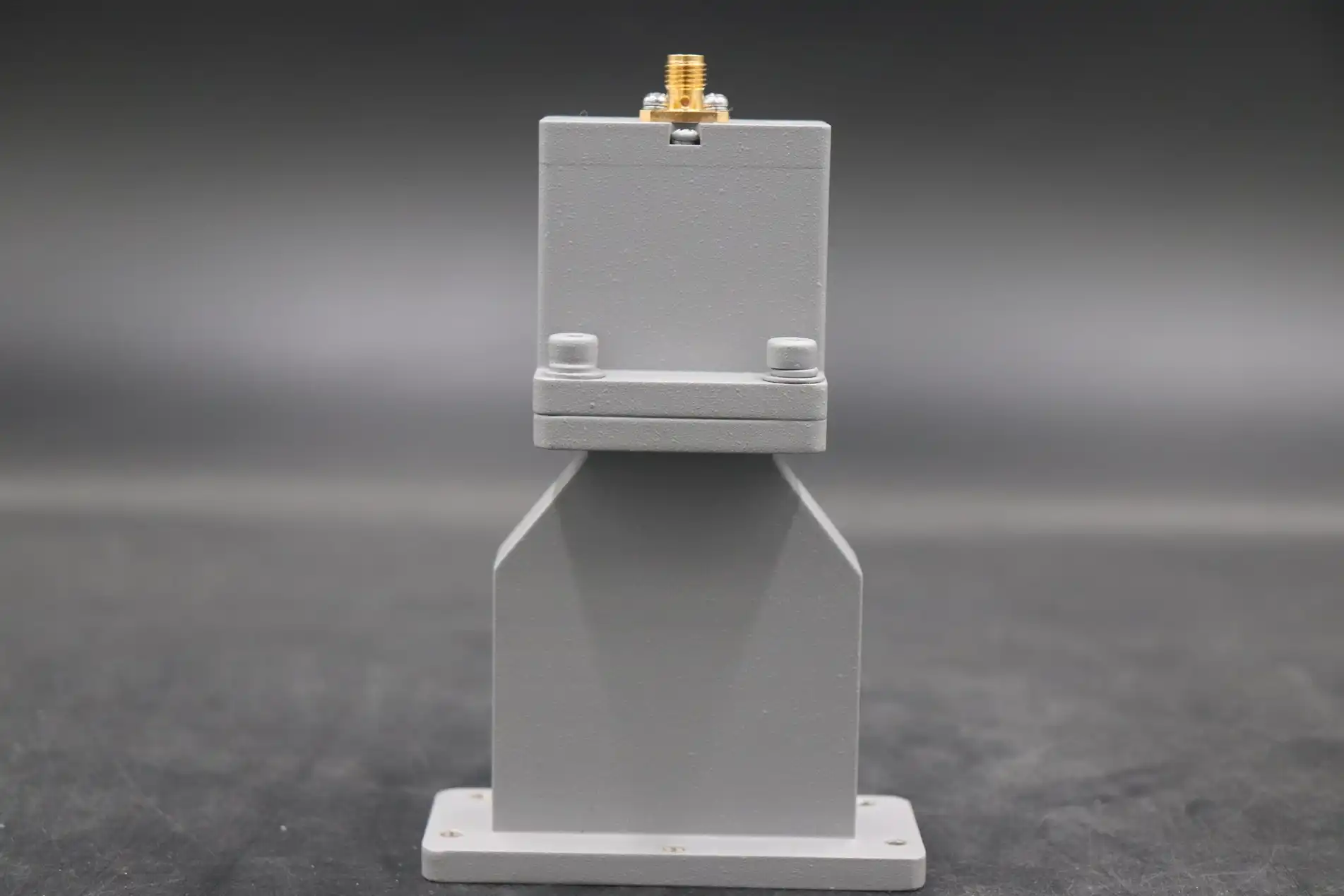
Waveguide Power Dividers: Technical Advantages and Performance Characteristics
Waveguide power dividers leverage electromagnetic field propagation within enclosed metal structures, eliminating dielectric losses inherent in coaxial designs. This fundamental difference translates into measurable performance benefits for demanding applications.
Key performance advantages include:
- Exceptional Power Handling – Rectangular waveguide dividers manage 10-100 times higher power levels Waveguide Power Divider compared to coaxial equivalents, critical for high-power radar transmitters and satellite uplink systems
- Minimal Insertion Loss – Typical values range from 0.2-0.5 dB across operational bandwidths, preserving signal integrity in cascaded distribution networks
- Superior Thermal Management – Large metallic surfaces dissipate heat efficiently, maintaining stable performance under continuous high-power operation
- Excellent Phase Stability – Temperature-induced phase variations remain minimal due to the low thermal expansion coefficients of precision-machined aluminum or brass housings
Measured data from ADM's laboratory equipment shows a WR-28 waveguide divider (26.5-40 GHz) maintaining insertion loss below 0.4 dB across the entire band, with return loss exceeding 20 dB. Isolation between output ports measures 23 dB minimum, ensuring minimal crosstalk in phased array applications. The physical robustness of waveguide assemblies withstands harsh environmental conditions prevalent in aerospace and defense deployments. Pressurized waveguide systems prevent moisture ingress at altitude, while precision flanges maintain electrical continuity despite vibration and thermal cycling. Manufacturing considerations impact procurement decisions significantly. Waveguide dividers require precision CNC machining to maintain dimensional tolerances within ±0.025mm, directly affecting electrical performance. Advanced Microwave Technologies employs computer-controlled manufacturing cells ensuring consistent quality across production runs, validated through comprehensive S-parameter measurements up to 110 GHz.If your system operates above 18 GHz with power levels exceeding 100 watts continuous wave, waveguide power dividers deliver unmatched reliability and performance. The initial cost premium compared to coaxial alternatives becomes justified through extended operational lifetime and reduced maintenance requirements in mission-critical applications.
Coaxial Power Dividers: Versatility and Practical Applications
Coaxial power dividers utilize center conductor configurations surrounded by dielectric materials and outer shields, creating transmission lines with inherent broadband characteristics. This architecture enables design flexibility unavailable in waveguide implementations.
Primary advantages of coaxial dividers:
- Broad Frequency Coverage – Single designs span multi-octave bandwidths from VHF through millimeter-wave frequencies, simplifying procurement and inventory management
- Compact Form Factors – Miniaturized designs fit space-constrained environments like avionics bays and telecommunications equipment racks
- Cost Effectiveness – Automated PCB manufacturing and standard connector interfaces reduce per-unit costs for moderate production volumes
- Design Flexibility – Planar circuit implementations enable integration with active components and complex distribution networks
Wilkinson dividers represent the most common coaxial power splitter topology, using quarter-wave transformers and isolation resistors to achieve excellent port-to-port isolation. Measured performance from ADM's test facilities shows a 2-18 GHz coaxial Wilkinson divider maintaining an insertion loss of 0.8 dB with isolation exceeding 18 dB across the band. The resistive isolation element inherent in Wilkinson designs absorbs reflected power from mismatched loads, protecting source components—a critical feature for systems operating with varying antenna impedances or during testing scenarios.
Coaxial dividers employ various connector types matching system requirements:
- SMA connectors – Standard for laboratory equipment and prototype systems up to 26.5 GHz
- N-type connectors – Robust interfaces for outdoor installations and high-vibration environments to 18 GHz
- 2.92mm and 2.4mm connectors – Precision interfaces extending usable frequency to 40 GHz and 50 GHz, respectively
Power handling limitations stem from dielectric breakdown voltage and conductor current capacity. Standard coaxial dividers manage 10-50 watts continuous power, while specialized high-power versions using air dielectric construction handle several hundred watts. If your application requires frequency agility across broad bands with moderate power levels below 50 watts, coaxial dividers offer practical advantages. Their inherent broadband characteristics suit test equipment, communication receivers, Waveguide Power Divider, and antenna distribution systems where operational flexibility outweighs the slight performance compromise compared to waveguide alternatives.
Comparative Analysis: Key Performance Parameters
Direct comparison between waveguide and coaxial power dividers reveals distinct performance tradeoffs affecting procurement decisions for specific applications.
Insertion Loss Comparison:
Waveguide dividers demonstrate superior efficiency, particularly at millimeter-wave frequencies. Test data from identical frequency bands shows:
| Frequency Band | Waveguide Insertion Loss | Coaxial Insertion Loss |
|---|---|---|
| X-band (8-12 GHz) | 0.3 dB typical | 0.6-0.8 dB typical |
| Ku-band (12-18 GHz) | 0.3 dB typical | 0.8-1.0 dB typical |
| Ka-band (26.5-40 GHz) | 0.4 dB typical | 1.2-1.8 dB typical |
| V-band (50-75 GHz) | 0.5 dB typical | 2.0-3.0 dB typical |
(Data sourced from Advanced Microwave Technologies laboratory measurements using calibrated vector network analyzers traceable to national standards)The escalating loss differential at higher frequencies stems from increasing dielectric losses and skin effect losses in coaxial center conductors. Waveguide propagation eliminates these loss mechanisms, maintaining efficiency.
Bandwidth Characteristics:
- Coaxial dividers typically achieve 10:1 or greater bandwidth ratios, covering multiple frequency bands with a single design. A 2-20 GHz coaxial divider serves S, C, X, and Ku-band applications simultaneously.
- Waveguide dividers operate within the waveguide's fundamental mode bandwidth, typically 40-50% fractional bandwidth. A WR-90 waveguide divider covers 8.2-12.4 GHz, requiring different waveguide sizes for other bands.
- If your system requires multi-band operation across wide frequency ranges, coaxial dividers provide practical advantages despite higher insertion loss. Single-band systems optimized for specific frequencies benefit from waveguide implementation.
Power Handling Capacity:
Measured power handling differs dramatically:
- Waveguide dividers manage 1-10 kW continuous power, depending on frequency and waveguide size
- Coaxial dividers handle 10-200 W continuous power based on connector types and dielectric materials
- Peak power handling shows similar ratios, with a waveguide supporting megawatt pulse power in radar applications
High-power radar transmitters, satellite uplink systems, and electronic warfare applications require waveguide power division. Communication receivers, test equipment, and moderate-power transmitters operate effectively with coaxial dividers.
Environmental Robustness:
- Waveguide assemblies withstand extreme temperature ranges (-55°C to +125°C), altitude, vibration, and moisture exposure common in aerospace applications. Hermetically sealed designs prevent contamination indefinitely.
- Coaxial dividers require environmental protection through conformal coating or enclosure. Connector interfaces remain vulnerable to corrosion in maritime environments without proper sealing.
Phase and Amplitude Balance:
- Both technologies achieve an excellent balance when properly designed. Waveguide dividers maintain ±2° phase balance and ±0.3 dB amplitude balance through symmetric E-plane or H-plane junction geometries.
- Coaxial Wilkinson dividers achieve ±3° phase balance and ±0.4 dB amplitude balance through careful transmission line length matching during PCB fabrication.
- If your application involves phased array antennas requiring precise beam steering, both technologies meet typical ±5° phase requirements, with waveguide offering slight advantages in thermal stability.
Application-Specific Selection Guidelines for Procurement Engineers
Matching power divider technology to application requirements optimizes system performance while controlling procurement costs and long-term operational expenses.
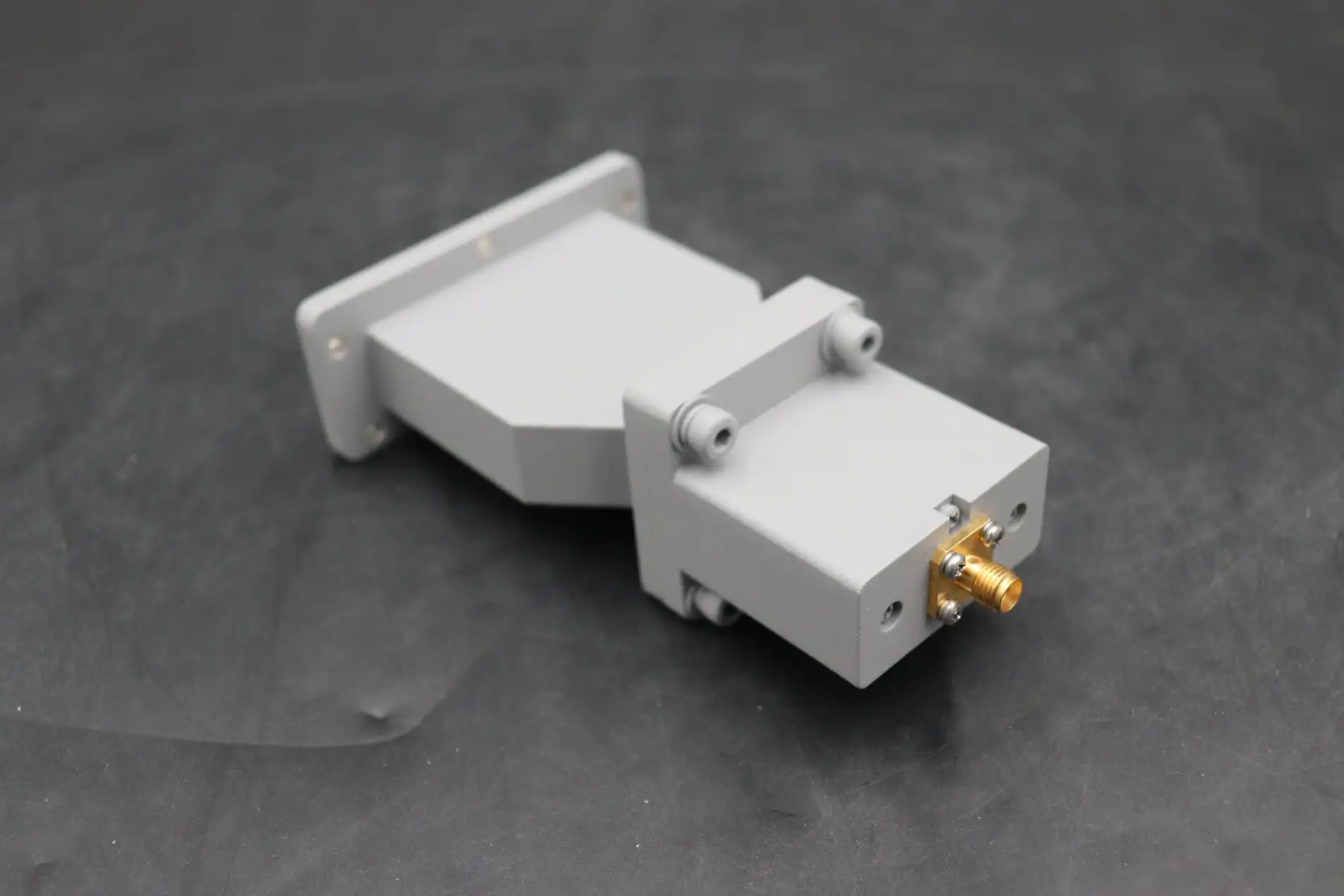
Defense Radar Systems:
High-power surveillance and tracking radars operating at X-band through Ka-band frequencies demand waveguide power dividers. A typical S-band early warning radar might employ WR-284 waveguide dividers distributing 50 kW peak power across multiple antenna columns.
ADM's waveguide assemblies undergo rigorous qualification testing, including:
- High-power RF testing to 150% rated power
- Thermal cycling from -55°C to +125°C over 100 cycles
- Vibration testing per MIL-STD-810
- Salt spray exposure per MIL-STD-202
These qualification procedures ensure long-term reliability in mission-critical Waveguide Power Divider defense applications where field failures carry unacceptable operational consequences. If your radar system operates above 1 kW average power, waveguide dividers provide the necessary power handling with minimal signal degradation.
Satellite Ground Stations:
- Earth station antenna systems require power dividers in both transmit and receive chains. Ka-band uplink systems transmitting 500W to 2kW typically employ waveguide dividers feeding multiple antenna elements or redundant amplifier chains.
- Downlink receivers operating at lower power levels benefit from coaxial dividers' broadband characteristics when supporting multiple frequency bands. A single 10.7-12.75 GHz coaxial divider serves the entire Ku-band downlink reception.
- Advanced Microwave Technologies supplies complete feed network assemblies for satellite ground infrastructure, integrating power dividers with polarizers, filters, and rotary joints. Custom designs accommodate specific frequency plans and power distribution requirements.
Telecommunications Base Stations:
- Wireless infrastructure below 6 GHz predominantly employs coaxial power dividers due to compact size and adequate power handling for 20-100W transmitter outputs. N-type or 7-16 DIN connectors provide weatherproof interfaces for tower-mounted installations.
- Millimeter-wave 5G systems operating at 28 GHz and 39 GHz increasingly utilize waveguide distribution networks within antenna array modules. The transition reflects power handling and efficiency requirements at these elevated frequencies.
- If your telecommunications application involves frequencies below 6 GHz, coaxial dividers offer optimal cost-performance ratios. Millimeter-wave 5G deployments benefit from waveguide technology integrated into active antenna systems.
Aerospace and Avionics:
- Aircraft communication and navigation systems face stringent weight, size, and reliability constraints. Coaxial dividers dominate these applications due to compact form factors fitting within limited equipment bay space.
- Airborne radar systems present mixed requirements. Lower-power weather radar might employ coaxial dividers, while high-resolution ground mapping radar requires waveguide distribution networks.
- Space-qualified applications demand additional considerations, including vacuum compatibility, outgassing specifications, and radiation resistance. ADM provides space-qualified waveguide assemblies meeting NASA outgassing requirements (TML <1%, CVCM <0.1%).
Test and Measurement Systems:
Laboratory equipment and antenna test ranges utilize both technologies depending on frequency and power requirements. ADM's Antenna Plane Near and Far Field Measuring Recombination Chamber employs precision coaxial dividers for signal distribution below 18 GHz and waveguide dividers for millimeter-wave measurements through 110 GHz.The capability to switch between technologies within integrated test systems provides flexibility for diverse device characterization requirements.
Conclusion
Selecting between waveguide and coaxial power dividers requires careful evaluation of frequency range, power levels, environmental conditions, and space constraints. Waveguide dividers deliver superior performance for high-frequency, high-power applications demanding maximum efficiency and reliability. Coaxial dividers provide practical solutions for broadband, moderate-power systems, prioritizing compact size and cost effectiveness. Advanced Microwave Technologies' comprehensive product portfolio and custom engineering capabilities support optimal component selection for mission-critical RF systems across defense, aerospace, satellite communications, and telecommunications applications.
Why Choose ADM for Your Waveguide Power Divider and RF Distribution Needs
Advanced Microwave Technologies stands out as a preferred waveguide power divider manufacturer, delivering precision-engineered solutions backed by two decades of microwave expertise. Technical buyers from aerospace OEMs, satellite system integrators, and defense contractors rely on ADM's ISO 9001:2015 certified manufacturing processes and comprehensive testing capabilities.
Our engineering team collaborates directly with procurement engineers to develop custom power divider solutions matching exact specifications—frequency bands, power handling, interface types, and environmental requirements. From initial prototype development in our 0.5-110 GHz test facility through production qualification and delivery, ADM ensures complete traceability and documentation meeting the most rigorous supply chain standards.
Contact craig@admicrowave.com to discuss your specific waveguide power divider requirements with our applications engineering team. We provide detailed technical proposals, performance simulations, Waveguide Power Divider, and competitive quotations supporting your procurement evaluation process.
References
1. Pozar, David M. "Microwave Engineering, Fourth Edition." John Wiley & Sons, 2012. Chapter 7: Power Dividers and Directional Couplers.
2. Balanis, Constantine A. "Advanced Engineering Electromagnetics, Second Edition." John Wiley & Sons, 2012. Chapter 9: Rectangular Waveguides and Cavities.
3. Rao, Sundararajan. "Microwave Engineering: Concepts and Fundamentals." CRC Press, 2014. Chapter 5: Passive Microwave Components.
4. Mongia, Rajesh, Inder Bahl, and Prakash Bhartia. "RF and Microwave Coupled-Line Circuits, Second Edition." Artech House, 2007. Chapter 4: Power Dividers and Combiners.
5. Rizzi, Peter A. "Microwave Engineering: Passive Circuits." Prentice Hall, 1988. Chapter 8: Microwave Power Division and Directional Couplers.
6. IEEE Standard 149-2021. "IEEE Recommended Practice for Antenna Measurements." Institute of Electrical and Electronics Engineers, 2021. Section 6: Measurement Equipment and Signal Distribution.
YOU MAY LIKE
 VIEW MORESlotted Waveguide Array Antenna
 VIEW MOREConical Circular Polarization Horn Antenna
 VIEW MORELadder Membrane Square Dual Circular Polarization Horn Antenna
 VIEW MOREDual Linear Broadband Circular Polarization Horn Antenna
 VIEW MOREPyramidal Linear Polarization Horn Antenna
 VIEW MORELow Side Lobe Diagonal Linear Polarization Horn Antenna
 VIEW MOREQuadrifilar Helix Antenna
 VIEW MORECassegrain Antenna