





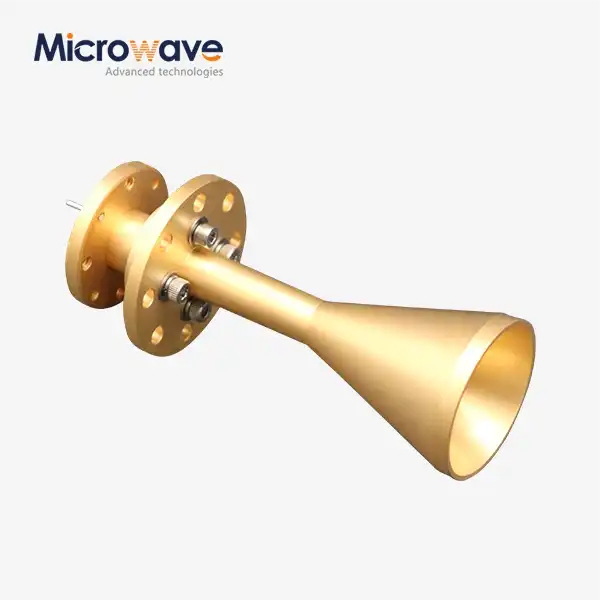
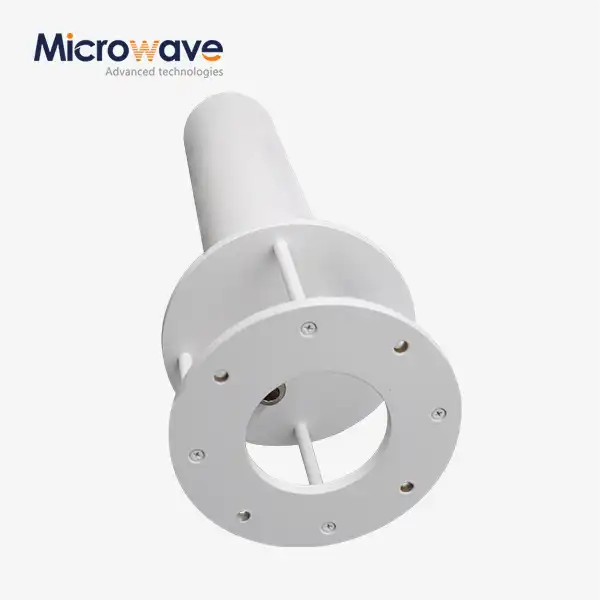
Conical Circular Polarization Horn Antenna
Conical Circular Polarization Horn Antenna for Satellite, Radar & OTA Testing
Advanced Microwave Technologies (ADM) designs the Conical Circular Polarization Horn Antenna for applications where polarization purity directly affects system performance — including satellite ground stations, radar systems, and anechoic chamber testing. The antenna generates Left-Hand Circular Polarization (LHCP) or Right-Hand Circular Polarization (RHCP) by combining a conical flare geometry with an internal polarizing mechanism. Gain ranges from 10 dBi to 25 dBi, and VSWR is maintained below 1.5:1 across the operating band.
Why Circular Polarization Matters in Practice for Conical Circular Polarization Horn Antenna
Most pyramidal horn antennas support only Linear Polarization (LP), which works well in controlled lab conditions. In satellite links and radar environments, however, linearly polarized signals are affected by Faraday Rotation — an ionospheric phenomenon that rotates the signal plane and introduces polarization mismatch loss at the receiver.
A circularly polarized signal behaves differently: upon reflection, the handedness reverses (RHCP becomes LHCP), so the receiving antenna naturally rejects multipath returns. This is particularly useful in clutter-rich environments such as airborne radar and ground-based SATCOM, where multipath noise is a persistent issue.
Technical Specifications
Parameter | Specification |
Axial Ratio (AR) | < 3 dB (ideally < 1.5 dB) across operating band |
Cross-Polarization Discrimination (XPD) | > 25 dB |
VSWR | < 1.5:1 |
Gain Range | 10 dBi – 25 dBi |
Polarization Type | LHCP / RHCP (dual-port OMT models support both) |
Frequency Coverage | 0.5 GHz – 110 GHz |
Applicable Bands | L, S, X, Ku, Ka and others |
Material | Precision-machined aluminum or brass with silver or gold plating |
Environmental Compliance | MIL-STD-810 (vibration, thermal shock, salt fog) |
Power Handling | CW and pulsed high-power capable |
Construction and Materials
The body of the antenna is carefully machined from brass or aluminium and then plated with silver or gold. At microwave frequencies, surface resistance is a big part of insertion loss. Both plating choices help keep the conductivity high across the operating band, especially when the power level is high.
For SATCOM operations outside, the aperture can be sealed with a PTFE or Kapton low-loss radome to keep water out. When there is moisture inside a waveguide, it causes an unexpected dielectric loading effect that changes the resonant VSWR and increases the chance of an arcing event when the power is high.
How Circular Polarization Is Generated
A septum polariser, dielectric vane, or Orthomode Transducer (OMT) combined with a 90° phase shifter is an internal polarising structure inside the conical flare that changes a signal that is fed in a straight line into a signal that is fed in a circle. The process changes based on frequency. At the center frequency, the phase shift is about 90°, which makes the circular polarisation almost perfect. The polarisation ellipticity gets bigger as you move toward the band edges because of phase deviation. This is why the Axial Ratio gets worse at the passband edges.
The angle of the flare is another important design factor. A larger flare makes the antenna shorter, but it also causes more aperture phase error, which lowers the efficiency of the radiation. Gain and phase uniformity are better with a narrower flare, but it is longer and heavier. The engineering team at ADM chooses the flare geometry based on what the customer tells them about the gain target and installation space limitations.
Application Scenarios
Satellite TT&C (Telemetry, Tracking & Control)
As satellites move or circle around the earth, ground station links in the L, S, X, Ku, and Ka bands must continue to work reliably. A Conical Circular Polarization Horn Antenna preserves consistent link budgets regardless of the satellite's attitude, avoiding the polarization loss that would affect a linearly polarized feed.
In parabolic reflector SATCOM systems, dual CP horn feeds allow frequency reuse, which means that LHCP and RHCP can carry two separate data streams on the same frequency. This doubles the spectral efficiency within the same bandwidth.
5G/6G OTA Testing and EMC Measurement
When testing in an anechoic chamber, these antennas are used as source antennas to measure Total Radiated Power (TRP). A CP horn cuts down on the time needed to rotate the receive antenna for both vertical and horizontal scans when the Device Under Test (DUT) orientation changes. This happens a lot in mobile and automotive radar testing.
Radar, Electronic Warfare & Weather Sensing
These antennas are used to copy jamming signals and target signatures in hardware-in-the-loop (HIL) simulations. Dual circular polarisation helps polarimetric weather radar tell the difference between different types of hydrometeors, like rain and hail, and stops ground clutter returns. The rotationally symmetric beam from the conical horn lights up the opening evenly, which is needed for accurate volume scanning.
Antenna Measurement Ranges
These horns have a high polarisation purity (XPD > 25 dB) and a gain that can be predicted. This makes them good for use as probe antennas in both near-field and far-field anechoic rooms, such as when the Axial Ratio of an Antenna Under Test (AUT) needs to be measured correctly.
Customization and Engineering Support
Custom specifications can be made for ADM, such as the frequency band, flare angle, gain level, connector type, and polarisation configuration. Standard single-port models are set to either LHCP or RHCP depending on the screw orientation or internal septum. Dual-polarized types with an OMT and two ports can work with both polarisations at the same time or switch between them. Because of this, they are bigger.
Performance testing of the Conical Circular Polarization Horn Antenna is conducted in ADM's 24-meter Microwave Darkroom, which is equipped for antenna plane near-field and far-field measurement. The facility works from 0.5 GHz to 110 GHz, so the far-field radiation pattern, gain, and Axial Ratio can all be checked before they are sent out.
FAQ
Q: Can this radio change from RHCP to LHCP?
A: Standard models with only one port can only use one polarisation. Dual-polarized models with an OMT and two ports can support both LHCP and RHCP at the same time or switch between them. The dual-port version costs more because it is bigger.
Q: Why does the Axial Ratio go up as you get closer to the edges of the band?
A: At the center frequency, the internal polariser gives a phase change of about 90°. As the frequency moves away from the center, the phase deviation grows and the polarisation becomes more elliptical. This is a feature of the polarising mechanism, not a problem with the way it is made.
Q: How does the flare angle change how well something works?
A: An antenna with a larger flare is shorter and more compact, but it has more aperture phase error and is less efficient. A narrower flare makes the gain and phase more uniform, but it also makes the assembly longer and heavier.
Q: What is the difference between this and a spiral antenna for broad use?
A: Spiral antennas cover a wider range of fractional bandwidths, but they usually have lower gain and can't handle as much power. The product covers about an octave, has a much higher gain (up to 25 dBi), and can handle high CW and burst power levels, which are important for radar uplinks and SATCOM feeds.
Q: What kind of care do outdoor installations need?
A: The most important part of maintenance is checking the radome (PTFE or Kapton) for cracks or broken seals. If the radome is broken, water can get into the waveguide and change the VSWR. This can lead to arcing at high power levels.
Q: What ranges of frequencies can be used?
A: ADM can make and test things from 0.5 GHz to 110 GHz, and they can work with L, S, X, Ku, Ka, and millimeter-wave bands. Get in touch with ADM to make sure they are available for your desired frequency.
Contact Us
To discuss specifications, custom configurations, or application requirements for the Conical Circular Polarization Horn Antenna, reach ADM at craig@admicrowave.com.
YOU MAY LIKE
 VIEW MOREStandard Horn Antenna
 VIEW MOREMMDS Transmitting Antenna
 VIEW MOREPyramid Horn Lens Antenna
 VIEW MOREFeed Fired Lens Antenna
 VIEW MORELadder Membrane Square Dual Circular Polarization Horn Antenna
 VIEW MORELadder Membrane Conical Dual circular Polarization Horn Antenna
 VIEW MOREDual Linear Broadband Dual Circular Polarization Horn Antenna
 VIEW MOREQuadrifilar Helix Antenna