





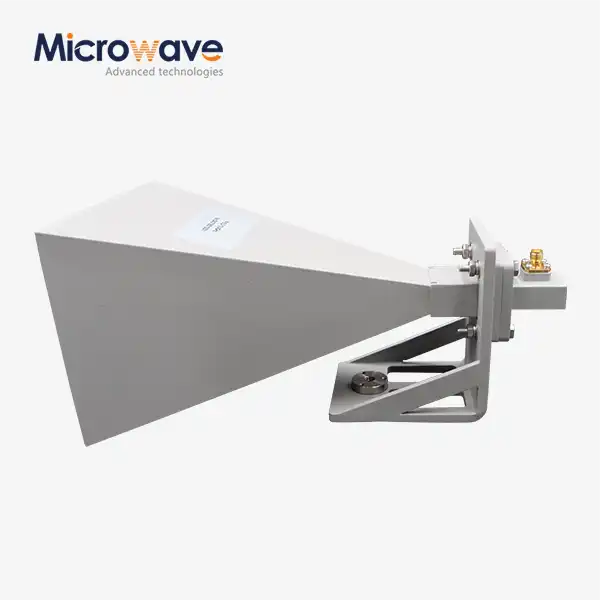
Standard Horn Antenna
Standard Horn Antenna for Microwave Measurement & EMC Testing
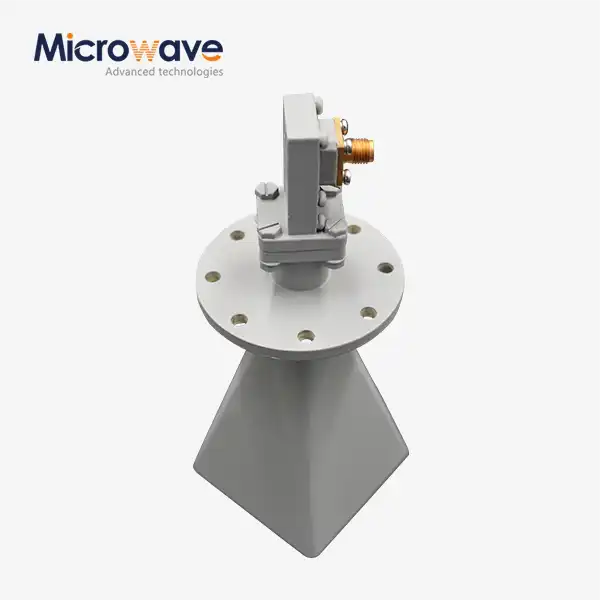
Advanced Microwave Technologies Co., Ltd. (ADM) makes a variety of Standard Horn Antenna products that are used to test microwaves, calibrate antennas, and measure EMC. The antennas are made of aluminium or brass and are linearly polarised. They cover frequencies from 300 MHz to 300 GHz across standard rectangular waveguide bands. Gain values that are commonly used are 10, 15, 20, and 25 dBi, and the uncertainty in the gain is usually less than 0.3 dB. If you ask, you can get custom gain settings and horn sizes.
What Is a Standard Horn Antenna?
A Standard Gain Horn is a product that is a pyramidal aperture antenna made to be used as a standard in microwave and radio frequency measurements.
This kind of antenna is designed to work with a certain waveguide band, like X-band or K-band. Broadband horns are used for general spying. Because its shape stays the same, it has a gain that can be calculated conceptually and repeated in experiments. This directly solves the problem of measurement uncertainty in precision RF work.
Engineers need a known-reference antenna to set up measurement systems in anechoic chambers and open area test sites (OATS). When you use designs that are based on NRL Report 4433 or similar standards, you can figure out the gain from the size of the part. This makes it easy to calibrate antennas, measure radar cross section (RCS), and test high-field-strength immunity.
Key Technical Properties
When it comes to professional measurement tasks, ADM's horn antennas are made to work reliably and accurately.
Take on Characteristics
The gain curve stays the same and ranges from 10 dBi to 25 dBi, though this can change based on the shape of the horn. Because the error in the gain is kept below 0.3 dB, these antennas can be used as standards in measurement systems that have been calibrated.
Coverage of Frequencies
It is made to work with common rectangular waveguide bands, like WR-90 and WR-62, and its frequency range goes from about 300 MHz to 300 GHz for mmWave bands.
Impedance and VSWR
VSWR is usually less than 1.5:1 and less than 1.25:1 at the center frequency, which means that testing with little reflected energy is possible.
Purity of Polarisation
It is very pure in terms of linear polarisation, and cross-polarization detection is usually more than 25 dB.
Material and Treatment of the Surface
Strong aluminium or brass is used to make it. To keep the conductivity and stop oxidation over time, Alodine or gold/silver plating is used on the inside surfaces.

Product Specifications
Parameter | Specification |
Gain Values (Standard) | 10, 15, 20, 25 dBi |
Gain Uncertainty | < 0.3 dB |
Frequency Range | ~300 MHz to 300 GHz (waveguide band dependent) |
VSWR | < 1.5:1 (typical); < 1.25:1 at center frequency |
Polarization | Linear |
Cross-Polarization Discrimination | > 25 dB |
Waveguide Standards | WR-90, WR-62, and other standard rectangular waveguide bands |
Material | High-grade aluminum or brass |
Surface Treatment | Alodine, gold plating, or silver plating |
Custom Options | Custom gain values, horn sizes, and frequency bands available |
Application Scenarios
How to Calibrate and Replace an Antenna
The Standard Horn Antenna is used as a standard in RF and microwave test labs to describe a Device Under Test (DUT). Its gain is stable and known, so it can be used as the starting point for substitution-method calibration, which is a common method used in business-to-business measurement settings.
EMC Immunity and Emissions Testing
The product is used to make electric fields that are very strong in high-field test environments like MIL-STD-461 or DO-160 testing. It can handle high levels of input power because it doesn't have any internal dielectrics or baluns and instead matches the input impedance through geometry. This means it can be used for testing electromagnetic susceptibility in programs for avionics and car oecus.
5G mmWave and Beamforming Characterization
In the Compact Antenna Test Ranges (CATR), horn antennas are used as feed sources as 5G moves into the mmWave frequency range. The clear radiation pattern makes it possible to light up the quiet area consistently, which helps characterise active antenna systems (AAS) that are used in the development of 5G base stations.
Quality Control Process
Before delivering an antenna, ADM makes sure it meets metrological standards.
Traceability of Calibration
Each antenna comes with a calibration certificate that can be tracked back to national standards using well-known methods like ANSI C63.5 or SAE ARP 958.
Verification of Dimensions
Since gain is based on physical geometry, coordinate measuring tools are used to make sure that the lens sizes and flare angles are in line with the theoretical design.
Wideband VSWR Sweep
A full VSWR sweep is done across the whole operating band to look for surface flaws or waveguide flange misalignments that might cause resonance.
Checking the Surface Finish
The internal waveguide throat and flare are checked for surface damage or oxidation. At mmWave frequencies, where skin-effect losses are higher, keeping the inside of the device conductive is very important.
ADM Testing Facility
ADM runs a 24 m microwave darkroom with an antenna plane near and far field measuring recombination chamber that lets them switch between near-field and far-field measurement modes easily. The testing ranges from 0.5 GHz to 110 GHz, which lets you check the performance in both traditional microwave bands and millimeter-wave applications.
Options for customisation
ADM can make Standard Horn Antennas and horn antennas that meet special needs for gain, frequency band, and size. You can get custom waveguide interfaces, flange types, and surface treatments if you ask for them. Send the team your technical specs so they can talk about what configurations will work for your application.
FAQ
Q: What is the difference between a product and a wideband or double-ridged horn?
A: The product works on a certain waveguide band and calculates gain using a fixed geometry, which makes measurements more accurate. Wideband horns use ridges to increase bandwidth, but they usually have more gain ripple and uncertainty, which makes them less useful as absolute measurement standards.
Q: How do I figure out how far away my horn antenna is from me?
A: Use the Fraunhofer distance formula, which is R = 2D²/λ, where D is the aperture's biggest size and λ is its wavelength. If you take measurements closer than this, you need to use near-field corrections to get accurate readings.
Q: Does the receiver need to be re-calibrated every so often?
A: Yes. Even though these antennas are mechanically stable, ISO 17025 says that they should be re-calibrated every one to three years. Over time, surface changes and connector wear can have an effect on VSWR and gain.
Q: In order to test immunity, can the receiver handle a lot of power?
A: The antenna can handle a lot of power because it doesn't have any internal dielectrics or baluns. What determines the practical limit is how the air inside the waveguide and at the flange interface breaks down.
Q: Why does the gain go up as the frequency goes up in the working band?
A: This is how aperture antennas usually work. When the frequency goes up, the fixed physical aperture gets bigger electrically compared to the wavelength. This makes the gain and directionality better.
Q: Can ADM give me gain values other than 10, 15, 20, and 25 dBi?
A: Yes. ADM makes horn antennas that meet certain size and gain requirements. Send your technology specs to craig@admicrowave.com so that the team can talk about your needs.
Contact Us
For quotes or technical inquiries about the Standard Horn Antenna, contact the ADM team at craig@admicrowave.com. We welcome both standard orders and custom specification requests.
YOU MAY LIKE
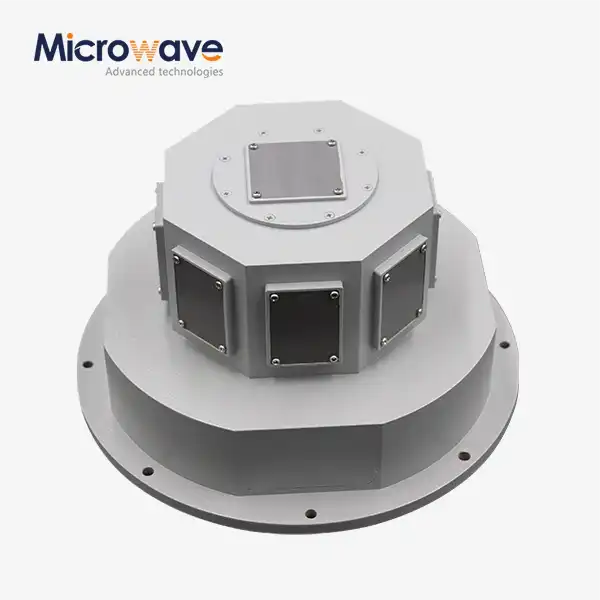 VIEW MORESlotted Waveguide Array Antenna
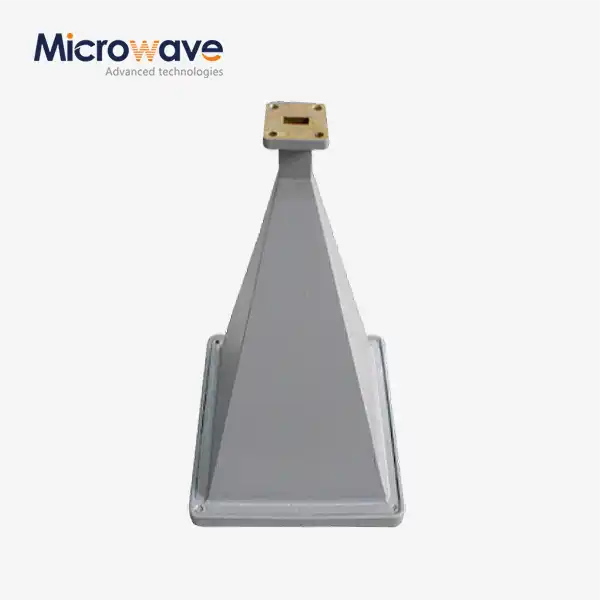 VIEW MOREPyramid Horn Lens Antenna
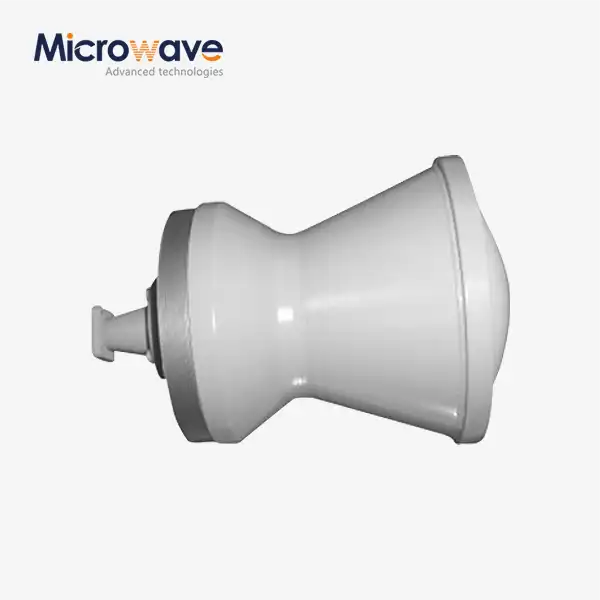 VIEW MOREPoint Focusing Horn Lens Antenna
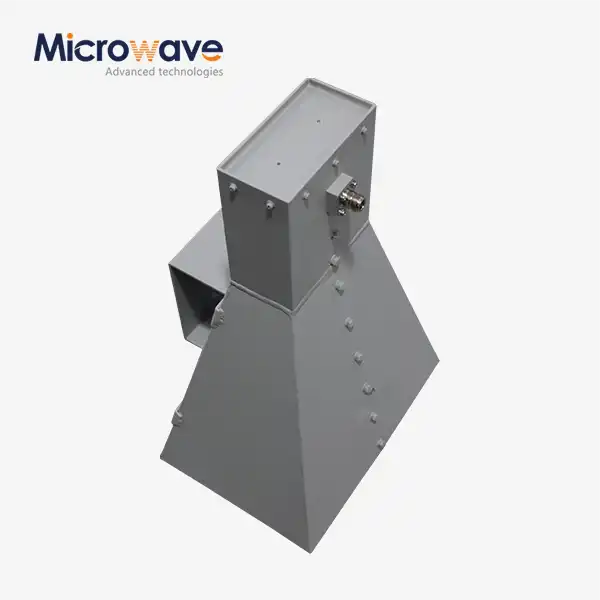 VIEW MOREWideband Double-ridged Horn Antenna
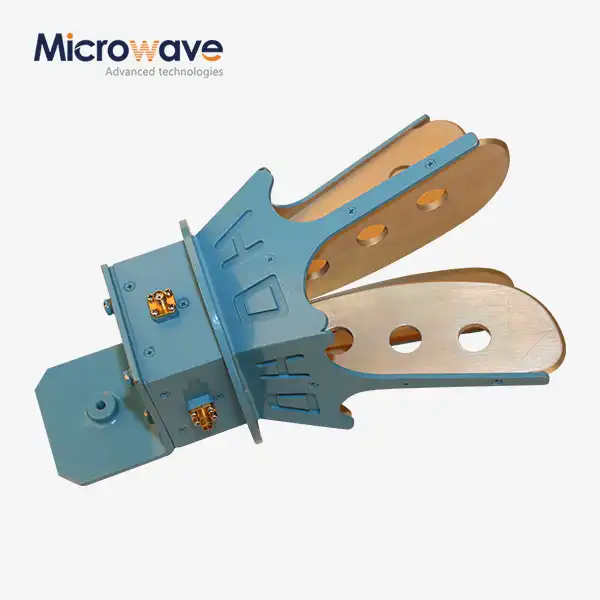 VIEW MOREOpen Boundary Dual Linear Polarization Four Ridged Horn Antenna
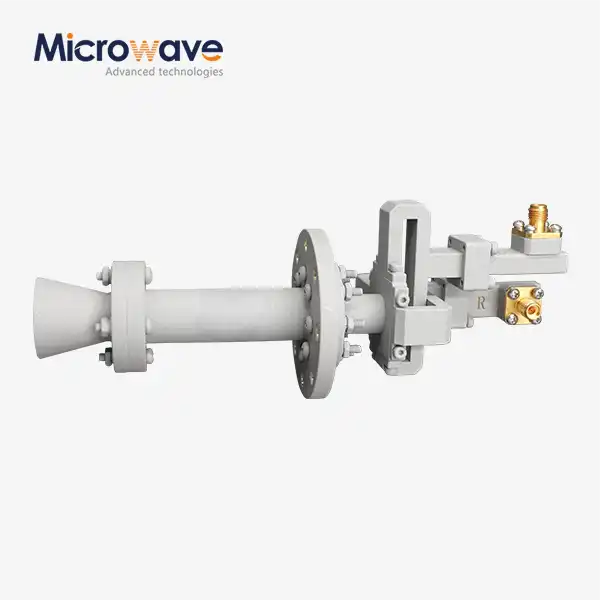 VIEW MOREConical Dual circular Polarization Horn Antenna
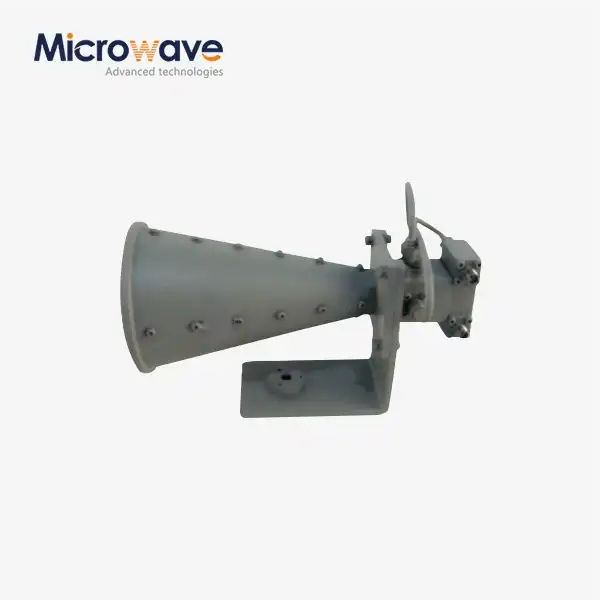 VIEW MOREDual Linear Broadband Dual Circular Polarization Horn Antenna
 VIEW MORELow Side Lobe Diagonal Linear Polarization Horn Antenna