





Open Boundary Dual Linear Polarization Four Ridged Horn Antenna
Open Boundary Dual Linear Polarization Four Ridged Horn Antenna
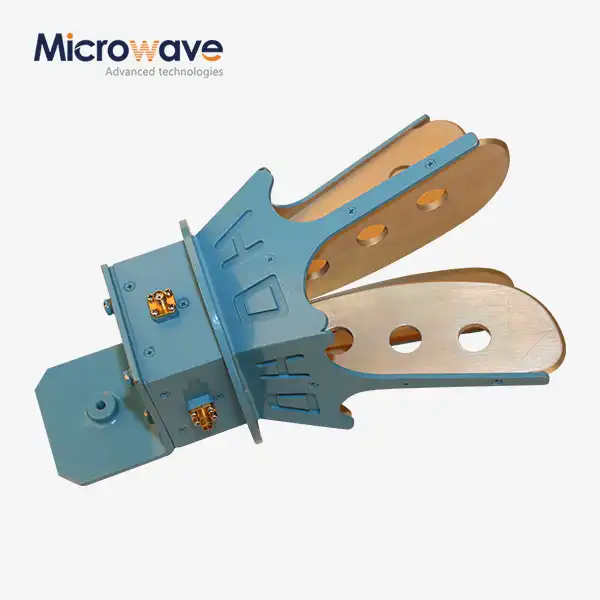
The Open Boundary Dual Linear Polarization Four Ridged Horn Antenna from Advanced Microwave Technologies (ADM) is an ultra-wideband aperture antenna designed for professional microwave testing and measurement. The design doesn't surround the feed structure with metal walls; instead, it leaves four flared ridges open to the air. This gets rid of the enclosed cavity completely and covers many octave bands, like 400 MHz to 6 GHz or 2 GHz to 18 GHz, with two coaxial input ports that accept both linear and circular signals at the same time.
What Makes the Open Boundary Dual Linear Polarization Four Ridged Horn Antenna Design Different?
Classic closed quad-ridged horns keep electromagnetic energy inside a metal space. This leads to internal box resonances that cause gain gaps and pattern distortion, which are tough to fix once the antenna is built.
This problem is solved by the open boundary design, which gets rid of all the side walls. Since there is no enclosed space, there are no box modes to turn off. As a result, the gain curves are smoother, the patterns are more even, and there are fewer problems across the working band.
Taking down the side walls also lowers the antenna's weight and wind load, lessens radar cross-section interactions in antenna ranges that are sensitive, and enhances off-axis spectral purity. All of these factors are important in controlled RF test environments.
Key Technical Properties
The antenna's impedance stays at 50 ohms and its gain goes up steadily with frequency. The open structure blocks higher-order modes, which helps make the pattern more symmetrical than with closed horn alternatives.
How much power it can handle depends on the type of connector chosen (Type N or 7/16 DIN). The interface between the connectors is usually where the heat and electricity get stuck. The open form lets air flow around the ridge structure and cools it passively, which helps heat escape during continuous wave operation.
As the frequency changes, the phase center moves along the shaft of the antenna. Use the phase center adjustment data in the calibration report to get accurate range readings.
Technical Specifications
Parameter | Specification |
Frequency Range | 400 MHz – 6 GHz / 2 GHz – 18 GHz (multi-octave) |
Impedance | 50 Ohm (nominal) |
VSWR | < 2.0:1 (optimized bands: < 1.5:1) |
Polarization | Dual Linear (Horizontal & Vertical) |
Port-to-Port Isolation (XPD) | > 25 dB |
Input Connectors | SMA / Type N / 2.92 mm |
Bandwidth Ratio | > 10:1 |
Application Scenarios
EMC/EMI Compliance Testing (CISPR/IEC): The Open Boundary Dual Linear Polarization Four Ridged Horn Antenna open boundary structure reduces backscatter and wall coupling inside anechoic chambers, improving repeatability for both radiated immunity and emissions measurements in CISPR and IEC compliance workflows.
Near-Field Antenna Measurement: When used as a probe in planar or spherical near-field scanners, the compact open profile allows closer positioning to the device under test without significant mutual coupling. This is particularly relevant for characterizing 5G massive MIMO arrays and automotive radar systems.
Spectrum Monitoring and Signal Intelligence: Defense and aerospace applications benefit from simultaneous dual-polarization capture. Signals with arbitrary polarization vectors are not attenuated due to polarization mismatch, supporting wideband surveillance across the full operating range.
Both ports can also be driven simultaneously with phase-matched signals through a quadrature hybrid coupler to generate circular or elliptical polarization. Always observe the maximum combined power rating for the connector type in use.
Quality Control and Verification
ADM's QC process is aligned with ANSI C63.5 and SAE ARP 958 standards. Each unit goes through the following steps before shipment:
· VSWR and Return Loss Sweep: Verified with a Vector Network Analyzer across the full operational band. Resonance spikes indicate ridge misalignment and are flagged for rework.
· Cross-Polarization Discrimination (XPD): Port isolation between vertical and horizontal inputs is confirmed to exceed 25 dB.
· Gain Calibration and Pattern Symmetry: Calibrated at standard ANSI reference distances. Pattern asymmetry in measurement data is treated as an indicator of structural deviation.
· Connector Integrity: Torque verification on all input connectors and passive intermodulation (PIM) testing are performed to minimize nonlinearities at high power levels.
ADM operates an in-house microwave darkroom that supports far-field performance evaluation, radiation pattern analysis, and gain measurement — providing a controlled environment for pre-shipment verification.
Customization and Supply
ADM offers customized Open Boundary Dual Linear Polarization Four Ridged Horn Antenna configurations based on your target frequency range, connector type, and application requirements. The engineering team works with customers to adapt antenna designs for specific test setups, including modified aperture dimensions, alternative connector interfaces, or integration support for automated test systems.
For outdoor deployment, a specialized dielectric radome is available and required to protect the open ridge structure from dust and moisture, which can alter impedance at the ridge gap. Note that adding a radome may slightly affect VSWR performance.
Contact ADM directly to discuss configuration options and to request a quotation based on your specific requirements.
FAQ
Q: Why choose an open boundary design over a standard closed quad-ridged horn?
A: Box resonances can happen in enclosed metallic horns, which can lead to loss of gain and strange patterns. The open boundary design gets rid of the walls that surround the device, which gets rid of the source of these resonances and makes the performance more consistent across the operating band.
Q: Can I send on both ports at the same time?
A: Yes. When phase-matched signals are sent through a quadrature hybrid coupler to both ports, circular or oval polarisation is created. Always don't go over the highest combined power rating for the type of connector you choose.
Q: What does the phase center do as the frequency changes?
A: As the frequency changes, the phase center moves along the axis of the antenna. When you need to make accurate range measurements, use the phase center correction data from the calibration report.
Q: Do you think this antenna can be used outside?
A: Not without being safe. The open ridge structure lets dirt and other things from the outside get into the feed area. For outdoor use, a special insulating radome is needed, and it might slightly affect how well the VSWR works.
Q: What stops high-power operation?
A: The main limiter is usually the connector interface, both for the dielectric breakdown voltage and the heat loss. The open ridge shape allows passive air cooling, but the connector rating should be thought of as the maximum power that can be used.
Q: What rules does ADM follow for the quality control process for this product?
A: ADM goes by ANSI C63.5 and SAE ARP 958. Before shipping, they do full VNA sweeps, XPD verification, gain calibration, PIM testing, and plug torque checks.
Contact Us
Email our team at craig@admicrowave.com about the Open Boundary Dual Linear Polarization Four Ridged Horn Antenna and we will follow up with technical details and pricing.
YOU MAY LIKE
 VIEW MOREStandard Horn Antenna
 VIEW MOREConical Horn Lens Antenna
 VIEW MOREFeed Fired Lens Antenna
 VIEW MORECorrugated Horn and Multimode Horn Antenna
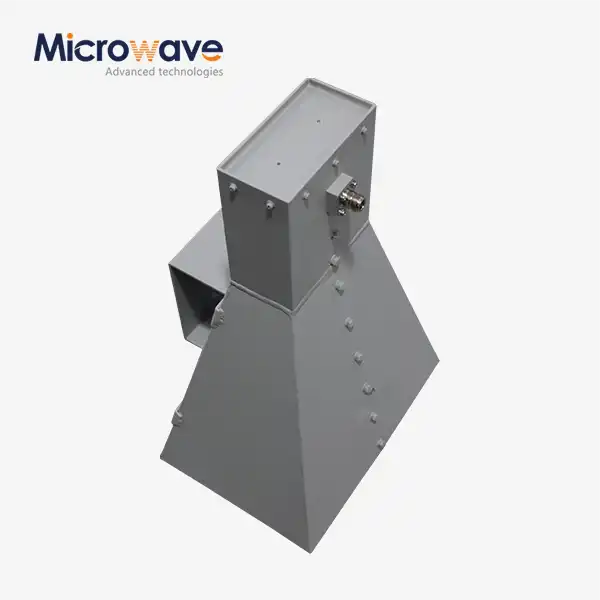 VIEW MOREWideband Double-ridged Horn Antenna
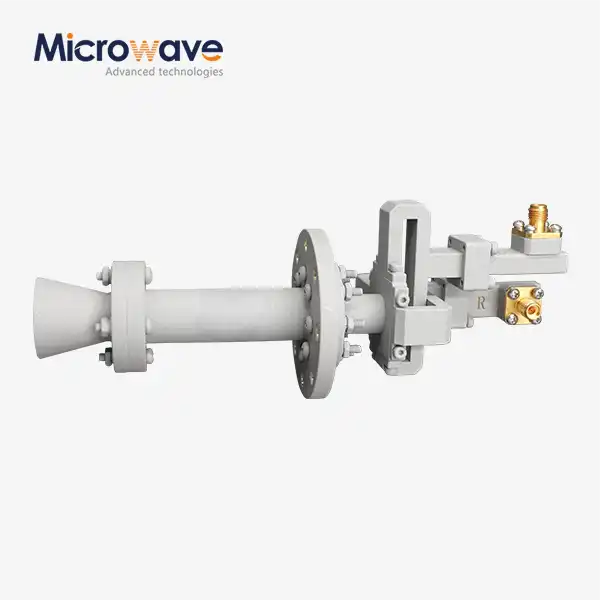 VIEW MOREConical Dual circular Polarization Horn Antenna
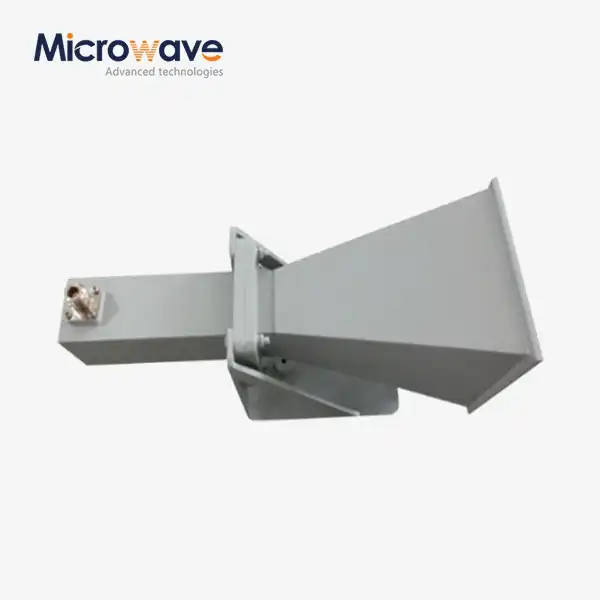 VIEW MORELadder Membrane Square Dual Circular Polarization Horn Antenna
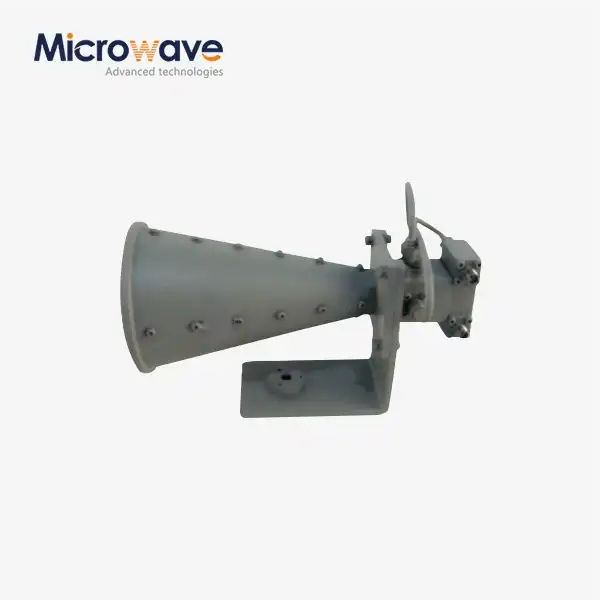 VIEW MOREDual Linear Broadband Dual Circular Polarization Horn Antenna