




How do microwave antennas work?
Microwave antennas work well from 1 GHz to 100 GHz and can change electromagnetic energy between directed waves and free-space radiation. At their heart, these devices change signals from microwave horn antenna transmission lines or waveguides into focused beams that can be used for testing, communication, or tracking. The microwave horn antenna is a good example of this process because it has a flared waveguide design that slowly grows to match the resistance of empty space while keeping echoes to a minimum. This shape lets you control the radiation patterns and predict the gain features. Because of this, horn designs are essential in places like precision measurement labs, aerospace systems, satellite ground stations, and places where signal integrity directly impacts mission success.
Understanding Microwave Horn Antenna Technology
The beautiful electric structure of microwave horn antennas is what makes them work so well. Microwave horn antennas use waveguide theory to get better directivity and wider bandwidth than simple wire antennas that rely on resonance.
The Waveguide-to-Free-Space Transition
Microwave horn antennas change the impedance between waveguide modes that are limited and the 377-ohm resistance of empty space. Microwave energy moves through a waveguide that is either square or round. It moves as a standing wave pattern that is limited by metal walls. The horn's gradual flare lets this limited energy spread out evenly, stopping sudden echoes that would lower efficiency. The change keeps the phase coherence across the opening, creating a coherent wavefront that sends waves into space with a standing wave ratio that is usually less than 1.5:1 across all operating bandwidths. This smooth flow of energy makes horn designs different from other antenna types that usually give up bandwidth to be smaller.
Core Structural Parameters Affecting Performance
Engineers change a number of physical factors to get the best performance from horns in certain situations. How quickly the waveguide extends toward the opening is based on the flare angle. When you cut the angle down to 10 to 20 degrees, you get longer antennas with better gain and smaller beamwidths. These are perfect for long-distance satellite links. While steeper angles make the device smaller, they also bring phase mistakes across the aperture, which lowers the gain and raises the sidelobe levels. The size of the aperture directly affects the directionality; bigger holes focus energy into narrower lines. Pyramidal horns with rectangular openings are used for tasks that need different beamwidths in orthogonal planes, while conical versions with circular openings work with systems that are polarized in a circle. Corrugated horn designs have concentric lines inside the flare that balance E-plane and H-plane patterns. This makes cross-polarization discrimination very low, which is important for current satellite systems that use dual-polarization feeds.
Simulation and Design Optimization Tools
Computational electromagnetics is used a lot in modern microwave horn antenna development to improve horn shapes before they are made. Software programs that use finite element analysis or the method of moments can model how fields will be distributed inside the horn structure and estimate how the far-field radiation will look. These tools help engineers find the best mix between different needs, like getting the most gain while keeping sidelobe levels low, getting a wide bandwidth without making the device too big, or making sure that the polarization purity fits the link budget. We at Advanced Microwave Technologies Co., Ltd. combine modeling processes with our 24m Microwave Darkroom testing power, which can handle frequencies from 0.5 GHz to 110 GHz. This mix checks designs against data taken in the real world, making sure that theoretical predictions are turned into reliable hardware for research institutions, defense companies, and satellite operators. Modeling and measuring work together to speed up development cycles while still meeting the high-performance standards needed for mission-critical apps.
Applications and Performance in B2B Industries
Microwave horn antennas are now standard in many fields where signal accuracy and environmental resistance are important. Their use ranges from standard radar systems to new wireless networks, showing how flexible they are in a way that few other types of antennas can match.
Radar Systems and Aerospace Applications
Defense and space systems use microwave horn antennas in radar arrays to both send and receive signals. Ground-based air traffic control radars use X-band (8–12 GHz) horns as feed elements for parabolic reflectors. This gives them the narrow beamwidths they need to track planes with an accuracy of less than one degree. Early warning systems that are carried by the air use light, cylindrical horns that can handle shaking and changes in temperature at high altitude while keeping the pattern stable. The tough build—mostly machined metal with conductive coatings—ensures life in difficult conditions like dry heat and arctic cold. For military observation purposes, horns with low sidelobes are needed to cut down on ground clutter returns and increase the range of tracking for targets that are hard to see. ADM's engineering team has helped aircraft engineers by providing custom pyramidal horns with specific flange interfaces and VSWR performance, which made it possible for them to be easily integrated into phased array modules and reflector feeds.
Satellite Communication Ground Infrastructure
Microwave horn antennas are always used as feeds for big parabolic dishes at earth stations for both business and military satellite networks. It is the horn's carefully shaped pattern of light that hits the mirror surface and strikes a balance between edge taper and spillover loss. Because they have uniform patterns and low cross-polarization, corrugated horns are great at this job because they keep signal-to-noise ratios high in weak downlink situations. High-throughput satellite stations that work in the Ka-band (26.5–40 GHz) use small conical horns that can handle kilowatts of send power without breaking down and keep their phase stability even when the temperature changes. When fed through orthomode transducers, the circular geometry easily allows dual-polarization operation. This doubles the channel capacity for apps that need to handle a lot of data. Operators of ground stations like how well-designed horns last a long time and work consistently, which cuts down on repair times and costs.
5G Network Backhaul and Testing
Millimeter-wave lines are becoming more and more important for next-generation wireless infrastructure. Microwave horn antennas act as both network parts and calibration standards. Point-to-point backhaul devices in the E-band (71–86 GHz) connect cell towers using small wideband horns to set up multi-gigabit data lines over several kilometers. The high directivity keeps disturbance from neighboring links to a minimum, which lets a lot of frequencies be used in cities. In the meantime, normal gain horns are needed as reference sources in anechoic rooms where 5G device certification is being done. These precise tools, which can be traced back to national metrology standards, create known field levels that can be used to test base stations and smartphones. Our ISO 9001:2015-certified factories make double-ridged wideband horns that cover 1–18 GHz and 18–40 GHz with recorded antenna factors. These horns are used by telecommunications labs and EMC testing centers in North America and Europe.
Comparative Advantages Over Alternative Designs
A lot of the time, procurement engineers compare microwave horn antennas to patch arrays, helical shapes, or parabolic mirrors. In certain situations, horns are very useful. Patch antennas have a small bandwidth and are sensitive to changes in temperature. Microwave horn antennas, on the other hand, have fixed impedance across octave bandwidths with little temperature shift. When compared to helix antennas, horns can handle more power, and their polarization clarity is easier to predict. Even though parabolic dishes have a larger opening, they need to be precisely aligned mechanically and aren't as durable as a solid horn structure. For moderate to high-gain uses (10–25 dBi), where mechanical ease and dependability are more important than small performance gains from more complicated options, horn fabrication is a cost-effective option. This is especially true for custom OEM designs.
Choosing the Right Microwave Horn Antenna for Your Business
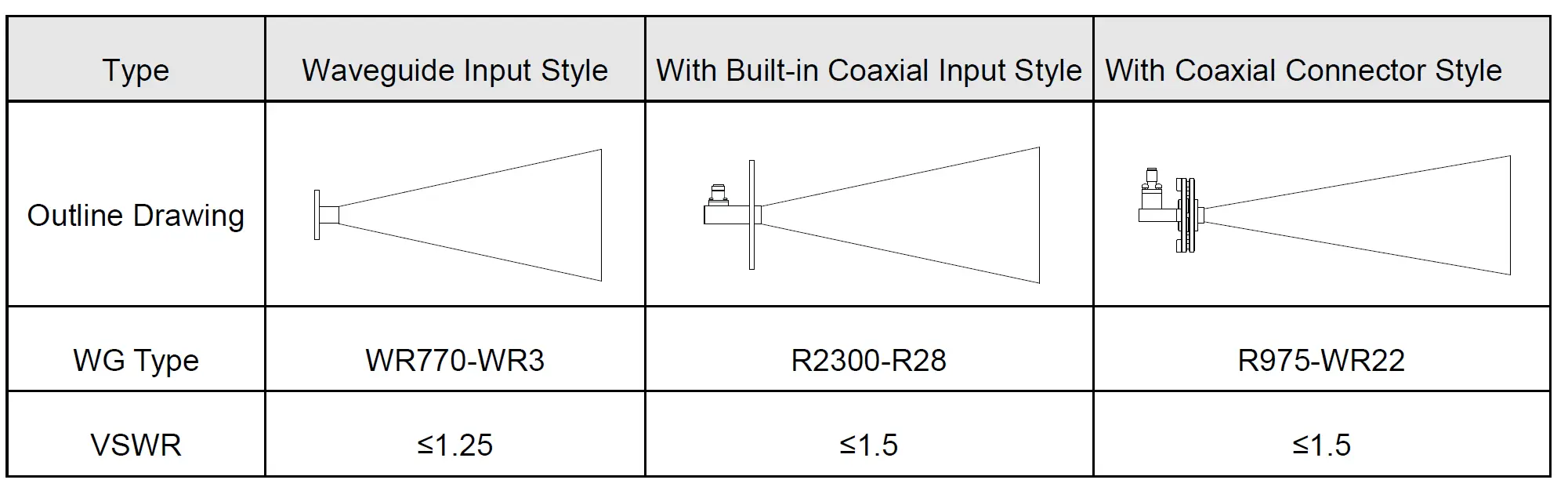
Aligning technical specs with practical needs is the first step to a successful procurement. The different ways microwave horn antennas can be set up need to be carefully looked at so that hardware powers and system needs don't get mismatched, which could cost a lot of money.
Technical Specification Priorities
For most uses, gain and beamwidth are the most important factors in choosing a device. Short-range measurement setups work best with a 15 dBi microwave horn antenna that has a 30-degree beamwidth. Long-range links work best with 20+ dBi designs that have beamwidths of less than 10 degrees. The frequency range needs to be able to handle both current needs and possible future growth. For example, a satellite operator planning Ka-band upgrades should ask for horns that cover 17.5–31 GHz instead of narrow designs that only work in Ku-band. VSWR limits rely on how sensitive the system is; study labs usually need less than 1.5:1, while industrial systems might be okay with 2.0:1. For satellite feeds, polarization is very important. Linear polarization is enough for some links, but septum polarizers or curved horn designs are needed for dual-polarization. Power handling specs need to include peak send levels plus safety margins. For example, horns for a 100W CW system should be rated for at least 200W to keep the multipactor from breaking down at high altitudes or from getting damaged by heat.
Customization and the ability to be an OEM
Catalog horns are useful for many things, but custom versions are often better for very specific systems. Custom flange types make sure that they can work with current waveguide runs without the need for adapters that add loss and VSWR decline. Changes to the opening sizes make it easier to light up non-standard reflector sizes or reach certain beamwidth goals. Advanced Microwave Technologies Co., Ltd. offers a flexible OEM service that lets customers test out fast prototypes before committing to large-scale production. Our expert team works with clients to improve mechanical connections, choose the right connector types (SMA, K, 2.92mm), and put on protective finishes that meet military weather standards. Off-the-shelf parts rarely meet all system-level microwave horn antenna standards without making trade-offs. This customization feature is especially useful for aerospace engineers and defense contractors who are working to tight deadlines.
Supplier Evaluation and Long-Term Partnership
There's more to picking a microwave horn antenna provider than just looking at datasheets. Catalog depth shows technical breadth; companies that offer pyramidal, conical, curved, and double-ridged shapes show that they are engineeringly flexible enough to handle a range of problems. Certification packages are important. For example, ISO 9001 makes sure that quality methods are always the same, and RoHS compliance makes it easier to sell products in Europe. If a supplier can grow with your program, you can tell by their lead time promises and production ability. When problems happen in the field, after-sales help is very important; responsive expert teams cut down on the time needed to fix problems and the time the system is down. We've built long-lasting partnerships with satellite operators and study labs by keeping thorough records on our products, giving each unit's measured antenna pattern, and providing quick replacement services when unexpected problems arise. When looking at the total cost of ownership over a number of years, these intangible factors often make up for small price differences.
Conclusion
microwave horn antennas are still very important in research, telecommunications, and the aerospace industries because they reliably turn guided electromagnetic energy into exactly directed radiation. Their strong waveguide-based design offers a large bandwidth, excellent directivity, and high weather resistance, which are all traits that other options have trouble matching at the same time. To choose the best horn configuration, you have to weigh scientific factors like gain and polarization against practical ones like the ability to customize, the quality systems of the provider, and the ability to provide long-term support. Procurement teams can be sure that delivered hardware will work as expected in the real world by putting it through thorough tests that include simulations, measurements in the lab, and validation in the field. We at Advanced Microwave Technologies Co., Ltd. are ready to help you with your project from the first idea to the final operating approval. We can do this by using our 20 years of experience in manufacturing and our state-of-the-art measurement facilities.
FAQ
What makes pyramidal horn antennas different from conical horn antennas?
Pyramidal microwave horn antennas have rectangular holes that are fed by rectangular waveguides. This makes beamwidths that are different in the E-plane and H-plane. This unevenness works well for tasks that need wide coverage areas, like ground-based radar systems that scan certain azimuth sectors. Conical horns use circular waveguides and circular openings to make patterns that are rotationally symmetric. These patterns are great for circular polarization and uses that need uniform beamwidths in all directions, like satellite feed systems that need consistent reflector lighting.
How does corrugation make horn antennas work better?
Internal corrugations, which are circular lines carved into the inside of the microwave horn antenna, create a hybrid electromagnetic mode (HE11) that balances the E- and H-plane radiation patterns. Cross-polarization levels drop by a huge amount because of this uniformity, and separation is often better than -30 dB. This is good for dual-polarization satellite feeds because keeping the polarization pure has a direct effect on channel separation and reducing crosstalk. Also, corrugated shapes have lower sidelobe levels, which means that more energy is focused on the main beam, which makes the link more efficient.
What limits the amount of power that horn antennas can handle?
Peak power relies mostly on the breakdown voltage in the waveguide feed section, where field levels are highest. The air dielectric strength restricts designs that aren't compressed to a few hundred watts of continuous wave. However, when dry nitrogen or SF6 gas is used to pressurize the design, this range is greatly increased. At high elevations, where low air pressure makes breakdown margins smaller, the quality of the surface finish changes multipactor limits. Thermal escape is very important during long transmissions; not enough heat sinking can damage thin-walled structures, changing their electrical performance before the materials fail.
Partner with ADM for Precision Horn Antenna Solutions
Advanced Microwave Technologies Co., Ltd. has been making microwave horn antennas for the defense, satellite, and internet industries around the world for more than 20 years. Our modern 24m Microwave Darkroom testing infrastructure and ISO 9001:2015-certified production facilities make sure that every part meets strict performance standards before it is shipped. If you need standard gain horns for EMC testing, special corrugated lines for satellite ground stations, or wideband double-ridged designs for spectrum monitoring, our engineering team can make it happen and provide full technical documentation. Email craig@admicrowave.com to talk about your application needs, get full specs, or look into OEM customization options that work with your project's budget and schedule.
References
1. Alanis, Constantine A. Antenna Theory: Analysis and Design, 4th Edition. John Wiley & Sons, 2016.
2. Milligan, Thomas A. Modern Antenna Design, 2nd Edition. John Wiley & Sons, 2005.
3. Olver, A. D., Clarricoats, P. J. B., Kishk, A. A., and Shafai, L. Microwave Horns and Feeds. IEEE Press, 1994.
4. Kraus, John D. and Marhefka, Ronald J. Antennas for All Applications, 3rd Edition. McGraw-Hill, 2002.
5. Stutzman, Warren L. and Thiele, Gary A. Antenna Theory and Design, 3rd Edition. John Wiley & Sons, 2012.
6. IEEE Standard 149-1979. IEEE Standard Test Procedures for Antennas. Institute of Electrical and Electronics Engineers, 1979.