





How Accurate Are Precision Phase Shifters in RF Applications?
When the measured phase matches the commanded phase within a specified error, precision phase shifters are accurate. This error is usually given in degrees, with a frequency range, temperature, and power level that are all known. Even though a 6-bit digital unit has a step of 5.625 degrees, its real error depends on its tolerances, calibration, and frequency response. A phase error of a few degrees or better is often written on datasheets for digital models. Because the test conditions are more important than any one number, I suggest that you look at measured phase error, repeatability, and insertion loss all at the same time.
How Precision Phase Shifters Work and Why Accuracy Matters
In RF sourcing, the word "accuracy" is used in a broad way, so let me start with the basics.
Accuracy Versus Resolution
What's phase accuracy? It's the difference between the phase you tell it to do and the phase you see at the output. Resolution is just the smallest step that can be taken with the device. Even if a unit has small steps, it may still miss its goal by a few degrees. OEM teams, distributors, and procurement staff should treat these as two separate lines on the datasheet, as I've told them. For beam steering, signal combining, calibration, impedance matching, and making measurements over and over, accurate control is important. If an error number doesn't come with the test conditions, it doesn't tell you much.
How a Phase Shifter Changes the Signal
An RF wave's timing can be changed by changing the phase shifter's electrical path of the signal or network it goes through. To find the phase in degrees, divide the length of the line by its wavelength. This makes me think that frequency and route length are linked. That link shows why a setting that works fine at one frequency might not work fine at another. To steer the beam 30 degrees off-center, a phased array with parts that are half a wavelength apart needs a 90-degree phase step between elements that are next to each other. If there are a few mistakes in that phase, the beam could change direction and sidelobes would get worse.
Why Step Size Is Not Accuracy
For precision phase shifters, the nominal resolution is equal to 2N times the phase range since digital models have N control bits. A 6-bit, 360-degree gadget has 64 states and a 5.625-degree step. It can travel through 256 stages with a step of around 1.406 degrees. They are only thoughts about values. Real accuracy takes into consideration these aspects, in addition to component tolerances, parasitic effects, control voltage, temperature, frequency responsiveness, calibration quality, etc. Two units, with an identical number of bits, may operate in totally different ways. I assess how delicate something is by how big the step is, not how exact it is.
Key Specifications and Digital Accuracy
It's much easier to read a datasheet once you understand the basics.
Specifications That Define Real Performance
There are three phase terms that require special attention: resolution, absolute phase accuracy, and repeatability, which is how close the same state is to returning when the settings are changed over and over again. In addition to phase, I assess insertion loss, amplitude variations between phase states, return loss (VSWR), power management, and turn-on and turn-off times. The frequency range is significant since the phase inaccuracy tends to grow larger as you approach the boundaries of the operational band. Control interfaces like as SPI, TTL, USB, and parallel logic all have a role in how well a device works with an existing board or test system. Some things appear nice on one line and not so well on another.
Environmental Factors That Shift Phase
Temperature is a common source of phase drift. When materials are heated, they expand, and their electrical characteristics alter. Vibration, humidity, and heat cycling are also significant for space, ship, and outdoor equipment. Waveguide phase shifters are often environmentally screened for temperature cycling of -40 to +85 degrees Celsius and salt spray testing under ASTM B117 for space or marine applications. People looking to purchase anything should question whether these tests apply to their particular part number and if the findings are stored somewhere.
How Accurate Are Digital Precision Phase Shifters?
It is easy to automate digital precision phase shifters because they take a control word and turn it into a discrete phase state. This allows for fast switching and states that can be repeated. There is a floor for error with quantization. A peak error of half a step, or about ±2.81 degrees for 6 bits and ±0.70 degrees for 8 bits, is thought to be ideal. The RMS error is about 1.6 to 0.4 degrees, which is the step size divided by -12. The repeatability of the switches, line tolerances, calibration limits, and thermal drift are all added by real units. The usual trade-offs are switching transients and insertion loss that change depending on the state. Because of this, an 8-bit device is not always more accurate than a 6-bit one.
Comparing Technologies and Verifying Accuracy
Architecture affects both how well something works and how much it costs, so I start by comparing the main choices.
Digital, Analog, and Mechanical Options
When I choose between the three technologies, these are the main differences I look at:
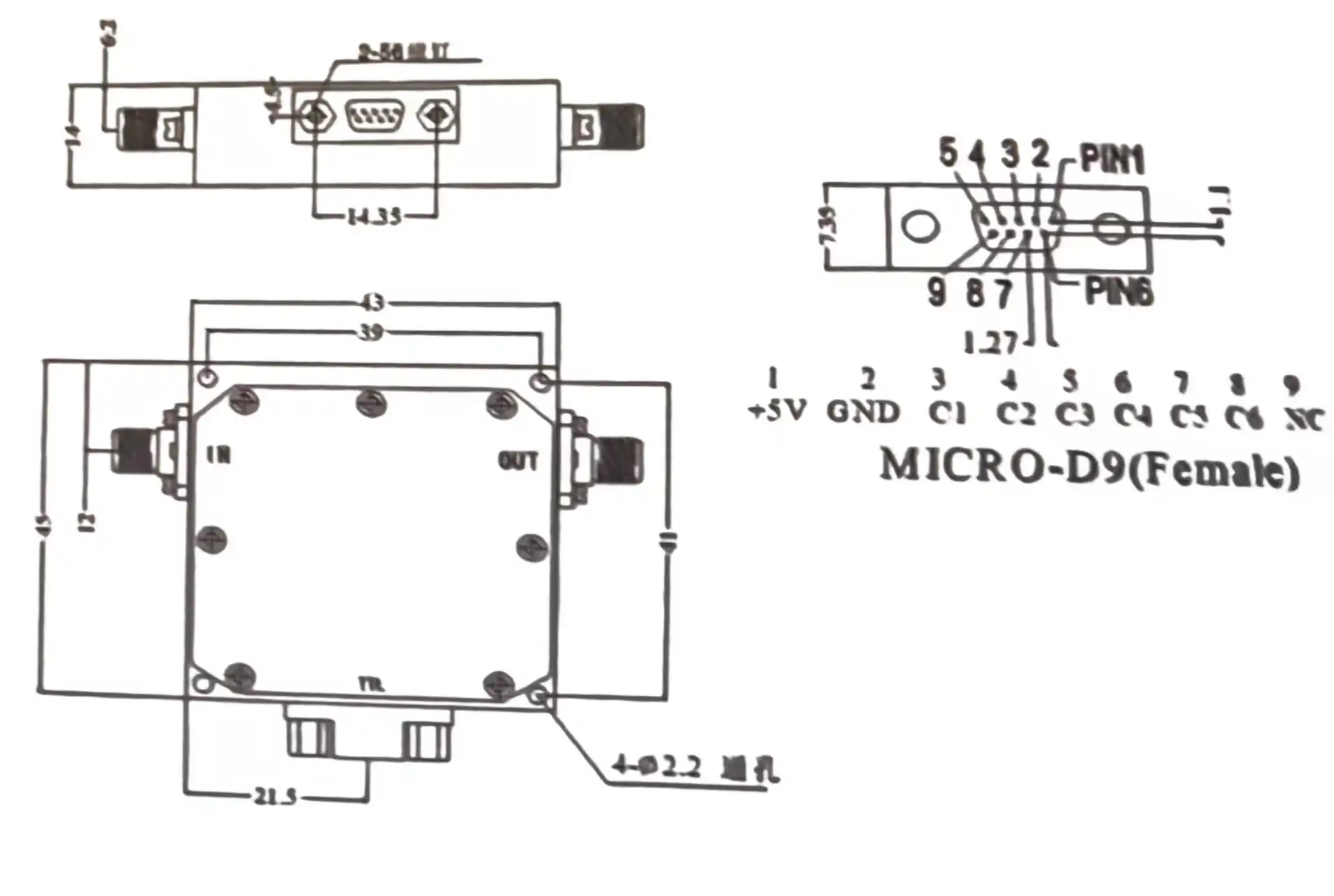
- Digital: Digital units move between programmed, repeatable phase states, making them suitable for phased arrays, automated test systems, and multichannel platforms. The trade-offs include quantisation error, switching transients, and state-dependent insertion loss. Also, many systems need a per-state calibration table and a suitable control interface, such as SPI or parallel logic, to get their greatest accuracy in service.
- Analogue: Analogue or voltage-controlled systems provide continuous adjustment, useful when smooth tuning is more important than quick switching. The phase is a function of the control voltage; thus, a clean, steady driver and temperature adjustment are important. And I also examine the linearity in the control range and over frequency before I sign off on a design for production.
- Mechanical: Mechanical units, such as many waveguide types, provide steady manual adjustment for laboratory calibration and specialised low-volume applications. They are slower to react and have limited remote control. I like them since they are easy to use and, once locked in, they have stable settings. The precise loss and power ratings are different for each model, so I always check the datasheet to confirm.
This is why, for precision phase shifters, there isn't just one type that works for every project. The right choice depends on the needs of the system, including whether it needs narrowband or wideband, how much power it uses, how much work it takes to integrate, how much calibration is needed, and the total cost of ownership.
How Accuracy Gets Measured
Both the makers and the people who buy the product use a vector network analyser and a controlled test setup to make sure it works right. While the measurement is going on, you should write down the S-parameters, insertion loss, return loss, phase shift, phase error, and amplitude balance. Your cable should be stable, the connectors should be clean, and the reference plane should be easy to see. Up to 110 GHz microwave measurement tools are used in our ADM labs, which is sufficient for the majority of RF and millimeter-wave tasks. I believe you should check every major phase state across the whole frequency range instead of just one point. Next, you should look at how often it happens, how long it takes to settle, and how much it changes over time.
What a Valid Accuracy Claim Includes
In order for a number to be accurate, it needs to include the frequency, power level, temperature, state of calibration, and test method. Like, when looking at a waveguide phase shifter, the set phase might be compared to the measured phase with an acceptance limit of ±2 degrees. The S11 and S21 sweeps across the band might also be used. Qualification records for vibration, thermal cycling, and drift give people more faith. Any supplier who can't show me these papers makes me doubt their claim. Not stating the conditions makes it impossible to compare two stories fairly.
Applications and Selection
It's only important when it makes sense, so let me connect it to real systems.
Phased Arrays, Radar, and Electronic Warfare
When it comes to phased-array antennas, beam direction and sidelobe control are strongly affected by channel-to-channel phase matching, repeatability, and minimal insertion loss. Most of the phase control in AESA radar is done electronically, so the antenna doesn't have to be rotated. This lets you quickly follow things that are moving. Radar and electronic warfare systems often need to be able to switch quickly, handle a lot of power, work in a wide range of temperatures, and keep test data that can be tracked. Waveguide assemblies, wire and cable assemblies, and microwave antennas are some of the things that ADM sells to Army and aircraft customers. I can talk about the phase factor that is part of the bigger RF chain.
Satellite, Test, Wireless, and OEM Uses
When it comes to satellites and aviation systems, the most important things are usually small packaging, low loss, certification, and a steady supply over the long term. It is possible for SATCOM terminals on ships and planes to stay in sync with geostationary or low-Earth orbit (LEO) satellites even when the platform moves. For testing and check-out of RF test tools in production, phase states must be stable and predictable. 5G huge MIMO base stations change the phase of beams to guide them to user equipment. Custom frequency bands, interfaces, connectors, housings, and branding can be made for OEM projects. One thing that all of these uses have in common is that the phase error has to stay within the system budget.
A Practical Selection Process
For precision phase shifters, I do five things. First, choose the frequency, phase range, resolution, number of channels, signal type, power level, environment, and volume. Second, place restrictions on things like phase accuracy, repeatability, insertion loss, return loss, VSWR, switching speed, and the device's performance at various temperatures. Third, pick an architecture that fits well within those constraints. Fourth, check the supplier’s data sheets, test reports, calibration ability, tracking ability, engineering assistance, and manufacturing capacity. Fifth, don’t just compare the unit pricing, but assess the whole value including qualification, integration, calibration, warranty, and lifetime support. Write down these boundaries before you contact vendors, and the quotation cycle will be shorter.
Avoiding Mistakes and Preparing a Strong RFQ
Most problems I see are caused by a few mistakes that can be avoided.
Common Selection Mistakes
Mistaking resolution for precision is the first mistake. Determine error amount and frequency under particular conditions. Or compare datasheets from various temperatures, frequencies, or power levels. Third, insertion loss between phase levels disrupts beamforming amplitude balance. The fourth is bypassing time, voltage, pinouts, and protocol checks. Choosing by unit pricing is the fifth mistake. Because supply continuity, documentation, and lifecycle support affect product cost over time. All are easy to price but costly to fix once the board is made.
What to Put in an RFQ
A comprehensive request reduces email exchange. Resolution, maximum phase error, insertion loss, state-to-state fluctuation, return loss or VSWR, average and peak power, switching or settling time, temperature range, connectors, dimensions. Note the control type (digital, analogue, mechanical), interface (SPI, TTL, USB, parallel), and driver software. Includes prototypes, annual volume, delivery goal, packaging, certificates, warranty, and Incoterms. Ask for test results, calibration certificates, S parameters, data sheets, and drawings.
How ADM Supports Your Project
ADM, or Advanced Microwave Technologies Co., Ltd., has been a manufacturer of microwave devices for over 20 years. Our goods are ISO 9001 certified, and we comply with RoHS regulations. We also test antennas in a 24m microwave dark room from 0.5 GHz to 110 GHz. We provide OEM services such as fast prototyping, technical assistance from our experts, and fast turnaround times. We have a complete supply chain system; manufacturing and R&D are integrated; we have stringent quality control, and we export all over the globe. These characteristics allow me to respond to RFQs with clear documentation and realistic timelines.
Conclusion
The accuracy of precision phase shifters is not a single figure but a specification of the full system. Resolution is the size of a step. For a 6-bit unit it is 5.625 degrees, while for an 8-bit unit it is 1.406 degrees. Accuracy, however, assesses the difference between what you would want to happen and what does happen. You have to consider insertion loss, return loss, power management, switching behaviour, frequency span, and temperature stability all at the same time. Digital ones are speedier and can be used many times; analogue ones are more stable, and mechanical ones may be modified by hand. Comparisons are only valid if test circumstances and calibration data are provided. The effect of modest phase errors on beam direction, sidelobes and signal quality in phased arrays, radar, satellite terminals and test systems is readily apparent. The proper option is determined when the application’s electrical, environmental, control and supply requirements are matched.
FAQ
Q1: Is an 8-bit phase shifter more accurate than a 6-bit one?
Not all the time. The step size is the only thing that bit count controls. To find out how accurate something is, you should compare the measured phase error to the architecture, frequency, calibration, temperature, and test conditions.
Q2: What is the difference between phase resolution and phase accuracy?
Resolution is the smallest step that can be programmed. Accuracy is the difference between what was ordered and what was measured. Even a small step can have a big mistake.
Q3: How do insertion loss and amplitude variation affect a system?
Loss lowers the signal level, and changes in phase states throw off the balance of the channel amplitude. In beamforming, that imbalance can change the shape of the beam and make sidelobes bigger.
Q4: Should I choose digital or analog for a phased array?
Digital units are good for most arrays because they can be set to fast, repeatable states and are easy to automate. Analog units work well in designs that need to tune continuously and smoothly.
Request Precision Phase Shifters Guidance or a Quotation from ADM
Are you ready to talk about your RF project? Email ADM at craig@admicrowave.com with your frequency range, phase range, accuracy goal, power level, control interface, quantity, and delivery date. ADM is a supplier of precision phase shifters with more than 20 years of experience in microwaves. They offer fast delivery, technical support, prototyping, and strict quality control.
References
1. Microwave Engineering (Pozar, Wiley), 2011
2. Phased Array Antenna Handbook (Mailloux, Artech House), 2005
3. Phased Array Antennas (Hansen, Wiley), 2009
4. Introduction to Radar Systems (Skolnik, McGraw-Hill), 2001
5. Antenna Theory: Analysis and Design (Balanis, Wiley), 2016
6. IEEE Transactions on Microwave Theory and Techniques, "Broad-Band Diode Phase Shifters" (Garver), 1972
YOU MAY LIKE
 VIEW MOREHigh Power Waveguide to Coaxial Adapter
 VIEW MOREEnd Launch Waveguide to Coaxial Adapter
 VIEW MOREWG Transition
 VIEW MOREDouble Ridged Flexible Waveguide
 VIEW MOREDouble-Ridged Waveguide Broadwall Directional Coupler
 VIEW MOREDigitally Controlled Phase Shifter
 VIEW MOREMMDS Transmitting Antenna
 VIEW MOREConical Horn Lens Antenna