





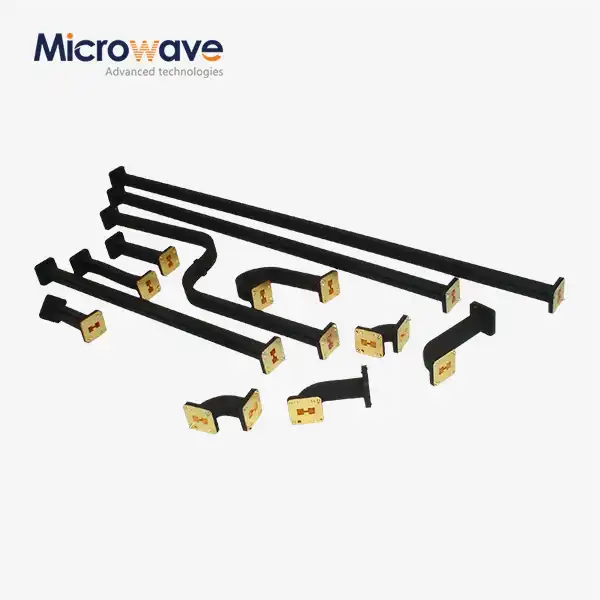
Double Ridged Flexible Waveguide
Double Ridged Flexible Waveguide for Wideband RF Systems
Advanced Microwave Technologies Co., Ltd. (ADM) manufactures double ridged flexible waveguide assemblies designed for systems requiring both mechanical adaptability and multi-octave bandwidth in a single transmission line. Available in WRD-650 (6.5–18 GHz), WRD-750 (7.5–18 GHz), and WRD-180 (18–40 GHz) configurations, these waveguides ship with a Neoprene jacket as standard. Custom lengths are produced to match specific routing geometries and installation constraints.
What Is a Double Ridged Flexible Waveguide?
A product is a microwave transmission line that has both the wide bandwidth of a rigid waveguide geometry with two ridges and the routing freedom of an internal structure that is twisted or interlocked. Ridges that stick out from the top and bottom inner walls lower the basic TE₁₀ mode's cut-off frequency. This makes the usable bandwidth ratio about 3.6:1, which is a range that regular rectangular waveguides can't reach.
The flexible core is made up of silver-plated copper or brass segments that are twisted or locked together. This design allows for E-plane bends, H-plane bends, and axial twisting, which makes installation possible in tight spaces or places where rigid pipe alignment is not possible.
Key Technical Specifications
Parameter | Details |
Frequency Range | WRD-650: 6.5–18 GHz / WRD-750: 7.5–18 GHz / WRD-180: 18–40 GHz |
VSWR | Typically < 1.35–1.40 across full bandwidth |
Bandwidth Ratio | Up to 3.6:1 |
Core Material | Silver-plated Beryllium Copper or Phosphor Bronze |
Jacket Material | Neoprene (standard) / Silicone (high-temperature or airborne environments) |
Flexibility | E-plane bends, H-plane bends, axial twisting |
Length | Customizable per installation requirements |
Power Handling | Lower than equivalent rigid waveguides; higher than coaxial cable at microwave frequencies |
Flange Compatibility | Compatible with standard rigid double-ridged flanges (verify alignment pin and 'D' drawing number prior to ordering) |
Performance Characteristics
The ridged internal geometry of Double Ridged Flexible Waveguide extends bandwidth and simultaneously lowers the voltage breakdown threshold relative to standard rectangular waveguide, due to the reduced gap between opposing ridges. Power handling therefore falls below that of a same-band rigid waveguide, though it remains substantially higher than coaxial cable at equivalent microwave frequencies. For wideband high-power RF transmission where a single transmission line must cover a range previously served by multiple separate waveguide sections such as WR-137, WR-90, and WR-62, this format is a practical consolidation option.
VSWR in flexible assemblies is typically specified at less than 1.35 maximum across the rated band. This is higher than rigid double-ridged counterparts, which commonly achieve around 1.15, because the corrugated or interlocked internal segments introduce minor periodic discontinuities that accumulate reflections. For most transmission and link-segment applications, the 1.35 figure is within acceptable limits.
Selecting the Right Model
ADM offers three standard bandwidth designations. Matching the correct model to the system frequency range is the primary selection criterion:
· WRD-650 covers 6.5–18 GHz and is suited to surveillance radar, ECM, and wideband test systems operating across the full 6–18 GHz span.
· WRD-750 covers 7.5–18 GHz and is appropriate where the lower 6.5–7.5 GHz portion of the band is not required.
· WRD-180 covers 18–40 GHz and is used in millimeter-wave and upper-microwave band applications.
Before ordering, confirm that the flange alignment pin positions and 'D' drawing number of the flexible assembly match the mating rigid waveguide flanges in the system. Double-ridged flange dimensions are not universally standardized, and mismatch will result in impedance discontinuities at the interface.
Typical Applications
Electronic Countermeasures in the Air (ECM)
For ECM and jamming systems to work, they need to send wideband signals from internal emitters to external antennas that work with frequencies between 6 and 18 GHz. The flexible structure can handle high-G loads and structural vibrations that would cause rigid waveguide plumbing to break down over time.
Satellite Earth Station High-Power Amplifiers
When you try to connect wideband TWTAs to antenna feed networks inside equipment racks, you may run into alignment issues that rigid pipe can't always fix. Flexible waveguide sections with two ridges can handle thermal expansion while they're working, and they make replacement easier because the rigid feed path doesn't have to be realigned.
EMI/EMC Tests in an Anechoic Chamber
Test setups sweeping from the lower microwave bands to 40 GHz use double ridged flexible waveguides to carry high-power signals from amplifiers to horn antennas, avoiding both the attenuation of coaxial cable at higher frequencies and the band-switching overhead of multiple narrow-band waveguide sections.
Inspection and Testing
Before being sent out, each unit goes through a full-band VNA sweep to check the VSWR and insertion loss across the whole rated bandwidth. Any VSWR values that aren't within the acceptable range can be traced back to changes inside the structure or bad solder joints at the ridge-to-flange contact.
Samples from production batches are bent over and over again until they reach the smallest possible bend radius. This is done to make sure that the silver finishing stays strong and the jackets stick together even when they are under dynamic mechanical stress.
Go/No-Go gauges that are used with ridge alignment models are used to check the dimensions of flanges. When parts are meant to be installed in pressurised air, they must be pressurised with dry air or nitrogen and then have their pressure decay measured to make sure the jacket and solder joints are still strong.
ADM's building has a 24-meter microwave darkroom and the ability to measure near- and far-field antennas, which helps with validating products over a wide frequency range.
Customization Options
Standard parts come in configurations with Neoprene jackets. For applications where operating temperatures are higher than Neoprene's limits or where airborne qualification standards need to be met, silicone jackets are available. To meet salt-fog exposure standards for use outside or in the navy, extra chemical-resistant coatings or mechanical armouring can be added. To order, custom lengths are made.
FAQ
Q: How does power handling compare to a regular square waveguide?
A: It can't handle as much power. The internal ridges lower the gap height between the conductors, which makes the voltage breakdown threshold lower than with a regular rectangular waveguide that covers the same frequency range. Power handling is a lot better than with coaxial wire at microwave frequencies.
Q: Can I use the antenna outside without any extra protection?
A: The flexible core by itself does not keep water out. For environmental protection, you need a Neoprene or Silicone jacket. For military or consistently harsh outdoor settings, it is suggested to add extra chemical-resistant coatings or armouring to keep the jacket's integrity when exposed to salt fog and UV light.
Q: Why is VSWR higher in flexible versions than in rigid double ridged waveguides?
A: The internal pieces that are corrugated or interlocked create small gaps every so often along the length of the guide. These add up to a reflected signal. A rigid WRD unit might get as high as 1.15 VSWR, while a flexible one is more likely to get between 1.30 and 1.35. This stays within acceptable limits for most gearbox segments.
Q: How big of a bend radius is needed?
A: The minimum bend radius is based on the model's cross-section. For example, the WRD-650 and WRD-180 have different physical dimensions, so their limits are also different. A steady installation can handle a smaller bend radius than a dynamic installation that bends over and over again. When the specified minimum is exceeded, the internal ridge geometry is distorted, which leads to permanent VSWR degradation.
Q: Can these flanges be used with regular hard waveguide flanges?
A: Rigid double-ridged flanges of the same bandwidth designation can be used with flanges. The sizes of double-ridged waveguide flanges are not as widely agreed upon as the sizes of normal rectangular waveguide flanges. Before you place an order, make sure you check the positioning of the alignment pins and the "D" drawing number for both the flexible assembly and the component that goes with it.
Q: What materials are used in the core and jacket?
A: The flexible core is made of silver-plated Beryllium Copper or Phosphor Bronze, which was chosen because it is both strong and good at conducting electricity. The normal jacket is made of Neoprene. There are silicone jackets that can be used when protection to high temperatures or airborne qualification is needed.
Contact Us
Send your frequency range, required length, and installation details for Double Ridged Flexible Waveguide to craig@admicrowave.com — ADM's engineering team will review your requirements and respond.