




Dual Channel Coaxial Rotary Joint vs Two Single-Channel Units: Which Wins?
When engineers and procurement teams ask whether a dual channel coaxial rotary joint outperforms two separate single-channel units, the short answer is: it depends on your application—but integrated wins most of the time. A dual-channel coaxial rotary joint combines two independent RF signal paths inside one housing, transmitting simultaneous signals through a 360-degree rotating interface without cable fatigue or entanglement. Compared to pairing two single-channel units, this architecture typically delivers a smaller footprint, fewer mechanical failure points, and cleaner signal isolation—making it the preferred choice in space-constrained, high-reliability systems.
Understanding Dual Channel Coaxial Rotary Joints and Single-Channel Units
It's helpful to know what each architecture does at the design level before comparing how well it works.
What Is a Dual Channel Coaxial Rotary Joint?
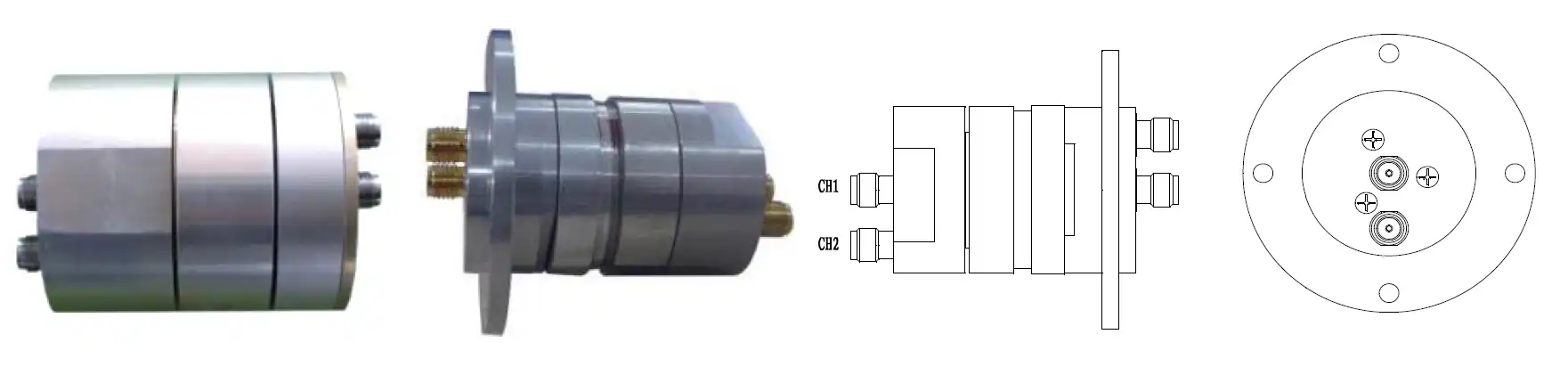
A dual-channel coaxial rotary joint is a precise electrical part that sends two separate RF or microwave signals between a stator that stays still and a rotor that keeps turning. Its internal structure uses precision dielectrics to separate concentric conductor paths, keeping more than 50 dB of isolation between channels even when they are rotating. Some high-performance types can separate sounds by more than 70 decibels. This design directly fixes two issues that hurt the quality of signals in spinning radar and SATCOM systems: phase wobble (Phase WOW) and crosstalk.
What Are Two Single-Channel Units?
Two rotating joints with a single channel work separately, with each one taking care of its own RF signal line. Engineers pair them up when two channels need very different frequency bands or when one channel needs to be replaced without affecting the other. Each unit has its own housing, connectors, and mechanical interface. This means that the combined system takes up more room and needs more mounting tools and cables to link the units.
Key Design Differences
A dual-channel unit's built-in concentric design keeps both signal lines aligned along their axes, which helps keep the phase stable when the unit is rotating. On the other hand, small alignment drift can happen over time between two different parts, especially when they are vibrating. For uses like air traffic control radar, where the joint turns all the time, that drift causes measured changes in how well it works.
Comparative Analysis: Dual Channel vs Two Single-Channel Units
Technically, both setups work. The best choice for your system will depend on which trade-offs in speed are most important to you.
Signal Integrity and Isolation
A dual channel coaxial rotary joint is better at isolating because both channels share a single body that was carefully made. Standard models keep channel isolation at or above 50 dB, and custom configurations keep it at or above 70 dB. To stop cross-channel interference between two paired single-channel units, external shielding and cable paths are needed. This is harder to control in places with a lot of electrical noise, like radar stations or EW systems.
Mechanical Footprint and Rotational Load
For size, the integrated unit is clearly the winner. Two single-channel units stacked on top of each other or next to each other take up a lot more space and weigh a lot more than a single dual-channel housing. There isn't a lot of room for EO/IR turret gimbal systems and SATCOM-on-the-move interfaces on military trucks. Less spinning mass also means less power load on drive motors, which makes the motors last longer.
Service Life and Reliability
High-quality dual-channel rotary joints are rated to last between 10 and 50 million revolutions under normal operating conditions. This is proven by accelerated life testing that checks the change in contact resistance. Micro-arcing and dynamic contact resistance noise are stopped by precious metal contacts, which are usually gold-on-gold. With two single-channel units, there are twice as many contact interfaces, which statistically raises the chance of a maintenance event during long service intervals.
Because of these big changes in performance, most defense and satellite procurement experts choose integrated dual-channel options for new system designs. Still, two single-channel units are useful when the channels need frequency bands that are very far apart or when the system-level redundancy design needs paths that are completely different.
Application Scenarios: Which Solution Fits Your Industry Needs?
When you connect technology to real-world operating environments, it's easier to pick the right configuration.
Radar and Surveillance Systems
In radars used for air traffic control and ground observation, the radar sends high-power pulses on one channel and receives low-power return signals on the other channel at the same time. Even at high peak power levels, the dual-channel system can handle this without cross-channel leakage. Continuous 24/7 operation outside needs ingress protection of IP65 or IP67 and the ability to handle temperature changes from -40°C to +85°C, which are both standard on qualified units.
Aerospace, Defense, and SATCOM Terminals
SATCOM-on-the-go terminals use two types of signals—right-hand circular polarization (RHCP) and left-hand circular polarization (LHCP)—to double the amount of data that can be sent or keep the link stable when the polarization changes while the vehicle is moving. These uses need to meet MIL-STD-810 vibration compliance. Integrated dual-channel joints are better at meeting this need than paired single units because they have fewer mechanical joints that are vulnerable to shock loads.
OEM and Industrial Automation
The small size of a dual-channel unit makes mechanical integration easier for OEM system builders who are putting together spinning sensor platforms or industrial measurement equipment. Channel 1 can be set up for X-Band (8–12 GHz), and Channel 2 can work on its own at L-Band (1–2 GHz). The internal geometry resistance of each channel is tailored to its unique frequency need.
Procurement Considerations for B2B Buyers
The choice to source isn't just based on technical ability. The procurement teams must also look at the qualifications of the suppliers and the total cost of ownership.
Certification and Quality Verification
A good dual channel coaxial rotary joint provider should give you Vector Network Analyzer (VNA) test data that shows S-parameter measurements (S11, S12, S21, and S22) taken during real rotation, not just measurements that are taken in a steady position on a bench. It is important that the phase and amplitude stay stable within ±3 degrees and ±0.05 dB during the whole 360-degree sweep. For defense and aircraft purchases, you need to have ISO 9001:2015 approval and follow RoHS rules.
Total Cost of Ownership
A combined dual-channel joint costs more per unit up front than a single-channel unit. Over a three- to five-year deployment period, however, the cost of two single-channel units plus the extra mounting hardware, cabling, alignment labor, and longer maintenance intervals usually exceeds that of the integrated option. When buying things for multi-year programs, procurement teams should ask suppliers for lifecycle cost data instead of just per-unit prices.
Customization and Lead Times
Applications that need non-standard frequency band combinations, connector types, or environmental ratings need suppliers that can make them. Make sure the maker can help with engineering for changed designs, quickly turn around prototypes, and keep track of paperwork for traceability. These things have a direct effect on the program risk for aerospace and military projects.
Maintenance, Troubleshooting, and Long-Term Value
To make sure the system works well in the long term, even the best-designed rotary joint needs to be maintained.
Routine Inspection Protocols
At regular times, check the surfaces of connectors for rust and mechanical wear. Using a calibrated VNA, compare the values of insertion loss and return loss to the standard datasheet values. If the insertion loss changes by more than 0.3 dB from the baseline, it means that the contact is breaking down before it becomes a problem at the system level.
Diagnosing Rotational Noise
During spinning, spikes or "noise bursts" usually mean that there is dynamic contact resistance or micro-arcing at the slip ring interface. Even though gold-on-gold touch technology makes this less likely, pollution or mechanical wear can still happen over time. Cleaning the contacts with the right RF-grade chemicals can often get them working again without having to replace the whole unit.
Component Replacement vs. Full Overhaul
For dual-channel units, it is often possible to repair them partially by changing the internal contact parts instead of the whole housing. Two single-channel units are better because you can replace only the broken channel, but taking apart a dual-mount setup can make that benefit less useful. Check to see if your system can be serviced in the field before you decide on the design.
Conclusion
A dual channel coaxial rotary joint is the better option for most high-reliability rotating devices that need to fit in a small area. This is true for radar, defense, and satellite uses. Compared to two paired single-channel units, it has better signal isolation, less mechanical complexity, and a longer service life. Two single-channel units can still be used if the design goal is to have a wide frequency range or separate support. Make sure that the design you choose fits the needs of your application, and work with a supplier that can offer both versions with proven performance data and engineering customization.
FAQ
Can a dual-channel coaxial rotary joint replace two single-channel units directly?
In most cases, yes. If both channels fall within the frequency range and power ratings of the integrated unit, a direct replacement reduces footprint and connector count. Verify that connector types, frequency bands, and isolation specifications match your existing system design before substituting.
What frequency ranges do these joints typically support?
Channels are independent and can cover different bands simultaneously. For example, one channel can operate at X-Band (8–12 GHz) while the other covers L-Band (1–2 GHz). Custom internal geometries allow impedance matching for each channel's specific frequency requirement.
How do I evaluate signal quality during rotation?
Request VNA-based rotational variance test data from your supplier. Phase stability within ±3 degrees and amplitude stability within ±0.05 dB during a full 360-degree rotation are standard benchmarks for quality-grade units.
What causes rotational signal noise, and how is it controlled?
Rotational noise typically originates from dynamic contact resistance at the slip ring interface. Gold-on-gold contact technology and precision concentric machining suppress this effect. Quality units maintain stable electrical continuity throughout the rated rotational life.
What environmental ratings should I specify for outdoor or defense use?
IP65 or IP67 ingress protection, MIL-STD-810 vibration compliance, and thermal cycling tolerance from -40°C to +85°C are standard for defense and outdoor surveillance applications. Confirm Environmental Stress Screening (ESS) test reports are available from your supplier.
Get the Right Rotary Joint Solution from ADM
Advanced Microwave Technologies Co., Ltd. (ADM) makes high-quality dual channel coaxial rotary joints for use in defense, radar, SATCOM, and OEM settings. ADM gives you confirmed performance data with every order because they have been making products for over 20 years, are ISO 9001:2015 and RoHS certified, and test their products in-house up to 110 GHz. You can email craig@admicrowave.com to get a custom quote or talk to our engineering team directly about your application needs.
References
1. Pozar, D. M. Microwave Engineering, 4th Edition. Wiley, 2011.
2. Collin, R. E. Foundations for Microwave Engineering, 2nd Edition. IEEE Press, 2001.
3. IEEE Transactions on Microwave Theory and Techniques. "Rotary Joint Design and Signal Integrity in Rotating RF Systems." IEEE, 2018.
4. Defense Electronics Magazine. "RF Component Qualification Standards for Aerospace and Defense Procurement." Defense Electronics, 2020.
5. Skolnik, M. I. Introduction to Radar Systems, 3rd Edition. McGraw-Hill, 2001.
6. International Electrotechnical Commission. IEC 61169: RF Connectors — Performance Standards for High-Frequency Coaxial Components. IEC, 2016.