




Custom Horn Lens Antenna Solutions for Advanced Systems
The feed horn and the precision dielectric lens are joined together in a horn lens antenna. It has fewer sidelobes, more gain, and a shorter body than a plain horn that does the same job. Engineers can set the frequency range, aperture, polarization, waveguide interface, and mounting for a custom design so that it works with the whole RF system. We at ADM have been making microwave equipment for more than 20 years. We make equipment for radar, satellite communication, millimeter-wave testing, and OEM. This guide tells you how these antennas work, how to choose the right one for you, and how to buy them without any worries.
Why Advanced Systems Need a Custom Horn Lens Antenna
Performance Gaps That Standard Antennas Leave Open
Most of the time, catalog antennas work well, but their limits are often shown by more advanced radar, communication, and measurement systems. Problems that often happen are not enough gain, beamwidth that moves around the band, sidelobes that pick up interference, not enough frequency coverage, and flanges that don't match the waveguide run. A horn lens antenna talks to a lot of these at the same time. The lens flattens the wavefront as it leaves the horn, which lets the aperture work better. The antenna is no longer a compromise when the aperture size, lens profile, and polarization are changed to fit the budget of the system. It turns into a planned part of the RF chain.
Where Custom Designs Are Used
Engineers ask for unique designs for radar, satellite ground equipment, over-the-air testing for 5G and millimeter-wave, measuring antennas, and OEM subsystems. In the validation of automotive radar, 77 GHz and 79 GHz sensors are tested in chambers with a flat wavefront and low sidelobes. This makes a short indoor range look like a long outdoor range. Narrow beams let a lot of links be placed on crowded towers in E-band wireless backhaul, which works at frequencies between 71 and 86 GHz. The narrow beam method is also used by industrial radar level gauges to get through small tank nozzles. Size, polarization, and environmental protection are all needed in different ways for each case.
What International Procurement Teams Expect
One thing that buyers in defense, aerospace, telecom, and research all want is documents that match the hardware. In the US, procurement teams usually want full datasheets, measured radiation patterns, steady production quality, test reports, and engineers who can quickly answer technical questions. It's easier to qualify when the supplier shows how each unit was measured. This is especially true when the horn lens antenna feeds a larger certified system. The fact that ADM products are ISO 9001 certified and RoHS compliant means that buyers have a clear process to check. We think of paperwork as part of the product because even the best design fails review if it can't be tracked or if batches don't match.
How a Horn Lens Antenna Works and What to Specify
The Physics Behind the Lens
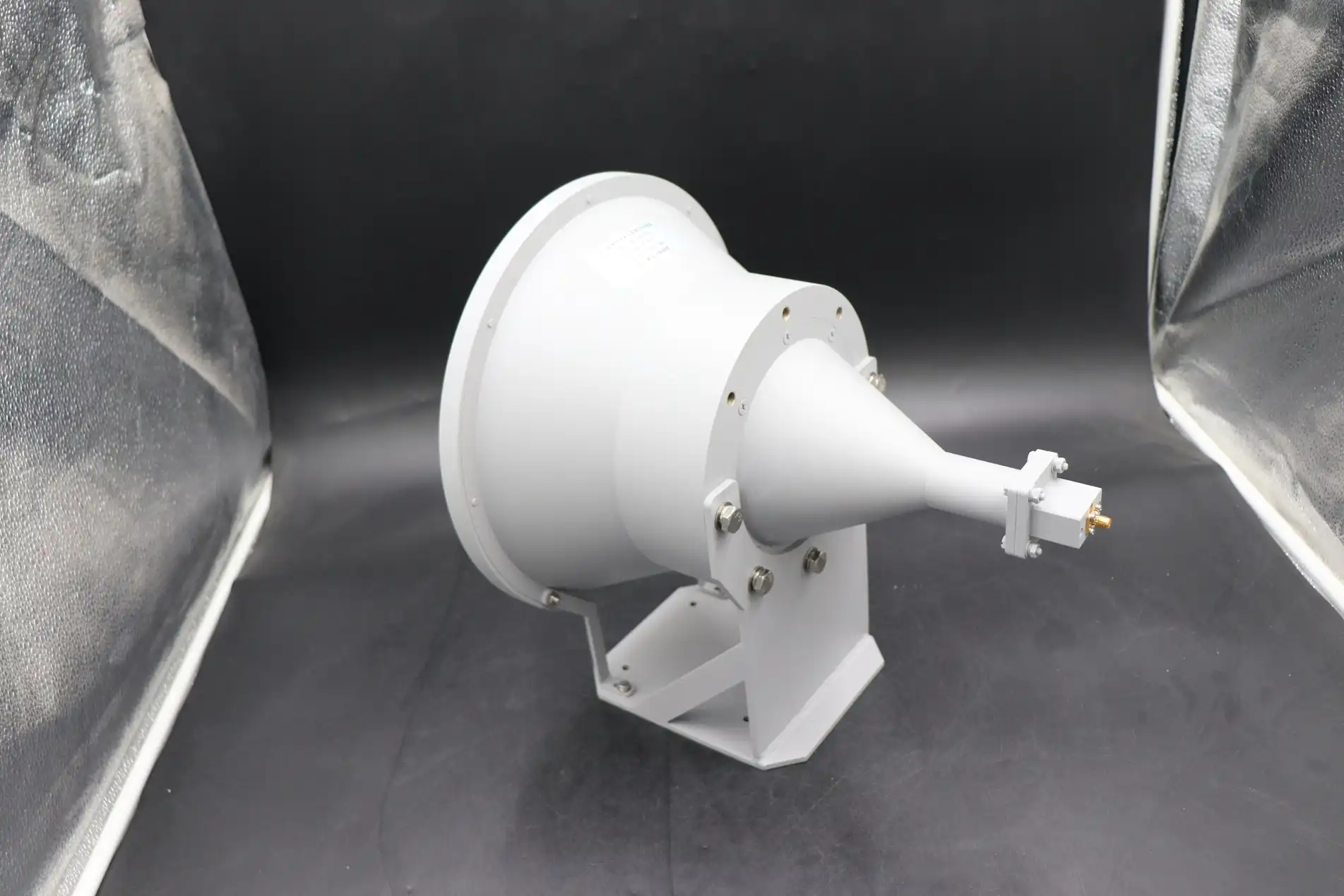
A spherical wavefront comes from a feed horn. As the aperture gets bigger, the edge of the opening moves away from the throat more than the middle. This makes the phase different across the aperture. Then the gain is less than what the aperture area suggests because it grows as the aperture area is divided by the square of the wavelength. Classic optimum-gain horns can handle a path difference of about a quarter to three-eighths of a wavelength. A longer flare is usually used to fix this problem in a plain horn. A plano-convex or hyperbolic dielectric lens can do the same job with less length. It slows down the wave's center, making the wavefront that comes out of the aperture flat.
Key Parameters to Specify
There's more to a datasheet than just center frequency and gain. Ask for the frequency range that can be used, the beamwidth, the level of the sidelobe, the pattern symmetry, the cross-polarization, the return loss, the VSWR, the aperture efficiency, and the phase behavior. A bigger aperture makes the antenna bigger and narrows the beam, but it also makes it harder to fit in certain places. Also, say how the measurements will be done, because the test method and range distance will change the results of the gain and pattern. A distance of 2D²/λ is usually used to measure far fields. Here, D is the largest aperture dimension. So, a big antenna might need a system with a long range or a system with a close range.
Lens Materials, Power, and Environment
Loss and durability are affected by the choice of material. A lot of low-loss lens materials are made from PTFE, Rexolite, and TPX. At Ka-band, lens loss stays below 0.3 dB, and the gain from phase correction is greater than the lens loss. Take care when handling power. The metal horn can handle a lot of power, but the lens soaks up some of it and gets warmer. For transmissions in the kilowatt class, you need materials like quartz or ceramic and a known CW power rating. If you're outside, VSWR can be thrown off by water, ice, or conductive dust on the lens. This can change the pattern, so hydrophobic coatings or a radome can help. If you step-zone lenses like a Fresnel lens, they make big apertures lighter, but they might make the frequency range a little smaller.
Horn Lens Antenna Compared with Other Antenna Technologies
Versus Conventional Horns
Because phase error needs to be kept low, a standard gain horn can only reach high gain when its body is long. A lens horn has the same gain and aperture efficiency as a lens but is smaller and has better sidelobe suppression and beam symmetry. For an extra fee, work needs to be done on the manufacturing process to make the lens, check the materials, and line up the lens and horn. A regular horn is still easier to use and less expensive for general purposes with low gain. The lens version is worth the extra money when there isn't much room or when pattern purity affects how accurately measurements are made. Because the planar wavefront gives a clear picture of the amplitude and phase distribution, pyramidal versions are also good for near-field scanning probes.
Versus Parabolic Reflectors
Many times, a parabolic reflector is the most cost-effective choice for very large apertures even though it can reach very high gains. To work, a feed has to be held in front of the dish. If the feed support is in the middle, it can block part of the aperture unless the design is offset. A horn lens antenna has the feed, lens, and aperture all in one body that runs along the length of the antenna. This makes packaging easier for many millimeter-wave systems. It is easier to align and protect a single small unit than a dish with separate feed hardware on a short test range or a crowded tower mount. The reflector is better when you need more than what a lens can give you.
Versus Phased Arrays
Phased arrays use electronics to move beams around, scan quickly, and make more than one beam at the same time. They also need a lot of control electronics, calibration, and radiating elements, which adds to the amount of power they use and the upkeep they need. A lens horn antenna's beam stays in one place. That beam is enough if the app points at a satellite, a device being tested, or a fixed link. It has less hardware that could go wrong. You should use a phased array when you need to scan. When gain, pattern quality, size, cost, and ease of use are more important than steering, choose the lens horn. The answer is not just about the antenna, but about the whole system.
Application-Specific Solutions and the Custom Design Workflow
Radar and Satellite Communication
It is common for radar designs to need narrow beams, low sidelobes, symmetrical patterns, and stable gain. This is because sidelobes can pick up noise and clutter. It is necessary for satellite links to have high gain, accurate pointing, and either linear or circular polarization. The front end of the waveguide needs to match the interface with the waveguide. We can talk about the antenna along with the hardware that connects to it since ADM works on waveguide assemblies, coaxial and cable assemblies, microwave antennas, feeds, and satellite communication products. Our products are used in shipboard systems, UAVs, systems for finding your way, weather monitoring, and security check systems.
Millimeter-Wave Testing and Measurement
At 24 GHz, 28 GHz, 60 GHz, and 77 GHz, test systems need calibrated patterns and repeatable phase behavior to make measurements over the air and make sure the device works. Pyramidal and conical horn lens antennas work best between 18 GHz (K-band) and 110 GHz (W-band). For 6G, research is now expanding to D-band. Planar wavefronts are used in compact antenna test ranges to make indoor far-field conditions more like the real thing. There are trade-offs between aperture size, frequency coverage, gain, and available space in compact or ultra-wideband designs. We recommend that you share your measurement setup early on and use application-specific data instead of headline gain numbers to compare suppliers.
From Requirements to Production
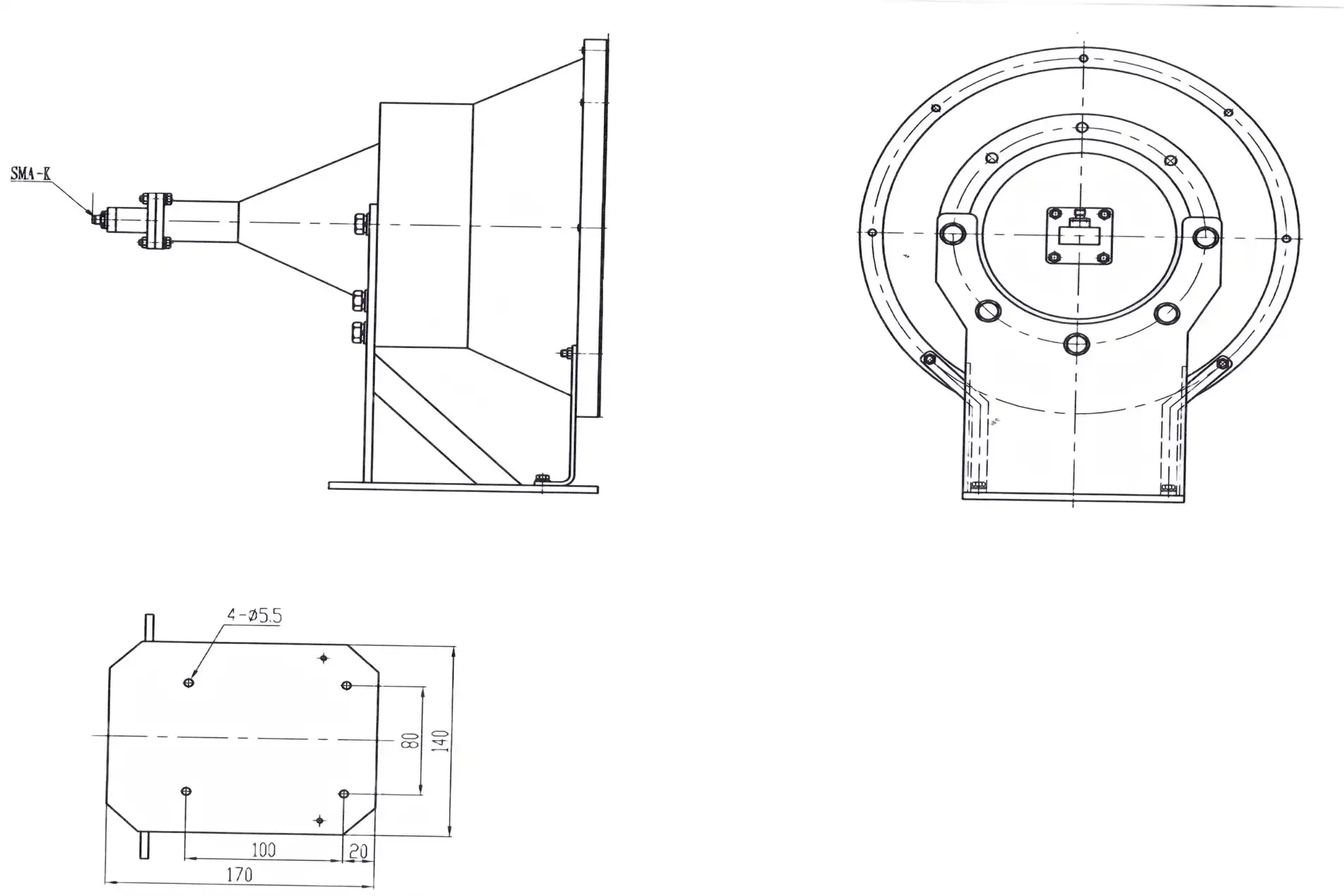
Writing down the project's purpose, frequency, gain, beamwidth, polarization, power, environment, and mechanical interfaces is the first step to making sure it will work. After that, engineers pick the type of horn, lens material, aperture, focal geometry, and waveguide configuration. They then simulate phase and illumination. After that, S-parameters, gain, beamwidth, pattern, polarization, and dimensions were measured on the prototypes. ADM has measurement tools up to 110 GHz in our labs and offers quick-turn prototyping for testing before full-scale production. Once the design is approved, we set up the production drawings, tolerances, inspection steps, batch testing, and the ability to track down materials. After that, we help with engineering changes, repeat orders, and document exports.
Choosing a Supplier, Planning Cost, and Verifying Quality
What to Look for in a Supplier
First, seek proven antenna expertise with microwaves and millimeter waves. Then discover how much you can adjust, including frequency, aperture, polarization, mounting choices, and connections. Please consult information sheets, radiation patterns, gain and beamwidth data, return-loss curves, mechanical drawings, material information, and environmental parameters before purchasing. An example qualifying phase should include acceptance criteria, inspection responsibilities, corrective action, and change control. There are other significant commercial terms like lead time, minimum order quantity, the opportunity to make repeat orders, export packaging, and OEM labeling. For more than 20 years, ADM has been manufacturing microwave equipment and providing OEM services, prototyping, technical support, and shipping worldwide.
Cost Drivers and the RFQ
The price depends on the frequency, aperture size, gain, sidelobe restrictions, lens material, precision of machining, polarization, interfaces, testing, and the quantity of orders. Standard models save engineering costs and lead time while unique designs may improve system integration and performance. An RFQ in full will include operational requirements, mechanical drawings, quantity, sample expectations, delivery location, documentation, and acceptance criteria. Ask the provider to provide a breakdown of the expenses of engineering, testing, tools, shipping, and the warranty. And add the total cost of ownership. The modest difference in unit pricing may be less essential than such factors as the time to integrate, availability of replacement parts, and long-term support for manufacturing.
Verification and Quality Assurance
Once approved, it should be checked for such things as gain, radiation patterns, beamwidth, sidelobe levels, polarization purity, cross-polarization, and frequency sweeps throughout a certain band. Mechanical tests include such things as dimensions, flange mating, hole alignment, surface polish, and mounting of the pieces. Record test settings and equipment to allow comparison of sample and production results. IEEE test protocols for antennas may be used as a reference. ADM features a 24 m long microwave darkroom with an antenna plane near-field and far-field measurement recombination chamber. The test range is 0.5 - 110 GHz. Then, revision control, tracking, inspection records, and secure packing decrease the danger of delivery.
Conclusion
A horn lens antenna utilizes a dielectric lens to correct the phase inaccuracy of a conventional horn. It features a shorter body but high gain, low sidelobes, and symmetrical beams. Choice depends on frequency range, beamwidth, sidelobe level, VSWR, efficiency, lens material, power rating, and environmental protection. So that findings may be compared, test conditions need to be set forth. But the lens includes phase control, not only horns, and is harder to construct. It is simpler to package than reflectors. It can't steer the beam as phased arrays do, but requires less circuitry. All of these problems are addressed in one way or another by radar, satellite, millimeter-wave testing, and OEM programs. A procedure that involves specifications, simulation, measuring prototypes, and written approval allows a bespoke design to suit not just an antenna standard, but the full system.
FAQ
Q1: Why choose a lens horn over a standard gain horn?
In order to keep phase error low, standard gain horns need bodies that are long. That mistake is fixed by the lens, which makes the antenna gain the same in a smaller package with fewer sidelobes and more even beams.
Q2: Does the dielectric lens add significant loss?
It takes some loss to have each dielectric. Loss stays below 0.3 dB at Ka-band with low-loss materials like PTFE or Rexolite, and the gain from phase correction is greater than it.
Q3: Can a horn lens antenna handle high power?
Be careful. The metal horn can handle power well, but the lens can heat up when it takes in power. Systems in the kilowatt class need quartz or ceramic materials, and you should check the CW power rating.
Q4: What should I include in a custom inquiry?
Tell us about the frequency range, gain, beamwidth, polarization, waveguide interface, power, environment, quantity, and delivery date. Clear criteria for acceptance help us give accurate quotes.
Request a Custom Horn Lens Antenna Solution from ADM
Looking for a horn lens antenna supplier that can work with both prototypes and large OEM orders? ADM offers integrated R&D and production, as well as ISO 9001 certification, RoHS compliance, fast shipping, and exporting all over the world. Email craig@admicrowave.com with your frequency, gain, beamwidth, polarization, interface, and quantity. Our engineers will get back to you with a design suggestion.
References
1. Antenna Theory: Analysis and Design, 2016
2. Antenna Engineering Handbook, 2007
3. Microwave Antenna Theory and Design, 1949
4. IEEE Standard Test Procedures for Antennas, 1979
5. Antennas for All Applications, 2002
6. Modern Antenna Handbook, 2008