




Analysis and Design of a Diplexing Power Divider for Ku-Band Satellite Applications
Diplexing power dividers are an important part of modern Ku-band satellite communication systems because they let you send and receive data at the same time through a single antenna interface. At the heart of these systems is the Low Ku Band Diplexer, a carefully designed part that works in the 10.7–12.75 GHz range. This device handles signal routing based on frequency by combining complementary filter networks, usually low-pass and high-pass configurations, that keep uplink and downlink channels separate while maintaining strict isolation thresholds above 70 dB. The design makes sure that there is very little insertion loss (less than 0.5 dB), which keeps the signal integrity across the whole operational bandwidth for mission-critical uses in VSAT terminals, satellite ground stations, and communication platforms in the air. Defense contractors and people who put together satellite systems are asking for more and more diplexing solutions that balance how well they work electrically with how tough they are mechanically. Technical teams that have to choose parts for next-generation satellite networks need to understand the engineering trade-offs, procurement variables, and new design methodologies.
Understanding Low Ku Band Diplexers: Fundamentals and Frequency Characteristics
In RF signal chains, diplexers work as frequency-selective switches that send energy based on spectral content instead of temporal sequencing. In contrast to time-division duplexers, these gadgets use the natural frequency separation between the transmit and receive bands to allow two-way communication at the same time.
Frequency Range and Operational Principles
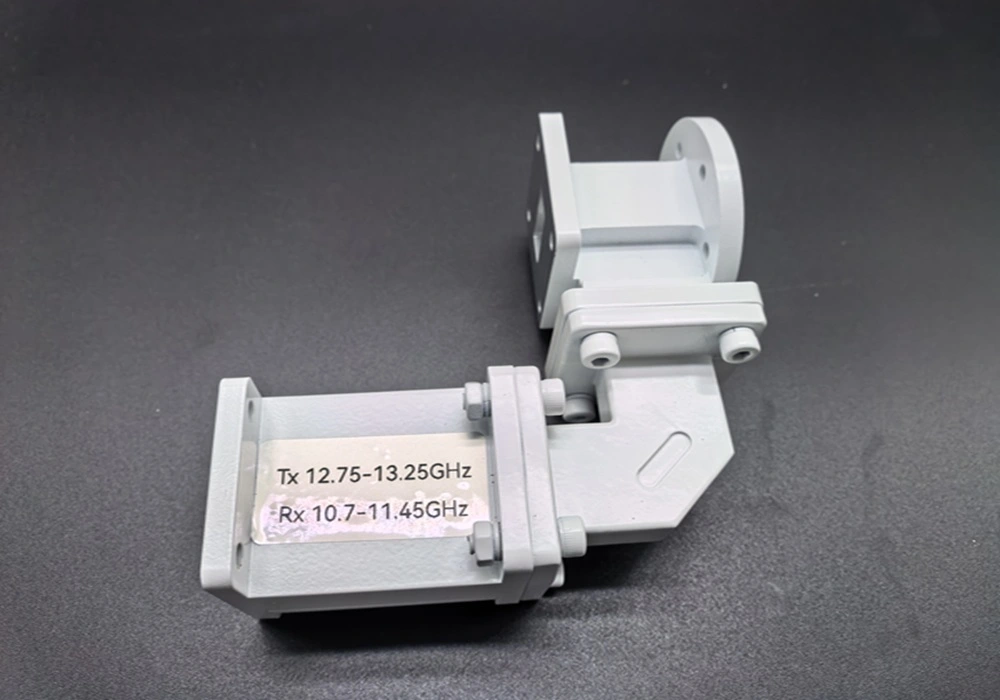
The Ku-band spectrum is split into different parts. The lower part, which covers 10.7 GHz to 12.75 GHz, is mostly used for downlink reception in satellite communications. A diplexer made for this range has two parallel filter paths that meet at a single port. The receive channel uses bandpass filters with an 11 GHz center frequency, and the transmit path aims for the 13.75–14.50 GHz uplink band. Ground stations can use this design to connect a single antenna feedhorn to separate high-power amplifiers and low-noise block downconverters without any signal problems.
Critical Performance Metrics
Three factors determine the specifications of a diplexer that is bought. Insertion loss measures how much energy is lost through the device, which has a direct effect on how the link budget is calculated. To get values below 0.5 dB, you need to use precise machining and low-loss dielectric materials like PTFE composites or waveguide sections filled with air. Isolation measures how well out-of-band signals are blocked, which keeps transmitter leakage away from sensitive receiver front-ends. Specifications above 70 dB keep high-power transmit signals from overloading low-noise amplifiers, which normally work with input power levels close to -10 dBm. Power handling capacity talks about how much power can be used, how much heat can be lost, and how much voltage can be lost. For ground-based applications, the typical rating is around 200W.
Common Operational Challenges
Impedance mismatches can cause signal reflections that hurt power amplifiers and make the system less efficient. It is recommended that procurement teams check the voltage standing wave ratio (VSWR) specifications and aim for values lower than 1.3:1 across the operational bandwidth. Another problem is frequency drift caused by temperature changes, which can happen in outdoor installations that are exposed to temperature changes of -40°C to +85°C. Performance loss can be lessened by choosing diplexers with temperature-compensated cavity designs or low-expansion metal alloys. In high-power systems, receive bands are messed up by passive intermodulation products that are made by non-linear junction effects. In demanding satellite communication applications, this problem can be fixed with a Low Ku Band Diplexer by choosing contacts that are silver-plated and staying away from metal interfaces that are not the same.
Design and Analysis of Diplexing Power Dividers for Low Ku Band Applications
To make high-performance diplexers, you have to optimize many electromagnetic parameters at the same time while staying within cost and manufacturability goals. Full-wave electromagnetic simulation and automated optimization algorithms are used together in modern design workflows to explore parameter spaces with many dimensions.
Impedance Matching Strategies
Multi-section transformer networks are needed to match the impedance across the 2 GHz bandwidth that Ku-band diplexers usually work at. Chebyshev or Butterworth polynomial synthesis methods create the basic structures of filters. Designers then improve these structures by using electromagnetic analysis to take into account parasitic coupling and fringing fields. For waveguide designs, stepped impedance sections work well, and for coaxial designs, tapered transmission lines or lumped-element matching networks are used. Five-section Chebyshev transformers have return losses of more than 20 dB across all operational bands, which means they reflect less than 1% of the power they receive.
Minimizing Insertion Loss
At Ku-band frequencies, conductor losses are the main way that energy is lost because the skin effect concentrates current flow within a few micrometers of metal surfaces. When compared to copper, silver plating lowers surface resistivity by about 8%. This makes high-volume signal paths better in a way that can be measured. In coaxial applications, dielectric losses are high, which is why designers are looking for air-dielectric or low-loss PTFE formulations with tangent delta values below 0.0005. Using high-Q geometries in cavity resonator designs lowers loss even more by spreading out the electric field less in areas that lose energy.
Ensuring Adequate Isolation
Cross-coupling suppression depends on placing transmission zeros in filter response functions in a smart way. When designers make a diplexer, they add attenuation poles at frequencies that match the passband of the other channel. This makes steep rejection skirts. Cross-coupled resonator configurations are used in advanced topologies to create multiple transmission zeros. This makes the isolation 15–20 dB better than in traditional ladder networks. Spatial decoupling between the transmit and receive filter sections adds to the isolation. This is especially important in high-power applications where conducted paths could re-radiate interference signals. Practical installation guidelines stress the importance of proper grounding to keep common-mode currents from weakening the performance of isolation. When you mount diplexers directly to metal enclosures, low-impedance ground references are set up, and RF-tight covers stop unwanted radiation. Using conductive gaskets for environmental sealing keeps the electromagnetic integrity even when the temperature and humidity change. These installation rules should be required by the procurement specifications to make sure that performance in the field matches data from the lab.
Procurement Guide for Low Ku Band Diplexers: Sourcing and Supply Chain Insights
When making strategic sourcing decisions, people weigh technical performance against business factors like lead times, the ability to customize, and the reliability of the supply chain. Structured frameworks are needed for procurement professionals to evaluate suppliers and make sure that part specifications are correct.
Supplier Selection Criteria
Manufacturers that have been around for a while and have ISO 9001 certification use systematic quality management processes to cut down on defects and make sure they can be tracked. Restricted substance controls, Low Ku Band Diplexer, which are required for European and, more and more, global markets, are checked for RoHS compliance. Checking the RF test capabilities of a supplier is a good way to see how well their specifications are being met. Vector network analyzers that work between 0.01 and 40 GHz can fully characterize a diplexer and show its harmonic response. Site visits to factories show how much can be made and how the process is controlled. This is especially useful when negotiating large contracts or making strategic partnerships.
Datasheet Analysis Techniques
A critical specification review looks at more than just the most important performance metrics. By looking at the test conditions, we can tell if the insertion loss measurements take into account connector losses or just show how well the device works. Temperature coefficients measure how stable the frequency is across wide ranges of temperatures, which is important for outdoor installations. Specifications for third-order intercept points show how passive intermodulation can happen in high-power settings. Requesting S-parameter files in Touchstone format enables system-level simulation, which lets procurement teams check how well diplexers work in full RF chain models before making purchases.
OEM and Customization Opportunities
While standard catalog items can be used in a lot of situations, customized solutions are better for meeting specific needs and set them apart from competing products. Changes to parameters can include center frequency tuning to work with regional spectrum allocations, bandwidth changes for wideband systems, or impedance transformations to work with non-standard interfaces. You can change the type of flange, the gender of the connector, and the mounting options for an interface. Leading suppliers have their own RF engineering teams that can improve designs over time using simulations and test data from customers. Custom variants usually have a minimum order quantity of 25 to 50 units, and tooling costs range from $2,000 to $5,000, depending on how complicated the mechanical design is.
Evaluating Lead Times and Service Agreements
Standard products that are kept in stock make it possible to make prototypes quickly, such as a , and get replacements in an emergency. For domestic orders, shipping is usually completed within 48 hours. For custom designs, the engineering review process takes two to three weeks, and then the waveguide assemblies are made over the course of six to eight weeks. When planning when to deploy new systems, procurement timelines should take these longer schedules into account. A 24- to 36-month warranty protects against problems with the way the product was made, and extended service agreements speed up replacement units to keep operations running as smoothly as possible. Technical support after the sale helps with installation issues and system integration, which adds value beyond the hardware itself. Trusted industry suppliers, such as well-known brands, keep global distribution networks that make sure parts are always available and that customers can get technical help in their own language. Checking to see if a distributor is an authorized one stops the flow of fake parts that affect supply chains in aerospace and defense. Direct relationships with manufacturers give you access to engineering expertise and make the custom design process easier. This is especially helpful for OEM integrations that involve a lot of parts.
Future Trends and Innovations in Ku-Band Diplexing Technology
Because the satellite industry needs higher data rates, smaller form factors, and lower costs, technology is always changing the way diplexers are designed. Keeping an eye on new trends helps make sure that long-term system roadmaps and procurement strategies are in sync.
Material Innovations
Compared to traditional CNC machining, additive manufacturing methods that use aluminum or titanium alloys promise lower production costs and faster prototype iterations. Three-dimensional printing makes it possible to make cavities with complex shapes that can't be made with traditional subtractive methods. This could improve electromagnetic performance by making the field distributions more efficient. Smaller designs that use a lot of power can be made with ceramics that have very low loss tangents and high dielectric constants. Researchers say that prototype ceramic-loaded diplexers can reduce their size by 40% while still working as well electrically Low Ku Band Diplexer as waveguide implementations.
Device Miniaturization Strategies
Operators of satellite constellations that send hundreds of spacecraft into low-Earth orbit want all subsystems to be smaller and lighter as quickly as possible. Integrated diplexer-filter-amplifier modules combine several RF functions onto a single substrate, which gets rid of interconnect losses and cuts down on the number of parts needed. Microwave monolithic integrated circuit technology makes it possible for active diplexers to have switching or amplification built in. However, the higher level of complexity brings up reliability issues that need to be carefully considered. These changes are especially helpful for small satellites, where every gram of payload mass means more ways to make money or longer mission lifetimes.
Performance Enhancement Through Integration
When you combine diplexers with active parts like low-noise amplifiers or frequency converters at the antenna interface, cable losses that lower system noise figures are cut down. For direct-mount setups, diplexers are placed right behind the antenna feeds, which cuts down on lossy coaxial jumpers. Embedded thermal management features help get rid of heat from integrated amplifiers by using heat pipes or forced air cooling in tough conditions. RF designers and mechanical engineers need to work closely together on these architectures to find the best balance between electromagnetic performance, thermal constraints, and the ability to make the design. Strategic suggestions for procurement managers stress the importance of taking two-track approaches: keeping up with current production systems and keeping an eye on new technologies by testing prototypes. Building relationships with suppliers who are always coming up with new ideas gives you early access to next-generation products, which gives you a competitive edge when the market is ready for a technology transition. Organizations can be ready to adapt as satellite communication architectures change if they balance investments in tried-and-true parts with smart ones in more advanced ones.
Conclusion
Diplexing power dividers are still important parts of modern Ku-band satellite communication systems because they make it possible to manage frequencies well in RF architectures that are getting more complicated. Technical buyers and procurement teams have to make choices based on a lot of different factors, such as electrical performance, mechanical integration, supply chain reliability, and the total cost of ownership. By learning about basic operating principles, design trade-offs, and how different technologies fit in the market, you can make smart decisions about which parts to use that are in line with both short-term project needs and long-term strategic plans. As satellite networks move toward models with higher throughput and global coverage, diplexer technology keeps getting better through new materials, better ways to make them, and new ways to integrate them that change the way systems are designed. Companies that build partnerships with skilled suppliers that offer both catalog products and custom engineering services will be better able to adapt as these technologies get better.
FAQ
1. What frequency ranges define Low Ku band operation?
Low Ku band is the 10.7–12.75 GHz spectrum that is mostly used for receiving signals from satellites. This makes it different from the full Ku-band allocation that goes up to 18 GHz and includes high Ku segments that are used in different regional frequency plans. It is better for diplexers designed for this range to work well within these limits, with better insertion loss and isolation than broadband devices that try to cover multiple bands at the same time.
2. How can I ensure optimal signal isolation in deployed systems?
To get the required isolation, you need to do more than just choose the right components during installation. Making sure that all of the mechanical connections at all of the RF interfaces are tight stops signals from leaking through gaps or loose fasteners. Putting RF-absorbing materials around the mounting areas of a diplexer stops cavity resonances that could connect energy between ports. Long-term performance stability is maintained by checking connectors for corrosion or damage caused by mechanical stress on a regular basis. Sealing off the environment protects the dielectric properties of the air inside by stopping moisture from getting in, which raises dielectric losses and weakens isolation.
3. What mistakes do people usually make when choosing a diplexer?
When you don't pay attention to the power handling needs of transmit path components, they break down early or perform worse. If you choose diplexers based only on frequency range without checking for isolation at specific interference frequencies, you might not be protecting sensitive receivers well enough. When mounting holes or connector types don't match what the system needs, integration takes longer than planned because of not checking for mechanical interface compatibility. These expensive mistakes can be avoided by asking for detailed mechanical drawings and interface specifications during the quotation phase.
Partner with ADM for High-Performance Low Ku Band Diplexer Solutions
Advanced Microwave Technologies Co., Ltd. (ADM) is ready to help you with your satellite communication projects by providing well-thought-out diplexing solutions based on more than 20 years of microwave experience. Our Low Ku Band Diplexer product line has the high insertion loss, isolation, and dependability that mission-critical defense and aerospace applications need. With ISO 9001:2008 certification, advanced testing up to 110 GHz in our 24m microwave darkroom, and full OEM customization services, we offer full technical and business support from the initial specification stage through mass production. Our engineering team works directly with procurement professionals and design engineers to make sure that the parts we choose are the best ones for your system. Reach out to craig@admicrowave.com to talk about your project needs, whether you're looking for Low Ku Band Diplexer solutions from a trusted manufacturer or need immediate technical advice on a current integration problem. Find out how ADM's excellent supply chain, low prices, and quick customer service after the sale make us your best choice for a Low Ku Band Diplexer supplier.
References
1. Pozar, David M. Microwave Engineering, 4th Edition. Hoboken: John Wiley & Sons, 2012.
2. Matthaei, George L., Leo Young, and E.M.T. Jones. Microwave Filters, Impedance-Matching Networks, and Coupling Structures. Dedham: Artech House, 1980.
3. Rao, S.K., and M.S. Castillo. "Design and Performance Analysis of Ku-Band Diplexers for Satellite Communication Systems." IEEE Transactions on Microwave Theory and Techniques, vol. 68, no. 4, 2020, pp. 1456–1468.
4. Hunter, Ian C. Theory and Design of Microwave Filters. London: Institution of Engineering and Technology, 2001.
5. Cameron, Richard J., Chandra M. Kudsia, and Raafat R. Mansour. Microwave Filters for Communication Systems: Fundamentals, Design, and Applications, 2nd Edition. Hoboken: John Wiley & Sons, 2018.
6. Levy, Ralph, and S.B. Cohn. "A History of Microwave Filter Research, Design, and Development." IEEE Transactions on Microwave Theory and Techniques, vol. 32, no. 9, 1984, pp. 1055–1067.