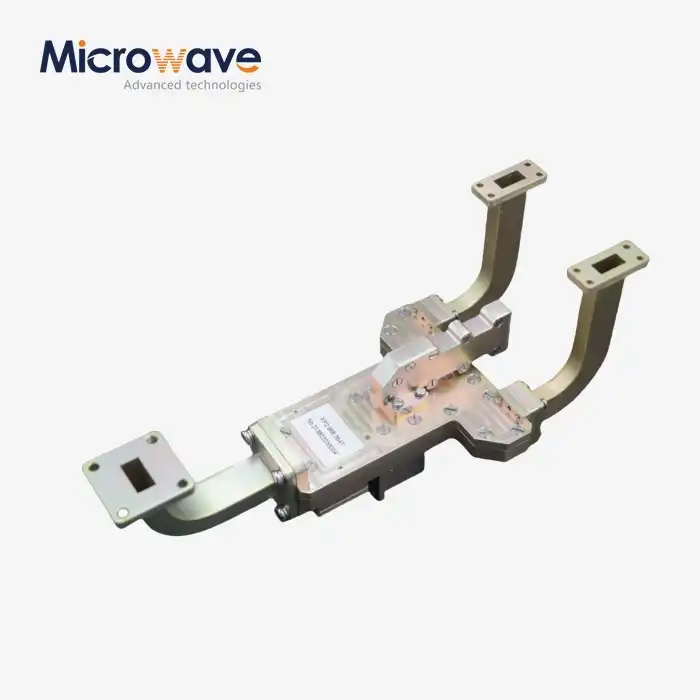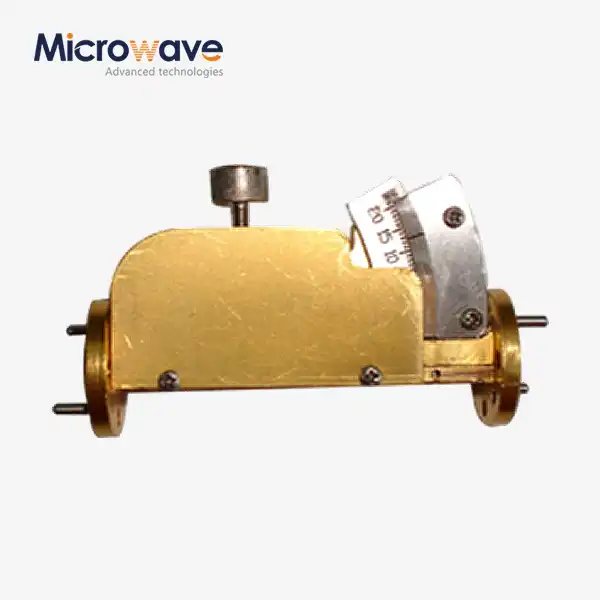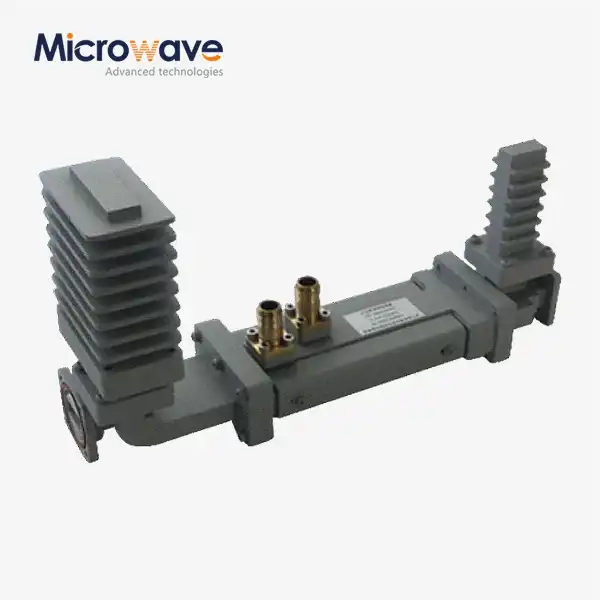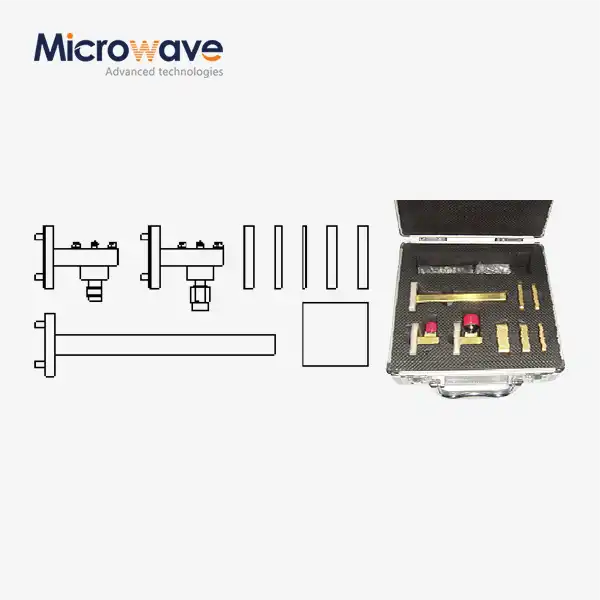





90° Polarized Rotary Joint
90° Polarized Rotary Joint for Radar & SATCOM Systems
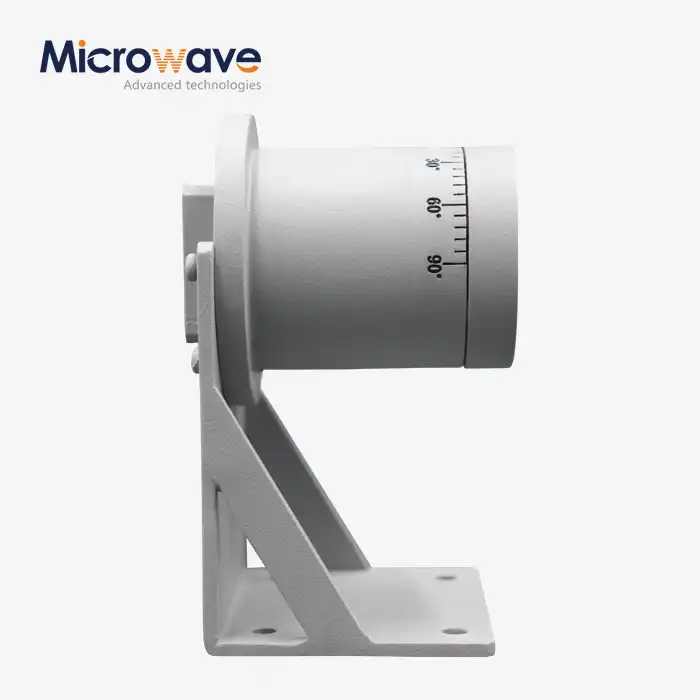
Advanced Microwave Technologies Co., Ltd. (ADM) designs and manufactures the 90° Polarized Rotary Joint, a precision electromechanical component that transfers microwave energy between fixed and rotating transmission lines while preserving polarization integrity. It has internal waveguide phase-shifting structures, such as septum polarisers and orthogonal mode transducers (OMTs), that keep cross-polarization separation of 35–50 dB even when the device is rotating 360°. The device works in X, Ku, and Ka bands and has an insertion loss of less than 0.2 dB. It can be used with dual-polarization radar, SATCOM terminals, and ATC monitoring systems.
What Is a 90° Polarized Rotary Joint?
A product is a microwave electromechanical part that sends radio frequency signals between platforms that are still and platforms that are moving while keeping track of specific polarisation states.
This device is different from a normal rotary joint because it solves a problem that radar and satellite systems face: it stops signal depolarisation and cross-channel interference while the azimuth is being rotated continuously.
By adding waveguide phase-shifting structures to the rotary interface, the joint lets two different polarisations (vertical and horizontal, or LHCP and RHCP) pass through at the same time without information crossing over between channels.
Key Technical Properties
Electromagnetic Performance
- Operating bands: X, Ku, Ka-band
- Insertion loss: < 0.2 dB
- Cross-polarization discrimination (XPD): 35–50 dB
- Dynamic cross-polarization isolation: > 40 dB throughout full rotation
Phase Stability (WOW)
Rotational WOW — amplitude and phase modulation during spinning — is restricted to < 0.05 dB, keeping signal integrity stable at any rotation angle.
Mechanical Construction
Built from high-grade aluminum or brass alloys, with precision bearings for low starting torque and minimal rotational run-out.
Power Handling
The 90° Polarized Rotary Joint supports peak powers up to 200 kW at X-band. Thermal dissipation is accounted for in the phase shifter design.
Environmental Compliance
- MIL-STD-810 compliant for vibration and shock
- IP65/IP68 sealing for outdoor and harsh-environment deployment
Technical Specifications
Parameter | Specification |
Operating Frequency | X, Ku, Ka-band |
Insertion Loss | < 0.2 dB |
Cross-Polarization Isolation (XPD) | 35–50 dB |
Dynamic Isolation (during rotation) | > 40 dB |
WOW (Amplitude/Phase Variation) | < 0.05 dB |
Standard Rotation Speed | 10–60 RPM |
High-Speed Option | Up to 300+ RPM |
Peak Power Handling (X-band) | Up to 200 kW |
Operating Temperature | -40°C to +85°C |
Sealing Rating | IP65 / IP68 |
Environmental Standard | MIL-STD-810 |
Bearing Lifecycle | 5–10 million revolutions |
Application Scenarios
Dual-Polarization Radar for Weather
The joint lets the antenna turn while sending and receiving horizontal and vertical pulses at the same time. Differential reflectivity (ZDR) can be calculated using the steady 90° polarisation phase shift. ZDR is needed to tell the difference between rain, hail, and snow when classifying storms.
Terminals for Satcom-On-The-Move (SOTM)
The joint makes it possible for the antenna to keep tracking satellites in both sea and air conditions, even if the platform moves. The 90° polarising function changes linear signals to circular polarisation (RHCP/LHCP) as needed for satellite uplinks. This keeps the link margin even when the platform moves.
Air Traffic Control (ATC) Surveillance
Polarisation diversity is used by primary monitoring radars to cut down on rain clutter. The joint can switch between polarisations reliably over millions of rotations and through the whole temperature range of operation.
Quality Control Process
A Vector Network Analyser (VNA) is used to test each unit and make sure that the S-parameters (VSWR, insertion loss, and channel isolation) are correct across the entire working bandwidth.
A rotational variation (WOW) test is done in a dynamic way: the joint is loaded and rotated while amplitude and phase changes are measured and found to be less than 0.05 dB.
At stated peak power levels, high-power breakdown testing makes sure that there is no arcing or corona discharge inside the waveguide structure or phase shifters.
As part of the environmental stress testing process, temperatures are changed from -40°C to +85°C, and gas-filled waveguides are put through pressurised leak tests to make sure the seals are strong against water getting in.
Customization and Integration Options
ADM lets you set up things in a way that fits your system's needs. High-speed models with ceramic bearings and balanced rotors can spin faster than 300 RPM, making them good for airborne scanners that need to scan quickly without mechanical resonance.
The 90° Polarized Rotary Joint can serve as the core of a larger hybrid assembly. Electrical slip rings (for motor power and encoder data) and fluid rotary unions can be put together by ADM into a single tested sub-system stack.
About the testing infrastructure at ADM
ADM has a special microwave darkroom that is 24 meters long and has an antenna plane near and far field measuring recombination chamber that can handle readings from 0.5 GHz to 110 GHz.
ADM has branch offices in Xi'an, Chengdu, Beijing, Tianjin, and Shijiazhuang and has been working as a microwave engineer for more than 20 years. They help customers with creation, testing, and delivery.
FAQ
Q: How does this joint keep cross-polarization separation while it turns?
A: It has orthogonal mode transducers (OMTs) and precision-machined internal chokes. It is tested that dynamic separation stays above 40 dB even when the device is turned 360° nonstop.
Q: Can it handle high-speed rotation for use in the air?
A: Most units work at speeds between 10 and 60 RPM. Specialised models with balanced rotors and ceramic bearings can go faster than 300 RPM without mechanical resonance.
Q: How long do you think it will last?
A: Bearings are sealed and oiled for life, and they can handle 5 to 10 million turns before they need to be fixed. Because the RF choke doesn't touch anything, there are no wear parts in the electrical line.
Q: Does the 90° phase shift change how much power it can handle?
A: Phase shifters add a small amount of thermal load, but the design of the thermal cooling system takes this into account so that it can handle peak powers of up to 200 kW at X-band.
Q: Can slip rings for power and data be added to the RF joint?
A: Yes, ADM can combine electrical slip rings, fluid rotary unions, and the RF joint into a single hybrid assembly that has been tested as a whole subsystem.
Q: In what kinds of weather conditions can this joint work?
A: It's sealed to IP65/IP68 standards and meets MIL-STD-810 standards for shaking and shock. It has been tested for temperature ranges from -40°C to +85°C and can be used for outdoor radar and satellite installations.
Contact Us
Have a technical question or a custom requirement for a 90° Polarized Rotary Joint? Reach our engineering team at craig@admicrowave.com.