




High Power Waveguide Differential Phase Shift Isolator
High Power Waveguide Differential Phase Shift Isolator
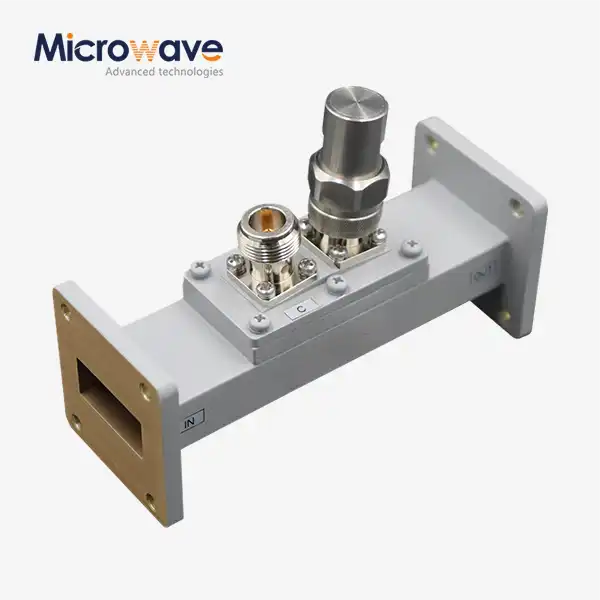
Device design is just as important as rated power when it comes to protecting Klystrons, Magnetrons, or Solid-State Power Amplifiers from damaging signal reflections. The High Power Waveguide Differential Phase Shift Isolator from Advanced Microwave Technologies (ADM) handles peak power from 1 MW to 10 MW and average power from 1 kW to over 100 kW. It stays below 0.25 dB for insertion loss and goes over 20 dB for reverse isolation. This page describes how the program works, what its requirements are, how it is tested, and how it can be customised.
How It Differs from a Standard Junction Isolator for a High Power Waveguide Differential Phase Shift Isolator
A normal junction isolator has a ferrite disc in the middle that soaks up energy that is reflected. Because that disc is hard to cool, it can only handle a small amount of power on average.
Instead of waveguide walls, the differential phase shift design puts ferrite blocks right up against them. This lets more surface area absorb RF energy and lets liquid cool the ferrite elements directly. This makes it possible to run at a steady high average power level, which is something that junction isolators aren't meant to do.
Operating Principle
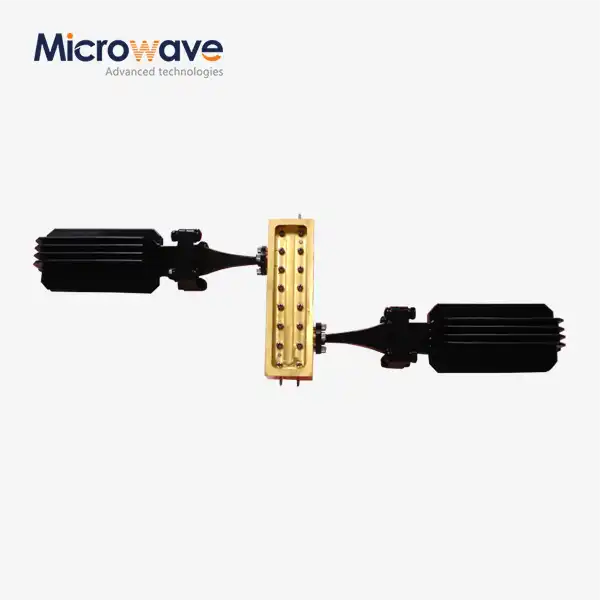
A dual-mode or bridge topology is used by the device. At both ends, a 3 dB hybrid coupler, like a Magic T or short-slot hybrid, is placed.
There are two waveguide sections with longitudinally magnetised ferrite bars in between these couplers. There is a 90-degree phase difference between the forward and reverse signals. This sends the energy that is reflected into a high-capacity dummy load instead of back to the source.
At high power levels of MW, energy reflected from a load that isn't matched can cause arcing inside the source or damage a protection device that wasn't made for this way of routing energy. This is taken care of by the phase-differential design, which stops reflected energy from ever getting to the source port.
Key Technical Specifications
Parameter | Typical Value |
Peak Power Handling | 1 MW – 10 MW |
Average Power Handling | 1 kW – 100 kW+ |
Insertion Loss | < 0.25 dB |
Isolation | > 20 dB or > 25 dB |
VSWR | < 1.10:1 or < 1.15:1 |
Operating Frequency Bands | L, S, C, X, Ku |
Ferrite Material | YIG or Spinel Ferrite (Curie Temp > 200°C) |
Cooling Method | Direct liquid cooling (low-conductivity distilled water recommended) |
Pressurization Gas | SF6 or Nitrogen |
Expected Lifespan | 15–20 years with proper cooling maintained |
Material and Design Notes
Ferrite Material: ADM utilises Yttrium Iron Garnet (YIG) or Spinel Ferrites chosen for high-power thresholds. The materials exhibit low nonlinearity and Curie temperature above 200 °C, which reduces the probability of the materials being magnetically saturated while applying large power loads for a long time.
High Breakdown Voltage Design: The form of the waveguide allows to use SF6 or Nitrogen to boost the pressure. This increases the threshold of dielectric breakdown above the breakdown voltage of 30 kV/cm in air at normal pressure, which is crucial at MW level peak electric field strengths.
Water Cooling Channels: Water cooling channels inserted into the waveguide body enable water to cool it directly. Use low conductivity distilled water (LCW) to avoid corrosion and electrolysis. The input temperature is generally maintained between 20°C and 35°C and the flow rate is modulated according to the load in kilowatts.
Application Environments
Medical and Scientific Linear Accelerators (Linacs)
Klystrons make MW-level pulses, which are used in radiotherapy tools and particle accelerators. The High Power Waveguide Differential Phase Shift Isolator is put in place right after the Klystron to get rid of reflections caused by beam loading or cavity detuning. To keep units in this environment from arcing during microsecond pulses, they must work in a strict vacuum or high-pressure gas environment.
Industrial Microwave Heating and Drying Systems
Large-scale systems for making plasma, drying wood, and processing food at 915 MHz or 2.45 GHz have load impedance that changes a lot as the materials used change. The isolator keeps the magnetron from seeing a changing match when the load changes. This helps keep mode shifting and source damage from happening.
Long-Range Defense and Weather Radar
For accurate Doppler processing, high-power radar systems need to keep the phase stable. Travelling Wave Tubes (TWTs) and Crossed-Field Amplifiers are kept safe from receiver-end reflections by the isolator. For this use, units are made to handle mechanical shock, vibrations according to MIL-STD-810, and quick changes in temperature.
Testing and Quality Verification
Before being sent out, every unit goes through a structured inspection process.
High-Power Burn-In Test: Each device is tested at full rated power—and at 1.2× overdrive—for up to 24 hours. With infrared thermography, hotspots that are caused by bad ferrite bonding or uneven heat distribution can be found.
S-Parameter Verification: Vector Network Analyzer (VNA) measurements confirm insertion loss, return loss, and isolation across the full operating bandwidth.
Hydrostatic Pressure and Flow Test: The cooling channels are pressed up to 6–10 bar to make sure there are no leaks where the cooling jacket meets the waveguide body.
Helium Leak Detection: For units that can work with vacuums or gases, the leak rate must be checked to be better than 1×10⁻⁷ mbar·l/s to make sure that SF6 is contained over the service life.
Arc Detection Verification: Integration of optical arc detectors and reflected power monitors is checked where applicable.
Customization and Supply Options
ADM can be configured for custom L, S, C, X and Ku frequency bands. You can choose the type of flange, position of cooling intake and outlet, pressurisation fittings and load ratings to match your system design.
Throughout the whole integration process, engineers are there to help.
If your system requires a High Power Waveguide Differential Phase Shift Isolator in a non-standard configuration, ADM will collaborate with your technical team to set specifications and test performance before delivery.
FAQ
Q: If there is a full short-circuit reflection, can this isolator handle it?
A: The device is made to send all of the power that is reflected into the fake load at Port 3 or Port 4. The load in question needs to be able to handle the full amount of reflected power. Before you install it, make sure that the dummy load rating matches the output power of your source.
Q: Why do MW-level units need to be pressurised with nitrogen or SF6?
A: At MW peak powers, the strength of the internal electric field can be higher than the 30 kV/cm dielectric breakdown voltage of air. Pressurisation raises the dielectric strength of the gas inside, which lowers the chance of arcing that could harm the ferrite surfaces or coatings inside.
Q: What kind of coolant should be used in liquid-cooled units?
A: To keep the cooling ducts from rusting and breaking down, you should use low-conductivity distilled water (LCW). The temperature at the inlet should stay between 20°C and 35°C, and the flow rate should be set to match the kilowatt load.
Q: How long do you think this device will last?
A: Passive lifespan is usually 15–20 years if good cooling and pressurisation are kept up. The main type of failure found is ferrite cracking, which is caused by thermal shock from a broken cooling system or dirty cooling ducts.
Q: What ranges of frequencies are there?
A: ADM makes units that work with the L, S, C, X, and Ku bands. You can get frequency configurations that are made just for your system.
Q: How is the performance of the isolation checked before it is shipped?
A: S-parameter readings taken with a VNA confirm the isolation values across the entire operating bandwidth. Infrared thermography is also used for high-power burn-in tests to make sure the units work properly when they are under load.
Contact Us
To discuss specifications or request a quote for a High Power Waveguide Differential Phase Shift Isolator, contact our engineering team at craig@admicrowave.com.