





Learning About Microwave Horn Antenna for Everyday Applications
When engineers and sourcing experts look for high-precision RF parts, the microwave horn antenna always comes up as a key technology that connects theoretical physics with real-world system integration. These flared waveguide structures change electromagnetic energy that is contained into guided radiation in free space. This makes it possible for radar calibration labs and satellite base stations. Technical buyers can choose parts that meet strict performance standards while staying within budget and meeting delivery deadlines if they understand how they work, how designs can vary, and what to think about when buying them.
What Is a Microwave Horn Antenna and How Does It Work?
A microwave horn antenna's main job is to change guided waves that are moving through enclosed waveguides into electromagnetic fields that are emitted and moving through empty space. The flared shape gradually widens the waveguide opening, which lets controlled impedance change happen, reducing echoes and improving power transfer efficiency. This design principle solves one of the most important problems in RF engineering: how to match the high impedance of empty space (about 377 ohms) with the low characteristic impedance of waveguide structures.
Wave Propagation and Impedance Matching
How electromagnetic waves phase match at the antenna's opening is directly affected by the flare angle and hole size. Gradual growth stops sudden breaks that would otherwise cause signal reflections, which show up as high voltage standing wave ratios. Engineers tweak these geometric factors to get wideband impedance matching across frequency bands from 1 GHz to more than 100 GHz. Directivity is based on the size of the aperture compared to the wavelength. Larger apertures focus energy into smaller lines, which raises the antenna gain.
Radiation Patterns and Frequency Ranges
Radiation patterns show how the energy moves around the antenna in three dimensions. Horn antennas have main lobes that are very straight and side lobes that are pushed down. This makes them perfect for point-to-point communication lines and precise measurement tasks. Operating frequencies range from L-band (1-2 GHz) to W-band (75–110 GHz), and designs are made to fit the needs of each application. Waveguide sizes get smaller as frequency goes up, so systems with higher frequencies can use smaller structures while still working well electrically.
Aperture Illumination and Gain Enhancement
Overall effectiveness is based on how the field is spread across the horn opening. While uniform lighting improves gain, it may also raise the levels of side lobes. On the other hand, tapered distributions lower side lobes but lower gain. Design engineers use electromagnetic simulation tools that model field behavior acrossmicrowave horn antenna working bandwidths to find a balance between these trade-offs. The antenna gain, which is given in dBi, shows how well the horn focuses the power being sent out compared to an isotropic standard.
Types and Performance Characteristics of Microwave Horn Antennas
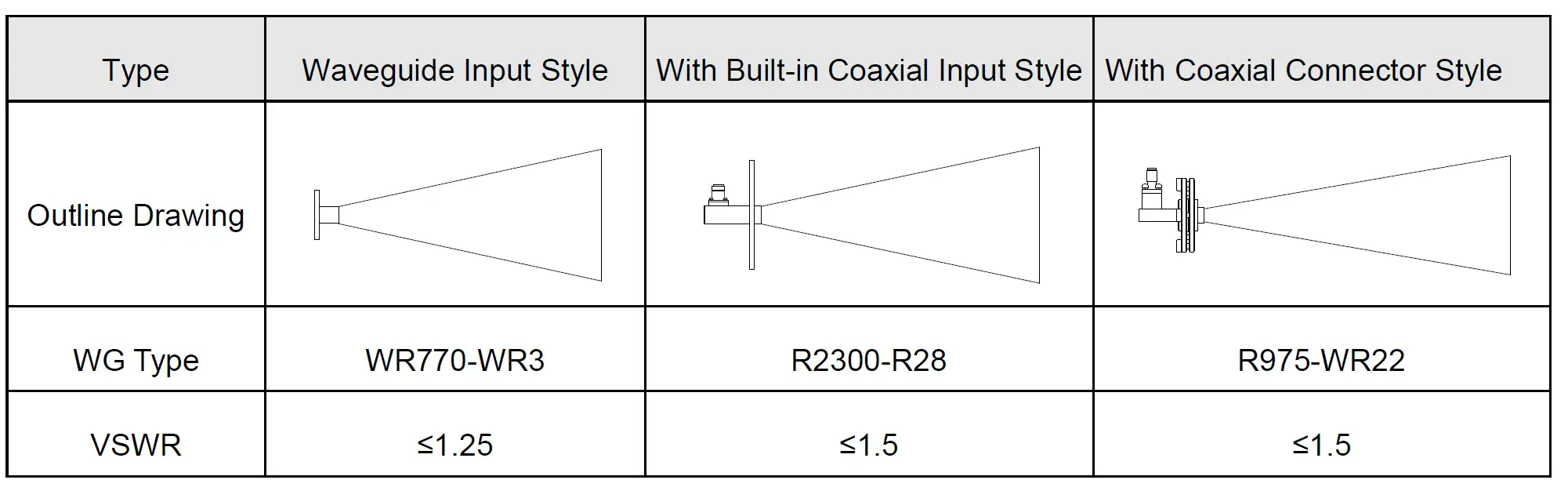
By changing the shape and structure of the waveguide feed, different microwave horn antenna configurations can meet the needs of different applications. Knowing these differences helps buying teams match the right antenna type to the performance goals at the system level.
Pyramidal Horn Antennas
Pyramidal horns make rectangular waveguides bigger in both the horizontal and vertical directions, making holes that work well for linear polarization tasks. These antennas have a high gain and a modest bandwidth. They are often used in radar feed systems and communication links on land that work at frequencies between 2 and 40 GHz. Because the rectangular aperture form creates different beamwidths in orthogonal planes, engineers can change the coverage patterns to fit different situations. For example, spy radar needs wide azimuth coverage with narrow elevation beams.
Conical Horn Antennas
When conical shapes flare circular waveguides into circular openings, they create symmetrical radiation patterns that are perfect for uses that need uniform coverage or circular polarization. These designs are most common in satellite communication systems, where polarization agility lets frequencies be reused, and disturbance is reduced. When it comes to gain, conical horns usually range from 15 to 25 dBi, based on the aperture diameter and working frequency. They work the same way across a wide range of frequencies. In tracking devices, the axisymmetric structure makes it easier to place mechanically and line up rotationally.
Corrugated Horn Antennas
Corrugated designs have holes around the inside edges that create mixed electromagnetic modes that lower cross-polarization and side lobe levels by a large amount. In fields like radio astronomy, deep space transmission, and millimeter-wave imaging, where signal clarity and pattern control determine how sensitive a system is, these performance improvements are very important. Cross-polarization detection is better than 30 dB, and side lobe reduction is better than -30 dB for corrugated horns. This means that they can be used in demanding situations, even though they are more difficult to make.
Double-Ridged Horn Antennas
Ridge-loaded waveguide sections lower the cutoff frequencies and smooth the frequency response, which makes ultra-wideband operation possible. Mini wideband double-ridged horns are very small and can cover very wide frequency ranges, like 1-18 GHz or 18-40 GHz. This makes them essential for checking electromagnetic compatibility, keeping an eye on the spectrum, and making electronic warfare systems. The VSWR of these antennas stays below 2.0:1 throughout their working range, and they can handle power levels ranging from milliwatts to hundreds of watts, based on the materials they are made of and how they handle heat. Simulation tools check plans for errors before making a real prototype. Software systems can simulate the spread of electromagnetic fields, figure out performance measures, and use iterative refinement to find the best shapes. This computational method shortens the time it takes to develop products and makes sure that the finished goods meet the requirements spelled out in technical datasheets that are given to buying teams during the evaluation of vendors.
Real-World Applications and Advantages of Microwave Horn Antennas
The adaptability of microwave horn antenna technology shows up in many different fields where dependable high-frequency signal transfer is essential.
Telecommunications Infrastructure
Horn antennas are used as main feeds for parabolic reflectors at satellite ground stations. These antennas send messages between networks on Earth and spacecraft in orbit. To keep the signal quality high over thousands of kilometers of air tracks, these feed systems must keep stable phase centers and low noise temperatures. Point-to-point microwave relay links that connect cell phone base stations also use horn antennas to send large amounts of data through both urban and rural areas.
Aerospace and Defense Systems
Horn antennas are used to light up targets and pick up echoes in radar sites that do everything from tracking the weather to controlling air traffic. The narrow beamwidth and high gain make it possible to measure angles accurately and block out noise, which is important for following planes through complex electromagnetic environments. Electronic countermeasures, missile guidance, and shipboard communication systems are all defense uses where toughness, sealing against the climate, and electromagnetic compatibility must meet strict military standards.
Industrial and Laboratory Environments
Standard gain horns are used as standardized reference sources in antenna test areas to measure unknown antenna patterns. These measurement horns give gain values that can be calculated from their physical dimensions. This gets rid of the need for guesswork when calibrating equipment for production testing and study development. High-power horn antennas are used in industrial heating applications to send microwave energy into processing rooms for heating up large areas without touching them. This is done for chemical reactions, food processing, and treating materials. Horn antennas are popular because they have great gain-bandwidth products, are easy to build, which makes them more reliable, and have expected electrical performance that lets you confidently integrate them into your system. Low VSWR across all operating bands improves power transfer efficiency, which means you don't need as many amplifiers and don't have to worry as much about managing heat. Since there are no harmonic elements, there are no narrow-band limitations like there are with other antenna types. This allows for flexible frequency operation and broad signal processing.
How to Choose and Procure the Right Microwave Horn Antenna
For procurement to go well, technical needs must be clearly spelled out and turned into measurable specs that suppliers can meet with standard or special goods. To pick out the best microwave horn antenna and get it, one must balance performance, size, and application environment.
Frequency Requirements and Gain Metrics
The basic waveguide size and material choices are based on the operating frequency. The specs for the purchase should list the center frequencies, the bandwidth needs, and the amount of gain variation that is allowed across the operating range. The goal is to reach a balance between the link's budget needs, its actual size, and growing issues. Engineers often set the minimum gain at the edges of the band, where performance naturally drops, to make sure there is enough room for error across the whole working range.
Physical Dimensions and Mounting Configurations
Mechanical integration with the current infrastructure is affected by the size of the aperture, the total length, and the type of flange. Standard waveguide flanges, like the UG-series and CPR-series, make sure that they work with standard components in the industry, and special mounting options can be used for installations with unusual shapes. Extreme temperatures, humidity levels, vibration patterns, and toxic atmospheres are some of the environmental factors that affect the choice of materials. These factors include aluminum alloys, corrosion-resistant finishes that meet military environmental standards, and vibration profiles.
Environmental Resilience and Power Handling
For locations outside, the building has to be weatherproof, and the waveguide connections have to be sealed so that water doesn't get in and change the dielectric properties or cause corrosion. Power handling standards take into account both peak and average power levels. Safety margins keep voltage from dropping and heat damage from happening. For high-power uses, pressurization systems or special dielectrics may be needed to make the operating limits go beyond what is normally expected.
Customization and OEM Manufacturing Options
Catalog products can't always meet the needs of complex systems, which is why there is a need for designed solutions that are made to fit unique needs. OEM relationships let engineering teams from different suppliers work together to make antenna designs that meet the performance goals, interface needs, and production numbers set by the customer. Prototyping services shorten the time it takes to evaluate something, so you can get real-world feedback before you spend money on production tools and goods. Some of the best sellers keep very large catalogs of products that include standard gain horns, broadband ridged designs, and precise measurement antennas. Technical datasheets show how well an electrical device works by listing its gain values, VSWR plots, and radiation pattern cuts at different frequencies and polarization states. Mechanical sketches show the size, weight, and places of connectors, which allows CAD to work with them during the system design stages. The way prices are set depends on how complicated the design is, how many are made, and how much customization is needed.
Enhancing Your Microwave Horn Antenna Experience through Simulation and Testing
To get predictable performance over the life of an asset, it needs to be rigorously validated during the design, development, and production acceptance stages. Electromagnetic simulation helps improve the microwave horn antenna design before physical manufacturing.
Design Optimization through Electromagnetic Simulation
Computational microwave horn antenna electromagnetic model antennas software tools let you model antennas in great detail before they are built. Engineers set the physical factors, the qualities of the material, and the excitation conditions that correspond to the real waveguide feeds. Maxwell's equations are solved by simulation engines in three-dimensional computing areas. They figure out field distributions, impedance features, and far-field radiation patterns. Through iterative optimization, geometric factors are changed to meet customer-specified gain goals, bandwidth requirements, and pattern needs.
Laboratory Measurement Techniques
Anechoic test rooms are controlled settings that get rid of reflections that could mess up antenna readings. Automatic positioning systems move test antennas around in spherical coordinates while network analyzers record amplitude and phase information to build full radiation patterns. When measuring gain, comparison methods are used with standard gain horns that have been measured and whose properties are known. VSWR readings over a range of frequency bands check the quality of the impedance matching and find any possible resonances or discontinuities that need to be fixed in the design.
Field Validation and Quality Assurance
Production acceptance testing makes sure that the units that were made accurately copy the designs that were tested and found to be good. Statistical process controls keep an eye on important dimensions and electrical factors and take appropriate action when patterns show that the process is drifting. Environmental stress screening puts goods through temperature changes, vibrations, and high and low humidity conditions that are typical of their use. This finds hidden problems before they are sent to the customer. When goods are shipped, they come with detailed test reports that show how they were made and can be tracked, which is needed by quality control systems in aerospace and defense procurement. Understanding performance standards helps procurement teams and tech partners have more productive conversations. Power handling rates include safety margins that protect against temporary overloads, and environmental standards make sure that the equipment will work reliably for years.
Conclusion
Microwave horn antenna technology offers mature but always-evolving answers to basic problems in designing microwave and millimeter-wave systems. When you combine theoretical electromagnetic principles with real-world manufacturing methods, you get reliable parts that are used in mission-critical situations in the aerospace, military, industrial, and telecoms sectors. A successful procurement relies on having clear technical requirements, choosing a seller wisely by looking at both their catalog offers and their ability to customize products, and working together with the provider so that their engineering knowledge complements the customer's knowledge of how to use the products. Performance claims are backed up by strict simulation and testing methods, which give users faith that systems they deploy will meet operational goals for the duration of their service lives.
FAQ
What frequency ranges do microwave horn antennas typically support?
Horn antennas can work with a wide range of frequencies, from about 1 GHz to 110 GHz and beyond. Some types are better at working with standard waveguide bands. X-band (8–12 GHz) is used for radar and satellite communication, Ku-band (12–18 GHz) is used for broadcast and VSAT terminals, and millimeter-wave bands (30–110 GHz) are used for advanced wireless networks and high-resolution images.
How do horn antennas compare to parabolic dish antennas in radar systems?
Parabolic reflectors have higher gain because their opening areas are bigger, but they need precise feed antennas, which are usually horns, placed at the focus points. Horn antennas can be used as separate radiators in small systems or as feeds to make reflectors work better in big ones. Which one to use relies on how much gain is needed, how much space is available, and how the system is built, so that speed, cost, and complexity are all balanced.
Can horn antennas be customized for specialized applications?
Customization is one of the main skills that experienced makers have. To meet the needs of each project, engineering teams change the mounting connections, waveguide transitions, flare angles, and opening sizes. Custom designs are needed for frequency bands that aren't standard, certain polarization traits, odd physical limitations, or to work with system architectures that aren't open source. OEM partnerships give these joint development efforts access to specialized engineering tools that help.
Partner with Advanced Microwave Technologies for Your Horn Antenna Requirements
Advanced Microwave Technologies Co., Ltd has been making horn antennas for over 20 years and is a reliable company that works with the aerospace, defense, telecommunications, and research groups around the world. Our engineering team works with procurement experts to define, build, and deliver precise microwave horn antenna solutions that meet your exact needs for frequency bands, gain goals, and weather conditions. Our ISO 9001:2015-certified methods make sure consistent quality, backed by full test paperwork, whether you're looking for standard gain calibration horns, wideband double-ridged designs, or fully customized OEM solutions. We have a 24-meter microwave darkroom with testing tools that can go up to 110 GHz to make sure that performance is good across your entire operating range. Contact craig@admicrowave.com to talk about the details of your project, get full datasheets, or get cheap quotes that will help you meet your procurement timeline.
References
1. Balanis, Constantine A. Antenna Theory: Analysis and Design. Fourth Edition. Hoboken: John Wiley & Sons, 2016.
2. Olver, A.D., et al. Microwave Horns and Feeds. London: Institution of Engineering and Technology, 1994.
3. Silver, Samuel, ed. Microwave Antenna Theory and Design. MIT Radiation Laboratory Series Volume 12. London: Peter Peregrinus Ltd., 1984.
4. Milligan, Thomas A. Modern Antenna Design. Second Edition. Hoboken: John Wiley & Sons, 2005.
5. Granet, Christophe, and Graeme L. James. Design of Corrugated Horns: A Primer. IEEE Antennas and Propagation Magazine, Vol. 47, No. 2, April 2005.
6. Love, A.W., ed. Electromagnetic Horn Antennas. New York: IEEE Press, 1976.
YOU MAY LIKE
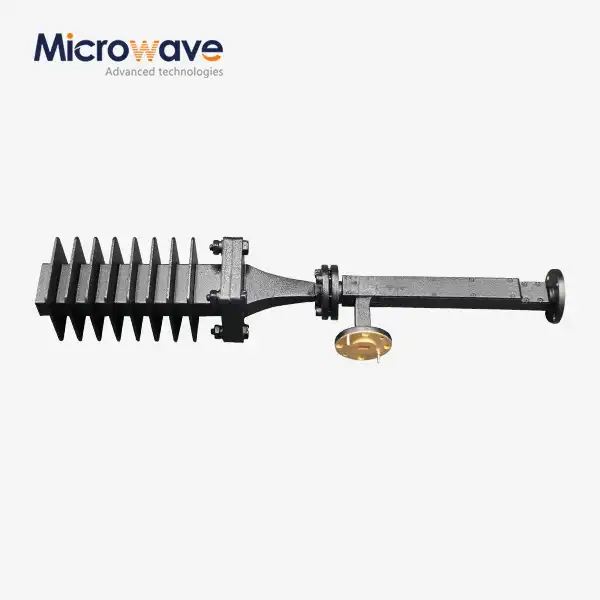 VIEW MOREWaveguide Fixed Attenuator
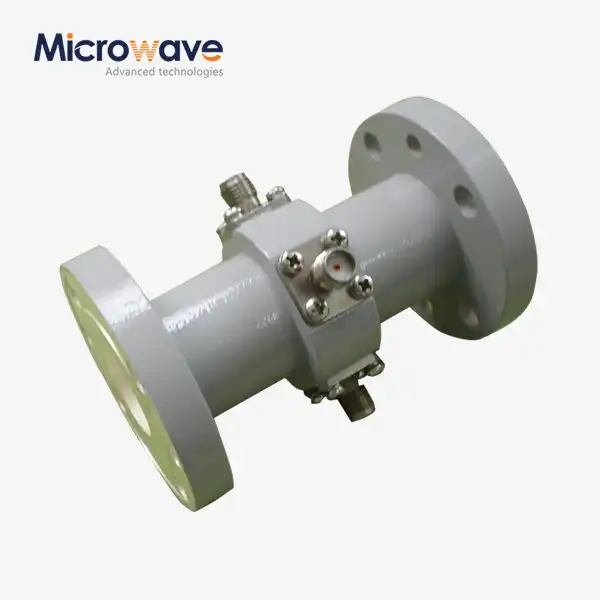 VIEW MOREWaveguide Probe Coupler
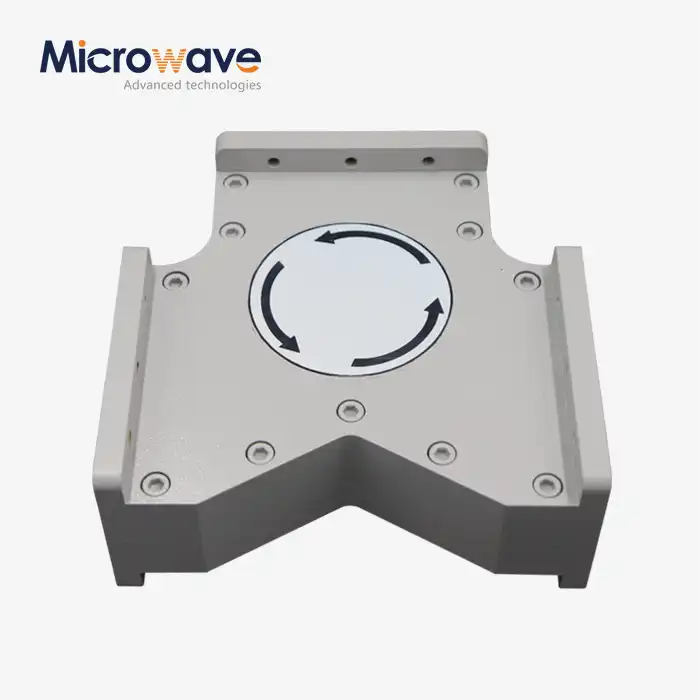 VIEW MOREHigh Power Waveguide Circulator
 VIEW MOREHigh Power Waveguide Differential Phase Shift Circulator
 VIEW MOREWaveguide Variable Attenuator
 VIEW MOREHigh Power Waveguide Isolator
 VIEW MOREWG Bandpass Filter
 VIEW MOREWG Harmonic Filter