





How Does a Planar Spiral Antenna Work vs. Traditional Antennas?
In satellite communications and defense applications, signal degradation across multiple frequency bands has long plagued system designers, forcing them to deploy multiple antenna systems at tremendous cost and complexity. Traditional narrowband antennas simply cannot maintain consistent performance when communication requirements span from 1 GHz to 40 GHz, creating critical operational gaps that compromise mission success. The Planar Spiral Antenna revolutionizes this challenge by delivering ultra-wideband circular polarization across extraordinarily broad frequency ranges, eliminating the need for multiple antenna installations while ensuring reliable signal transmission in the most demanding environments where traditional dipole and monopole antennas fail completely.
Understanding the Fundamental Operating Principles of Planar Spiral Antenna Technology
The operational mechanism behind a Planar Spiral Antenna differs fundamentally from traditional antenna designs through its unique traveling wave propagation behavior rather than the standing wave resonance found in conventional systems. When radio frequency energy is introduced at the central feed point of the Planar Spiral Antenna, it propagates outward along the metallic spiral arms in a progressive manner, with each frequency component radiating most efficiently at the specific region where the spiral circumference approximately equals one wavelength of that particular frequency. This frequency-selective radiation mechanism creates an inherently broadband operation spanning multiple octaves, typically from 1 GHz extending up to 40 GHz in advanced implementations like those manufactured by Advanced Microwave Technologies. The spiral geometry naturally produces circularly polarized electromagnetic radiation, offering substantial advantages over linearly polarized traditional antennas by minimizing signal fading caused by polarization misalignment and significantly reducing the detrimental effects of multipath interference that plague urban and complex propagation environments.
The distinctive spiral configuration itself plays an instrumental role in determining the antenna's polarization characteristics, as the direction of the spiral rotation directly establishes whether the antenna produces right-hand or left-hand circular polarization. Unlike traditional antennas that require additional polarizers or complex feeding networks to achieve circular polarization, the Planar Spiral Antenna inherently generates this desirable polarization characteristic through its geometric design alone. The traveling wave current distribution along the spiral arms creates a phase progression that results in the circular polarization of the radiated electromagnetic field, and this polarization remains consistent across the antenna's entire operational bandwidth. Advanced Microwave Technologies optimizes these spiral geometries using either Archimedean or logarithmic mathematical progressions, each carefully calculated to maximize performance parameters including gain stability, impedance matching, and radiation efficiency across the complete operational frequency range. The antenna typically achieves gains ranging from 3 dBi to 8 dBi while maintaining remarkably low Voltage Standing Wave Ratio values across its entire bandwidth, ensuring maximum power transfer and minimal signal reflection back toward the source.

Comparative Analysis: Planar Spiral Antenna vs. Traditional Dipole and Monopole Systems
Traditional dipole and monopole antennas operate on fundamentally different electromagnetic principles, relying on resonant standing wave patterns established along linear conductor elements of specific electrical lengths. These conventional antennas achieve maximum radiation efficiency when their physical dimensions correspond to integer multiples of half-wavelengths at the desired operating frequency, inherently limiting their useful bandwidth to relatively narrow frequency ranges typically less than one octave. When operating outside their designed resonant frequencies, traditional dipole systems experience dramatic impedance mismatches, resulting in poor power transfer efficiency, increased signal reflection, and degraded radiation pattern characteristics that render them essentially unusable for wideband applications. The physical length requirements of these traditional antennas become particularly problematic at lower frequencies where half-wavelength dimensions can extend to several meters, making them impractical for mobile, airborne, or space-constrained installations where size and weight considerations are paramount operational factors.
In stark contrast, the Planar Spiral Antenna achieves its exceptional wideband performance through inherent geometric properties rather than resonant dimensions, allowing a single compact antenna element to replace multiple traditional antennas that would otherwise be required to cover the same frequency spectrum. The self-complementary nature of logarithmic spiral designs creates frequency-independent impedance characteristics that remain stable across decade bandwidths or more, eliminating the complex matching networks and tuning elements that traditional antennas require for bandwidth extension. Advanced Microwave Technologies has refined these design principles through extensive electromagnetic modeling and empirical testing in their state-of-the-art 24-meter microwave darkroom facility, where precise far-field measurements validate antenna performance across the complete 0.5 to 110 GHz test capability range. This comprehensive testing infrastructure ensures that every Planar Spiral Antenna delivered maintains consistent electrical characteristics including impedance stability at 50 Ohms, low VSWR values below 2:1 across operational bands, and predictable radiation patterns that meet stringent aerospace and defense specification requirements.
The radiation pattern characteristics also differ substantially between planar spiral and traditional antenna technologies, with important implications for system design and deployment scenarios. Traditional dipole antennas produce omnidirectional radiation patterns in the plane perpendicular to their axis with nulls along the conductor axis, while monopole antennas create similar omnidirectional patterns in the horizontal plane when mounted on ground planes. These radiation characteristics prove advantageous for certain broadcasting and communication applications but offer limited directional control without additional reflector or parasitic element structures. The Planar Spiral Antenna, when properly cavity-backed with absorbing material, generates a unidirectional cardioid-shaped radiation pattern with peak gain broadside to the spiral plane, providing focused coverage toward desired target areas while minimizing unwanted radiation in other directions. This directional characteristic makes the Planar Spiral Antenna particularly valuable for electronic reconnaissance, direction finding, and point-to-point communication applications where controlled radiation patterns are essential operational requirements.
Advanced Design Features and Performance Characteristics of Modern Planar Spiral Antenna Systems
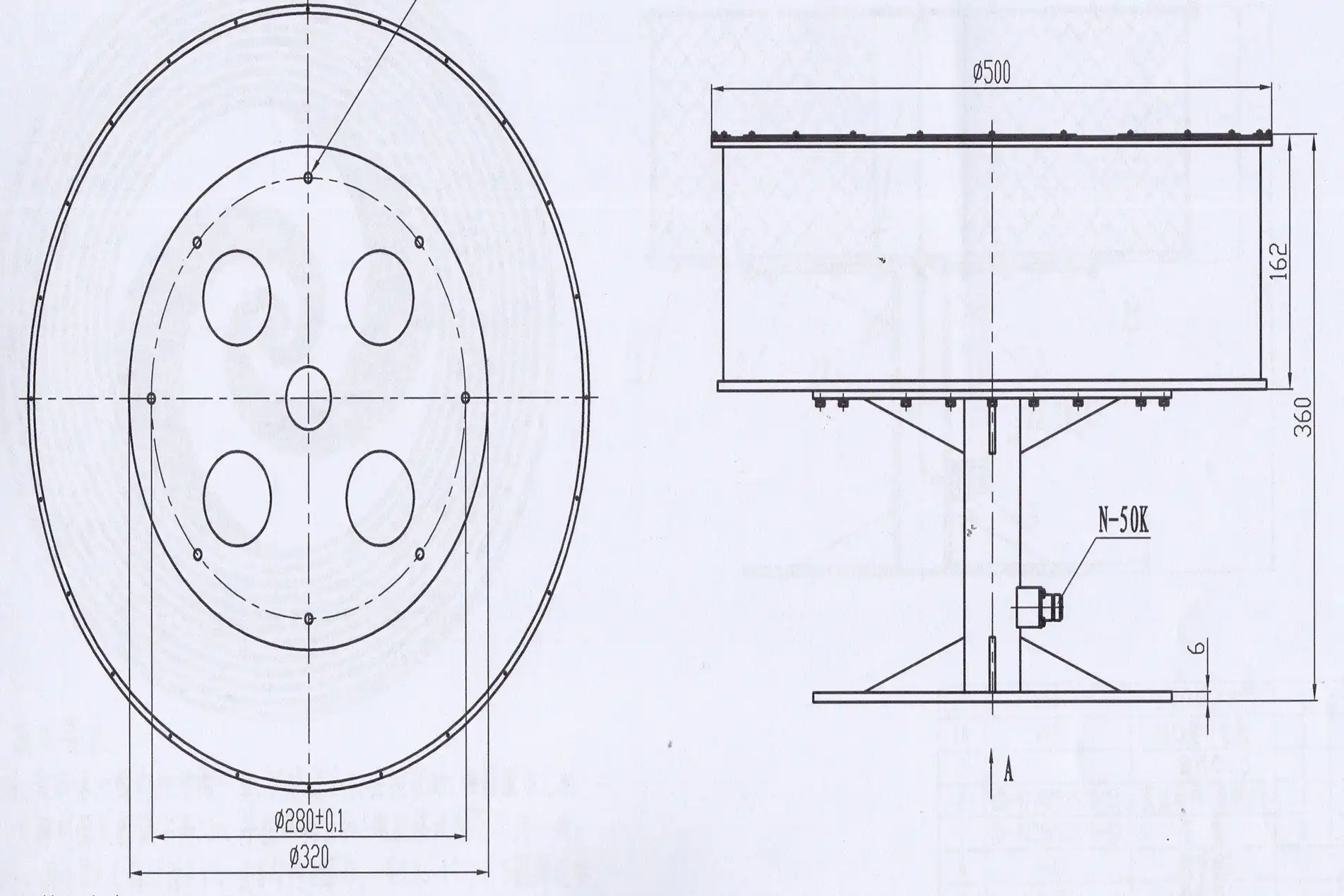
The physical construction and material selection for Planar Spiral Antenna systems critically influence their electrical performance, durability, and suitability for demanding operational environments. Advanced Microwave Technologies employs premium dielectric substrates with carefully controlled permittivity and loss tangent characteristics, ensuring optimal wave propagation along the spiral conductors while minimizing unwanted signal attenuation. The metallic spiral arms are fabricated using precision photolithographic etching or advanced thin-film deposition techniques on these specialized substrate materials, achieving the exacting geometrical tolerances necessary for maintaining consistent performance across multi-octave bandwidths. The substrate material selection becomes particularly critical at millimeter-wave frequencies where even minor variations in dielectric constant or conductor dimensions can significantly impact impedance matching and radiation efficiency. Advanced Microwave's extensive experience with materials like Rogers RT/Duroid and similar low-loss substrates ensures reliable operation across the antenna's full 1 GHz to 40 GHz operational range.
The cavity backing structure represents another crucial design element that distinguishes high-performance Planar Spiral Antenna implementations from basic designs. The cylindrical metallic cavity filled with microwave-absorbing material serves multiple essential functions: it prevents backward radiation that would otherwise create bidirectional patterns, establishes a stable impedance environment for consistent antenna performance, and provides mechanical support for the spiral element itself. The cavity depth typically equals approximately one-quarter wavelength at the antenna's lowest operating frequency, although optimized designs may use different depths to enhance specific performance parameters. The absorbing material within the cavity, usually a lossy foam or ferrite-based composite, dissipates electromagnetic energy that would otherwise reflect from the cavity walls and interfere with the desired forward radiation pattern. While this absorption mechanism slightly reduces overall antenna efficiency compared to some traditional designs, the trade-off proves entirely acceptable given the extraordinary bandwidth and circular polarization benefits that the Planar Spiral Antenna configuration provides for critical applications in satellite communications, electronic warfare, and signal intelligence operations.
The balun or impedance transformation network integrated into the Planar Spiral Antenna feed structure represents another sophisticated design element requiring careful engineering attention. The spiral antenna arms present a balanced feed point at the center, while most practical RF systems utilize unbalanced coaxial transmission lines requiring proper mode conversion for optimal power transfer. Advanced Microwave Technologies incorporates carefully designed balun structures that maintain excellent amplitude and phase balance across the entire operating bandwidth, ensuring proper Mode 1 radiation pattern characteristics without undesirable beam squinting, pattern distortion, or axial ratio degradation. Poor balun design can introduce significant performance degradation including pattern nulls, cross-polarization contamination, and impedance fluctuations that compromise system operation, making this component absolutely critical for achieving the superior performance that military and aerospace customers demand from their antenna systems.
Practical Applications Where Planar Spiral Antenna Technology Excels Beyond Traditional Solutions
The unique combination of ultra-wideband operation, circular polarization, and compact form factor makes the Planar Spiral Antenna the optimal solution for numerous challenging applications where traditional antenna technologies simply cannot meet performance requirements. In electronic reconnaissance and signal intelligence gathering operations, the ability to instantaneously receive signals across decade bandwidths without antenna switching or tuning proves invaluable for threat detection and communication intercept missions. The Planar Spiral Antenna enables receivers to monitor entire spectrum segments simultaneously, capturing frequency-agile threats and spread-spectrum communications that would elude narrowband traditional antenna systems. The circular polarization characteristic further enhances reception capability by accepting signals regardless of their transmitted polarization state, ensuring that critical intelligence information is not lost due to polarization mismatches that would severely attenuate signals received by linearly polarized traditional antennas.
Satellite communication ground stations benefit tremendously from Planar Spiral Antenna technology, particularly in applications requiring operation across multiple frequency bands or with satellites utilizing frequency-agile transmission schemes. The antenna's wideband characteristics allow a single installation to support communications across L-band, S-band, C-band, X-band, Ku-band, and even Ka-band frequencies without requiring multiple antenna systems or complex switching arrangements. Advanced Microwave Technologies has optimized their Planar Spiral Antenna designs to deliver efficient signal transfer for high-definition video, critical data links, and voice communications with orbiting satellites, ensuring reliable connectivity even as satellite constellations evolve and new frequency allocations are introduced. The low-profile compact design of these antennas also facilitates installation in space-constrained locations including mobile platforms, shipboard systems, and transportable ground stations where traditional parabolic reflector antennas would prove impractical due to their large physical dimensions and mounting requirements.
Defense and aerospace applications represent another domain where Planar Spiral Antenna technology demonstrates clear superiority over traditional antenna approaches. Military surveillance radar systems employ these antennas for target detection and tracking across wide frequency ranges, taking advantage of the circular polarization to reduce clutter from rain, vegetation, and other environmental factors that create misleading radar returns. Unmanned aerial vehicle platforms utilize compact lightweight Planar Spiral Antenna systems for command and control datalinks, ensuring reliable communications across their operational flight envelopes without imposing excessive weight or drag penalties that would compromise flight performance. Direction finding systems for threat location leverage arrays of Planar Spiral Antenna elements to determine angle-of-arrival information across wide frequency ranges, enabling rapid identification and geolocation of electromagnetic emitters. Advanced Microwave Technologies supports these critical defense applications with rigorously tested antenna systems that meet stringent military specifications for environmental resilience, electromagnetic interference immunity, and long-term reliability in the harsh operating conditions that characterize modern military operations.
Telecommunications infrastructure represents an emerging application area where Planar Spiral Antenna technology offers significant advantages for next-generation network deployments. The antenna's ability to operate across the extended frequency ranges required for 5G and future 6G wireless systems enables network operators to deploy single antenna installations that support multiple frequency bands and communication protocols simultaneously. This multi-band capability reduces tower clutter, simplifies maintenance logistics, and accelerates network rollout timelines compared to traditional approaches requiring separate antenna systems for each frequency band. In remote and rural connectivity applications, Planar Spiral Antenna technology optimizes long-distance signal propagation for bringing high-speed internet access to underserved regions, while also supporting industrial Internet of Things deployments that require reliable wide-area connectivity for distributed sensor networks and remote monitoring systems across agricultural, energy, and infrastructure sectors.
Conclusion
The Planar Spiral Antenna represents a paradigm shift from traditional narrowband antenna technologies, delivering ultra-wideband circular polarization across 1 GHz to 40 GHz through innovative spiral geometry and traveling wave propagation principles. Its superior bandwidth, compact design, and frequency-independent characteristics make it the definitive solution for modern satellite communications, defense electronics, and advanced telecommunications applications where traditional dipole and monopole antennas cannot meet performance requirements.
Cooperate with Advanced Microwave Technologies Co., Ltd.
Advanced Microwave Technologies Co., Ltd. stands as your trusted China Planar Spiral Antenna manufacturer, supplier, and factory, offering High Quality Planar Spiral Antenna solutions at competitive wholesale prices with Planar Spiral Antenna for sale globally. With over 20 years of microwave expertise, ISO-certified quality systems, and state-of-the-art 24-meter measurement facilities, we deliver customized antenna solutions backed by comprehensive OEM services, rapid prototyping, and expert technical support. Our global supply chain ensures fast delivery of precision-engineered products serving aviation, aerospace, defense, satellite communications, and UAV applications worldwide. Contact our team today at craig@admicrowave.com to discuss your specific requirements and discover how our Planar Spiral Antenna technology can optimize your communication systems. Explore our complete product portfolio and save this page for future reference when antenna challenges arise.
References
1. Nakano, H., Mimaki, H., and Yamauchi, J. "Numerical Analysis of Spiral Antennas Printed on Dielectric Substrates." IEEE Transactions on Antennas and Propagation.
2. Curtis, J. A. "Spiral Antennas for Broadband Applications." Microwave Journal, Technical Articles on Antenna Design and Performance.
3. Dyson, J. D. "The Equiangular Spiral Antenna." IRE Transactions on Antennas and Propagation, Seminal Work on Spiral Antenna Theory.
4. Corzine, R. G. and Mosko, J. A. "Four-Arm Spiral Antennas: Analysis and Design." IEEE Press Series on Electromagnetic Wave Theory.
5. Balanis, C. A. "Antenna Theory: Analysis and Design." Chapter on Frequency Independent Antennas, John Wiley & Sons Engineering Textbook.
YOU MAY LIKE
 VIEW MOREWaveguide Fixed Attenuator
 VIEW MOREWaveguide Probe Coupler
 VIEW MOREHigh Power Waveguide Circulator
 VIEW MOREHigh Power Waveguide Differential Phase Shift Circulator
 VIEW MOREWaveguide Variable Attenuator
 VIEW MOREHigh Power Waveguide Isolator
 VIEW MOREWG Bandpass Filter
 VIEW MOREWG Harmonic Filter