




Cassegrain Antenna vs Prime Focus: Which Design Wins at High Frequency?
When engineers ask which antenna configuration delivers superior performance at high frequencies, the cassegrain antenna consistently emerges as the dominant choice for demanding applications. Its dual-reflector architecture — a primary parabolic dish paired with a hyperbolic sub-reflector — positions the feed horn behind the main reflector, eliminating long waveguide runs and preserving signal integrity. Prime Focus antennas, while mechanically simpler, place the feed at the focal point, introducing feed blockage and elevated noise temperature. At Ku-band, Ka-band, and above, these differences become operationally decisive.
Understanding Cassegrain and Prime Focus Antenna Designs
The Dual-Reflector Advantage
The Cassegrain antenna folds its optical path back toward the dish vertex. This makes room for active electronics like LNBs, LNAs, and high-power amplifiers at the rear hub. This design makes it possible for cross-polarization discrimination of more than 30 dB and aperture efficiencies of 60–70%. When budgets for system links are limited, the effective focal length is much longer than the physical structure. This lowers spherical aberration and tightens beam focus, which is a clear benefit.
Prime Focus: Simplicity With Trade-offs
The feed is held directly at the focus point by a Prime Focus parabolic dish. The design is easy to make and doesn't cost much, which makes it appealing for low-frequency uses or deployments that need to stick to a budget. But there is a real structural cost: the feed support struts cast shadows across the aperture, making sidelobes bigger and the signal-to-noise ratio worse. This blockage penalty gets worse very quickly above the X-band, which is where aperture light regularity is very important.
Understanding these structural differences is the starting point for any procurement decision involving high-frequency reflector antennas.
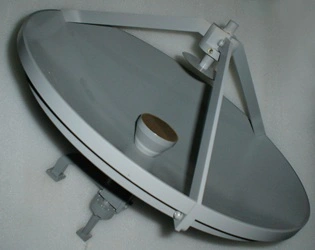
Performance Comparison of Cassegrain vs Prime Focus at High Frequencies
When technical buyers look at reflector antennas for radar arrays, satellite ground stations, or millimeter-wave backhaul, they need specific numbers instead of vague explanations. In the most important ways, here's how the two systems compare.
- Gain and Aperture Efficiency: To get the best gain and aperture efficiency, a well-shaped Cassegrain antenna design usually gets between 65 and 70% aperture efficiency in production units. Most Prime Focus dishes land between 55 and 65%, and as the frequency goes up, blockage losses become more noticeable. At Ka-band (26.5–40 GHz), a 3-meter Cassegrain dish can give you 2–3 dB more useful gain than a Prime Focus dish of the same size.
- Noise Temperature and G/T Ratio: In a cassegrain antenna, the sub-reflector sends the feed horn toward the cool sky instead of the warm ground. This makes the noise level drop noticeably. This G/T improvement is a must for high-throughput satellite (HTS) and deep-space telemetry uses.
- Sidelobe Performance: ITU-R S.580 and FCC 25.209: Cassegrain shapes are better at meeting sidelobe envelopes. Near-in sidelobes are blocked by the offset feed shape. This is very important for frequency-reuse satellite systems that work in dense orbital circles.
- Beamwidth and Directivity: The basic relationship between opening diameter and beamwidth is the same for both designs. However, the Cassegrain has a tighter lighting taper that makes the main beam cleaner, which is especially useful for monopulse radar tracking where beam squint makes accuracy worse.
These performance differentials explain why satellite teleports handling Ku, Ka, and V-band traffic almost universally standardize on Cassegrain configurations, while Prime Focus dishes remain common in broadcast receive-only or low-frequency radio astronomy installations.
Practical Considerations for Procurement and Deployment
A lot more is hidden in performance data than meets the eye. Purchasing managers also look at the total cost of ownership, wait time, and upkeep costs over the antenna's useful life, which for fixed infrastructure is usually 15 to 25 years.
Maintenance and Mean Time to Repair
The electronics for Cassegrain antennas mount at the back of the dish, so technicians can work on amplifiers and feeds without having to use elevated platforms or special equipment. The mean time to repair (MTTR) is cut down directly by this architectural benefit. When technicians do routine maintenance on Prime Focus systems, they have to get to the feed horn that is suspended at the focal point. This adds to the cost of labor and the risk of being exposed to the weather.
Quality Assurance in Procurement
Your investment is safe because of the thorough inbound check. When sourcing a Cassegrain or Prime Focus antenna, make sure that any qualified supplier gives you the following:
- Surface accuracy reports: Laser tracker or photogrammetry data showing that the RMS reflection error is less than λ/20 for the desired frequency band.
- Factory acceptance test (FAT) data: Factory acceptance test (FAT) data: measurements taken close up or in a small area to check the gain, VSWR (usually less than 1.3:1), and sidelobe patterns against the right regulatory masks.
- Environmental qualification records: When used outside, environmental approval records show that the structure can withstand wind speeds of up to 200 km/h and salt spray tests according to ASTM B117.
These requirements are standard practice among defense-grade and satellite-infrastructure procurement teams and should be non-negotiable line items in any purchase agreement.
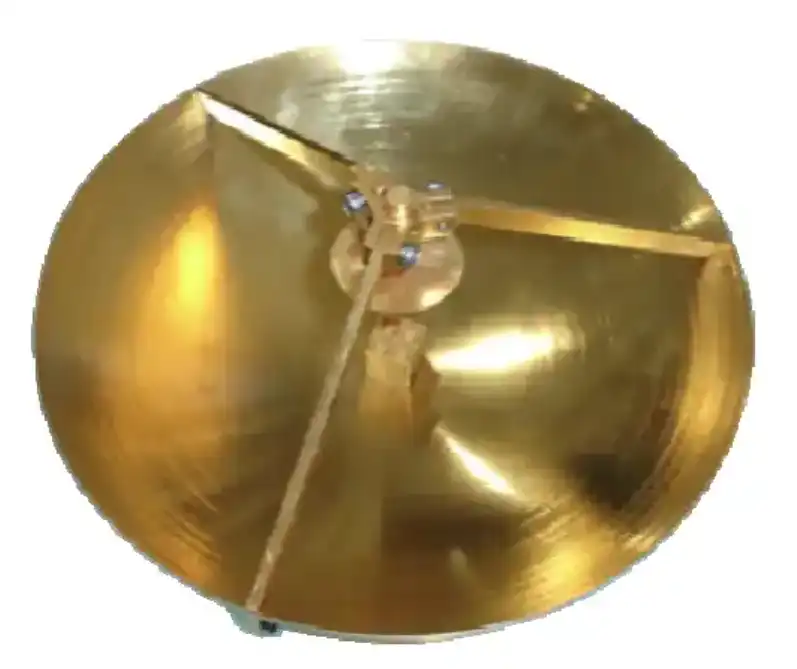
Decision-Making Framework for B2B Buyers
In the end, picking between these two antenna architectures comes down to matching the needs of the system with the realities of operation. The table below frames the key decision variables:
- Frequency band above X-band (8 GHz+): Above the X-band (8 GHz+) frequency range, the cassegrain antenna pattern is chosen; feed blockage fines in Prime Focus become practically important.
- High G/T requirement (deep space, HTS gateway): For high G/T needs (like deep space or an HTS gateway), Cassegrain is recommended because it has a lower noise temperature built in.
- Budget-constrained, lower-frequency receive-only application: For a lower-frequency receive-only application with a limited budget, Prime Focus may be enough; easier production cuts unit cost.
- Monopulse radar or multi-mode feed cluster: Cassegrain is strongly recommended for either a single-pulse radar or a multi-mode feed cluster. The rear-hub room can fit complex feed network systems.
- Remote deployment with limited maintenance access: For remote placement with limited access to repair, the Cassegrain is recommended; electronics mounted on the back make on-site service easier.
Before finalizing specifications, engineering teams should engage directly with experienced antenna manufacturers who can model your specific link budget, reflector diameter, and environmental profile. Custom shaping of the Cassegrain sub-reflector, for example, can push aperture efficiency above 75% in specialized configurations — an option unavailable with standard Prime Focus geometry.
Future Trends and Innovations Impacting High-Frequency Antenna Design
The antenna business is changing faster now than at any time in the last 20 years. Over the next five to ten years, buying decisions will be changed by a number of trends that are coming together.
Stretch-formed aluminum is being replaced by carbon fiber composite reflector panels in large-aperture Cassegrain antenna systems. This reduces the structure's mass by 30–40% and achieves RMS surface accuracy below 0.15 mm, which is good enough for V-band and W-band operation. The economics of building a big ground station are better when the structures are light because they lower the costs of the base and platform.
At the same time, feed technology is getting better. Wideband corrugated horn feeds and multi-band ring-focus feeds now make it possible for a single lens to serve the Ku, Ka, and Q/V bands at the same time. High Throughput Satellite providers are already requiring this ability in new teleport contracts. Integrated waveguide networks with built-in calibration ports allow automatic beam verification, which cuts down on the time needed for setup.
Adding software-defined radios to the antenna hub is also changing how maintenance is done. The number of site visits is going down because of remote diagnostics, automated alignment verification, and over-the-air calibration. This makes the Cassegrain's maintenance advantage even stronger.
Conclusion
The dual-reflector design of the cassegrain antenna gives it measurable advantages in gain, noise temperature, sidelobe control, and long-term maintainability at high frequencies that Prime Focus configurations can't match at aperture sizes that are the same. Prime Focus is still a good option for low-frequency installs that need to stay within a tight budget. However, the Cassegrain's design strengths will make it better for any use above X-band, especially satellite gateways, radar systems, and millimeter-wave infrastructure. You can protect both the performance of your system and your purchasing investment by choosing antennas based on proven performance data and buying them from companies with quality systems that can be tracked.
FAQ
1. Why does the cassegrain antenna outperform Prime Focus at Ka-band and above?
At Ka-band, signal loss is big when waveguide runs are used. By putting the receiver right behind the reflector hub, those long runs are cut out, protecting the signal where every tenth of a dB in the link budget is important for the Cassegrain antenna.
2. Does the sub-reflector cause meaningful aperture blockage?
For openings bigger than about 50 wavelengths, like a 2.4-meter dish at Ku-band, the sub-reflector's blocked area is only a small part of the total aperture. The extra efficiency from the dual-reflector optics makes up for it more than enough.
3. How is standing-wave interference between the feed and sub-reflector managed?
Professional designs have a vertex matching plate or a sub-reflector surface with a geometric shape that scatters central reflections. This stops VSWR spikes from going back to the feed horn and lowering the system noise figure.
4. Can a Prime Focus dish be converted to a Cassegrain configuration?
Most of the time, no. Prime Focus dishes have a deep parabolic curve (f/D ratio of 0.3–0.4). For Cassegrain optics, the main reflector needs to be shallower (f/D of 0.6–0.8), which means that the primary reflector has to be replaced completely.
5. What customization options exist for high-frequency applications?
Manufacturers with a lot of experience can provide sub-reflector shaping, multi-band feed networks, custom mounting interfaces, and surface accuracy targets that are made for specific applications. Get your provider involved early in the planning process to make the most of these choices.
Partner With ADM for Your Next Cassegrain Antenna Project
For more than 20 years, ADM has been providing high-precision microwave antennas, such as custom Cassegrain antenna systems, to clients in the military, satellite, and telecom industries around the world. As an ISO 9001:2015, ISO 14001:2015, and RoHS-compliant cassegrain antenna maker, ADM offers full OEM support, fast development, and factory acceptance testing in a 24-meter microwave darkroom that can measure up to 110 GHz. To get a price, email craig@admicrowave.com with your requirements.
References
1. Stutzman, W. L., & Thiele, G. A. — Antenna Theory and Design, John Wiley & Sons, 2012.
2. Balanis, C. A. — Antenna Theory: Analysis and Design, 4th Edition, Wiley, 2016.
3. ITU-R Recommendation S.580-6 — Radiation Diagrams for Use as Design Objectives for Antennas of Earth Stations, ITU, 2004.
4. Rahmat-Samii, Y., & Imbriale, W. A. — Applied Computational Electromagnetics Society Journal, Special Issue on Reflector Antennas, 2009.
5. FCC Part 25 §25.209 — Antenna Performance Standards for Earth Stations, Federal Communications Commission, 2020.
6. Milligan, T. A. — Modern Antenna Design, 2nd Edition, IEEE Press / Wiley-Interscience, 2005.