




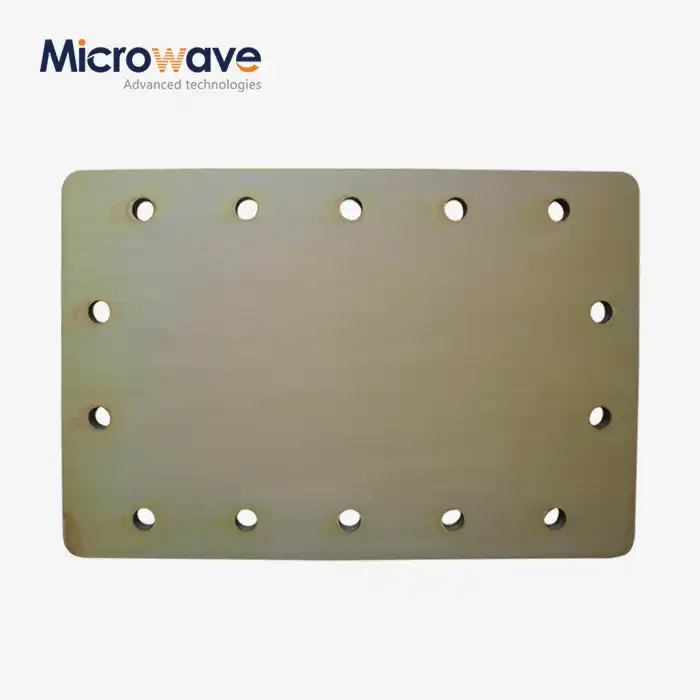
Waveguide Short Plate
Waveguide Short Plate for Microwave Termination — 1.72 to 110 GHz
A Waveguide Short Plate at ADM is a precise inactive part that closes off a waveguide port with a nearly perfect short circuit. This sends any electromagnetic energy that comes in back to the source. With a VSWR of at least 60:1, it works with 18 waveguide bands, ranging from WR-10 to WR-430 and 1.72 GHz to 110 GHz. These plates are made to be very flat so they can be used for calibration, radar, and cavity tuning. They come in OFHC copper, aluminium 6061 with silver or gold treatment, UG square cover, UG round cover, and CPR-style flanges.
What Is a Waveguide Short Plate?
A product, which is also known as a waveguide short circuit or shorting plate, makes a metal wall at the end of a waveguide port that is very good at conducting electricity. In terms of electricity, it creates a short circuit with a reflection value of 1 and a phase shift of 180 degrees.
This is not the same as a matched amount. A load takes in energy that comes in, while a short plate completely reflects it, making a standing wave with no voltage at the contact plane. That clearly defined reference plane is what makes it useful for testing and calibrating systems.
A custom-made short plate is different from a standard blank flange because it is made to exact specs for surface flatness and plating. This is something that standard covers can't always do at microwave and millimeter-wave frequencies.
Key Features and Design Specifications
ADM's shorting plates are designed for laboratory accuracy and durable field use. Key design attributes include:
· Materials: Oxygen-Free High Conductivity (OFHC) Copper or Aluminum 6061
· Surface Plating: Silver plating for lower ohmic loss, or gold plating for improved corrosion resistance
· Flange Options: UG square cover, UG round cover, CPR-style
· Minimum VSWR: 60:1, ensuring high-quality total reflection
At microwave and millimeter-wave frequencies, the skin effect confines current flow to the surface layer. Silver offers low surface resistance, which reduces heating in higher-power applications. Gold-plated versions are better suited for environments where oxidation or humidity is a concern.
Technical Specifications
Parameter | Specification |
Frequency Range | 1.72 GHz – 110 GHz |
Waveguide Bands | 18 bands |
Waveguide Sizes | WR-10 to WR-430 |
Minimum VSWR | 60:1 |
Flange Types | UG Square Cover, UG Round Cover, CPR-Style |
Material Options | OFHC Copper, Aluminum 6061 |
Surface Finish | Silver Plating, Gold Plating |
Applications
VNA Calibration and Metrology
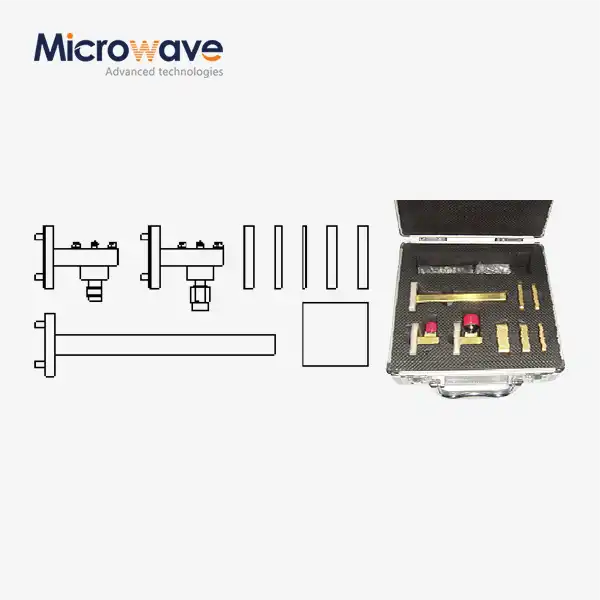
A Waveguide Short Plate is an important part of SOLT (Short-Open-Load-Thru) and TRL (Thru-Reflect-Line) testing kits used in the lab. It gives engineers the "Short" standard they use to get rid of systematic errors in measures made by vector network analysers.
The exact flatness of the plate creates a known phase reference plane, which is necessary for describing radar parts, antenna systems, or any other setup where measurement accuracy has a direct impact on design choices.
Radar Systems and High-Power Port Termination
In test and repair areas for radars, shorting plates close off open waveguide ports. This stops radiation from going along paths that aren't being driven and lets engineers check circulator isolation when power is being reflected. Whether to use silver or gold plating depends on the working environment. Silver is better for low-loss lab use, while gold is better for use in the field where rust is a risk.
Stub Tuning and Changing the Resonant Cavity
A defined reactive load is made by a fixed short plate placed at a certain electrical distance in particle accelerator systems, plasma generation equipment, and telecom filter assemblies. This method adjusts the resonant frequency of a cavity or waveguide stub and keeps signals stable in places where the temperature changes.
Why Choose ADM's Waveguide Short Plates?
Over more than twenty years of work in radio engineering, ADM has built up its line of passive components. With the ability to switch between near-field and far-field, the 24-meter Microwave Darkroom in-house allows testing from 0.5 GHz to 110 GHz, which is the full frequency range of the shorting plate portfolio.
To make a stable, repeatable phase reference plane, each plate is made to very tight tolerances for flatness. This level of manufacturing control is important for calibration, since a bad reference directly lowers the quality of measurements.
ADM lets you make changes to the flange designs, materials, and plating choices. The cities of Xi'an, Chengdu, Beijing, Tianjin, and Shijiazhuang are home to engineering teams.
Storage and Handling
Waveguide Short Plate parts last longer and keep their measurement accuracy if they are stored correctly. To keep the surface from oxidising too quickly, silver-plated items should be kept in sealed, non-reactive packaging. Oxidation raises the surface resistance, which lowers the amount of reflection and causes phase mistakes over time.
Use isopropyl alcohol and a soft, lint-free cloth to clean mating flanges. When it comes to millimeter-wave frequencies, surface scratches hurt electrical performance, so stay away from rough materials. Gold-plated plates can handle wet or corrosive surroundings better and don't need to be checked as often.
FAQ
Q: What's the difference between a falling short and a business?
A: A fixed short plate at the flange face acts as a permanent reference plane for calibration and port termination. A sliding short can be mechanically changed to tune the phase over a range. The fixed plate is the usual way to take measurements that are stable and can be repeated.
Q: Can a standard blank flange be used instead of a short plate?
A: Not really. Standard blank flanges don't have the precise flatness and smooth surface finish that microwave or millimeter-wave frequencies need. When you use one instead of the other, phase changes can happen that you can't predict, and in higher-power setups, arcing can happen.
Q: What's the point of surface plating?
A: Only the outside of the conductor is moving with current at GHz frequencies. Silver finishing lowers the resistance of the surface. A little less conductivity is given up when gold plating is done in exchange for long-term corrosion protection. The working environment determines the best choice.
Q: What effect does oxidation have on performance?
A: Oxidation increases surface resistance, which lowers the size of the reflection and causes phase errors. Plates that are plated with silver are more likely to feel this effect. Keep them in sealed containers and check the contact areas often.
Q: What sizes and frequency ranges of waveguides are there?
A: As for ADM's products, they have WR-10 to WR-430 in 18 waveguide bands that go from 1.72 GHz to 110 GHz. You can get flanges in the CPR style, a UG square cover, or a UG round cover.
Contact Us
For technical questions about Waveguide Short Plate or to discuss a custom configuration, contact us at craig@admicrowave.com. We respond to both technical and commercial inquiries.