





Why Does Your High Power Waveguide Circulator Need Water Cooling?
When a high power waveguide circulator handles kilowatt- to megawatt-level RF signals, even a fractional insertion loss — typically under 0.15 dB — translates into substantial heat deposited directly into the ferrite junction. Without an aggressive thermal extraction strategy, junction temperatures rise rapidly, driving the ferrite material toward magnetic saturation and destabilizing the entire signal routing function. Water cooling exists precisely to solve this problem: it removes heat faster than the device generates it, keeping the circulator within its safe thermal operating envelope across sustained, high-duty-cycle transmission cycles.
Understanding Thermal Challenges in High Power Waveguide Circulators
The Physics of Heat Buildup at High Power
Every watt of power that is lost inside a high-power waveguide circulator adds to the heat that the structure around it has to get rid of. This load grows nonlinearly when the power level goes above 1 kW average. This happens in applications such as radar stations, industrial heating systems, and satellite transfer chains. Some ferrite materials, like lithium or nickel ferrite, have limited Curie temperatures. When the junction gets hotter, their magnetic permeability changes, which throws off the circulator's center frequency and makes insertion loss even higher. In this compounding cycle, more heat leads to worse performance, which in turn leads to more reflected energy and further heat generation.
Why Conventional Cooling Falls Short
Passive heat sinking and air cooling depend on convective and conductive paths that cannot handle the high temperatures in small waveguide systems that are many kilowatts in size. In radar or accelerator settings with a lot of duty cycles, forced-air devices still make noise, take up more space, and reach thermal saturation. Active fin arrays face the same ceiling. Researchers at particle accelerators, such as those who published data from CERN's RF power systems, have found that when the input power is the same, liquid-cooled ferrite isolators keep junction temperatures 40–60°C lower than similar forced-air designs. That difference is not marginal; it is the difference between a part failing early and the system working reliably.
Principles Behind Water Cooling for High Power Waveguide Circulators
How the Cooling Architecture Works
Around the ferrite junction, where heat builds up the most, liquid cooling ducts are machined straight into the body of the high power waveguide circulator housing. Deionized water — or a water-glycol mixture for sub-zero environments — circulates through these channels at controlled flow rates, typically between 1 and 5 liters per minute depending on power rating. Water has a specific heat capacity of 4.18 J/g·°C, which is about four times that of air by mass. This makes it perfect for absorbing and moving large amounts of heat away from the junction without causing the temperature to rise significantly along the coolant path.
Installation and Maintenance Considerations
When setting up a water-cooled RF circulator, it is important to pay attention to the input pressure, the flow rate, and the chemistry of the coolant. Electrochemical breakdown of aluminum and copper cooling passages is prevented by corrosion inhibitors. Periodic maintenance should include checking the inlet and outlet fittings visually for tiny leaks, making sure the flow rate matches the manufacturer's instructions, and checking the conductivity of the coolant to make sure the ion content stays low. High conductivity can cause RF to leak through conductive coolant paths. These are routine maintenance tasks, but skipping them shortens the service life substantially.
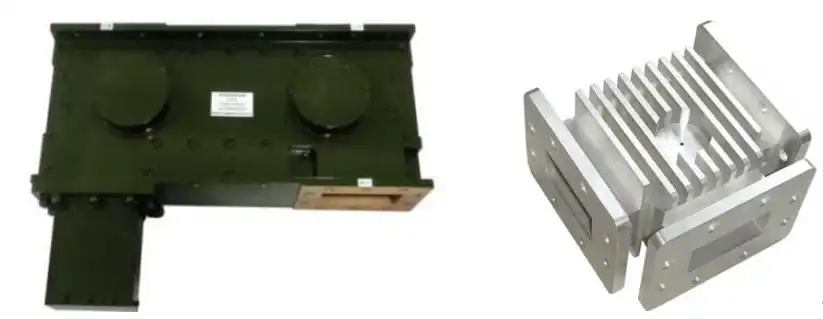
Advantages of Water Cooling in High Power Waveguide Circulators
The stability at low temperatures that liquid cooling provides leads to real, measurable performance gains over the working life of the high-power waveguide circulator. If you cool high-power RF circulators with water, these are the main performance benefits you get:
- Sustained frequency stability: Water cooling keeps the ferrite junction within a narrow temperature band. This preserves the circulator's tuned center frequency even during long transmit cycles, stopping the frequency drift that hurts system link budgets in radar and satellite uplink applications.
- Reduced insertion loss over time: Changes in temperature speed up ferrite aging and weaken the magnetic properties of the junction. Water-cooled units keep their insertion loss values close to the factory specifications for the whole time they are in use, protecting the efficiency of the entire transmission chain.
- Extended component lifespan: According to data from high-power RF test facilities, ferrite circulators that are properly cooled by water usually last longer than 10 years. In contrast, air-cooled counterparts working at similar power densities may need to be replaced or reconditioned within 3–5 years.
- Higher average power handling: Liquid cooling directly raises the device's average power ceiling, which lets system designers increase transmitter output without causing thermal derating. This is a key benefit for next-generation radar and 5G backhaul infrastructure.
All of these benefits lower the total cost of ownership for OEMs and systems developers that use high-power RF lines continuously. Investing in a water-cooled system up front pays off in less downtime, fewer replacement cycles, and more reliable maintenance plans.
Selecting the Right Water-Cooled High Power Waveguide Circulator for Your Needs
Key Procurement Parameters
Three important factors must be taken into account before choosing the right high power waveguide circulator: the average power rating, the peak power rating, and the center frequency and associated bandwidth. The thermal design is based on average power, while the susceptibility to voltage breakdown and multipactor (the electron resonance phenomenon that can cause catastrophic failure in vacuum or high-altitude environments) is based on peak power. For units used in pressurized areas, like airborne radar pods or sealed ground-based transmitters, SF6 or dry nitrogen pressurization ports may be required to raise the dielectric breakdown threshold.
Matching Material and Structural Properties to Your Application
The operating frequency must match the waveguide band choice, such as WR-90 for X-band or WR-62 for Ku-band. The temperature ceiling and bandwidth are both affected by the type of ferrite material used. Aside from raw specifications, procurement teams should check if the seller can provide MIL-STD-202-compliant environmental testing data, traceable material approvals, and written quality control processes. Customization is critical here, because standard catalog units rarely have the exact flange design, coolant port orientation, or power rating needed in a tightly integrated module.
Case Studies & Real-World Applications of Water-Cooled Circulators
There is a lot of evidence that water-cooled high-power waveguide circulators work well in a number of tough environments.
In defense radar systems, high-power waveguide circulators act as duplexers in Active Electronically Scanned Array (AESA) designs. They send kilowatt-level pulses of energy to the antenna while shielding the transmitter from harmful reflected energy. Water cooling keeps the radar running even during long rest times that would overheat an air-cooled option.
In particle accelerators and scientific research facilities, such as linear accelerators (LINACs), water-cooled circulators keep Klystron amplifiers from being affected by changes in the impedance of accelerating cavities. According to published facility reports from major accelerator labs, liquid-cooled isolators are necessary to keep the RF source stable during high-repetition-rate pulse operation.
In industrial microwave processing and plasma generation, the load impedance changes dynamically as the material's dielectric properties change. This occurs during sintering, food drying, or PECVD plasma ignition. To keep production lines running without unplanned downtime, water-cooled circulators absorb reflected energy surges and turn them into dummy loads.
Conclusion
When designing a high-power RF system, thermal management is not an afterthought; it is one of the most important factors that determines how reliable the system is. A high power waveguide circulator that is cooled by water keeps the ferrite junction stable, meets the requirements for insertion loss, and lasts much longer than air or passive cooling can deliver. If procurement engineers who specify parts for radar, satellite, defense, or industrial RF systems decide to invest in liquid cooling, they are protecting the whole transmit chain. Understanding how temperature control affects signal integrity is what makes some system designs more durable than others that fail under operational stress.
FAQ
What frequency ranges do water-cooled waveguide circulators typically cover?
Designs that are cooled by water are available for all standard waveguide bands, from UHF through Ka-band, which is about 0.5 GHz to 40 GHz. The specific band depends on the size of the waveguide and the ferrite tuning. ADM makes components that have been tested with gear that goes up to 110 GHz.
How much does water cooling extend the lifespan of a circulator?
With proper coolant upkeep, water-cooled high-power waveguide circulators often last longer than 10 years. The main types of failure, such as coolant channel corrosion and ferrite thermal cracking, can be controlled with regular maintenance. This is in contrast to air-cooled units, which are limited by thermal fatigue.
Can an existing air-cooled unit be retrofitted with water cooling?
Most of the time, retrofitting is not practical. During manufacturing, channels for liquid cooling are machined into the housing. When upgrading to higher power levels, it is standard practice to replace an air-cooled unit with a custom-built water-cooled version.
What coolant is recommended?
Most systems use deionized water treated with corrosion inhibitors. Mixtures of water and glycol are used in environments where freezing is a risk. To prevent RF interference through the coolant path, the conductivity of the coolant should stay below the manufacturer's recommended level.
Partner With ADM for Your High Power Waveguide Circulator Requirements
ADM has been making precise RF parts for more than 20 years and brings that knowledge to every water-cooled circulator project. With ISO 9001 certification and RoHS compliance, ADM is a reliable high power waveguide circulator manufacturer. They offer fully customizable solutions with fast prototyping and dedicated engineering support. You can email our technical team at craig@admicrowave.com to see our full product catalog, whether you need a single sample or a large OEM order.
References
1. Pozar, D. M. — Microwave Engineering, 4th Edition. Wiley, 2011.
2. Helszajn, J. — Ferrite Phase Shifters and Control Devices. McGraw-Hill, 1989.
3. IEEE Transactions on Microwave Theory and Techniques — "Thermal Management of High-Power Ferrite Devices." IEEE, 2018.
4. CERN Yellow Reports — "RF Power Systems and Ferrite Isolators for Linear Accelerators." CERN, 2016.
5. Collin, R. E. — Foundations for Microwave Engineering, 2nd Edition. IEEE Press / Wiley, 2001.
6. IEC 62037-1 — Passive RF and Microwave Devices, Intermodulation Level Measurement — Part 1: Measurement Methods and General Requirements. IEC, 2021.